
I am sitting on my porch, dripping like rain.
Cigar smoke is sitting next to and above me. The humidity is a weighted blanket to both of us, so there is no way for the smoke to climb any higher any faster.
I sit and listen to the cars amble by as they radiate an extra ten degrees Fahrenheit in my direction.
I take a mighty swig of Red Stripe and as it cools and dehydrates me, I picture what I could be doing instead: splashing on the shores of the Potomac River. I desperately crave to do that. But I can’t.
No, literally, I can’t.
According to DC Regulation No. 71-28, if as much as a pinky toe of mine hits that putrid water, I face a $300 fine or ten days in jail.
So, instead of soaking, I bake, and I stew.
In the rest of this essay, I want to try and convince you that there is no better example of what America’s psyche is producing right now than the state of the Potomac River.
If you want to read the history of how the Potomac got so terrible, read from this point on. If you want the immediate explanation of my thesis, skip to the section with the header of The River is Everything.
(ALSO, sidenote: if you like any particular line of this essay, please restack that line. It helps the reach so much. If you like the essay, please like it. Engagement is king!)
The DC section of the Potomac River is a (now) non-living artifact of America’s toughest truth of the past century: we (mostly) choose not to do things because they are hard, but we also don’t do things that are actually easy, and if you dare demand that we do those necessary, hard things you will be maligned as an unbeliever in America itself.
If you live in DC, you should be angry that, when it comes to the Potomac, we could’ve had it all. All we had to do was make the hard (see: common sense) choice back in the 1970s to remediate the damage of a century of industrialization and then work throughout the 2000s to restore the natural ecology of the river.
But, instead, we made a different set of hard choices. After all, surrendering the river took fifty years of labor, too.
And now we’re back where we were a century ago. Except, no we’re not.
A century ago, the Potomac was much better than it is today.
Though it’s now relegated to sharing space between Jefferson Monument photographers and people taking engagement photos beneath cherry blossoms, between 1914 and 1925, the Tidal Basin was the place District residents went to cool off in the summer. Fed by the gentle waters of the downstream Potomac, the Tidal Basin was a lively public beach, replete with diving barges, tug of war contests, day camps for children, and tons of open, free, public space.
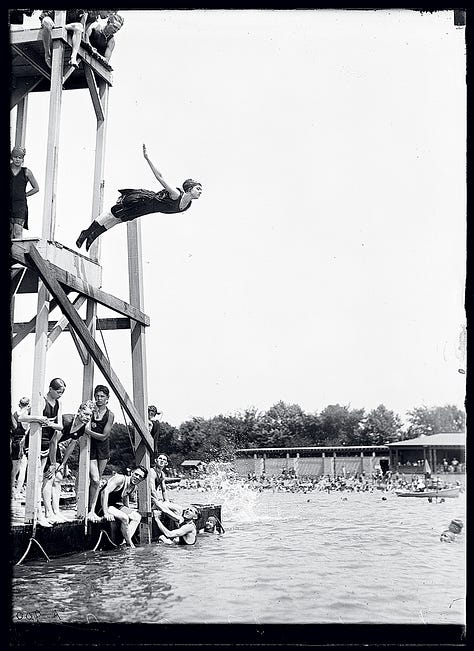
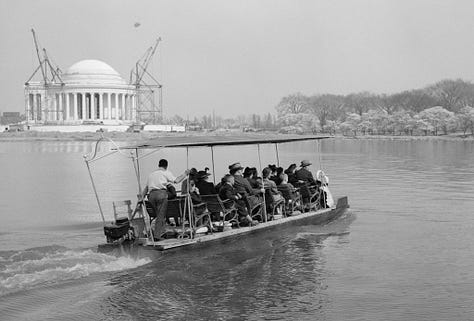
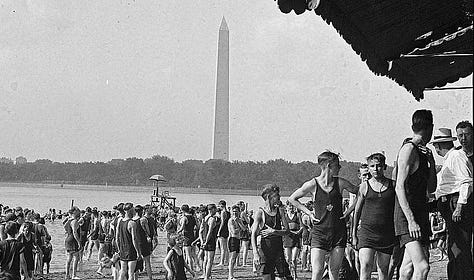
Notice what is missing from these photos: black people (which throughout the 1910s and 20s made up roughly one quarter of all residents of the district).
That was because this “public” beach was segregated. But then, in the early 1920s, the NAACP and the Black Washingtonians successfully pressured Congress to make a choice: either integrate the beach or fund the construction of a second beach for Black people to enjoy.
Southern Congresspeople and Senators (who we’d probably call Dixiecrats today), however, would have none of this. They argued that the nation’s capital cannot do something like integrate a public beach, for that might set a precedent that other states could follow.
In the end, these racist fucks won.
Congress did not vote to integrate the beach or to build a second (likely woefully inferior) beach. Instead, Congress voted to close the public beach all together.
This, in my opinion, was the original sin of the Potomac River’s modern history.
By choosing to not do the immediately hard thing of integrating the beach, Congress instead chose to do other hard things with worse long-term consequences. For one, closing the public beach was immediately hard. It was a gargantuan effort, requiring the District to remove 200,000 tons of sand and hire people to landscape over the beach’s carcass so as to erase all public memory of it. Not only that, this action seeded the conditions for what would become the 1949 Washington Race Riot (which happened due to racists harassing black people at a pool in Anacostia). But, more abstractly, Congress removed the one nexus through which people in DC could genuinely and easily access and connect to and build care for the Potomac River.
The outcomes of this physical separation of District residents from the river were disastrous. Over the next forty five years, the Potomac became little more than an open sewer for both the District and the growing satellite communities of places like Arlington, Tysons, and National Harbor. Mass die offs of fish species were common, and it became unbearably smelly in the summer as the literal millions of liters of raw sewage that sat on the top of the water wafted its stench up the District’s wide avenues. It became so bad that, in 1965, Lyndon Johnson declared the state of the Potomac a “national disgrace”.
Still, for another half-decade, the District and its cadre of dumper cities continued to say “fuck it, who needs this river?”. Then, ultimately, in August 1971, citing literally lethal levels of bacteria in the water (you know, from the tons of shit in and on top of the river) the District City Council passed the regulation that banned swimming in the Potomac once and for all.
This, too, was a decision to do hard things in place of doing hard things.
Yes, banning swimming was ultimately a safety decision I recognize.
But it was also a resignatory banner that said: the dumpers won, the river was a relic, and most importantly, that continuing business as usual was paramount even if that meant it would kill people who conduct said business as usual.
National disgrace, indeed.
But it’s not as though the fight ended there.
The year after DC banned swimming, Congress passed the Clean Water Act and made the country a promise: every river in America would be fishable and swimmable by 1983.
NOTICE THAT CONGRESS DID NOT SAY EVENTUALLY. THEY SAID BY 1983.

But to understand why that promise died here, you need to understand that DC’s problem was always in the pipes. The old half of the city was built with sewers that carry sewage and rainwater together, and, for over a century, every time it rained a ton they would overflow into the Potomac, the Anacostia, and Rock Creek Park.
But! There was a real fix!
In 2005, environmental groups sued the city’s water utility, DC Water, and won a court order that the District would have to use $2.7 billion to create giant tunnels under the city to catch the overflow.
But! Congress didn’t want to pay for any of it!
DCs answer to this was to pass the The Clean Rivers Impervious Area Charge (CRIAC) in 2009. This scheme had DC residents pay for the capital improvements through a new fee on their water bills: the more impervious surface a property had (concrete, asphalt, rooftops), the more it paid. Absorbent soil, trees, parkland? You paid less.
This sounds like a common sense solution until you realize that the combined sewers of DC that actually overflow sit almost entirely under the older, wealthier core of the city. East of the river, in majority-black Wards 7 and 8, there are exactly two combined sewer outfalls. But the fee didn’t care whose pipes were spilling, it hit every roof and parking lot in the city flat, no matter your income. So the wards where the most black people in DC lived got charged, month after month, to clean up the shit of the wealthier, whiter wards.
With conditions like this, it’s easy to see how a retreat from this already tardy solution was baked in.
Over the next decade, the tunnel costs would mount and the fees would climb every year. Eventually, the utility got the court order softened. The tunnel meant to protect Rock Creek was killed and the tunnel meant to protect the Potomac directly was shrunk into being useless.
By the late 2010s, people’s water bills were exploding. In 2018, one historic black church got hit with an $18,000 water bill in a single month and nearly had to cease operating. Naturally, the wards revolted and DC Water used the revolt as cover, warning of “potentially ruinous economic consequences” until the city withdrew its stricter swimming standards that same year. In 2020, DC Water even attempted to fully kill the remaining meager Potomac tunnel, only backing down when the Council threatened to force its construction by law.
Then, in 2023, Joe Biden’s EPA finally laid the question of “Do we care about this river?” to bed, when they issued the permit that stated the year by which the District needed to meet its clean water obligation.
2189.
Thaaaaaat’s right!
They said the capital of the United States needs to have clean water 163 fucking years from now.
Not only will you be dead, your grandchildren will be dead by then.
So, I mean, once a Federal agency writes that down, it’s curtains.
Disaster stops being a question of if.
On January 19, 2026, disaster arrived.
A 63-year-old sewer main carrying the suburbs’ waste to DC’s treatment plant ruptured upriver, and by the time it was patched, up to 300 million gallons of raw sewage had poured into the Potomac. It was the largest wastewater spill in American history, with enough shit to fill the Tidal Basin.
DC Water knew that exact stretch of pipe was rotting for eight years. But, because the pipe runs under federal parkland, the Park Service had to approve any dig to fix it. So, instead, the two bureaucracies just kind of looked at each other like
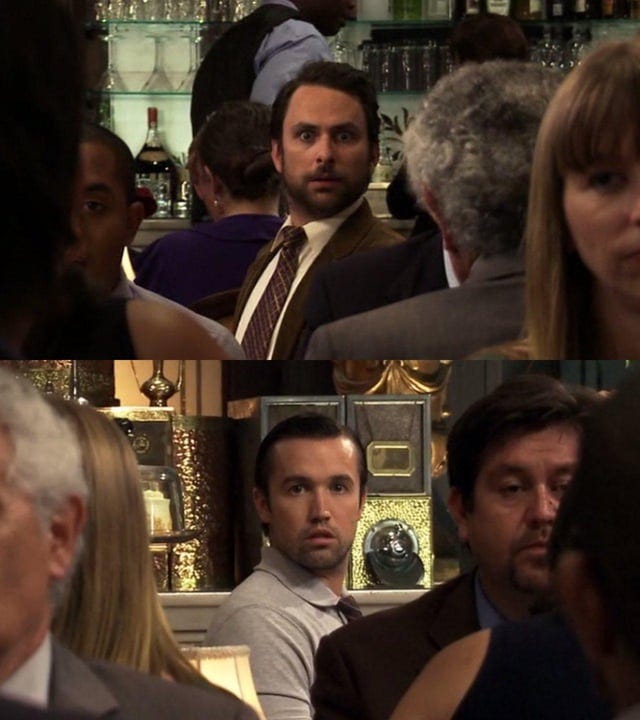
while this critical artery rotted.
Why not? Neither answers to anyone who can hurt them. Why do the hard thing now when you can wait for the hard thing later?
Then came the performance of concern, oh my God.
DC Water’s CEO (who arrived in DC by way of the firm that paid $53 million to settle claims over its role in the Flint water crisis, btw) looked at a rupture he’d been warned about for eight years and called it a “once-in-a-lifetime break.”
How about give me a fucking break?
Then, in May, with crews still hauling contaminated soil out of the national park, the EPA declared it had “fully achieved” its Potomac recovery goals. In that same month, DC Water held community events where they handed out poop-emoji stress balls.
Sooo sick! I love when an institution creates landfill slop merch about a generational health hazard!
Hey why don’t we have Morgan Wallen write a fucking song about it, too, while we’re at it?
Well, DC Water’s CEO got fired in June 2026 so that’s a win I guess?
But ya know what?
The EPA’s permit for DC still says we have until 2189 to have clean water in the Potomac, so idk how serious people are about this.
And the defense I’ll get from liberals and from Republicans when I wave my arms frantically about this whole thing is the obvious lines of dumbfuckery like: this is just what rivers cost! Cleanup takes generations! Be realistic!
Excusez-moi?
In 2015, Paris looked at the Seine, which had been closed to swimmers since 1923, and decided to fix it. Nine years and about $1.5 billion later, Olympians were racing in it, and the summer after, Parisians were swimming in the middle of their own capital for the first time in a century. (Not perfectly, mind you; the Seine does still close after hard rains, and critics dine out on every closure. But still: Paris wrote down nine years and mostly hit it, which is far better than us.)
“France is different.” Okay, well, Chicago spent fifty years digging its own overflow tunnels. Yes, they were slow, over budget, and unglamorous, but the deadline stayed alive the whole time. “Well that’s because Chicago has senators, congressmen, a state government, and people who could be punished for letting it die!” Fair! DC suffers from a genuinely unique wound, in that no other city in the country takes orders from a Congress it can’t vote in, so no other river dies from that particular disease.
But unique doesn’t mean unfixable, does it?
While I believe Statehood is the real cure, there’s something short of it that could still help: a tri-governmental compact of DC, Maryland, Virginia, with federal money on the table, where the District holds the biggest vote share in decisions related to its downstream section of the Potomac River; after all, it is the District’s river and the District’s residents who’ve been paying for everyone else’s runoff. We already have a version of this for the Chesapeake, just give this one teeth!
Just SomethingTM, anything would be better besides doing what we’re currently doing, which is folding our hands.
So why am I talking about the Potomac?
I told you that it’d serve as a conduit through which we can understand the bigger American political psyche, and I believe that.
The base reason I believe this is because rivers like the Potomac are the clearest evidence of the Truth that taking care of the place that keeps you alive is the most basic form of self-love we as humans can practice, and we can tell when we’re engaging in self-harm. Rivers are right there, they’re visceral, we know we need them. That’s because we are animals that thrive exactly as much as the environment permits us to (and not one degree more), so when waterways we depend on are unhealthy it feels in our guts as though we are peering into a dark mirror of the future.
But, politically speaking, when we are capable of looking at the thing our survival literally floats on - like the Potomac - and saying fuck it, then of course everything that’s downstream politically from it rots, too.
Of course housing policy is incoherent. Of course we have no national strategy on AI. We couldn’t count on a literal century of establishment politicians - Democrat or Republican - to actually move on keeping our drinking water safe sooner than NEXT CENTURY. With conditions like that, how the fuck do we really expect young people to trust that those same people and their friends have any ability to do anything other than manage decline when it comes to everything else?
Young people today are looking at the marginal care of the last 100 years and they’re saying: holy shit you killed us. They’re saying: you told us to major in STEM, and each of those four letters’ fields say we’re fucked. They’re asking the real questions. Not “what does it cost for us to act?” but “what will it cost us not to?”. And they’re smart enough to know the answer because the older people ran the experiment for us!
When people in the past chose to only marginally care for the environment, it is not as though they then handed us only a marginally worse environment. No, they handed us an annihilated one. That is because neglect of open systems does not accumulate in a linear line, but instead compounds in ways that are unimaginable through every node of the system.
Every hard thing that was refused has now become three harder things for someone downstream, and we are all someone’s downstream.
Which is why the river tells you more than the river. The thing about environmental policy is that it’s a bellwether for whether any policy that isn’t immediately self-serving will ever get passed, because it is the only promise you make to people you will never meet. There’s no payoff by the next election. No ribbon. Just you, telling someone a hundred years out: I know you will live, and I want you to keep living. A government that can say that can do anything.
So is it any wonder people are done with managed decline in both its flavors, blue and red? They’re reaching for anyone whose pitch is actually, you can have it all. Right now that’s the democratic socialists–here in DC, DSA-backed Janeese Lewis George just swept the Democratic mayoral primary by sixteen points.
Turns out people want to vote for someone who still believes the future is a place you build instead of a thing you brace for, who woulda thunk?
But I’ll be honest with you all: even the DSA slate running nationally doesn’t talk about climate with anything close to the severity it deserves.
Almost nobody does. But I get the sequencing.
They’re meeting people where the pain is, which for now is affordability, and it’s easy to see why. Once you convince someone they can afford their life, the next question arrives on its own: what if we could have more than affording? What if the thing we get more of is the earth itself, the river, the shade, the shoreline, the whole living inheritance we were told to write off?
So does the pace scare me? Fuck yeah, the bad math is moving fast.
But for the first time in my life, the other math is moving too (at least it’s moving at all).
And if it keeps compounding, we could have things like a swimmable Potomac before I hit the grave.
But, for the moment, it’s still so, so hot.
No posts
Comments
Nothing yet. Say the first thing.
Sign in to join the conversation.