
Every few months, the internet rediscovers an ancient practice. A particular hand position. A strange syllable. A breathing technique. A ritual said to “shift your reality.”
Recently, one such practice has been circulating widely: rhythmically striking the sides of the hands together while chanting the sound HAR, alternating between different finger positions associated with planetary archetypes.
To some, it is another manifestation trend but to others, it is an echo of traditions that have existed for thousands of years. Practices like these continue to emerge across cultures and many people report that they work.
The answer to why may lie somewhere between neuroscience, embodied cognition, contemplative practice, and the extraordinary capacity of human attention.
Modern Western culture usually describes thought as something confined to the brain but ancient contemplative traditions rarely made this distinction. Like in yoga, Buddhism, Taoism, Sufism, and many indigenous traditions, the body is not merely carrying consciousness—it is participating in it.
Meditation is movement. Breath. Gesture. Sound. Rhythm. Each are another language through which consciousness can organize itself.
One of these languages is the mudra.
The Sanskrit word mudra is often translated as seal, gesture, or energetic lock.
They are intentional positions of the hands (and sometimes the entire body) used throughout yogic, Buddhist, and Hindu meditation. To an outside observer they appear simple. Practitioners have employed these gestures for thousands of years because they are believed to influence attention, emotional state, and subtle energetic processes during meditation.
Different traditions assign different symbolic meanings. The thumb may represent universal consciousness. The index finger, the individual self. The joining of the two symbolizes the dissolution of separation. Whether understood symbolically or literally, mudras are sophisticated tools for directing awareness.
Something I only just learned… the hands occupy an enormous amount of cortical real estate. If you’ve ever seen the cortical homunculus (a distorted map of the brain) you’ve likely noticed something strange.
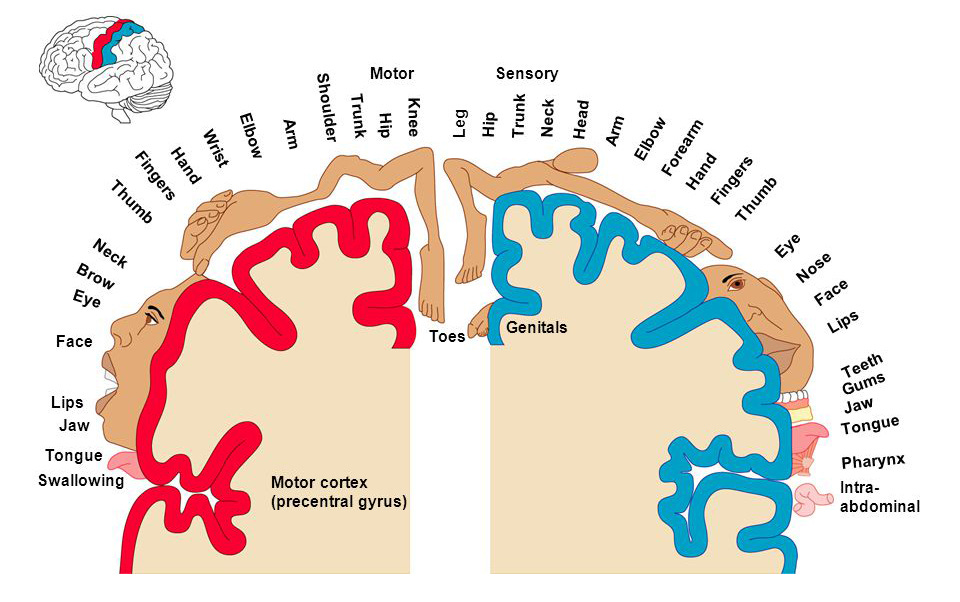
The hands and face appear absurdly large. The brain devotes vastly more neurons to processing them. Our fingertips are among the most densely innervated structures in the human body. Every subtle shift in finger position changes patterns of sensory input arriving at the somatosensory cortex. When we intentionally place the hands into specific configurations while maintaining focused attention, we are creating a continuous stream of sensory feedback. It is seen as a way of changing what the brain is paying attention to.
One of the greatest challenges of meditation for most is that the mind constantly wanders. Ancient traditions solved this problem beautifully, they gave it something meaningful to do.
A mantra, breath, visualization… a hand position.
Rhythmic movement becomes an anchor. The brain begins synchronizing around repetition. Neural activity becomes less fragmented and attention stabilizes. The nervous system gradually shifts away from vigilance and toward regulation.
This is one reason repetitive rituals often feel calming even when we don’t fully understand why.
Many of these practices also involve vocalization.
The sound HAR, for example, appears in several contemplative traditions, though not always with the same meaning. Kundalini Yoga employs “Har” in various meditations as a symbol of creative force, courage, and transformative energy.
Other traditions use entirely different seed syllables (known as bija mantras) whose significance lies less in their literal translation than in the vibratory quality produced during chanting.
Modern neuroscience has also become interested in vocal resonance. Slow vocalizations naturally lengthen exhalation. Longer exhalations stimulate the vagus nerve. Heart rate decreases and muscle tension softens. The brain shifts toward parasympathetic regulation.
This is where conversations often become polarized. Some insist everything is purely neurological. Others argue everything is energetic. Science has already established that the body is fundamentally electromagnetic. Every heartbeat generates an electric field. Every neuron communicates through electrochemical signaling. The brain itself produces measurable oscillatory activity.
Whether these fields extend meaningfully beyond the body, or interact in ways described by traditional energy systems, remains an active area of exploration rather than settled fact.
Practices describing prana, qi, or subtle energy cannot yet be equated directly with measurable electromagnetic fields. They arise from different conceptual frameworks, and while there are intriguing parallels, they are not the same thing.
It is equally true that our internal physiological state continuously shapes perception, attention, emotion, and behavior. The fields we know exist inside us already influence how we experience the world. The deeper question is whether ancient traditions discovered practical ways of working with these embodied processes long before modern science developed the language to describe them.
Attention changes the brain. Repeatedly directing awareness toward particular thoughts strengthens those neural pathways. Repeatedly practicing gratitude changes emotional habits. Repeatedly entering states of calm makes those states more accessible. Neuroplasticity tells us that the brain becomes what it repeatedly does. Meditation traditions have been quietly demonstrating this for millennia.
That depends on what we mean by reality. If we mean that a hand gesture magically rearranges external events, science offers no compelling evidence for such a claim. If we mean that deliberate rituals can alter attention, emotional regulation, physiological state, behavior, and ultimately the decisions we make, then the evidence is much stronger. And because perception shapes action, and action shapes experience, changing the way we meet the world can genuinely change the world we inhabit.
During my meditation teacher training, one lesson resurfaced in countless forms: the mind rarely transforms through force. It transforms through relationship.
Ancient traditions developed remarkably elegant ways of cultivating that relationship. A mudra gives the hands a purpose. A mantra steadies the breath. Rhythm quiets mental fragmentation. Together they create conditions in which awareness can settle into itself.
Whether you understand these practices through the language of subtle energy, neuroscience, or both, they invite the same experiment:
Become fully present.
Observe what changes. T
he deepest value of these rituals isn’t that they promise to bend reality to our will. It is that they remind us consciousness is participatory. We are not passive observers drifting through experience; we are active participants in shaping how each moment is perceived, interpreted, and lived.
And sometimes, the smallest gesture—a fingertip touching another, a single repeated syllable, one conscious breath—is enough to begin that shift.
Comments
Nothing yet. Say the first thing.
Sign in to join the conversation.