
How Long Does This Actually Take?
For everyone who’s wondering if they’re behind.
I remember telling my mum that I got to go to work and paint and draw and get paid for it.
That moment. That feeling. That’s why we’re all here, isn’t it.
But I also had something working in my favour that I didn’t fully appreciate at the time. I was young. I had industry experience behind me already. And I had that particular brand of self-belief that you sometimes only get before you know enough to doubt yourself.
So when people ask me how long it takes, I always want to answer honestly. Because the truth is, it took me years. And I came in with a head start.

The question we get asked more than almost any other
When will I be good enough to make a living from this?
We hear it constantly. In our community, in our inbox, in the comments on our posts. And we understand why. A lot of what’s out there right now makes it sound like the answer is soon. Six months. A year. Follow these steps and you’ll be earning passive income while you sleep.
We’re not going to do that to you.
Not because we want to put you off. The opposite, actually. We want you to stay in this long enough to actually make it. And that means being straight with you from the start.
What lands in our inbox every week
We receive portfolios almost daily. We love it. Genuinely. Seeing so many creative people share their work and their love for this craft is one of the best parts of what we do.
But there’s a gap that shows up regularly and it’s pretty obvious. Not in a harsh way. Just in the way that experience shows itself, or doesn’t yet. The work is sometimes lovely. But it hasn’t been refined. The repeat isn’t sitting right. The colour story isn’t commercial. The file isn’t presented the way a buyer would expect.
None of that is a talent problem. It just means the hours haven’t been put in yet.
The portfolios that stop us in our tracks are from designers who’ve been at this for years. They know how to edit ruthlessly. They know how to present. They know what a buyer needs before the buyer has to ask. That doesn’t come from a course alone. It comes from time, and a lot of work that never sees the light of day.
It’s like any real skill
Playing piano. Running a business. Becoming a surgeon. Nobody expects to perform at a professional level after twelve months of lessons. Surface pattern design is no different. It’s a craft. Crafts take years.
That’s not a discouraging thing. It’s actually a clarifying one. There’s no mystery to it. No secret shortcut that everyone else knows and you don’t. You just have to put the time in, in the right direction.
That’s the part we can actually help with.
So what does the path actually look like?
Everyone’s different. But here’s an honest framework, not a promise, just the shape of it.
Learn to draw and paint properly. Not a quick sketch. Real study of the motifs that drive commercial surface design. Florals, botanicals, geometrics. Understand how they’re constructed and how to make them yours. If you’ve already got strong illustration skills, you’re ahead. If not, this is where you start.
Get across Photoshop. Industry standard, no workaround. You need to know it well enough to work quickly, build clean repeats, fix your mistakes, and prepare files a client can actually use. That fluency takes time.
Get the right tools. Good paints and paper. A decent scanner. A Wacom tablet. A Photoshop subscription. Not luxuries. Professional infrastructure.
Learn what the market actually needs. This is where a lot of designers stall. Making beautiful art is one thing. Making art that works as a commercial print is something else. Repeat construction, file formats, colour for print, trend awareness, what a buyer will and won’t pay for. This takes study and exposure to real commercial work.
Get industry experience wherever you can. Working inside a brand or a studio, even briefly, teaches you things you cannot replicate in isolation. Production limitations. How a brief becomes a product. What gets sent back and why. If a studio placement isn’t possible, mentorship and real feedback from people actually working in the industry gets you part of the way there.
Then go pro. Build your body of work. Start approaching clients. But only when the foundations are solid. Not before.
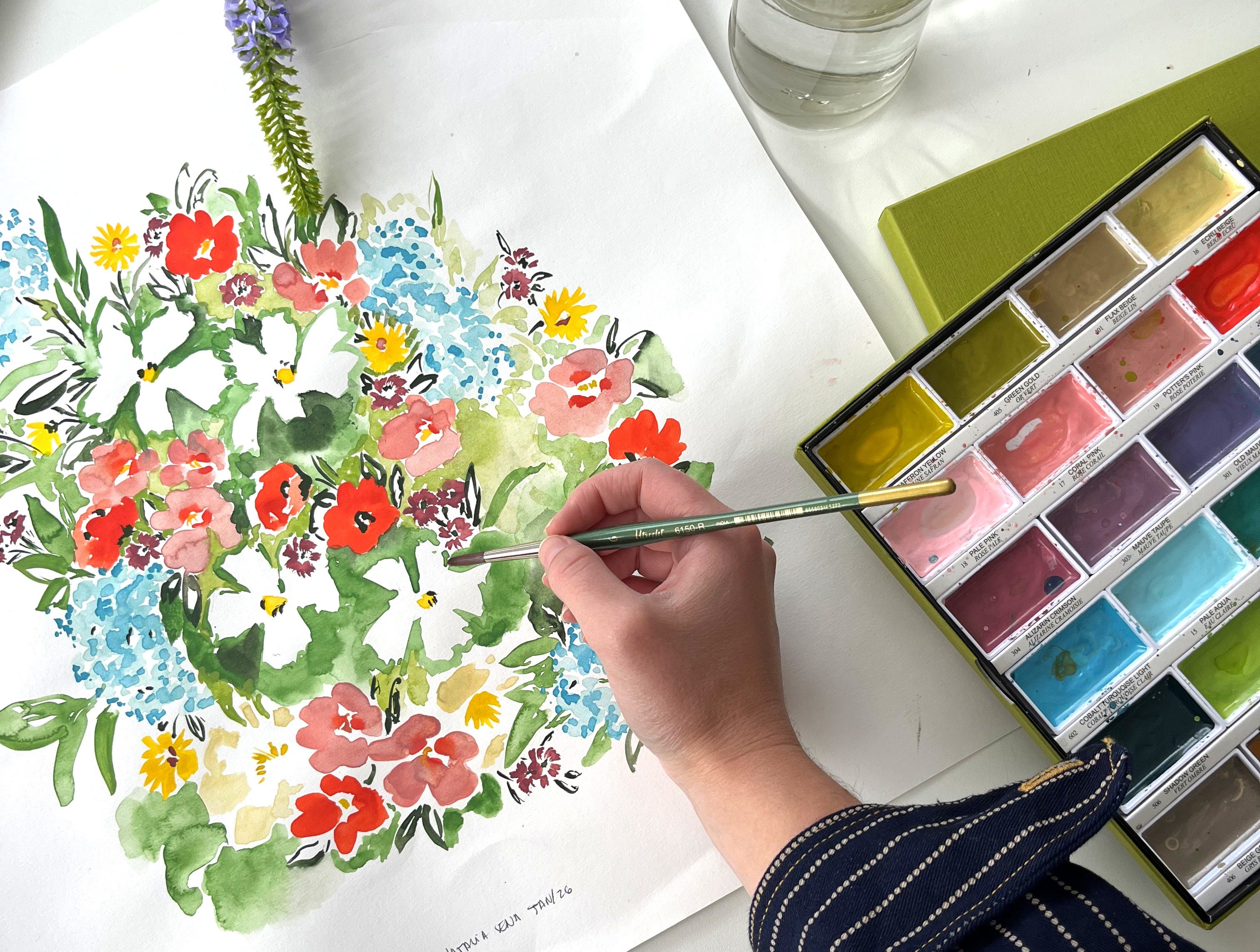
While we have you here, we wanted to let you know about something we’re very excited about. We’ve released a new course, Watercolour Florals for Surface Designers Intensive. If it sounds like something you would be interested in, explore below
Watercolour Florals: Intensive
What if you’re starting later?
A lot of our students are making a career shift. Coming from graphic design, illustration, fashion, or something else entirely. Some are starting fresh in their forties or fifties.
That’s not a disadvantage. Life experience makes you better at reading a brief, handling feedback, and understanding what a client actually needs. The timeline might feel longer. But the motivation is usually sharper. And that counts for more than people think.
The thing about self doubt
Here’s something I don’t think gets said enough.
Even now, after all these years, it doesn’t always flow. Sometimes it does and sometimes it doesn’t. As creatives, we beat ourselves up. All of us. I still do.
The difference isn’t that it stops. It’s learning to recognise when you’re in one of those moments and knowing how to pivot out of it. Keep moving. Try a different angle. Come back to it tomorrow.
The designers who make it aren’t the ones who never doubt themselves. They’re the ones who keep going anyway.
What we can actually promise you
Surface pattern design can absolutely become your income. People do it every day. Our studio has been doing it since 1988.
But whether it becomes your income comes down to one thing more than talent, more than which courses you take, more than your Instagram following.
Tenacity.
The designers who make it are the ones who build their library slowly and consistently. Who do the research. Take the feedback. Put in the hours before they feel ready. And come back the next day and do it again.
We can’t shortcut the years. But we can make sure the years count.
If you’re ready to do the work, we’re here.
Bec and the TPS Team x
No posts
Comments
Nothing yet. Say the first thing.
Sign in to join the conversation.