
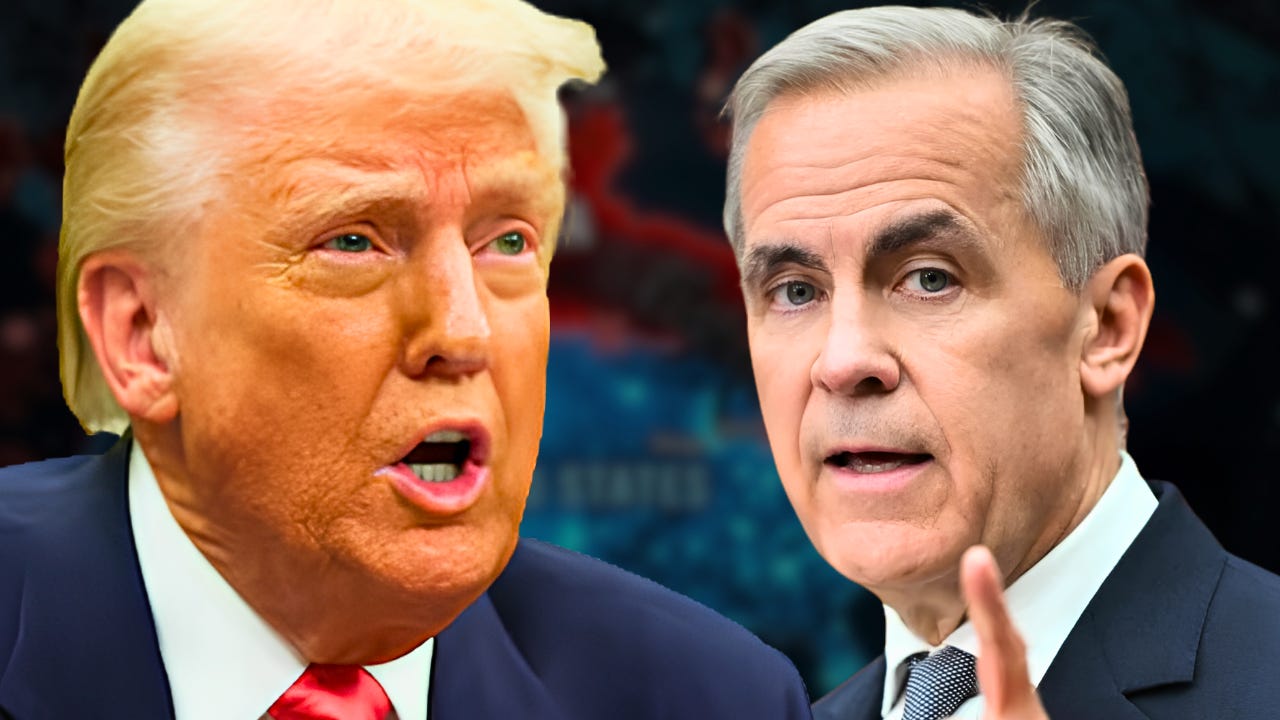
Well, if Canadians needed any more proof that Trump’s Tariff strategy is crashing, you just have to look at the deep-fryer line at the Iowa State Fair where Republican heavyweights are currently choking on their corn dogs while begging their own president to stop shooting American farmers in the foot. Two days out from Washington’s manufactured August 19 trade apocalypse, the big bad tariff trap has not broken Canada; it has triggered a full-blown domestic mutiny across Trump’s most loyal rural base, leaving the White House desperately haggling with itself.
And it is not just the Corn Dog confession that is blowing things up for Trump; there are actually four separate fronts collapsing on Washington at the exact same time, and once you line them up, Carney’s refusal to fold stops looking stubborn and starts looking like he’s just reading the room correctly. Canada is outplaying the Mango Mussolini again.
There is nothing quite like American heartland politics in mid-August. You have politicians wandering around in freshly purchased cowboy boots, sweating through their button-downs, and pretending to love deep-fried butter. But at this year’s Iowa State Fair, the political theatre took a sudden, catastrophic turn for Trump.
Longtime Republican Senator Chuck Grassley, a man who has dutifully backed Donald Trump on virtually every conservative priority for a decade, stood near the concession stands and publicly told his own president to back off Canada. And Grassley wasn’t just yelling into a corndog here; he drew an actual line in public. Fine, he said, call the tariffs leverage. Call them a wake-up call. But this cannot be allowed to destroy CUSMA . Do I smell a TACO here?
When your most reliable farm-state senator takes a public stand against your flagship trade policy in the middle of a Republican fortress, you have officially lost the room.
And he’s not the only one. Other fairgoers told the same reporters they voted for Trump expecting relief, not another trade war with their biggest customer. That’s the silver bullet right there. Actual Republican voters, at an actual Republican stronghold state fair, saying what is actually happening instead of lip service from a political sycophant.
Here’s why that quote should be a headline in this trade fight. Canada buys 30% of everything Iowa exports to the entire planet: $4.9 billion a year, machinery, chemicals, food, soybeans, corn, all of it moving through one door. Nearly one in three Iowa export dollars is Canadian, and Trump just spent a year threatening to slam that door shut for an ego stroke.
The political revolt in Iowa is only the first front crumbling beneath the administration’s feet. The second collapse is happening inside the Office of the United States Trade Representative, where the legal weapon behind the August 19 deadline is being quietly packed away.
To construct his threat of 50 percent tariffs on 20 billion dollars of Canadian commerce, Trump’s trade team reached all the way back into the 1930s to resurrect Section 338 of the Tariff Act. This statute is a Depression-era relic that has collected dust for nearly a century. Every American administration since the Second World War looked at Section 338 and refused to touch it because it is legally shaky, blunt, and fundamentally incompatible with modern international commerce.
Trump’s team strutted out in July waving this ancient club around like a corn dog at the Iowa State Fair. Yet, only weeks later, reports from the Washington Post confirm that American trade reps are actively offering to shelve Section 338 as part of ongoing closed-door negotiations
When your own trade reps are quietly stuffing their scary 100-year-old weapon back into the closet while offering discounts on auto duties, you are not holding a winning hand. You are desperately looking for a face-saving exit.
Consider the automotive sector, where American negotiators initially threatened 25 percent duties across Canadian vehicle manufacturing. Washington is now desperately haggling line by line, floating proposals to reduce those auto duties down to 10 or 15 percent
Prime Minister Mark Carney and Trade Minister Dominic LeBlanc have rightly treated those offers with total skepticism. Shaving a few percentage points off an illegal tariff still threatens the fundamental economics of building cars in Canada. Unifor National President Lana Payne has warned Ottawa not to surrender the leverage built through our own retaliatory measures, while municipal leaders like Brampton Mayor Patrick Brown have declared that no deal is vastly superior to a bad deal that leaves Canadian autoworkers vulnerable.
Now, let’s face it, Canada was supposed to be in a far worse position by now. But notice who’s doing the bending on the actual tariff numbers here. It’s Washington negotiating itself down from its own opening threat, one carve-out at a time, not Canada showing up begging for mercy.
If you want an honest assessment of an administration’s economic sanity, you do not listen to political speeches.. You look at the global bond market, which operates as the ultimate lie detector for government policy.
While Trump attempts to project total dominance, the United States national debt has officially crossed the 40 trillion dollar mark. More critically, yields on 30-year United States Treasury bonds have climbed past 5.22 percent.
For anyone who’s never had to care about bond yields before, that number is the interest rate the entire U.S. government has to pay just to keep borrowing money. When that rate climbs, it means the people lending America money are getting nervous, and they’re charging more for the risk. And right now a lot of that lending is being propped up by leveraged hedge fund strategies, not steady buyers with confidence in the plan.
So picture the position Washington’s actually negotiating from. You have a government that’s simultaneously threatening its neighbor with a Depression-era weapon while paying record interest just to keep the lights on domestically. That’s not the posture of a country holding all the leverage, is it? No, that’s a landlord who’s three months behind on his own mortgage still trying to raise everybody else’s rent.
The fourth front collapsing on Washington is the decisive movement of private corporate capital. You can argue with politicians, but you cannot argue with multinational boardrooms that are voting with their own money.
According to data reported by Reuters, German companies slashed direct investment into the United States to just 4.3 billion euros during the first half of this year. Prior to recent trade disruptions, German capital investment into America routinely hit nearly 16 billion euros over that same six-month window. That represents a staggering two-thirds collapse.
That’s companies just simply taking their money elsewhere. And the researcher behind the study specifically pointed to uncertainty created by American trade policy. You can out-argue a tariff. You can’t out-argue a company that just quietly moved its money to a country that isn’t rewriting the rules every six weeks.
While European capital quietly steps away from the American market, Canadian businesses are preparing for massive long-term expansion. The Bank of Canada’s latest Business Outlook Survey revealed that 46 percent of domestic enterprises plan to increase capital spending on machinery and equipment over the next 12 months, compared to only 16 percent planning reductions. That creates a balance of opinion of plus 30, marking one of the most dramatic upward sentiment shifts recorded in years, up from just plus 7 twelve months ago.
Canadian businesses are not cowering in fear of a White House deadline. They are placing multi-billion-dollar orders for advanced technology, upgrading manufacturing facilities, and positioning our economy for the next decade of independent growth.
When you assemble all four collapsing fronts, the reality of this trade war becomes unmistakable.
Trump’s core agricultural base in Iowa is openly revolting against his tariff threats. His trade negotiators are quietly shelving the 100-year-old Section 338 statute they spent all summer hyping. The international bond market is punishing Washington with 5.22 percent Treasury yields on a 40 trillion dollar debt pile. And global capital is choosing Canada over the country that supposedly holds all the cards.
Through every minute of this manufactured drama, Prime Minister Mark Carney has maintained a steady, unyielding position: Canada will sign a fair agreement that protects national interests, but we will never accept a bad deal just to satisfy an artificial deadline.
It turns out that saying no to a bully is remarkably easy when the other side needs your resources, your energy, and your market far more than you need their chaos.
If a deal lands before Wednesday, Washington gets to call it a win — and fine, we’ll call it a win too, if it’s actually good for Canadians. But let’s be honest about who forced whose hand to get there. This is what it looks like when the country everyone assumed would fold just didn’t.
Like this? Subscribe to Unfiltered North for clean facts, sharp satire, and zero spin. Then watch our latest breakdown on YouTube and drop your take in the comments.
We said what we said.
Dave & Deb
No posts
Comments
Nothing yet. Say the first thing.
Sign in to join the conversation.