
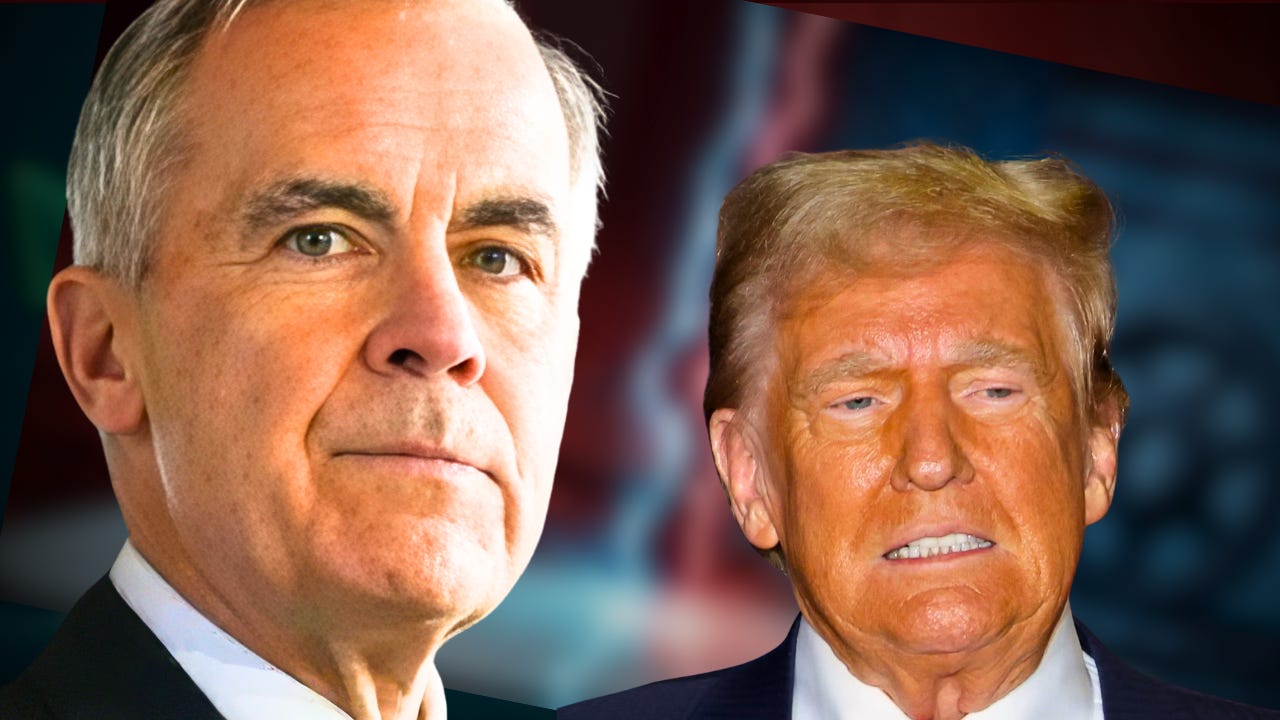
Leave it to Donald Trump to spend forty-eight hours pacing around the Oval Office waiting for Canada to panic over the tariff threats that could get implemented tomorrow, only for Canada to respond by dropping a $70B clean energy sledgehammer on his desk. While Trump continues to try and scare everyone with another arbitrary deadline, Prime Minister Mark Carney joined the premiers of Quebec and Newfoundland and Labrador to sign off on the largest hydro and wind expansion in North American history.
If you want to know what real economic power looks like, it does not come from screaming into a microphone surrounded by paid actors. It comes from owning the electricity grid everyone else is desperate to plug into. I don’t think Trump saw that one coming. Honestly, I don’t think Trump saw a lot of this coming.
And it is not just the $70 billion mic drop that is blowing things up for Trump either; Republicans are bailing on him, the deficit is about to hit 40 trillion dollars, his polling numbers are in the toilet, and everyone is talking about what is in the back of his pants instead of how the country is doing. Sounds like a typical week in the Trump dumpster fire to me. Compare that to what is happening in Canada, and it is easy to see how Trump is being outmanoeuvred every single day by us.
So let’s start here in Canada where the big announcements just keep coming. In a presser yesterday, when a reporter asked Mark Carney what message he planned to deliver to Donald Trump before the latest tariff deadline hit, the Prime Minister did not offer a defensive speech or a plea for special treatment. He just pointed at $70B of hydro and wind power he’d signed into existence with Quebec and Newfoundland and Labrador and basically said…this. That’s the whole answer. That’s the entire flex.
Carney even tossed in a dry joke, for good measure, that he might convert the megawatt measurements into metres so people in Washington could follow along. Which, translated out of fluent Canadian passive-aggression, means: “Maybe look at what we’re building before you slam another door, buddy.”
Now, this agreement between Hydro-Québec and Newfoundland and Labrador Hydro is a massive geopolitical milestone. The two provinces finally put an end to a bitter sixty-year dispute over Churchill Falls that has lingered since 1969, replacing decades of bad blood with an integrated clean power alliance.
With Ottawa providing up to ten billion dollars in federal backing, this project moves immediately from political concept into concrete construction. It unlocks twenty-five hundred megawatts from the Churchill Falls expansion, twenty-seven hundred megawatts from the long-delayed Gull Island development, and two thousand megawatts of fresh wind power.
When you connect those numbers to the broader regional grid, Canada is bringing fourteen thousand megawatts of zero-carbon power online.
Power is no longer just a nice-to-have anymore; it is the ultimate currency of the modern global economy. Modern AI data centres consume electricity like heavy industrial factories, advanced manufacturing hubs require immense baseload energy, and entire regions across the northeastern United States are desperately searching for power generation to stop their voters’ utility costs from doubling.
Canada did not just announce an energy project here. Canada just brought an enormous amount of long-term continental leverage online.
We are all well aware that Trump’s entire economic strategy against Canada relies on a single psychological trick. They establish an arbitrary countdown clock, threaten a catastrophic tariff percentage, and expect our country to act like a prisoner trapped in a locked room with no way out.
Well, Canada just cut a window in that locked room. We are actively building exit routes through deep-water ports, critical mineral processing hubs, and clean energy networks. While nobody pretends Canada does not value trade with the United States, every major domestic infrastructure agreement softens the impact of the next tariff threat from Washington.
The Corn Dog Confession: Mark Carney Outsmarts Trump's Tariff Trap as Republicans Revolt
·
Aug 17
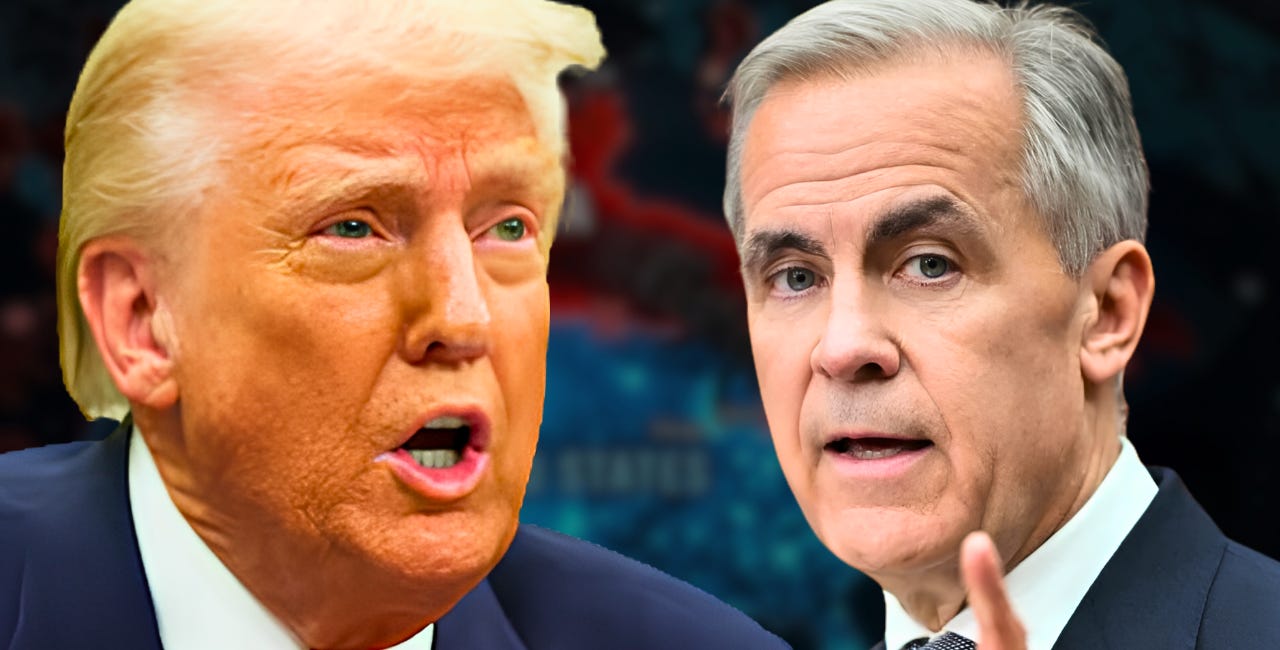
Well, if Canadians needed any more proof that Trump’s Tariff strategy is crashing, you just have to look at the deep-fryer line at the Iowa State Fair where Republican heavyweights are currently choking on their corn dogs while begging their own president to stop shooting American farmers in the foot. Two days out from Washington’s manufactured August 1…
You cannot use a tariff decree to seize a Canadian river. Geography does not take orders from the White House, and Labrador is not moving under Pennsylvania because an American president woke up in a foul mood on a Tuesday morning. A natural resource asset backed by hydro dams is permanent. A political ultimatum from a struggling administration has an expiry date that gets closer with every drop in Trump’s polling numbers.
Now, Let’s talk jobs, because this isn’t just an electricity story. PM Carney’s putting the construction number at over twenty-three thousand jobs just from the power build. Then another sixteen thousand tied to what opens up across the Labrador Trough. Stack those together, and you’re looking at roughly thirty-nine thousand jobs connected to this one announcement.
And the Labrador Trough, you know that eleven-hundred-kilometre geological formation, well it has already yielded more than two billion tonnes of iron ore. Flooding that corridor with abundant, low-cost electricity allows Canada to supercharge domestic processing, critical mineral refining, and advanced metals production.
“ More power in, more processing, more of exactly the material Washington claims it desperately needs to compete with China. Funny how that keeps happening.
This is the ultimate counter-punch to American industrial policy. The United States talks constantly about securing supply chains and competing with global rivals in critical technologies. Yet here is Canada, quietly locking down the clean power and processing capacity needed to produce those materials, while Washington isolates itself behind a wall of self-inflicted import taxes.
All of this is not happening in a vacuum either. While Donald Trump threatens fifty percent tariffs against his closest trading partner, his own domestic economy is cratering like a badly packed rental campervan rolling backward down the Rockies, leaving American consumers to clean up the wreckage while Washington pretends everything is under control.
The United States national debt is rapidly closing in on forty trillion dollars. In recent financial auctions, the yield on 30 year United States Treasury bonds climbed above five-point-three percent, hitting the highest government borrowing cost seen in twenty-five years.
And forty trillion is one of those numbers that’s so big it kind of stops meaning anything, but the real-world consequence here is staggering: American debt interest payments are on track to hit one trillion dollars every single year.
That means approximately one out of every five tax dollars collected by the United States Treasury is spent purely on paying rent for money that was already blown in the past. It does not fund highways, hospital systems, or modern defence equipment. It vanishes into bond coupon payments.
To make matters worse for the White House, the United States Supreme Court dismantled key emergency tariff authorities under IEEPA, wiping out the tariff revenue Trump so foolishly counted on to offset his massive deficits. Threatening heavier taxes on Canadian imports to plug a fiscal hole created by his own administration is the definition of a government chasing its own tail.
Add in a presidential job approval rating that has collapsed to thirty-three percent, with sixty-four percent of Americans disapproving, and the political high ground simply vanishes. American voters are now trusting Democrats over Republicans on the economy, which used to be Trump’s strongest card, and it just flipped. Think about the damage he is doing here. Not only to the Republican Party, but to the country as a whole.
So who is actually in a better position here? The 80-year-old man with tanking numbers, a tanking economy, and shit-filled diapers? Or the leader with a seventy-billion-dollar project behind him, provinces newly aligned, and a public that has his back? The idea that only Canada feels pressure in this room doesn’t survive five minutes of actually looking at the numbers.
And notice what Carney didn’t do here; he didn’t threaten to shut off the taps. He’s resisted every call to weaponize Canadian energy exports outright, and that’s smart, because once you play that card, it’s gone. You don’t build a thirty-year energy relationship with New England by threatening their lights. That restraint is deliberate and brilliant. The second you shut off the power to New England during a political fight, you burn your reputation as a reliable international energy partner.
Carney understands that true power does not come from making desperate threats to cut the cables. The power move here is quieter than that. It’s just reminding the guy across the table that you own something he needs, and you’ve got options for where it goes. That’s leverage you can use more than once, which is exactly the kind Trump doesn’t seem to understand exists.
There is also a profound lesson for Canadians in how this deal came together. Quebec and Newfoundland spent six decades arguing over the original 1969 Churchill Falls contract, creating an enduring symbol of interprovincial division. They fixed that sixty years of resentment in the same week they stared down an American tariff deadline. That’s not luck, that’s just Canadians finally getting our own house in order before someone else tries to walk through it.
This energy transformation touches every pillar of Canadian economic sovereignty and national security. By investing directly in our own transmission corridors and linking provincial hydro grids, Canada is insulating its economy from foreign disruption while establishing the foundation for sixty years of clean industrial growth.
For everyday Canadians, this moment serves as a powerful reminder of what our country can achieve when regional barriers come down. Supporting Canadian-made energy, purchasing domestic goods, and exploring our own provinces through ethical travel keeps capital working inside our borders, reinforcing our national negotiating position.
We do not need to accept bad trade deals or live in perpetual anxiety over foreign deadlines. We have the geology, the clean water, the engineering skill, and the political resolve to build a wealthy, self-reliant future on our own terms.
Like this? Subscribe to Unfiltered North for clean facts, sharp satire, and zero spin. Then watch our latest breakdown on YouTube and drop your take in the comments.
We said what we said.
Dave & Deb
No posts
Comments
Nothing yet. Say the first thing.
Sign in to join the conversation.