
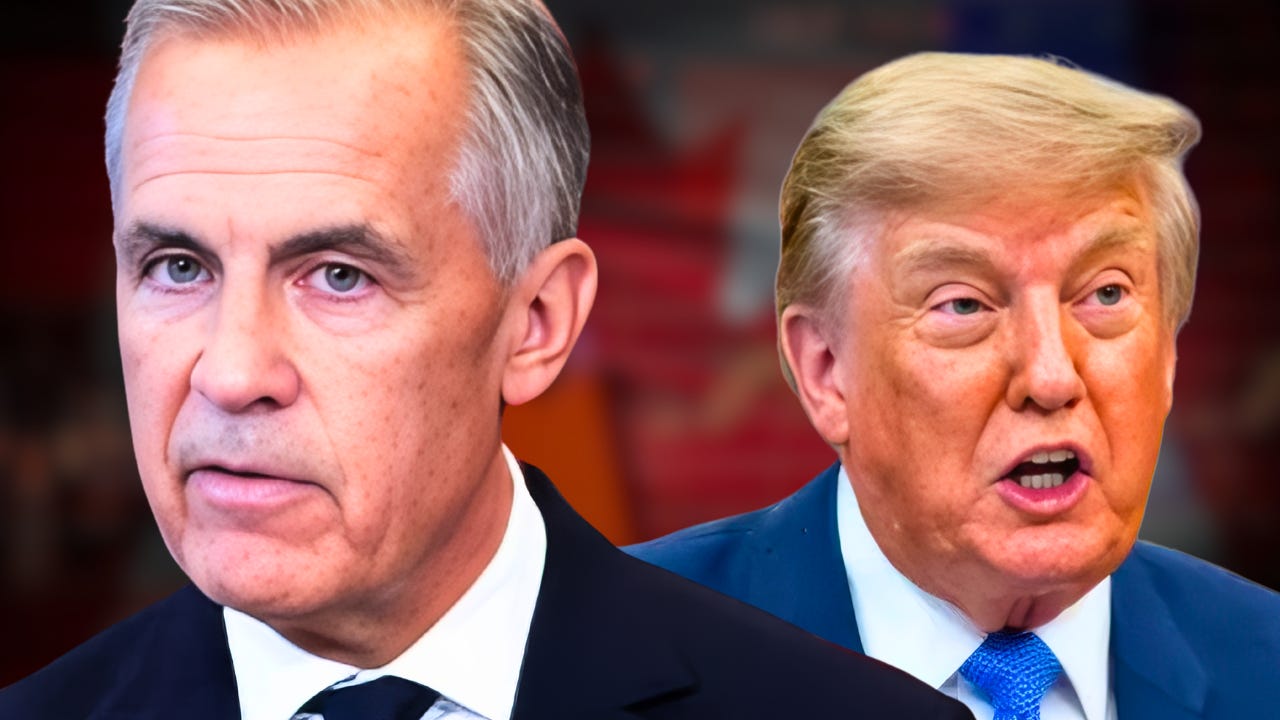
I couldn’t be more proud to be Canadian today. If you watched Mark Carney’s national press conference on Saturday, you witnessed the exact moment Canadian foreign policy grew a permanent spine.
While Donald Trump was busy posing for glamour shots for his new presidential headshots and Jamieson Greer and Commerce Secretary Howard Lutnick were busy trading high fives for executing a classic midnight shakedown, Canada delivered the ultimate reality check.
PM Carney did not just walk away from the table; he brought our negotiators home, exposed three outrageous sovereignty traps hidden inside Washington’s revised proposal, and calmly reminded the entire world that an American signature is increasingly written in pencil. The economic war is officially on, and Canada is playing for keeps.
For four decades, Canadian trade policy was constructed on the fundamental assumption that a signed agreement with Washington represented an ironclad guarantee.
On Friday night, the Trump administration shattered whatever remained of that naive illusion. Prime Minister Carney just told the world, in no uncertain terms, that the word of the President of the United States isn’t worth shit.
Heading into Friday afternoon, Canadian and American negotiators had established a functional framework. Negotiators from both sides were discussing meaningful adjustments: lowering proposed automotive duties from 25 percent down to 15 percent, reducing metals duties from 50 percent to 25 percent, and addressing provincial policies on American booze. Negotiations were on track.
Then Commerce Secretary Howard Lutnick stepped in during the final hours and decided that reasonable compromise looked like weakness. So, US negotiators slipped three aggressive, non-negotiable demands into the text, hoping Canadian officials were too exhausted and terrified of the midnight clock to push back.
So, at 12:01 AM on Saturday, the White House officially imposed 50 percent duties across 28 billion dollars of Canadian exports under Section 338 of the 1930 Tariff Act. United States Trade Representative Jamieson Greer immediately rushed to the news cameras to claim that Canada walked away from the best deal any exporter could ever receive. A load of BS.
But Carney dismantled that sanitized White House narrative line by line. He got specific, named the three predatory traps, and confirmed that none of them were ever up for discussion.
No wonder the world thinks that the word of the US actually now means the opposite of what it used to. You know what that means, don’t you? Every nation trading with the US will ask the same question. Does their signature, promise, or handshake mean anything at all? Trust is gone, and it is not easy to get back.
Now, let’s examine the exact poison pills Washington attempted to force down Canada’s throat at midnight.
The first trap targeted Canadian heavy vehicle assembly. While American negotiators agreed to lower prospective tariffs on consumer passenger cars toward 15 percent, they flatly refused to extend that same treatment to commercial, medium, and heavy-duty trucks. That targeted carve-out hit the heavy-duty F-Series platforms and the Chevrolet Silverados assembled by autoworkers in Oshawa and Oakville.
Carney pointed out the obvious: there was zero economic logic to the demand. Washington was asking Ottawa to sign a treaty that would intentionally make building commercial trucks in Ontario uneconomic over the next decade, gradually forcing global automakers to relocate heavy vehicle production south of the border. Accepting a deal that engineers the slow death of your own automotive manufacturing is not a compromise; it is industrial surrender.
The second trap was an overt attack on Canadian national sovereignty. In the final stretch of talks, Washington demanded veto power over Canada’s future bilateral trade agreements, alongside mandatory clauses requiring Ottawa to mirror American tariff actions against third-party countries.
That is the demand of someone who doesn’t even live in reality. So let me get this straight. The US is basically saying “we will still tariff your goods going south, and oh by the way we also want a say over your friendships going east and west.”
The White House wanted to penalize Canadian exports entering the United States while simultaneously demanding the legal authority to dictate who Canada can trade with across Europe, Asia, India, and the Pacific. That would have turned Canada into an economic vassal state where every independent trade mission required permission from Washington. No sane nation would ever sign any deal with that in it.
The third trap struck at the cultural identity of the country. American negotiators pushed aggressively against long-standing Canadian content rules, digital streaming protections, and cultural policies designed to safeguard the French language. Attempting to gut Quebec’s cultural and linguistic protections six weeks before a provincial election was an insult that no Canadian leader could ever accept.
“You can negotiate a tariff rate on industrial steel, but you never negotiate your cultural identity or your national sovereignty. Some lines are drawn in stone, and Washington crossed every single one of them.”
Carney stated bluntly that protections for the French language and Canadian cultural industries were never on the table, and they never will be.
The White House entered this dispute convinced that regional fractures would cause Canada to tear itself apart. American strategists expected Ontario to panic over autos, Quebec to fight over aluminum and culture, British Columbia to scramble over lumber, and the western provinces to demand immediate appeasement. Instead, Washington’s bullying produced the exact opposite outcome: an ironclad national coalition, well except for one obvious crack.
Ontario Premier Doug Ford threw his total support behind Mark Carney within minutes of the announcement, declaring that provincial leaders must stand united and match American tariffs dollar for dollar. British Columbia Premier David Eby backed the walkout completely, making it clear that Western Canada will not sacrifice forestry or regional sovereignty.
Manitoba Premier Wab Kinew doubled down on his popular provincial doctrine: no CUSMA, no booze-ma. Hell, even Saskatchewan Premier Scott Moe, who spends his entire career working solely for his own province’s interests, declared unequivocally that decisions regarding who Canada trades with must be made in Canada.
Then there is Danielle Smith, who is taking a different position, because of course she is. She says Canadians should not celebrate retaliation because tariffs hurt Canadian farmers and businesses too, and she wants negotiations restarted. Part of that is true; retaliation has costs, and nobody serious should pretend a trade war is free and painless.
She is facing a lot of backlash from Canadians because we know what she would do with that truth, right? Buckle like a lawn chair in a wind storm.
Danielle Smith’s past speaks volumes about where she sits with the Trump regime…in their back pocket. Her philosophy is that if resistance costs you money, then that automatically means you accept whatever comes across the table.
Well, PM Carney made the opposite calculation, and the polling suggests the country is backing him. Recent Leger polling indicates that 56 percent of Canadians want Ottawa to maintain a hard line against American demands, while 74 percent actively support levying export taxes on natural resources if the trade war continues. Prime Minister Carney is not running ahead of the public; he is executing a clear national mandate.
As Mark Carney stood at a podium in Ottawa, he was direct, firm, calm, and furious all at the same time. The message was clear. “We got attacked, so therefore we are at war. He then proceeded to methodically lay out the hard numbers that Trump continues to ignore.
The United States currently imports 99 percent of its foreign natural gas from Canada. It relies on Canadian hydro grids for 85 percent of its imported electricity. It depends on Canadian energy corridors for 60 percent of its imported crude oil. Furthermore, Canada is the number one export market for 26 individual American states and ranks among the top three destinations for 45 states. American businesses sold nearly 600 billion dollars in goods and commercial services to Canadian consumers last year alone.
Carney closed that section of his remarks with a razor-sharp Canadian smile, noting that he did not believe American industry genuinely wanted Canada to cut off those critical resource supplies.
It was a masterclass in asymmetrical leverage. Canada does not need to issue reckless threats to shut off the power grid or halt the pipelines. We just remind the room that dependence runs both ways. Oil and electricity and gas and aluminum and fertilizer and lumber and critical minerals are not novelty items you replace easily. They are buried deep inside American supply chains, and the side that pretends it has all the leverage is usually the side that never passed grade 9 math.
That is why so many Canadians, including us, heard this speech and felt pride, not panic. Not because trade wars are fun, the estimates around 90,000 jobs at risk if this lasts are sobering, and families behind those numbers deserve honesty, but because for once the answer wasn’t “we have no choice, they are bigger.” The answer was “we have choices, and we are going to use them,” and that is exactly the example other countries have been waiting to see.
Ottawa has officially scheduled comprehensive, dollar-for-dollar retaliatory tariffs to take effect on September 8. The Canadian counter-tariffs will hit American exports across primary steel, dairy products, household appliances, agricultural machinery, pulp and paper, and consumer electronics. Crucially, the federal government has already mobilized nearly 25 billion dollars in targeted domestic financing to protect Canadian workers, stabilize impacted manufacturers, and support agricultural producers through this transition.
Canada chose to absorb short-term friction to defend long-term national sovereignty.
While the White House attempts to project an aura of absolute dominance, the financial foundations beneath Washington are crumbling at their feet.
The United States national debt has officially breached 40 trillion dollars. Long-term borrowing costs have exploded, with 30-year United States Treasury yields closing above 5.27 percent, marking the highest debt interest burden the American government has faced in two decades.
At the same time, the United States Treasury has been forced to return over 100 billion dollars in tariff refunds after emergency executive decrees were struck down in federal court. The bill is coming in for Donald Trump. This is an administration paying one trillion dollars a year just to service its debt interest, facing an open mutiny from Republican farmers in Iowa, and watching its currency drop to 10-week lows.
Donald Trump desperately needs an economic victory to parade before voters ahead of upcoming midterm elections. But Mark Carney’s calm refusal to sign a toxic deal completely dismantled that timeline.
The nation holding the critical minerals, the clean hydro, the uranium, and 1.5 billion consumers secured through global trade pacts can afford to be patient. The administration drowning in 40 trillion dollars of debt cannot.
This trade war marks a permanent turning point in modern Canadian history. The era of automatic Canadian deference to Washington is over. By standing firm against predatory demands, Canada has demonstrated to the entire world that a sovereign democracy does not have to sacrifice its workers, its culture, or its independence to appease an aggressive trading partner.
This moment connects directly to the daily decisions made by millions of Canadians. Choosing Canadian-made products, buying domestically grown food, and redirecting holiday spending toward Canadian destinations keeps our wealth circulating inside our own communities.
We possess the resources, the industrial capability, and the collective willpower to build an independent economy that never has to beg for permission at the border.
Like this? Subscribe to Unfiltered North for clean facts, sharp satire, and zero spin. Then watch our latest breakdown on YouTube and drop your take in the comments.
We said what we said.
Dave & Deb
No posts
Comments
Nothing yet. Say the first thing.
Sign in to join the conversation.