
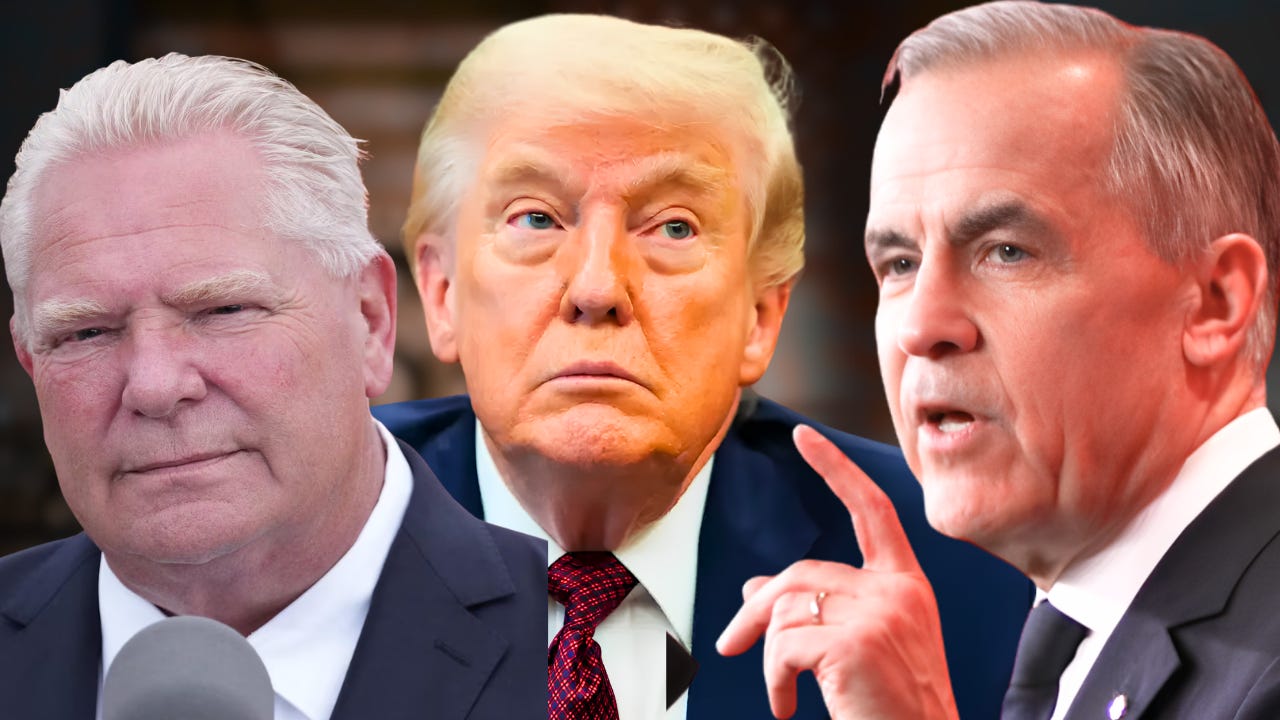
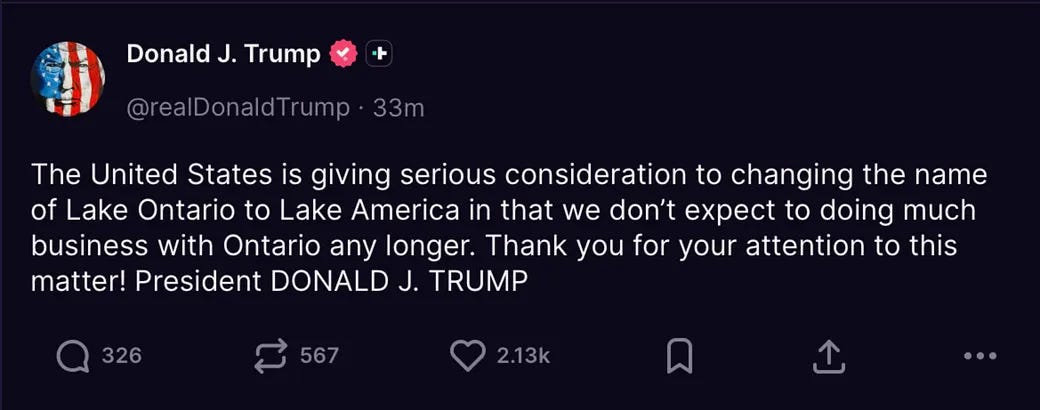
So, Donald Trump spent his weekend engaged in a masterclass of unhinged imperial theatre, threatening a 50 percent tariff on Canadian automobiles, claiming our national economy would collapse without his benevolence, and bizarrely announcing his intention to rename Lake Ontario the Lake of America. Sigmund Freud himself would have thrown his notebook into the fire trying to decipher that psychological meltdown.
Instead of trembling in fear, Wall Street handed the White House an immediate invoice as shares in Ford, General Motors, and Stellantis cratered. Within hours, Doug Ford stood in Hamilton to label Trump a dictator and the king of bankruptcies, telling him on live television to kiss his ass. Canada is officially done indulging Washington’s psychosis.
Nothing illustrates the profound economic illiteracy of the White House quite like watching Donald Trump announce a punitive tax on his own domestic manufacturing base and expecting Canadian workers to say thank you.
When the White House threatened to slap a 50 percent tariff on Canadian-built vehicles and automotive components by January 1, Trump assumed global financial markets would celebrate his aggressive posturing. Instead, Wall Street delivered a brutal, instantaneous reality check by dumping American industrial equities.
Shares in Ford dropped 3.6 percent, Stellantis plunged 4.2 percent, and General Motors fell 1.6 percent on the exact same trading day, with Japanese manufacturing giants like Toyota and Honda sliding in tandem.
The financial community recognized immediately what the political class in Washington refuses to grasp: North American automotive manufacturing is not two distinct industrial ecosystems divided by an ideological wall. It is a deeply integrated, highly synchronized supply chain where parts cross the international boundary three or four times before the finished vehicle rolls off the final assembly line.
When you slap a tariff on a Canadian-machined transmission or stamped steel bracket crossing the Detroit River, you are not punishing Ottawa. You are levying an aggressive tax directly on an assembly line in Michigan, driving up retail prices for American consumers, and endangering thousands of working-class jobs across the American Midwest.
Flavio Volpe, head of the Automotive Parts Manufacturers Association, laid out the facts with total clarity this week: American vehicle assembly plants literally cannot function without specialized Canadian components. If those northern parts stop flowing south, automotive production across the United States seizes up entirely.
Trump bragged that the United States does not need Canada. The actual engineers, floor managers, and industrial workers who build vehicles in Detroit and Windsor took one look at the supply manifests and realized the self-anointed master negotiator was preparing to smash his own thumb with a sledgehammer.
While the White House throws out baseless attacks on social media, PM Carney is executing a calculated, lethal counter-offensive.
Prime Minister Mark Carney, Finance Minister François-Philippe Champagne, Foreign Affairs Minister Mélanie Joly, Indigenous Services Minister Patty Hajdu, and Industry Minister Evan Solomon are stepping up this morning to announce a comprehensive $28B retaliatory tariff package taking effect on September 8.
This will not be an undisciplined scattershot response. Canadian trade officials have constructed a surgical strike list focused exclusively on product categories where Canadians already possess robust domestic producers or alternative suppliers across Europe and Japan.
The retaliatory duties are said to target American primary steel, dairy products, commercial appliances, agricultural machinery, pulp and paper, and consumer electronics. During previous trade confrontations, this targeted methodology caused targeted American imports into Canada to collapse by 17 percent, while untargeted trade experienced a minor 5 percent adjustment.
More importantly, look at the electoral geography of where that $28B invoice could be aimed. With the crucial midterm elections approaching in just 70 days, Ottawa is pointing its economic artillery directly at vulnerable Republican strongholds.
Michigan exports roughly one-third of its entire international production straight to Canadian buyers. Maine shares its electrical grid, its highway logistics, and its commercial economy with Eastern Canada, relying heavily on cross-border shipments of lobster, blueberries, and timber. Iowa depends on billions in agricultural machinery and fertilizer sales to Canadian farms, while Alaska counts on Canadian maritime transit for its commercial fisheries.
When Donald Trump imposes tariffs, an American business owner in Detroit or Portland writes a cheque to the United States Treasury, and that cost bleeds directly into American factories. When Canada retaliates on September 8, American exporters across those red states will see their order books evaporate overnight, prompting panicked calls to congressional offices across Capitol Hill.
While federal ministers organized the economic balance sheets, Ontario Premier Doug Ford decided that traditional diplomatic restraint had outlived its usefulness.
Standing before hundreds of industrial steelworkers in Hamilton, Ford delivered one of the most unapologetic, blistering takedowns of an American president in modern political history. Ford called Trump a dictator, an unprincipled bully, and the undisputed king of bankruptcies.
Then Ford looked squarely into the television lenses and declared that if Donald Trump believes he can march up here and steal Canada’s lunch money, he has another thing coming, finishing his broadside by telling the President of the United States to kiss his ass. Damn! That is not beating around the bush.
“If Donald Trump thinks he can come up here and push us around to steal our lunch money, he has another thing coming. You can tell him I said he can kiss my ass.”
The verbal strike hit with maximum force. Within hours, an enraged Trump took to Truth Social to fire back with juvenile insults, labeling the Premier of Ontario ‘Flunky Ford’. Now, the irony of a failed casino operator who ran multiple Atlantic City gaming properties into bankruptcy calling a sitting Canadian premier a flunky is staggering.
Ford did not retreat an inch. Queen’s Park confirmed that Ontario is actively evaluating provincial electricity exports, reminding the White House that major regional power grids in Michigan, New York, and Minnesota depend heavily on clean Ontario baseload electricity to prevent blackouts.
Whatever you think of Ford on provincial politics, and you know what we think, there is zero ambiguity where he stands on Trump trying to run this shakedown.
Trump’s entire calculation was based on the premise that Canadian premiers would turn on each other in a panic. Instead, Ontario, Quebec, British Columbia, and Manitoba formed an unbroken wall of resistance, supported by polling showing that 75 percent of Canadians fully back walking away from bad-faith American demands. Another Trump master plan blows up in his face.
Canada is navigating this economic warfare through a sophisticated two-lever strategy that completely upends Trump’s fantasy leverage.
Lever one is the formal, legal counter-tariff package launching on September 8. It is dated, targeted, and fully compliant with international trade law, calibrated to deliver immediate economic distress to exporters in pivotal swing states like Michigan, Ohio, and Maine.
Lever two is the strategic natural resource exports hammer that Ottawa and the provinces are holding in plain sight without pulling the trigger immediately.
That second lever involves Canadian electricity exports, critical minerals, refined uranium, and high-purity nickel. Ontario and Quebec power the industrial heartland of the American Northeast and Midwest. The Canadian Shield holds the unrefined lithium, graphite, and rare-earth deposits that American defense contractors and automotive conglomerates desperately need to build next-generation technologies.
You do not swing the heaviest club on day one. You deploy the first lever with absolute surgical discipline, and you let American corporate lobbyists stare nervously at the second one.
The American economy cannot replace Canadian hydro power, agricultural potash, or battery-grade minerals on short notice. Rebuilding those domestic supply chains would require decades of environmental permitting and hundreds of billions in capital expenditure.
By keeping our clean power and mineral exports visibly on the table, Canada reminds the White House that genuine geopolitical leverage is not measured in noisy late-night social media rants; it is measured in the physical energy and raw materials required to sustain an industrial economy.
While Donald Trump spends his afternoons getting his boot-licking assistant Natalie Harp to finger tap into a smartphone, Canada is quietly constructing durable industrial sovereignty.
In Lévis, Quebec, Prime Minister Mark Carney signed a historic 11.3 billion-dollar contract with Chantier Davie to construct six heavy polar icebreakers for the Canadian Coast Guard. Every single vessel will be constructed on Canadian soil, utilizing domestic steel poured by Canadian mills like Algoma, under strict Buy Canadian procurement standards. The project will generate nearly 5,000 high-paying industrial jobs across Quebec and Ontario during the construction phase alone.
At the same time, Canada’s macroeconomic fundamentals are thoroughly demolishing the White House narrative that our country is on the brink of collapse. RBC Economics recently upgraded its second-quarter annualized Canadian GDP growth forecast from 1.7 percent to a robust 3.4 percent, citing stronger-than-anticipated domestic manufacturing and export performance.
The contrast between the two capitals could not be more vivid. One regime is threatening to tax its own domestic manufacturing sector while drowning in a $40T national debt and paying historic borrowing costs on 30-year Treasury bonds. The other is linking provincial clean energy grids, pouring steel for Arctic patrol fleets, and expanding trade relationships across Europe and Asia. Which one do you think has the rosier future?
Trump wanted a quick capitulation before his Wednesday deadline theatre. Instead, he got a Team Canada that walked in sync, a premier who told him to pound sand on camera, and a dated $28 billion counterpunch aimed at the map he needs to win in ten weeks. Canada has made its message clear. If you want our power and you want our minerals, you drop the tariff, you pay market price, and you treat Canada like a sovereign partner, not a subsidiary you can shake down.
Like this? Subscribe to Unfiltered North for clean facts, sharp satire, and zero spin. Then watch our latest breakdown on YouTube and drop your take in the comments.
We said what we said.
Dave & Deb
No posts
Comments
Nothing yet. Say the first thing.
Sign in to join the conversation.