

In my utopia, on every street corner is a state-sponsored canteen offering high-quality meals (“Universal Basic Slop” is my friend Thomas’s memorable neologism). What if your college meal plan lasted forever?
I want other stuff too, fast and free, buses and housing and childcare and eldercare and libraries, but slop is front of mind right now because I’ve come to realize I resent cooking. It’s the dailiness. Like, we just cooked yesterday. Now the stomach comes back for more? At least laundry impinges on the life of the mind only once a week.
Cooking demands this: I put up my hair. I wash my hands with soap for twenty seconds. I take out the cutting board, the peeler. Strip-strip a mango or potato or carrot. Gaze murderously at the impertinent pile of scraps making a sticky mess on the counter. Scoop them into my hands to put in the compost. Wash my hands with soap for twenty seconds again. Think of Lady Macbeth. Look at the recipe. Forget all the quantities in the recipe. Look at the recipe again. Say fuck the recipe and sub out the spice we don’t have. I don’t cook that often. If I had to, I would lose my mind. Or I would do what I did in college, which was eat a lot of Trader Joe’s meals that let the lazy and time-strapped masquerade as chefs with some boiling water or a microwave.
Because cooking demands this, too: thinking of what to cook, what your partner/friends/housemates/family members like to/will be down to eat, going to the grocery store, picking up the items, putting them away in the correct places, remembering they’re there later, and more.
It can be joyful, but it’s also laborious and it can really suck. Like many forms of care and reproductive labor, cooking (for free) is highly feminized work. Marjorie DeVault’s groundbreaking 1991 book Feeding the Family: The social organization of caring as gendered work featured interviews that she conducted with 30 Chicago households in order to illuminate how meals ended up on the table. The people primarily responsible for cooking — overwhelmingly women — described tracking the preferences of their family members, strategizing on how to disguise certain foods so that picky children would eat them, how to cook meals that would make their husbands happy and even praise the quality of the food, and satisfying nutritional requirements for variety. DeVault found that in the absence of a language of labor, people mostly framed their effortful and disparate labor through a sentimental lens, leading her to write:
The underlying principles of housework must be made visible. The work must be separable from the one who does it, instead of in the traditional way as an expression of love and personality.
Food is emotionally charged. It’s a way we nurture each other and also a way we can be vulnerable to harm (e.g., foodborne illness). People get into huge fights online about how to cook rice, or whether you should wash chicken, or how much seasoning to put on food. MAHA adherents celebrate “real food,” RFK Jr.’s inverted food pyramid gives meat and dairy the vaunted place at the top, and influencer trad wives like “@ballerinafarm” Hannah Neeleman make Instagram reels of full-day cooking projects, sped up to look glossy and achievable instead of tedious. Everything I see on Instagram makes cooking look fun, but it always feels different when I’m standing at the counter with my hands covered in white jizzy streaks of tofu sweat and cornstarch after tossing blocks in a giant mixing bowl that doesn’t really fit in the dishwasher. I see dishes now and all I think of is future labor.
Something I really appreciate about my mom is that she didn’t cook all the time from scratch. For one thing, my parents liked going to restaurants more than the parents of most people I knew. I loved rolling out the free dough they gave kids at the Italian chain Cucina, Cucina; they baked it for you after you made a shape, and you got to eat it. I still remember the fiery taste of the shrimp fra diavolo at Spazzo. The salmon at Coho Cafe. All-you-can-eat sushi at Todai, where we went on birthdays for the buy one get one free deal, and my mom counseled me to eat strategically and not fill myself up with low-value calories. Wet burritos with rice and refried beans on platters wider than my head at El Toreador. Those restaurants are all gone now.
Eating at home went one of two ways:
Sometimes my mom would make several stir fried dishes in tandem. Tofu, maybe some bitter vegetables. The air filled with spicy smoke. We would approach the table show-coughing like wounded soldiers through the fog and complain incessantly.
Then there was also a lot of Costco Kirkland Signature Spinach Ravioli.*
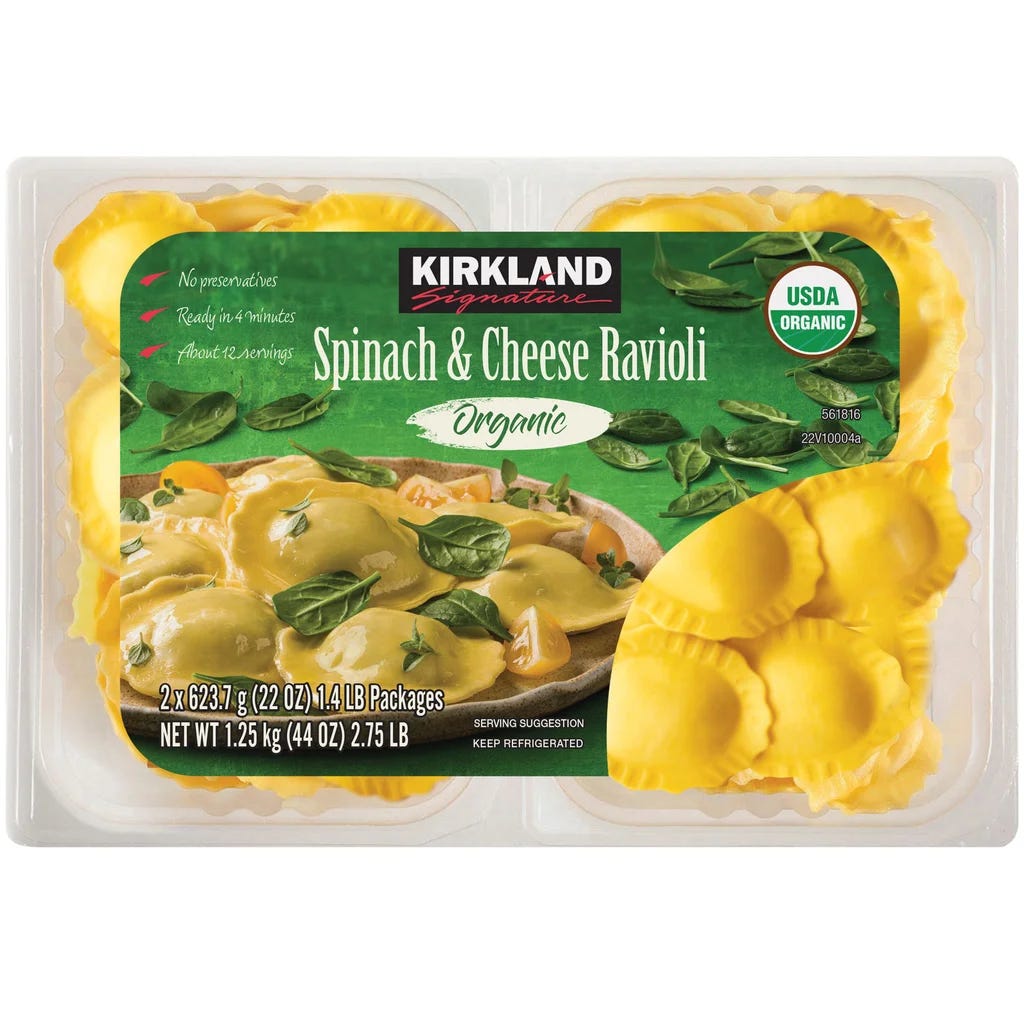
*I use Costco Kirkland Signature Spinach Ravioli here to mean a broad category, which includes but is not limited to: Kirkland Signature Four-Cheese Tortellini; frozen pizzas with artichoke hearts and other vegetables thrown on top and always cooked too long because neither of my parents followed the instructions; frozen lasagnas.
Why the ravioli? Because my mom had to do what those moms in Feeding the Family did and think about what she could feed our dumb picky asses, triangulating between a pescatarian husband with a low spice tolerance and me (pasta superfan) and my vegetarian sister who later went vegan (then ended up in the butter-soaked Midwest for senior year of high school in a tragic self-own). I’m grateful to my mom for this — both that she made us dinner at all, and that she didn’t spend more time doing it. If she had modeled a more labor-intensive style of cooking I might have inherited this internalized coercion of cooking a lot because that’s what you do for the people you love. Instead, I saw that you try your best in 30 minutes and sometimes you go to Subway. (That was the other place I loved growing up, for reasons I can’t quite access now. The Subway we went to was in its own median and glowed, an island of light in the black asphalt.)
Demanding more from her would have been demanding she give up other things she had going on, or the space for their possibility. And I’m not talking about her job, which was shitty and massively undercompensated. I mean her hobbies and leisure and reading and practicing French listening by browsing the France 24 YouTube.
At the gym I walked past two college boys, talking in the patois unique to certain of their genus (gym bro, under 20), defined by sentence fragments and occasional “Don’t be a bitch”s, and my ears perked up when one said “My mom makes that better than anyone.” I thought, immediately and probably ungenerously, I’m sure your mom’s meatloaf/mapo tofu/dal tastes great. Is it as good as leisure, unbroken time for writing a novel, self-actualization? (For sure, some people’s food is their novel, but I’d wager it’s not for most people.) I wanted to grab them by the yoked delts and shout, attachments like yours are the fuzzy handcuffs keeping Mom bound to the stove!
(It’s not just that, but I have to go eat dinner and writing about the other stuff would take too long.)
A final thought: what slithers into the lacuna of Mom is paying other people to do things, and I grant this is also not ideal! But maybe Marx would be sympathetic to the idea that it is a prerequisite on the way to Canteen Utopia (in which, I don’t know, we could have an elite cadre of good chefs working full-time and a volunteer corps with numbers pulled randomly so everyone has to cook sometimes but no one who doesn’t want to has to cook all the time?) or there are no “prerequisites” to anything and this is just the angel of history being blown around in the wind. Cool!
Recently my sister and I were in a conversation with our mom about kids. I said I didn’t want to be around hypothetical future offspring all the time, so might punt childbearing until the arrival of both the state canteen and childcare (jk haha! unless…) My mom (possibly a proto-girlboss), chirped, “Of course I didn’t want to be around you guys all the time either! That’s why I hired tutors.” To which my sister said, “What did you do with the time?” My mom shrugged and said, “I was on the computer.”
I read recently and would recommend:
Parul Sehgal’s review of Gisèle Pelicot’s book
The Baffler’s whole depressing feature on how you can’t make a living writing, “The Profession That Does Not Exist”
Please be in touch if you like cooking / have any incredibly low-effort vegetarian food to recommend.
PS - This is also an economic and cultural story in ways I did not have the time to get into but Dylan Gottlieb’s book Yuppies is really fantastic, talks a lot about food, and is out now!
Comments
Nothing yet. Say the first thing.
Sign in to join the conversation.