
There is, at the heart of artificial intelligence, a fundamental idea that I have always found striking. Why would anyone want to artificially reproduce human intelligence? It is, all things considered, a remarkable objective and a singular ambition at that. The same might be said of the desire to create an “artificial general intelligence”, or even an “artificial consciousness”.
Since Descartes, several philosophers have asked themselves the following question: what would a machine need in order to become a human being? What attributes would it have to possess? What is it that is distinctive about Man? It is by seeking to understand the particular qualities that set Man apart from animals and machines that the idea of an intelligent machine gradually emerged, and it has always been conceived in deference to the human being.
At the beginning of the seventeenth century, the hydraulic automata and mechanical figures of princely gardens furnished Descartes with a model for thinking about human beings. These were statues animated by water pressure, incorporated into artificial grottos, fountains and water displays. In the fifth part of the Discourse on the Method (1637), in a well-known passage, he argues that animals can be understood as “natural machines”.
Human beings, by contrast, are distinguished by two capacities: the genuine use of language and reason as a universal instrument, capacities that mean they cannot be reduced to a mere mechanism. Their body, to be sure, functions like a machine, but it is united to a thinking soul of a nature entirely different from matter. This last sentence deserves to be read carefully, for it lays the foundations of all the fundamental questions of our age. It is a sentence of immense importance in the history of thought:
“Their body, to be sure, functions like a machine, but it is united to a thinking soul of a nature entirely different from matter.”
This is the famous Cartesian dualism.
What Descartes could not foresee is that, in formulating these two criteria peculiar to human beings, language and reason, he had just described the first two objectives of artificial intelligence research.
In 1949, Gilbert Ryle arrived with a conceptual sledgehammer.
His thesis is simple and devastating for Cartesian dualism. Descartes made a category mistake. To speak of the mind as a substance separate from the body is like visiting a university, seeing its buildings, its libraries, its laboratories, and asking: “But where is the university?”
The university is not some additional thing over and above the buildings; it is the way they are organised and used. The mind is not some additional thing over and above the body.
Ryle calls Cartesian dualism “the dogma of the Ghost in the Machine”. Contrary to what Descartes claims, the soul is not a ghost wandering inside the machine that the body would be. There are behaviours, dispositions, capacities. That is all. What Ryle proposes in its place is radical: the mind is not a thing; it is a way of doing. Intelligence is not hidden behind behaviours. It is the behaviours.
By evacuating the soul, Ryle shifts the question and, unwittingly, opens the door to the only criterion that engineering can actually test. The question is no longer “what distinguishes man from machine?” but “does this machine behave like a human being?” If mind reduces to what it does, then the boundary between the human and the machine becomes far less clear.
It is often said that there are two Wittgensteins, and with good reason: the Austrian philosopher changed his mind. It is rather rare for a philosopher to publish a refutation of his own earlier work.
In the Tractatus Logico-Philosophicus (1921), he argues that language represents the world: propositions describe states of affairs, words refer to realities. In Philosophical Investigations (1953), he abandons this position.
Meaning does not lie in the correspondence between words and things. It lies in the use of language. A word does not mean something because it points to something. It means something because it slots into a shared practice. Take the word “pain”, for instance: it does not denote a private sensation inaccessible to others. The word functions because human beings complain, console one another, and seek care. Remove the practice, and the word loses its meaning.
A purely private language is impossible. One cannot have a meaning that only oneself understands, because meaning is always public. It resides in practices, not in minds.
If meaning is in linguistic practices and not in some inaccessible inner life, then a system trained on billions of human linguistic practices might inherit those meanings. It would not need a soul. It would need data. This is precisely the principle underlying Large Language Models, or LLMs.
These systems have been trained on vast volumes of human text: books, articles, forums, conversations, encyclopaedias, technical manuals. During training, the system learns to predict which word follows which other word, in what context, with what probability. It does not understand words in the way a human does. It learns their relationships. Meaning emerges from these proximities, distances, and configurations, not from a correspondence with the real world, not from lived experience, but from the statistical distribution of human linguistic practices accumulated over decades.
Thanks for reading The Philosophers’ Society ! This post is public so feel free to share it.
This article is a landmark text in both the philosophy of mind and artificial intelligence. To this day, over fifty years since its publication, it remains the most widely read article in the academic journal Mind. In it, rather than asking “can machines think?”, Turing proposes replacing that question with a game, the now-famous Turing Test.
An interrogator puts written questions to two interlocutors whom they cannot see: one human, one machine. If the machine succeeds in passing itself off as the human, it will be credited with a form of intelligence.
The question “can machines think?” is unanswerable because no one knows what “thinking” means. Turing does not resolve this problem. He sidesteps it, replacing a metaphysical question with a behavioural one. We are no longer seeking to know what is happening on the inside. We observe what comes out. This is Ryle’s move, formalised as an experimental protocol.
What Turing grasps, and what his contemporaries do not yet see, is that the question of intelligence may be undecidable from within. One cannot open a black box and search it for thought. One can only observe the behaviour produced, and note whether that behaviour is indistinguishable from human behaviour.
For decades, the Turing Test served as a compass for AI research. Then the LLMs arrived, and something peculiar happened: they passed the test. GPT-4 regularly fools human beings in sustained conversation. What was supposed to be the ultimate boundary has become a feature.
The Turing Test settled one question, but left another untouched, one that is deeper and more troubling. Thomas Nagel gives it a title: “What Is It Like to Be a Bat?”
Imagine a bat. It perceives the world through echolocation: it emits ultrasound and reconstructs its environment from the returning echoes. One can describe this mechanism in detail, model it, simulate it, but there is a question to which no physical description provides an answer: what is it like to be a bat? What is the subjective character of that experience?
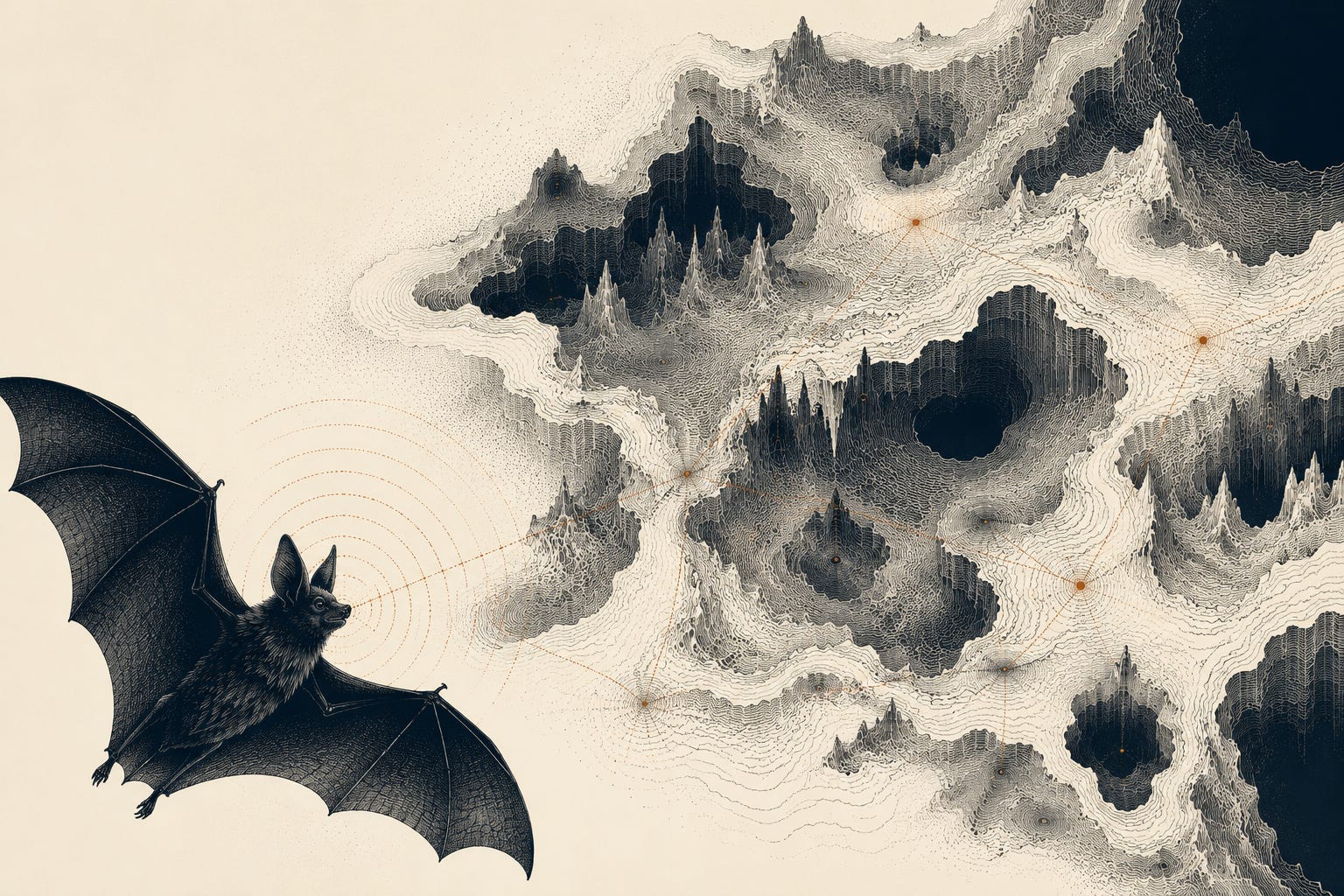
This is the question Thomas Nagel poses in 1974, and it changes everything.
There is, says Nagel, something it is like to be a conscious organism. A “what-it’s-like-ness”. Philosophers call this qualia. The red you see, the pain you feel, not the neurological mechanism that produces them, but the experience itself, in its irreducibly subjective dimension. We may all share the same tongue, composed of the same taste buds, yet we do not all enjoy the taste of strawberries or chocolate in the same way. There is an irreducible subjectivity that the Turing framework does not address.
One can know everything about a bat’s brain and know nothing of what the bat experiences. Science describes processes. It does not touch lived experience.
For AI, the implication is direct. A system can process information, produce behaviour indistinguishable from that of a human being, pass the Turing Test, and have no subjective experience whatsoever. No “what-it’s-like-ness” of being that system. Behaviour says nothing about inner experience.
Turing had sidestepped metaphysics. Nagel brings it back through the window.
Searle then arrives and drives the point home with a thought experiment that continues to occupy both AI researchers and philosophers to this day.
Imagine you are locked in a room. Through a slot in the wall, slips of paper are passed to you bearing Chinese symbols. You do not speak Chinese; you do not understand a single word of it. You do, however, have a very precise rule book: “if you receive this symbol, send back that one.” You follow the rules; you return the correct symbols. From outside, the room responds in perfect Chinese. A native speaker cannot tell the difference. The room passes the Turing Test, or seems to, because it does not understand Chinese in the fullest sense of the word.
This is the thought experiment of the Chinese Room: manipulating symbols according to formal rules, however sophisticated the manipulation, does not produce understanding. It produces a simulation of understanding.
An LLM predicts the next token from statistical distributions. It manipulates symbols with unprecedented sophistication. The question Searle poses in 1980 remains open in 2025: does something, somewhere within this process, actually understand? Or are we simply building the most elaborate Chinese Room ever constructed?
Nagel had shown that there exists a subjective experience irreducible to any physical description. Searle had shown that one can simulate understanding without possessing it. Frank Jackson pushes this intuition to breaking point with a thought experiment that is perhaps the most celebrated in contemporary philosophy, the case of Mary.
Mary is a brilliant neuroscientist. She has spent her entire life in a black-and-white room. She knows absolutely everything about the physics of colour, the neurology of vision, and what happens in the brain when someone sees red. She knows every mechanism, every chemical reaction, every neural signal. Yet she has never lived anywhere but in black and white.
One day, she leaves her room and sees a red rose for the first time. Does she learn something new?
Jackson says yes. And this answer is a bombshell. If Mary learns something upon seeing red, something that no physical description had given her, then there exist facts about experience that are by definition inaccessible to physics. Qualia are not reducible to information.
For AI, the implication is vertiginous. A system might ingest everything ever written about the colour red, its wavelengths, its uses, its metaphors, its cultural associations, and still miss something essential: the experience.
Consciousness Explained is a provocative book, sometimes nicknamed by its detractors “Consciousness Explained Away”. It is a particularly witty and sharp-tongued work. Dennett pours scorn on all those who champion subjective experience and advances a radical thesis: qualia do not exist. Not because experience does not exist, but because the notion of an irreducible subjective experience rests on an illusion.
Descartes had imagined a “Cartesian Theatre”: somewhere in the brain, there would be a central stage where everything converges, where the self attends as audience to the spectacle of its own perceptions. He located this in the pineal gland, the small structure at the centre of the brain that he took to be the junction between the immaterial soul and the mechanical body, the precise point where the ghost takes the controls of the machine. Dennett dismantles this picture piece by piece. There is no theatre. No central stage. No inner spectator. Consciousness is a distributed process, a narrative construction that the brain produces after the fact.
What you call your experience of red is not a raw and irreducible datum. It is an interpretation, produced by a system that processes information in parallel, without a conductor. Multiple cognitive processes run simultaneously, each producing its own partial version of reality. What you live as a unified and continuous experience is, in reality, an edit.
The brain edits, selects, reconstructs, and presents you with the result as though it were a direct feed. Dennett calls this the “multiple drafts” model: there is no definitive version of your experience; there are competing versions that are continually being revised. The sense of unity is the illusion produced by this process, not its starting point.
If Dennett is right, Jackson’s objection collapses. Mary does not learn something irreducible upon seeing red. She simply integrates a new piece of data into her information-processing system.
If consciousness is a functional process with no ontological mystery, then there is nothing in principle to prevent a machine from one day being conscious.
Dennett dissolved everything. Chalmers rebuilds.
He draws a distinction that will come to structure the entire contemporary debate: there are the easy problems of consciousness, and there is the hard problem.
The easy problems are not easy in the ordinary sense, they mobilise decades of research in neuroscience and computer science. Chalmers calls them “easy” solely because we know how to approach them. How does the brain integrate information? How does it direct attention? How does it produce adaptive behaviour? These are questions that can be answered by describing mechanisms. We know what we are looking for. They are engineering problems.
The hard problem is of a different nature entirely. Why is the processing of information accompanied by subjective experience? Here, we do not even know where to begin. We lack the tools. This is not a question of degree of difficulty; it is a question of the nature of the problem.
One could imagine a being that processes exactly the same information as you do, produces exactly the same behaviours, and experiences nothing whatsoever. Chalmers calls this a philosophical zombie. If such a being is conceivable, then subjective experience does not reduce to the functional.
For AI, the dividing line is clear. One can build systems that solve the easy problems. The hard problem remains entirely open. An LLM may be the most sophisticated philosophical zombie ever built.
Until now, all of these debates revolve around a shared picture: the mind as an information-processing system housed within a brain. Whether conscious or not, whether it understands or merely simulates, the mind is still conceived as something that takes place inside the head, with the body as a mere vehicle.
Varela, Thompson and Rosch shatter this picture.
Consider learning to ride a bicycle. You cannot learn to ride a bicycle by reading a manual. Balance is acquired in the body, through falling, correcting, physical repetition. Once you know how to ride, you cannot explain how you do it; you simply do it. There is no mental representation of balance that precedes and commands the body. Body and mind learn together, through action.
This is what Francisco Varela calls enaction: cognition is not a computation that takes place in the head and then issues commands to the body. It is a continuous loop between body, action and environment. To remove the body from this loop is not to simplify cognition; it is to mutilate it. It is worth noting that Varela was a dedicated meditator, profoundly inspired by Buddhism, in addition to being a neuroscientist. He published several books of dialogues with the Dalai Lama, among them Sleeping, Dreaming, and Dying.
For AI, this amounts to a structural critique. An LLM has no body. It does not act within an environment. It has never fallen, corrected itself, begun again. It processes text produced by embodied beings without ever having the experience of what that text is about. Varela suggests that this absence is not a technical detail to be corrected in the next version; it is a constitutive limitation.
One might ask whether an intelligence without a body understands the world, or whether it merely processes the written trace of it.
Marvin Minsky brings a new dimension to the question. In his view, intelligence is not a unitary faculty lodged somewhere in the brain. It is the result of the interaction of a multitude of simple processes, what Minsky calls agents. Each agent is mindless in isolation. It does only one thing, without understanding the whole. It is their interaction that produces what we call intelligence.
Take the act of picking up a glass. This gesture mobilises dozens of distinct processes: the visual recognition of the object, the calculation of distance, motor coordination, the adjustment of grip pressure. None of these processes “knows” that it is picking up a glass. Together, they pick it up.
This is the image of the society: no chief, no centre, no Cartesian Theatre. An emergent organisation of simple processes that produces something complex.
The connection to contemporary AI is direct, the notion of “agentic” systems is much discussed today, and the principles are similar. Minsky was describing cognitive modules; the intuition is nonetheless the same: intelligence as an emergent property of an organisation, not as a central faculty. It is this intuition that runs through the architecture of multi-agent systems today.
This list is obviously not exhaustive, and to read it through is to observe that none of these texts closes the debate. Descartes opens dualism, Ryle dismantles it, Turing sidesteps it, Wittgenstein shifts the problem towards language, Nagel shows that language does not suffice, Searle that simulation is not understanding, Jackson that experience escapes information, Dennett that experience is an illusion, Chalmers that this illusion remains unexplained, Varela that the entire framework is misconceived, Minsky that intelligence has no centre.
This is philosophy’s peculiar calling. We respond to one another across the centuries, refining our concepts. It is Hegel’s famous dialectic at work. Analytic philosophy, the name given to the Anglo-Saxon tradition, as opposed to so-called “continental” philosophy, exacerbates this tendency: it advances through contradictions, through refutations, through successive displacements. It is a demanding philosophical tradition, for it requires understanding the totality of conceptual frameworks before one can stake out a position of one’s own.
The engineers who built AI have, for the most part, solved technical problems. They optimised loss functions, designed architectures, ran GPU clusters. Many of them have not read Descartes. Some have not even read Turing. And yet the problems they confront are precisely those that these texts opened up: what does it mean to understand? What does it mean to represent? Does meaning reside in the mind or in the world? Does intelligent behaviour presuppose inner experience?
The discussions opened in the seventeenth century in treatises on metaphysics resurface today in engineers’ forums, in debates on alignment, in questions about what a language model “understands”. Not because engineers have read the philosophers, but because the foundations of this whole enterprise are, at root, philosophical.
Aucun post
Comments
Nothing yet. Say the first thing.
Sign in to join the conversation.