
I oftentimes research issues going on in my home. Situations my kids (or subsequently our family) are experiencing, behaviors, things I notice and are questioning why. And something funny happens - new research about the very same topic comes into my inbox, or I happen to read a chapter of whatever book is on my nightstand explaining the very same thing. This week is no different and it turned out to explain something in my own house that I have been getting wrong.
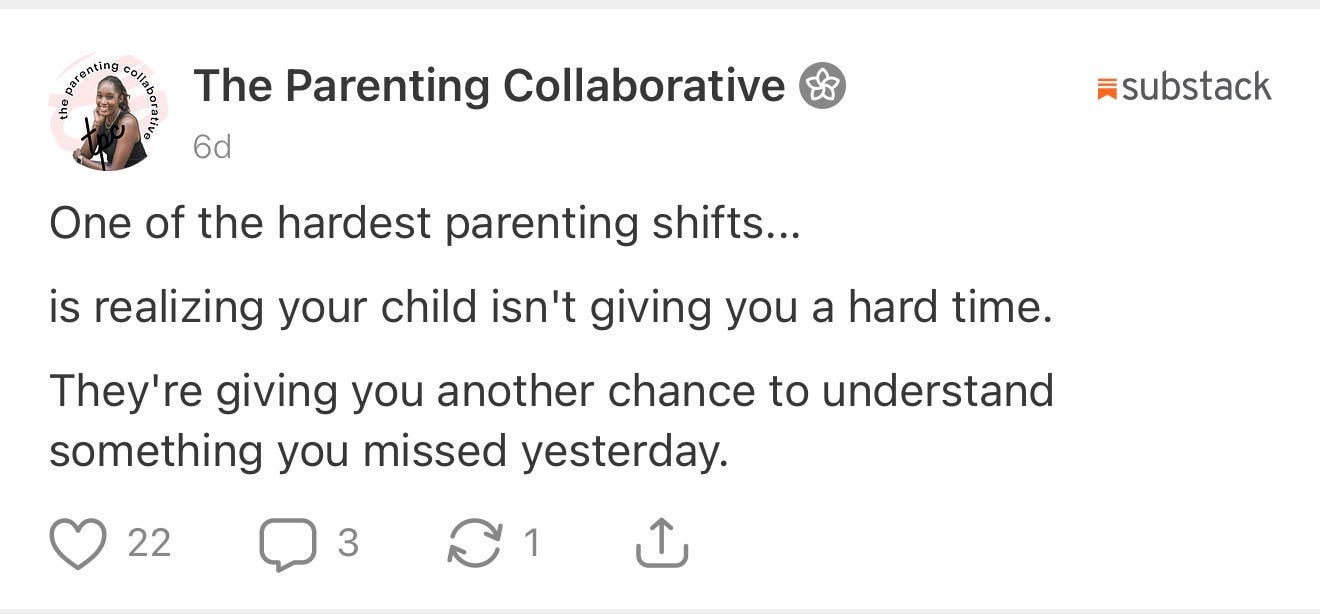
Last week my son didn’t get to use his iPad for maker camp because the class ran out of time. He held it together. We don’t think always think about the rules kids are taught in school, and surely not about the unspoken ones, like the ways kids are taught to manage their feelings. Even in a fairly progressive, social-emotionally rich school, he has learned that this is a feeling to manage. So he managed it, all through out the rest of the school day.
When I asked him how his day was, this wasn’t something he mentioned. He went about his afternoon, but when he asked to watch tv after playing outside and I told him no, it was too close to dinner time, he lost it. And not a tv sized losing kind of lost it. It was the kind that was hard to pull him out of, the kind that rocked and impacted the rest of evening. Normally I would file this under “tv rules are apparently a big deal to him.” It wasn’t the tv. It was the second thing in one day that got decided for him, out of his control, and he did everything right for the first one… the second one took him over the edge. He told me at bedtime, once he was calm enough to actually say it, that the iPad thing had been sitting heavy with him the whole time.
This isn’t about him finding the words to tell me about the iPad when he got home, or even telling me when tv time couldn’t happen. The research made it click for me.
Two studies of kids ages 5 to 12 years old, in both China and the US found that kids believe anger at an unfair outcome is judged fine, unless the process was fair. And anger at an adult in charge gets judged as less ok than the exact same anger at a friend. Kids already believe that - at five! Which means if my son isn’t showing me anger, its not disappearing or evaporating. It’s sitting somewhere, and “somewhere” is very rarely random.
So I tested this with my own kids who both run hot on “that’s not fair,” equally. If one gets a Band-Aid, the other wants one too, regardless if they need it or not. I am not always graceful handling that in the moment. And I’ve made a decision to match every thing for both of them because my kids are never going to have identical lives, and starting that precedent is a trap I can see from here and have zero interest in. What works better than negotiating it fresh every time is having something consistent like rock, paper, scissors for the coin-flip sized stuff, alternating turns for the bigger stuff like whoever didn’t get a show yesterday gets to choose it today, and me actually remembering who’s turn it was. It breaks when one of us forgets, of course. Even then, what I get back is “that’s not fair” about the forgetting, not about the system itself. The system has stopped being the argument. That’s the whole point.
This research also has me thinking about my college best friend who never once, that I saw, get visibly angry at her parents. She was calm, easy - the kid every adult loved. She’d vent to me instead about the same stuff other people fought their parents about out loud. She told me it was a respect thing in her family, that you don’t show anger to parents or elders… it wouldn’t even help because they wouldn’t understand anyways. I still don’t know if that was true. I always wanted to know whether saying something other than “ok…” would have actually gone badly, or just felt too dangerous to test, or even the opposite - it may actually change something for the better. But I know where her anger went. Not home.
My own childhood ran very differently. I was allowed to be angry at my parents. That was never even something I questioned. But I did know that the calmer I could stay, the better it landed. A rule I still believe in (even if it doesn’t come out calmly at first). What’s interesting is that I have a vivid memory of a clear shift when my sister and I became teenagers. My mother who was mostly even-tempered, started losing her tempter often, and then everything got louder on both sides. I’m still not sure if it was just what adolescence does to a family system when rules that worked fine get pressure tested when the rules become more serious.
One thing I want to be clear about, because this research can get misread easily: none of this means tolerating being yelled at, or hit, or even tolerating bad behavior associated with anger. I want to hear my kids, but when someone is screaming at me, the only thing I can think of is “why are you screaming at me?” and not the message underneath the volume or tone. So I try not to engage with yelling (whining lives in the same realm for me, but I’m less successful with that), and what I say is “I want this conversation, and we will have it once the big feelings have passed enough for me to actually hear the words you have to say.” I try to live by this when I am feeling triggered to the point of yelling to - they can’t hear me, they’re looking at me with equal parts fear, shock (because they probably didn’t see it building), and confusion about why I’m yelling. The feeling is always allowed. How it gets delivered is a separate, non-negotiable thing, and that boundary is mine to hold.
So here is where I’ve landed: stop treating every explosion as a closed case about whatever’s directly in front of it - that’s always low hanging fruit. Ask later, once it’s calm: what part felt unfair, or what happened earlier that this might actually be attached to? Build something consistent for the recurring fights so the process stops being on trial every single time. That is the work! And let your kid be mad at you, help them feel safe enough to mad at you, inside of a clear boundary, so the anger has somewhere legitimate to land instead of the thing that takes it over the edge.
The kid who’s allowed to be angry at you keeps bringing it to you - but in the ways we want. They become the 15 year old who tells us when something has happened and they need somewhere to vent or get advice. That’s the child we are building.
If the anger in your home has a pattern that you can’t see yet, that’s exactly what a discovery call is for. Book yours today to chat about your specific kid, your home, and we will connect the dots.
And if any part of this was useful, share it with a parent who just weathered a blowup that didn’t make sense.
Then subscribe for the weekly version.
By Lauren GreenoChild & Adolescent Development Specialist & Parenting Coach | Founder, The Parenting Collaborative
Lauren specializes in helping parents understand invisible dynamics shaping their children’s development and redesigning family systems before patterns calcify into adult identity. With expertise in child development, family systems theory, and trauma-informed parenting, she works with families navigating sibling dynamics, only child considerations, neurodivergence, emotional regulation, and breaking generational patterns.
Work with Lauren: Book a discovery call | Learn more| Instagram | TikTok
References:
Ritov, O., Langenhoff, A. F., Benozio, A., Keltner, D., Zhang, Z., & Engelmann, J. M. (2026). (When) is it okay to be angry? Children and adults' judgments in China and the United States. Child Development. https://doi.org/10.1093/chidev/aacag072
No posts
Comments
Nothing yet. Say the first thing.
Sign in to join the conversation.