
If you don’t know me, I write short fiction and essays about archetypes, folklore and horror films. Here is what Ive learned since joining Substack, I’ll show you what my stats look like. I’m not a coach. I’m not a growth expert. I am someone that had zero professional writing experience before starting Substack in January 2025 and I’m a person that has learned a few things since then.
I usually include some kind of disclaimer at the start of my work, and this piece is no different.
Algorithms change, so do websites and social media channels…constantly. Trends shift, attention moves, this is the way of the world. By the time you read this, some of what I’m saying will likely already be outdated. This isn’t a bible, and it’s not really a how-to guide. It’s just a look behind the scenes at my own Substack in which I share short horror fiction, essays on folklore and film and some personal things too. I chat about my writing rhythm, what’s worked for me and what hasn’t. If you write about politics or AI or growth strategy, this will probably be completely useless to you. My message is not about growth at all costs. It’s about growing in a way that feels nice and good and sustainable.
I’ll share how I gained subscribers, what kinds of work and things resonate most with people, how I figured that out, and how I take time off without everything falling apart.
I’ll try to fit in as much as I can and be as coherent as possible but I can’t make any promises.
Subscriber numbers can feel important but they’re also a bit arbitrary (I’ll explain why later). How many times have you read something incredible on Substack with zero likes? It happens to me on a weekly basis.
Validation does matter though, especially with creative work that takes something out of you. Some of my stories leave me shaken after writing them. So when someone responds, when they say, “I feel this too”…that…well that means a whole lot to me.
Having someone listen means you’re not shouting into the void. You’re shouting towards your audience.
In January 2025 I started my Substack The Pale Horse. I thought it would be a mix of personal essays, illustration and fiction but it’s become something else: mostly feminist essays about horror films and short horror fiction. This theme revealed itself over time, through both what I enjoyed writing and what resonated with readers. I would say at the beginning, don’t rush to niche down. Pay attention to what you like writing, what people respond to, and follow that thread.
When I started my Substack, my goals were as follows:
Finish stories
Use Substack as a portfolio
Get eyes on my work
Get better at writing
Write consistently
It took me two months to get 30 subscribers. If even one person read my work, that felt like success because it meant it wasn’t lost forever in the dark abyss of an old laptop hidden under my bed.
Most of what I wrote during those first weeks and months got about ten views, maybe a like or two. That was it, though it felt like a success because do you know how many people usually read my work?
Zero people.
What helped me grow my account in those early days was simple: engaging with other people. I read a lot; short stories, flash fiction, poetry, personal essays. I cast my net wide, because I am interested in a lot of different kinds o things. This helped me understand both writing and writers. It helped me see some of the length and breath of Substack and how vast it is, how much space there is on here. When I engaged, I tried to do it meaningfully.
I never did follow-for-follow posts. I did reply to a few of those in hope that they were genuine, and mostly got ghosted. Instead of taking it personally, it taught me something useful; what real connection feels like online and just as importantly, what it doesn’t.
I don’t have evidence that Substack favours accounts that use the platform in a social way but I believe that it does based on my own experience and based on what I see on the Substack subreddit where people constantly are upset that no one is reading their work. And yet they don’t read anyones work…Substack is reciprocal in nature. I think.
Finding your community is key. I sit somewhere at the intersection of horror, fiction, and folklore. I tried submitting to a few “competitions” within writing communities on the platform, but nothing really came of it. I never got an honourable mention, or any compliments on my work. I didn’t get additional readers. At first, I felt deflated. I wondered if I was just a terrible writer or if it was something else. My work is rooted in Ireland, written in an Irish vernacular. Most readers on Substack are in the US, I thought do they know what a “yoke” is? Or a “geebag”? Does my humour fall flat (definitely) or is my horror too disgusting (probably)?
In the end, I decided not to overthink it. Maybe that particular corner just wasn’t for me and that’s totally fine.
I did eventually find a group called Milk and Honey, run by Meg, which felt like a much better fit. My work was selected there a couple of times, and more importantly, I found writers whose work I genuinely loved reading. This is actually where I found my still favourite authors on the platform. Through that, I gained subscribers but also encouragement, feedback and a sense of belonging.
You don’t need to do this by the way, a lot of people prefer to do things alone but for me, a new and inexperienced writer, this was very valuable to me.
Collaborations are powerful. Not just for building community, but because they multiply your readership. It isn’t just your readers reading the thing- it’s also your collaborators reading it.
I put a note out asking other folklore Substack writers if they’d like to collaborate and some people said yes. The ones who did were brilliant—genuinely talented writers I was delighted to be associated with. I learned a lot just from reading their work and they brought a heft to the collaboration I never would have been able to orchestrate alone. They were experts and damn good writers.
That collaboration brought in a wave of new followers, and it was the first time one of my essays really took off. It got shared widely and received a lot of praise. The funny thing is, my own contribution wasn’t even that strong but combined with everyone else’s work, it became something much better. It came together in a way I couldn’t have done alone.
You can read it here.
Hag-ography: Mapping the Hag Across Europe
·
July 16, 2025
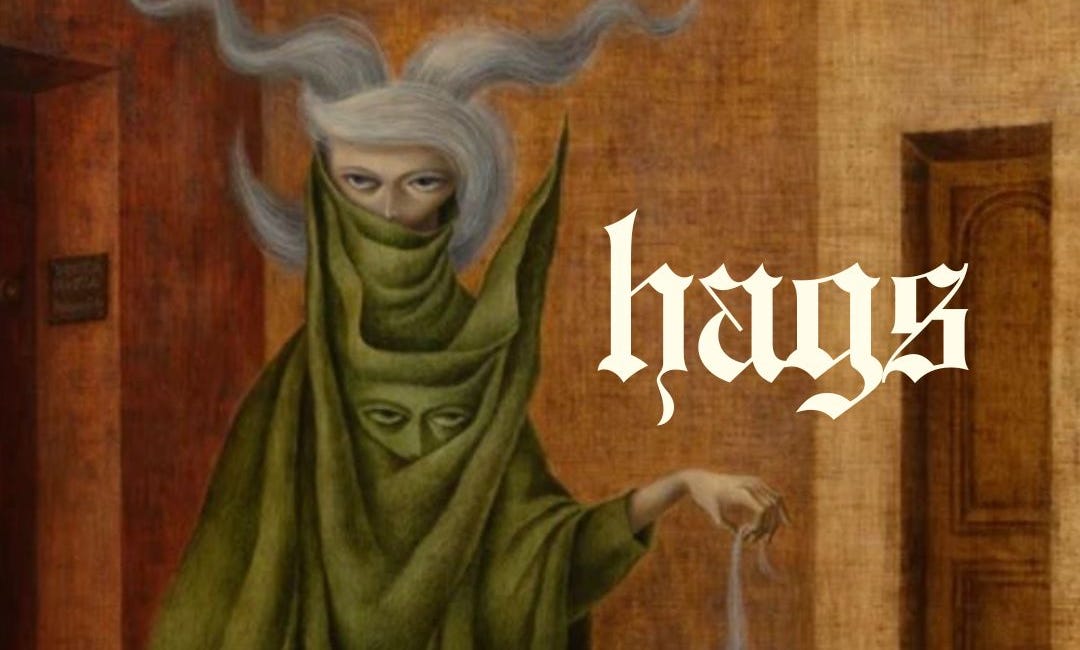
The hag is a potent and enduring figure in European mythology—an archetype that can instill both fear and reverence. She appears across cultures as an old woman living at the fringes, both literally and spiritually. The hag embodies deep-rooted anxieties around aging, female autonomy, and the supernatural.
I try to reply to every comment. If I’ve missed yours, I’m genuinely sorry- I do try to stay on top of it.
Some of the work that hasn’t been the most “popular” in terms of engagement like my Tarot essays, have actually had the most meaningful engagement in my opinion. The comments are thoughtful, insightful and those pieces feel like real spaces for connection. That’s where I find my people and my community strengthens.
Major Arcana, Major Terror: Archetypes of Horror in Tarot Part 2
·
August 30, 2025
Welcome to the next instalment here of my essay series on Tarot Archetypes in Horror. If you missed Part 1, you can catch up here. In that first installment, I explored The Fool, The Magician and The High Priestess, as well as my own history with Tarot and why I believe it’s a useful tool when we think and talk about sto…
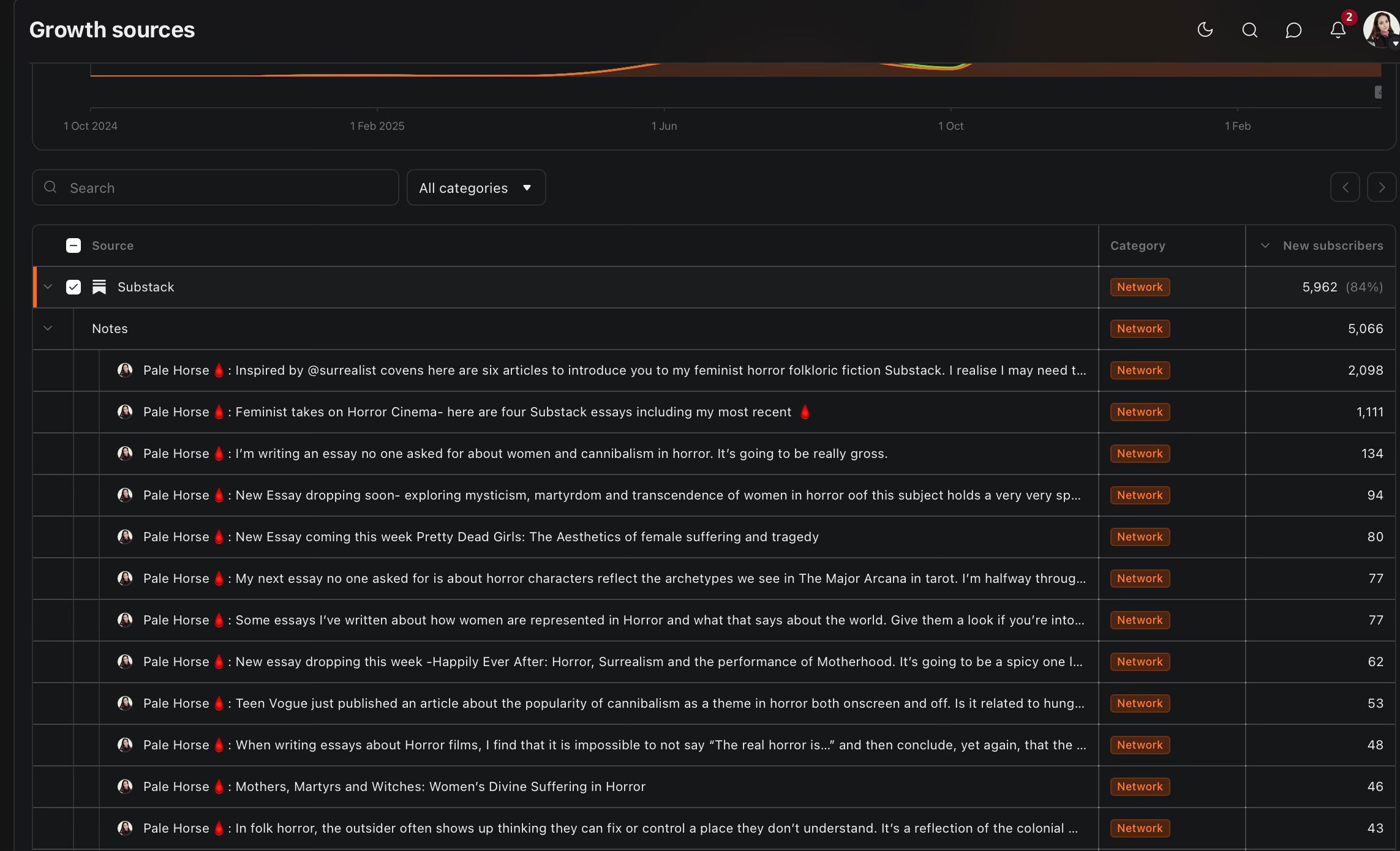
I don’t think Substack will thank me for this, but I’m going to say it anyway: Notes are where most of my subscribers have come from. Easily 90%.
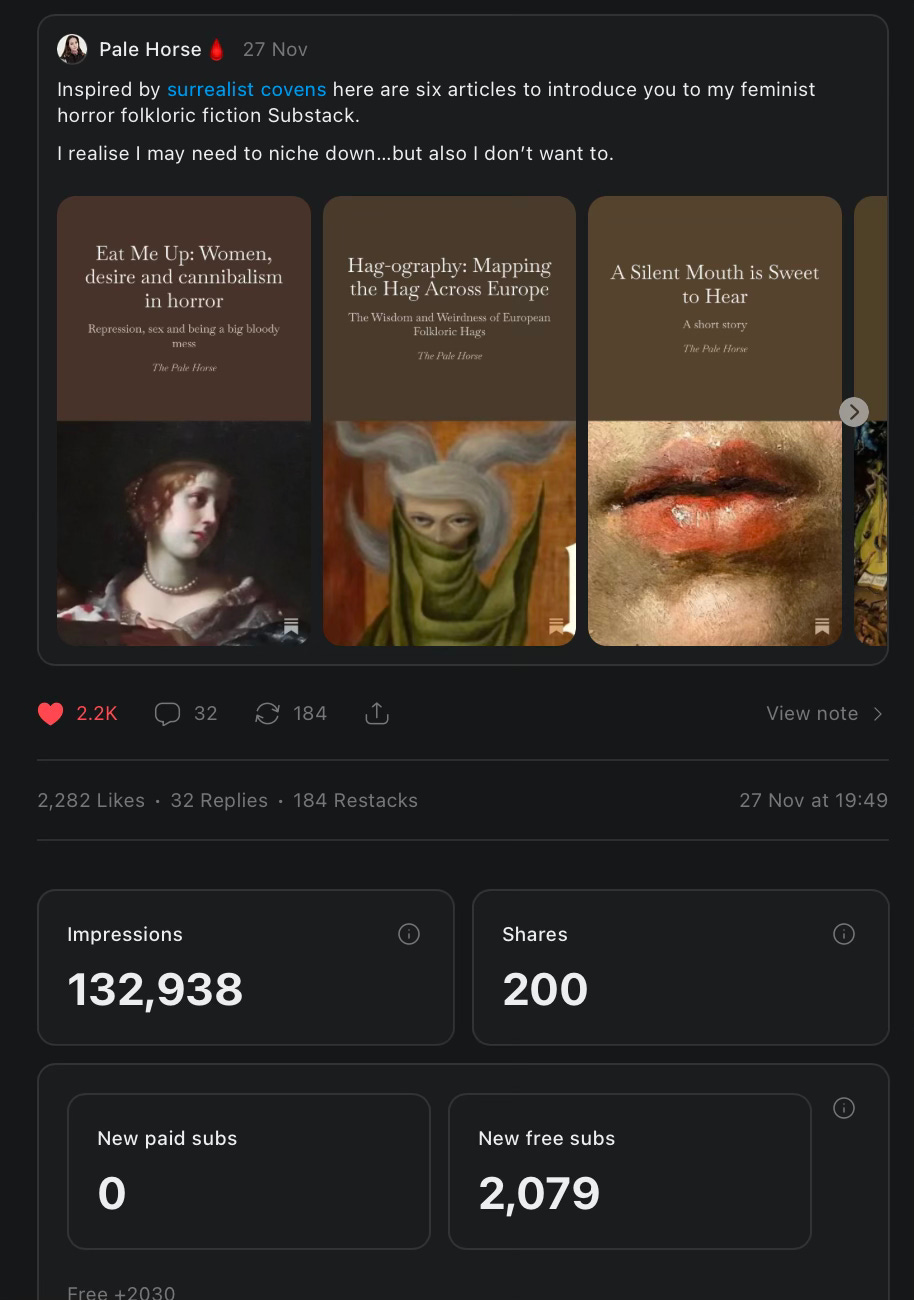
The most effective Notes are the ones where I link to my work- especially collections. Introduce your Substack with a selection of your writing. Use your assets. I do this every few weeks. It used to be more effective than it is now, but it still works. Here is a recent example from this past month.
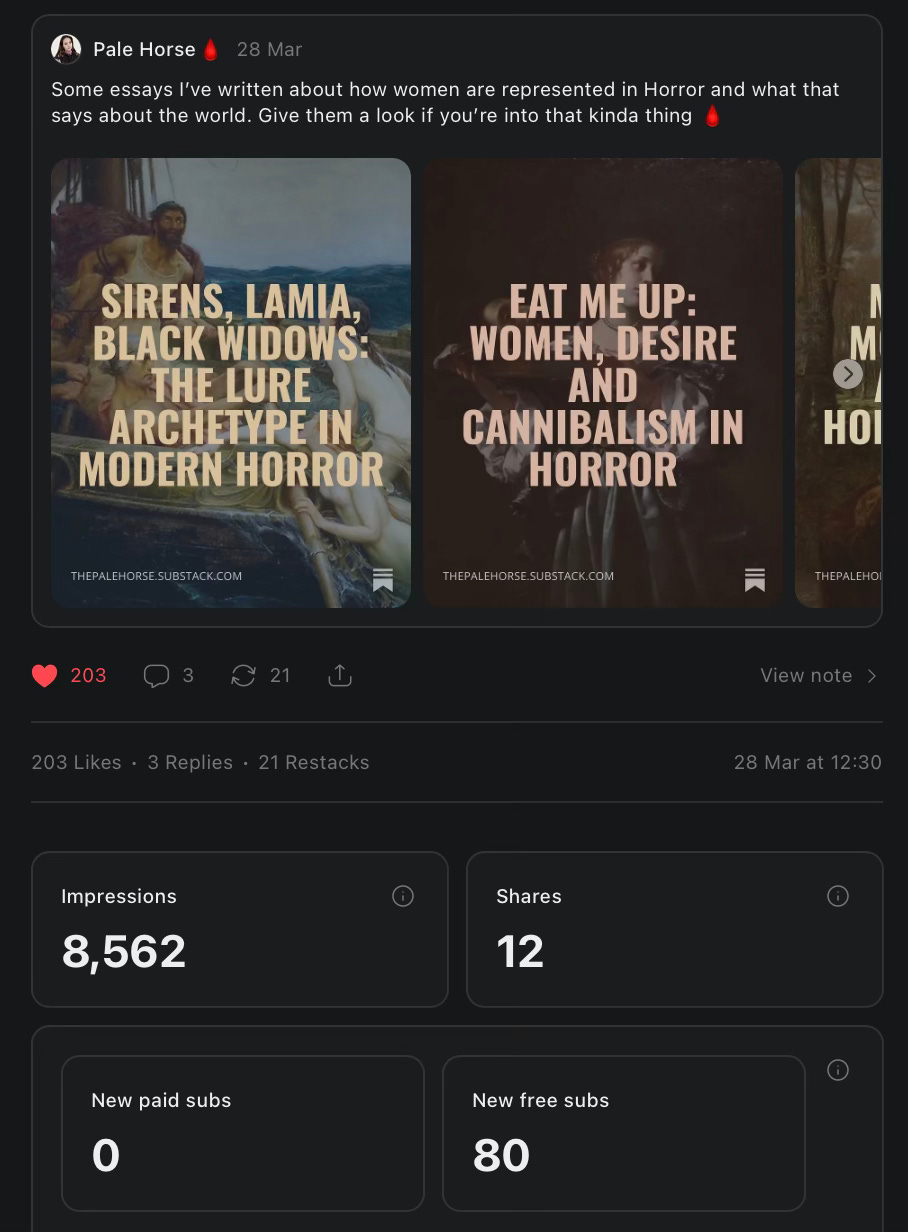
There’s also something nice about it as a reader. In a world of short attention spans, it gives older pieces a second life. Even now, I discover writers I’ve never come across before through these kind of posts and as a reader I want that. I want to see what people are making. I would consider the essays I write to be evergreen in that they are not about something thats happening right now this minute. I discuss old films, I write short stories, I explore folklore and archetypes. So I’m not going to hit publish and forget about those pieces because I care about them. I regularly re-share older work. Some of my older pieces still gain me new Subscribers.
Perhaps on your account different notes work better. Go to your Dashboard, go to Growth for New Subscribers and filter by “All Time” It will give you a breakdown of your top performing Notes. Analyse what pulls in Subscribers for you and repeat the pattern- not verbatim obviously.
The other notes that perform are ones that tell my audience and Substack at large about what I’m working on and what I’ll be publishing very soon. I usually introduce an essay about a week before I publish it.
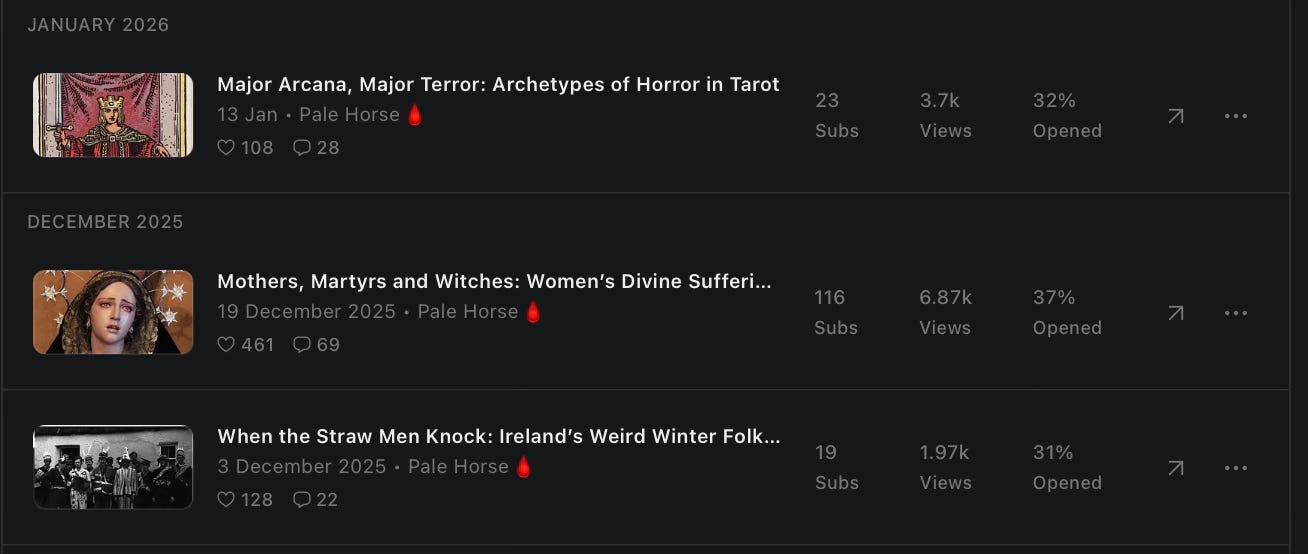
By comparison, essays or short stories don’t tend to bring in the largest number of subscribers, but they do bring in some. Fiction is personal and in my mind people either connect with a story or they don’t. Essays are more open-ended and have a larger audience.
Essays, about topics a lot of people relate to cast a wider net. Personally, I enjoy doing a mix of both essays and fiction. My essays and the research for them inform my creative short fiction. I write them in a completely different way too. Like, I write a short story in a haze where I forget to eat and drink whereas an essay might take about ten sessions at the laptop before I publish it.
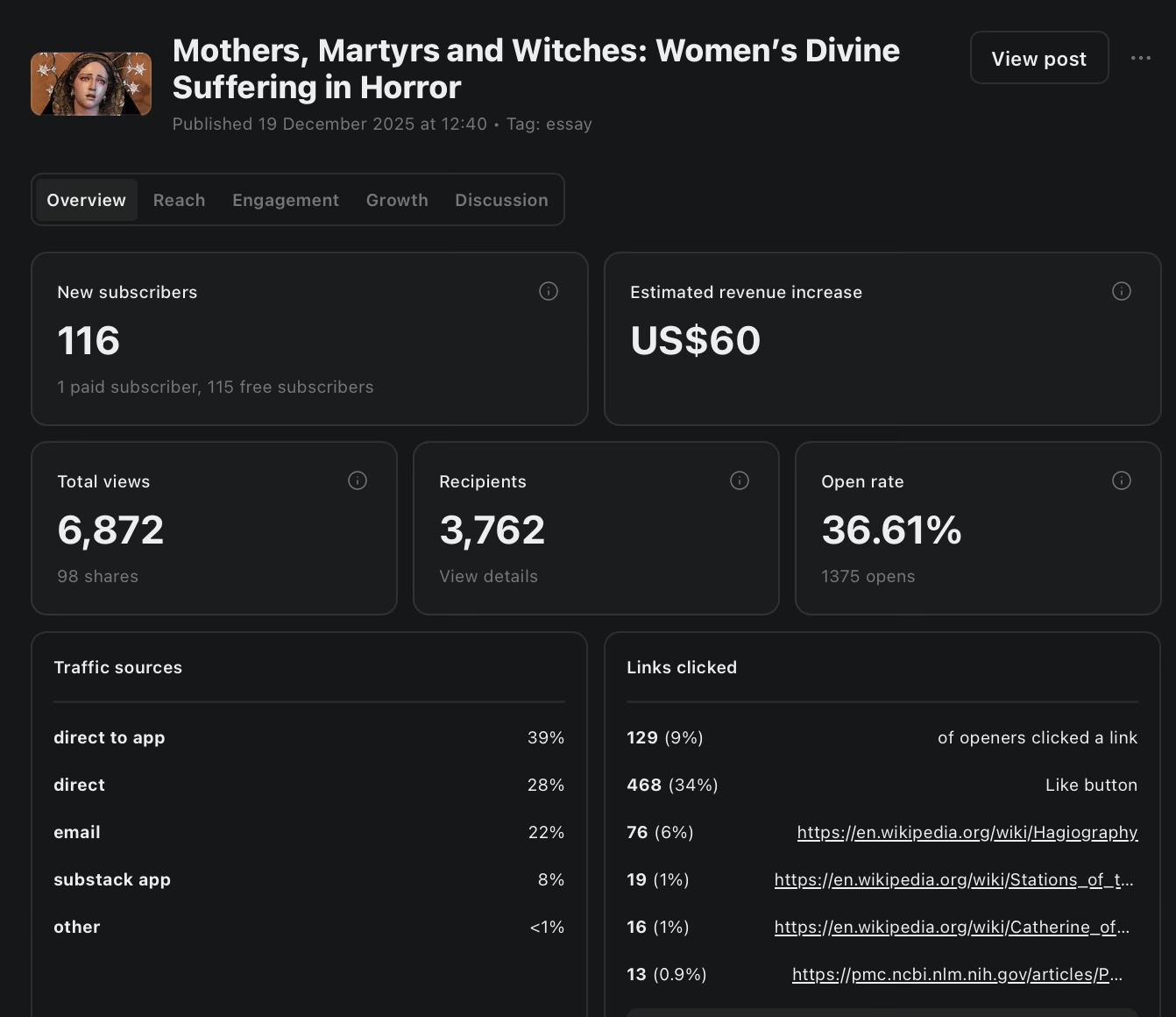
The essays I write that resonate with readers most tend to include something personal. That’s where I see more comments, more engagement, more connection. So I would include my own experience with Catholicism when critiquing the Church’s depiction of female pain. I do this for a few reasons, but one is because I’m not a scholar on the Catholic Church or depictions of female pain so I can’t give a reader an expert opinion on it. I am however, a woman in modern Ireland that was indoctrinated into the Church and I can see how depictions of Mary and a crucified Jesus have affected the way I think about things for better and for worse. So while I never position myself as an authority, my experience is an authority all its own. My voice and my experience matters. This goes back into the whole imperialism thing I’m not a huge fan of.
I’m an introvert. If I reveal too much of myself, I feel exposed and sometimes even embarrassed. And before anyone says “just push through it”…in the past I have against my better judgement. I used to post on TikTok as I was a business owner and this was how I made sales. A few videos went viral (the most embarrassing ones), and when I started getting recognised in real life in my town, I felt deeply uncomfortable. The woman who approached me was lovely but I realised then how much I value anonymity.
There’s also a wider pattern I’m aware of, particularly with women writing personal essays, laying themselves bare and then being picked apart for it. Think of writers like Lindy West or Lena Dunham. The backlash can be intense, and often deeply misogynistic. I see it, I recognise it, and I factor it in. I am not comparing myself to either woman by the way but I am careful when I speak about certain things because I recognise the pattern. I heard a saying lately “Write from the scar not the wound: and so I write from the scar, if something is still a wound you won’t find me bleeding on the internet for anyone.
So for now, I’ll keep some distance. You won’t find me back on TikTok anytime soon talking about medical neglect that’s for sure.
I recommend quite a few Substacks but only ones I genuinely enjoy reading, and that I think my readers will like too. It’s important to me that it feels real, not transactional.
I’ve also been lucky enough to be recommended by other writers, and that’s been one of the most effective ways to gain subscribers. It’s simple, but it works- people trust people. This feeds back into the community piece. My top recommenders are people I actually chat with on here and whose work I read.
This one’s big.
Sometimes I wonder, if I hadn’t taken time off, would I have more subscribers? Probably. But I also think I might have burned out and stopped writing altogether.
Without going too much into it, I have health problems that are chronic in some respects. I cant really plan for them. There are times when my health completely takes over. Last summer, I was in bed for weeks. It frustrates me, of course but it’s not optional. It has to come first.
I took a few weeks off around Christmas and January. If you look at my posting history, it’s not exactly consistent. But during that time, I wrote one “big” essay (something I put a lot into) and let it breathe over those weeks. It ended up being one of my most-read pieces.
I still dipped in and out of Substack, sharing quotes from it, keeping it visible.
Recently, I must admit I’m not feeling too hot and I took a few days off to do some gardening work and exercise a different part of my brain.
For the past few days Ive only dipped into Substack once or twice- no intense writing, some engagement and I’ve gained 136 new Subscribers because of slightly older Notes that Substack is still pushing.
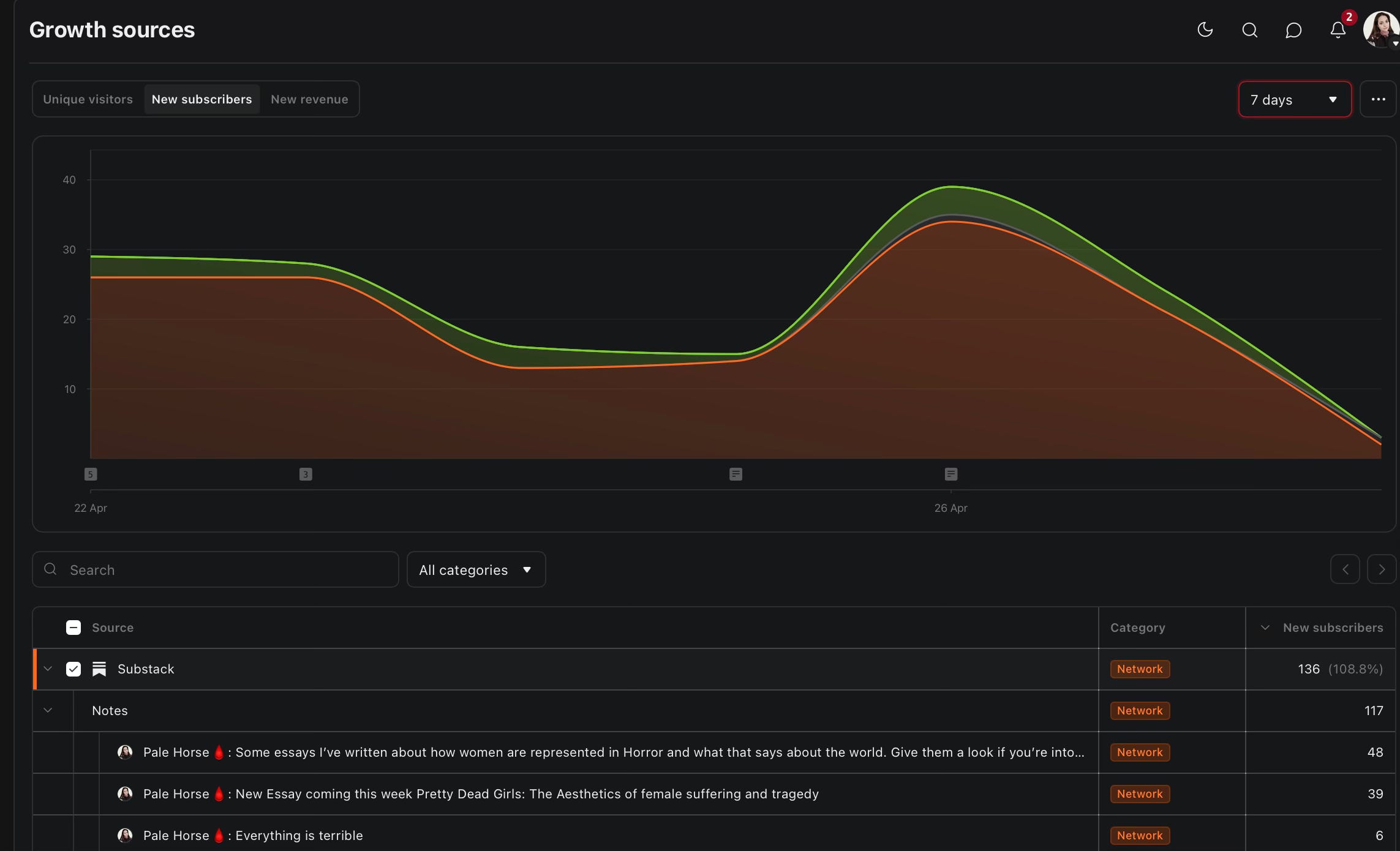
So if you’re sick, tired, or just need a break I advise you take it! Maybe reshare your work as a collection. Schedule a few Notes. Keep a gentle presence without pushing yourself too hard. I’m sure someone, somewhere, will say I’m doing all of this wrong. But this feels like sustainable growth to me.
The goal isn’t to exhaust yourself chasing numbers- it’s to use the data in a way that feels empowering. Push your older work to new readers! Don’t let them gather dust.
Right now, I aim for two to three essays and stories a month, but it’s not always sustainable.
If there’s one thing I’ve learned: quality over quantity. Always.
I’ve only started experimenting with this recently, but I’ve noticed something interesting- scheduled Notes seem to perform better for me.
I don’t think it’s just the content. I think it’s the act of using the feature itself. I used to work in tech, and platforms tend to reward users who adopt new tools early. Think about when Instagram rolled out Reels, early adopters saw huge growth.
I don’t have hard proof that this is happening on Substack, but my own experience suggests it’s worth trying. Batching and scheduling Notes has helped.
In terms of what works: shorter Notes, often with images, tend to perform best for me. I’ve tried longer, more educational posts in Notes, and they fall a bit flat.
For example, I did a series—ten posts on Irish folklore over ten days. It was fun, but it didn’t really resonate with any specific audience. So I adjusted.
That’s what I mean by listening to your audience. If something isn’t landing in one format, don’t throw it away- just reshape it. I have all of those Notes saved in Google Docs and Ive use them in a longer form essay at some point.
It happens.
Over the past couple of months, I’ve noticed that every time I publish an essay, I lose around 15 subscribers. Of course I feel it—but I try not to dwell on it. This is what people call “churn.”
And to be fair, I unsubscribe from people too. Not because I don’t like them, but sometimes something just doesn’t land for me, or I’m overwhelmed. So I try to keep that perspective. It’s part of the process.
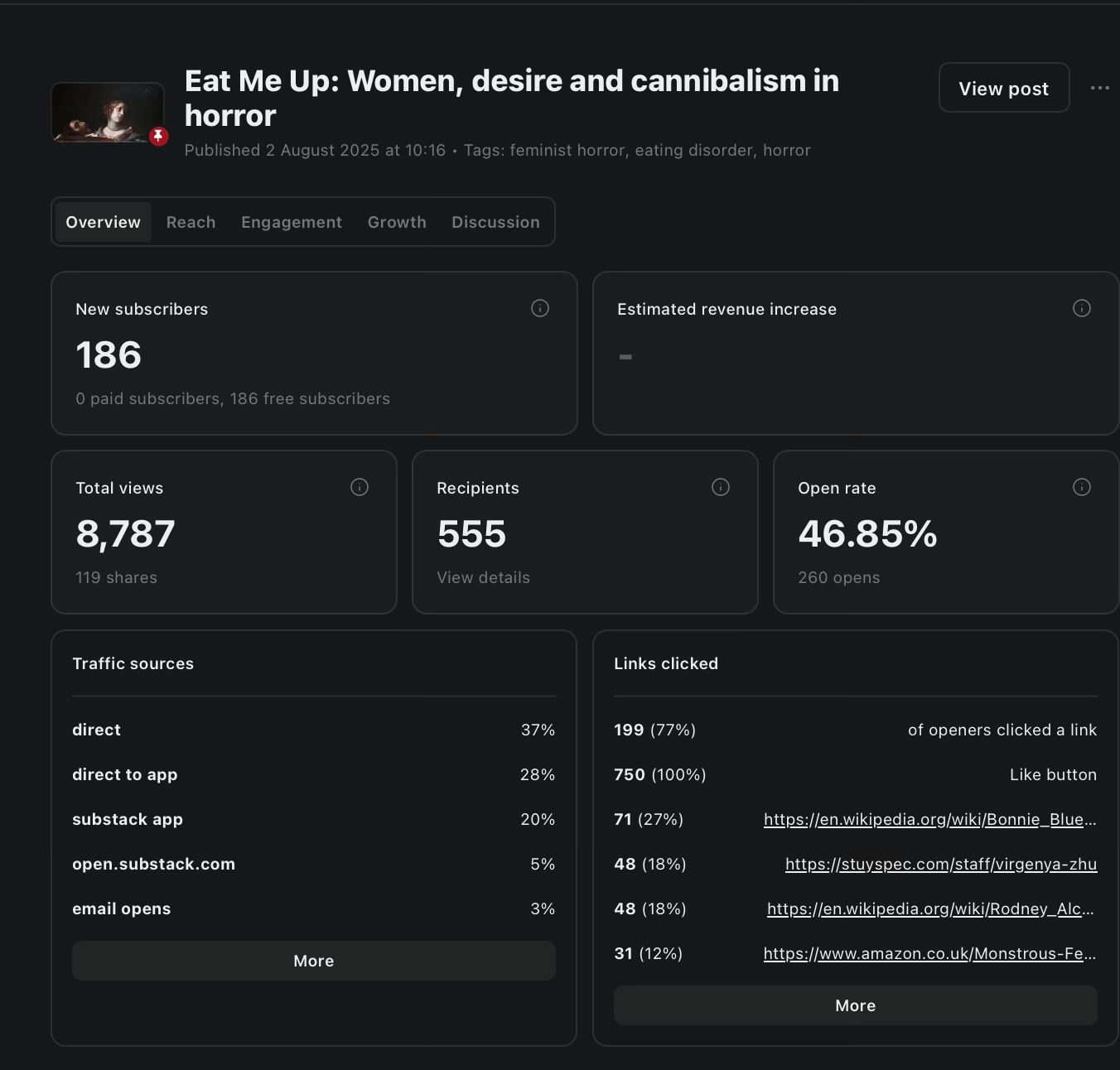
My Substack really started to grow from one essay—my piece on cannibalism. That was the catalyst. You can see from the data I had 555 Subscribers at that point but it ended up being viewed 8,787 times. My open rate is excellent. I’d credit this to having a slightly lower number of Subscribers and the title of the piece. My open rate has gone down the higher my Subscriber count has gotten.
Why did this piece blow up? Probably because it’s shocking. It’s niche. It tapped into something that was trending in horror at the time. But more importantly, I cared deeply about it. It’s long, a bit meandering, quite grotesque and it worked for my audience. I’m sharing this to show that actually, it takes one post to blow up a little bit - just one. Also, you can see here that the more eyes you have on your work, the more you grow and growth on Substack is exponential.
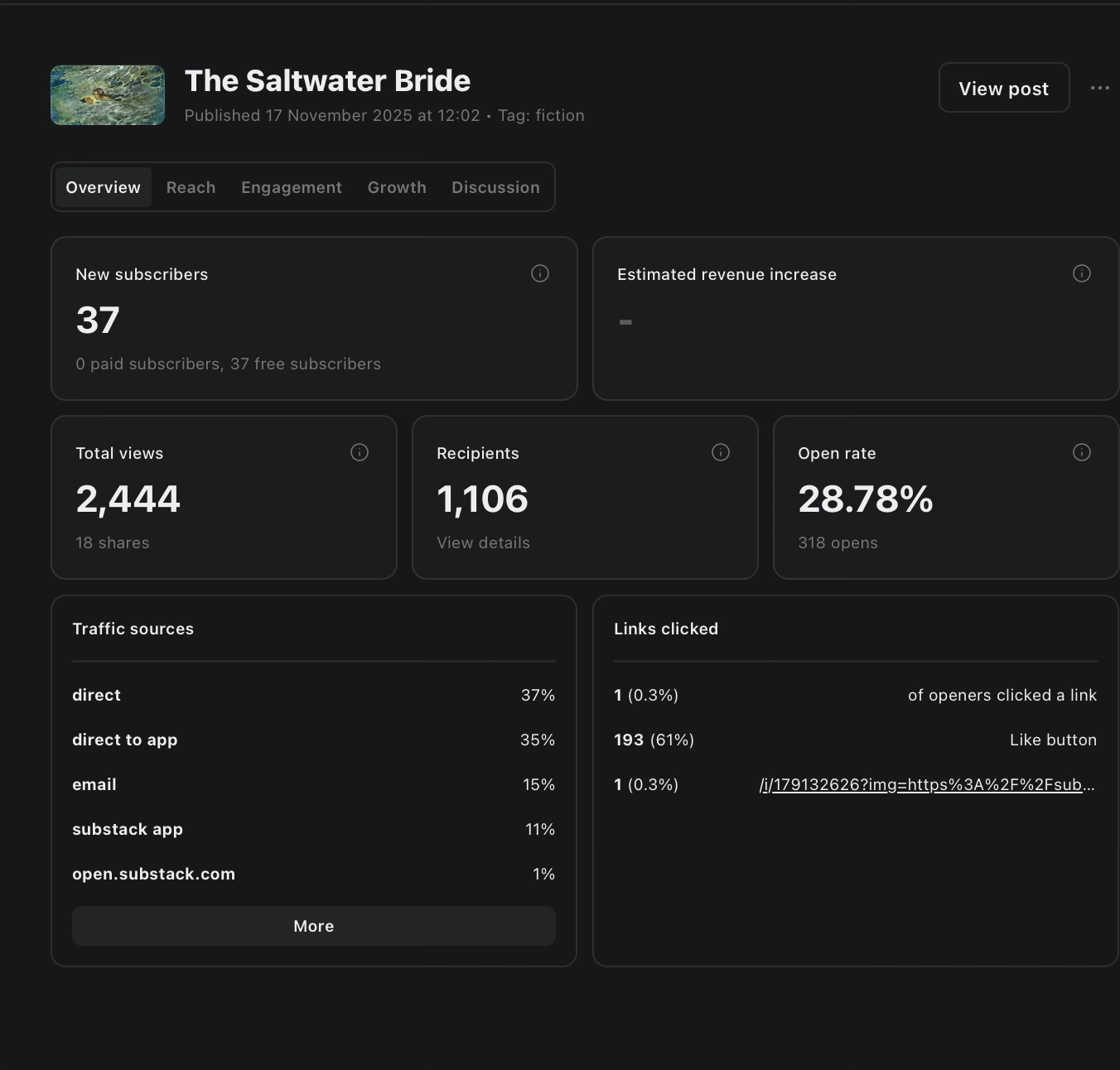
In terms of fiction, ome stories perform better than others. The Saltwater Bride, a sapphic love story about a mermaid, did really well. That piece means a lot to me. I see a lot about clean fiction on Substack and Ive gotten some not very nice comments about some of my more gross descriptions of death but you know, I write horror, I’m not changing that just now. If someone doesn’t like it, I’m not for them.
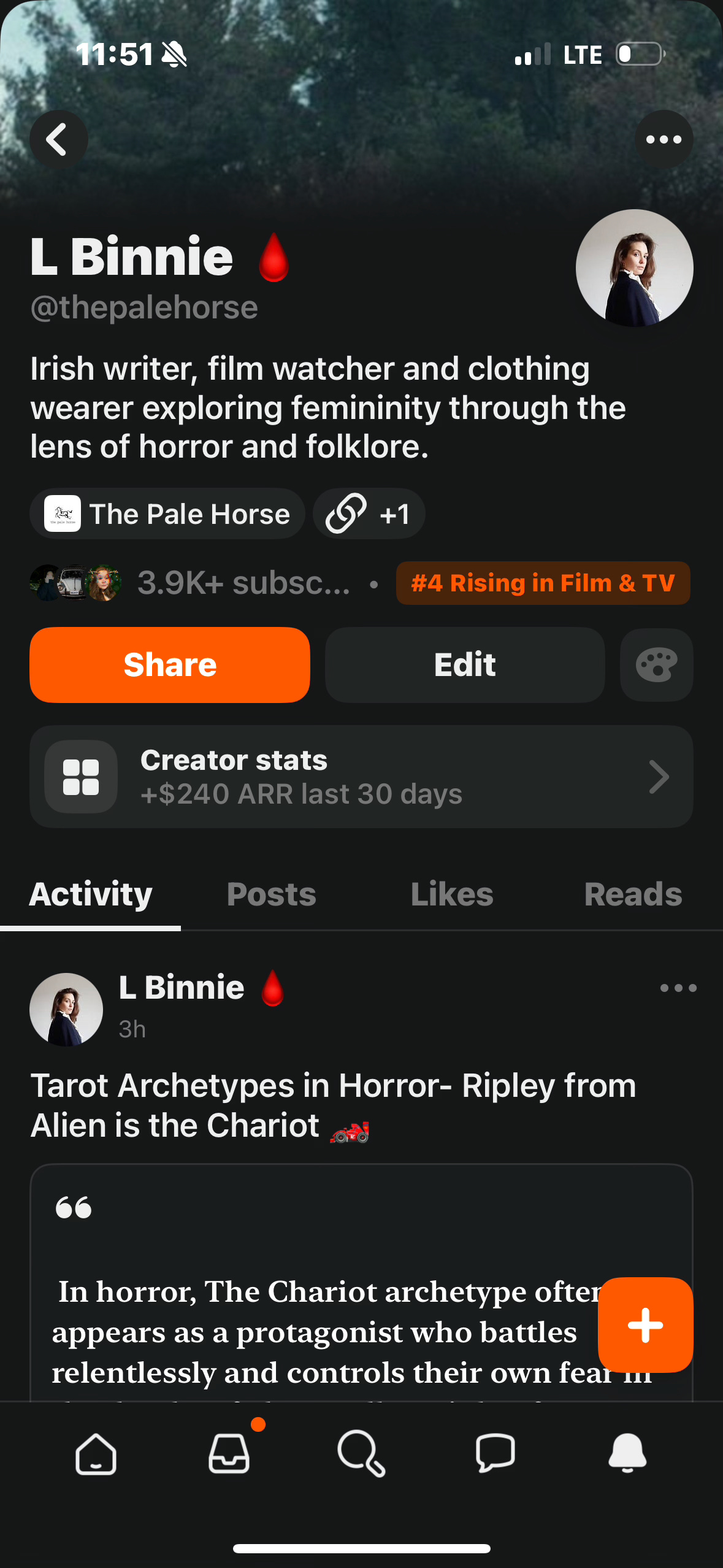
I’ve been on the Substack leaderboards a few times; “rising” in Fiction and in Film & TV.
Do you know how I got there? Paid subscribers.
I currently have 14 (that number changes, of course), and in the early days, every time I got a new paid subscriber, I’d end up on the leaderboard. Once, I got three new paid subscribers in a short space of time and suddenly I was number 4 in Film and TV. It felt completely surreal.
But I’m saying this for a reason: if you’re not on the leaderboard, the gap between you and someone who is might be as small as one paid subscriber.
With that in mind….ask a friend. Ask your partner. My first paid subscriber was my husband and I’m not embarrassed to say that. I more or less strong-armed him into it, but I also had a sense that once I broke that barrier, others would follow. And they did! Within a few days, I had another paid subscriber, who I didn’t have to threaten into supporting me, it came from the goodness of their own heart.
Some people subscribe for a month and leave. Some stay. I’m incredibly grateful for the ones who stay and read my work (Im watching you guys!) they genuinely keep me going. I’ve had a few people pay me for a whole years worth of writing. That is crazy to me. I am delighted.
At the moment, I put content that’s over a year old behind a paywall. Early on, I used to do things like writing subscribers’ names into stories, but that became unmanageable fairly quickly as fiction ebbs and flows in my brain and unfortunately I can’t force a story when there is no story try as I might.
I’ve thought about tiered subscriptions, but I haven’t quite figured out a version that feels right yet but I do think about it a lot.
If I’m honest, because I spend so long writing each piece, the idea that only a small number of people would read it behind a paywall doesn’t sit well with me. So this approach of paywalling older work feels like a good balance for now.
Most of my paid subscribers, I think, are there because they want to support the work. And that means a lot. I know that when I subscribe to other writers, it’s because I admire them and I want them to keep going.
This will run counter to what a lot of people think, people that are more experienced than me, people who don’t believe in doing anything for free. People deserve to get paid for their work, and thats a goal of mine, but for now, my goals are not just about the money at this moment in time. Outside of Substack I’ve been paid for pieces I’ve written and this will be a focus for me going forward.
If my goal was to make money from Substack, my journey and writing would look different.
In terms of promoting off-platform, I keep it fairly low-effort.
Each week, I share my work in a Facebook group for my favourite horror podcast the Evolution of Horror. I don’t think it brings in many subscribers, but I like that space and I enjoy contributing to it.
I also use Threads occasionally. It’s… mixed. I’ve met two of my closest writing peers there, and I was invited into a writing group that has genuinely made me a better, more hopeful writer.
That said, Threads can also be exhausting. It is full to the brim of people waiting to be offended by something you write or wanting an argument. I don’t have the energy for that.
I have an Instagram too, but I don’t post much. It’s useful for connections, for seeing what’s happening in horror and film and for spotting open calls and literary magazines. But I’m not particularly interested in growing it right now. I just don’t have the capacity.
And that’s the thing: you don’t have to do all of this. It depends on your niche, your energy, your goals.
Could I do more? Definitely. Video content, narration, talking-head posts, TikTok especially has huge reach. But it also takes a lot of energy, and right now, I don’t want to do that and there’s power in knowing that.
I want to focus on the writing rather than building an online persona. But if that’s something you enjoy, then absolutely lean into it.
More power to you.
I’ve learned a lot, honestly this is just a small slice but it’s informed my direction for the year ahead. Here are my upcoming goals for writing in 2026 and beyond.
Write short stories and submit to Lit Mags, Journals and Zines
Finish my Novel
Write more essays about the intersection of feminism and horror
Podcast (Top secret)
Continue to do Substack collabs!
Do a course on Screenwriting
Do a course on Editing
I hope some of you found this helpful and I apologise for the rambles. A powerpoint presentation might have been a format, alas, we have to work with what we’ve got. If you have any questions drop them in the comments and I’ll do my best to answer them.
Thanks for reading!
Comments
Nothing yet. Say the first thing.
Sign in to join the conversation.