
This is part of the Castration Culture series. Part 1: The Natality Pill. Part 2: Castration Culture. Part 3: Why I Am Not Anti-PMC. The latter explained the class formation. This one is about its worst outgrowth.
In the previous piece, I explained what the PMC is, why it matters, and yet why I am not anti-PMC. The Professional Managerial Class is a historical development, like the assembly line or the internet. It emerged from specific conditions in response to specific (working class) pressures. It’s silly to hate a class formation any more than a weather pattern — it’s old man waving fist at sky behavior. The PMC is simply a development that must be studied by anyone who wants to know the waters in which theory is swimming. The rebel priest class is, however, a different matter entirely.
The rebel priest class is the cultural outgrowth of the PMC that has inverted the Kantian categorical imperative: instead of only willing what would work toward a harmonious society if everyone were to do it, the rebel priest wills whatever flatters his own exceptionalism and then justifies it on grounds that have nothing to do with where we actually live, what people are actually like, or what happens when the oddest people in society try to normalize their preferences for everyone else.
Environmentalists blocking traffic so that workers cannot get to their jobs is the rebel priest class in action. Anti-natalism dressed up as personal philosophy while the civilization that produced that ideology cannot replace itself is the rebel priest class in action. Polyamory preached as liberation by people who have never had to raise a child on a shift worker’s schedule is the rebel priest class in action.
The PMC is how you end up with a class of clueless specialists who reify the meritocracy. The rebel priest class is the part of that stratum that resents the populace to such a degree that its sacraments of the Liberal Rumspringa, if mainstreamed, would result in civilizational collapse. Is that worth hating? I’m not so sure, hate is a strong word after all. But as far as classes go, the priests who go their own way, who refuse their radical responsibility to the good of the whole, all while functioning as the shocktroops of capital’s culture of castration, are perhaps least deserving of our sympathies.
Søren Kierkegaard broke off his engagement to Regine Olsen in 1841, even though he loved her. By all accounts, she loved him back. Yet he ended it, because he believed his calling required a sacrifice that marriage could not survive.
Kierkegaard spent the rest of his life writing about faith, irony, and the impossibility of authentic existence within the institutions of his time. He never married. He never had children. He died at forty-two, collapsed on a street in Copenhagen, estranged from his family and his church.
Friedrich Nietzsche proposed to Lou Salomé in 1882. She said no. He never proposed to anyone again. He spent the next six years writing the most explosive body of philosophy in modern history, and then he also collapsed on the street, after which he was never again himself. Nietzsche spent the final eleven years of his life in the care of his mother and then his sister, unable to feed or dress himself. He never married. He never had children. He died at fifty-five.
Though many who attempt to fill the burgeoning ranks of the modern rebel priest class have never heard of Kierkegaard or Nietzsche (they’re increasingly unrooted and illiterate), I take these two philosophers to be the exemplars who have most shaped both Christian and atheistic modernity for individuals who put their personal opinions before responsibility to others.
They were two of the most brilliant minds of the 19th century. Both childless. Both radical individuals. Both ended in isolation. One was a Knight of Faith whose theology was too good for any actually existing church, whereas the other was a prophet of a new mankind that has only ever arrived as tragedy or farce. Both, in a sense that matters for everything that follows, were essentially protestant.
I don’t mean Lutheran or Calvinist. I mean protestant in the sense that Durkheim identified in Suicide: the product of a culture that prizes individual opinion formation, personal conscience, and doubt over communal belonging and inherited authority. The protestant subject is the one who must work out his own salvation, his own meaning, his own relationship to truth, without the scaffolding of an institution to whose authority he is willing to submit. This is the modern individual in its purest form. It is also, as Durkheim showed, the form most susceptible to isolation, despair, and self-destruction.1
So, even though they would have never signed off on what they inspired, I take Kierkegaard and Nietzsche as the archetypical symptoms of what I am calling the rebellious priest class.2 Not because they were bad men or because their work was without value. They are two of my favorite philosophers and I think theorists who try to bypass them are wasting their time trying to understand the world. However, they indisputably embodied a new kind of figure: the priest who goes his own way. The path they carved, which was extraordinary and unrepeatable in their own lives, became over the next century and a half the default aspiration of an entire class of people who put their own freedom of opinion before the calling to care for, tend to, and uplift the lives of the masses.
This account will be deliberately overly simplistic. The goal is to paint a pattern you can see through, so that once the image is burned in you cannot stop noticing its trace.
In every human society that has ever existed, there are people who are gifted in the ability to shepherd souls. They go by many names across many times and places: elders, shamans, monks, priests, rabbis, advisors, intellectuals. They are the people who mediate between a community and its highest commitments, between the living and the dead, between what a society is and what it ought to be. In the smallest society, this might be a few elders. In a civilization, it becomes a class — or “the first estate” in the old sense.
I use the word “civilization” to mean a certain level of complexity in human relations where many societies coexist within, between, and because of the more complex division of labor that makes such coexistence possible. Civilizations lose the immediate trust of small tribes as they grow in scale.
The trust that holds a civilization together is abstract: no longer based in knowing everyone personally, but in institutions, laws, rituals, and norms that bind strangers to each other across distances and generations. The priest class is the one called to maintain those norms while mediating between the common mass and the rulers. Its function, then, is to tend to and care for souls uplifted to and measured against pro-civilizational standards that allow trust to operate at scale. This requires holding itself, power, and the mass accountable in reference to standards that transcend the immediate pressure of social necessity or nature.
When the priest class performs its job well, power has a check, the people are shepherded, and civilization holds. When it does this job badly, trust erodes, relationships sour, and raw power is free to exploit and abuse without conscience or repercussions. When the priesthood, as a class, refuses its radical responsibility entirely and begins actively working against the pro-civilizational norms it was charged to maintain, you get what we have now.
The priest class takes on as many forms and appearances as it does times and places. Any priest class can become corrupt in various ways. Ours, today, is more corrupt than most. I hope it’s obvious that I am not referring to literal Catholic priests or Jewish Rabbis. I am referring to the modern priest class, which is always also an oxymoron.
“Modern priest class” is a contradiction in terms because “modern” here refers to a certain kind of subject, an individual, considered equal and exchangeable to the rest. Priests are neither equal nor individuals, but rather serve a particular symbolic function that must be separate and apart from the other members within the given society. The priest class of every time serves its flock, congregation, parish, etc. — until modernity, at which point the mass got replaced by an aggregate of exchangable individuals.
Priests went from mediating and representing to going their own way. It started with academic philosophers, paragons of truth and the good, modeling a viciously rational form-of-life supposed to be for all mankind. Immanuel Kant summed it up in his What is Enlightenment?: the idea being that each person would become responsible for his own immaturity, applying himself to learn and grow in understanding without recourse to authorities, tradition, or institutions.3
Yet then Kant became an authority, as has every great philosopher since. While the ideal of modernity was that we all become like Kant, its prevailing tendency was instead for people like Kant to assume everyone else would have to become like him. But unlike the rebel priesthood, Kant still believed in duty, moral law, and the categorical imperative that binds all rational beings. To his credit, his rebellion only extended to ecclesiastical authority, not against the idea that rules exist and apply to everyone. Kierkegaard and Nietzsche went further. They rebelled not just against the church but against the very idea that the exceptional individual owes anything to the rules that govern ordinary life.
Weber, in “Science as a Vocation” (1917) and “Politics as a Vocation” (1919), tried to articulate what a responsible modern priesthood would look like. Assumign that God is dead, the enchanted world is gone and is not coming back, yet knowing science cannot tell us how to live, he concluded that the honest intellectual accepts this and equips people to make their own decisions without pretending to make those decisions for them. The political leader operates by an “ethic of responsibility” rather than an “ethic of ultimate ends,” weighing consequences rather than pursuing utopian visions regardless of cost.4
Weber himself was haunted by the suspicion that modernity would not produce people capable of living up to the ideals articulated in his vocation lectures. The closing pages of The Protestant Ethic are where that suspicion finds its most devastating expression:
“No one knows who will live in this cage in the future, or whether at the end of this tremendous development entirely new prophets will arise, or there will be a great rebirth of old ideas and ideals, or, if neither, mechanized petrification, embellished with a sort of convulsive self-importance. For of the last stage of this cultural development, it might well be truly said: ‘Specialists without spirit, sensualists without heart; this nullity imagines that it has attained a level of civilization never before achieved.’”5
That is the prophecy of what the PMC would actually become once its modern liberal ideals were stripped away and only the institutional machinery remained.
Weber’s lofty vision was one on which all good progressives from the era agreed. W.E.B. Du Bois’ “Talented Tenth” essay is a beautiful articulation of a responsible academic calling for his race to do as all the other progressives coming out of Ivy Leagues at the time advocated: separate from the unwashed masses, get organized, come up with a plan, become the best possible, and then bring that back to the people.
Du Bois knew better than most the difficulty posed by anyone trying to actually achieve this vision. In The Souls of Black Folk, he tells the story of a man who comes back to uplift and organize his people, only to find that they no longer trust him.
When I first listened to Du Bois while stowing product in an Amazon delivery warehouse, the section that most stuck with me was his “Of the Coming of John.” As Du Bois tells it: John Jones was a young black man from a small Georgia town who left for college. He was the town’s great hope. He went north, got educated, and absorbed the progressive intellectual culture of his time. When he returned home to teach, the John who came back was not the John his people remembered. He had been formed by institutions that gave him knowledge but also what Bourdieu would call habitus: a way of carrying himself, a set of assumptions about what matters and how to talk about it that was legible to his professors but alien to his people. He tried to teach and his community resisted. The white power structure shut him down. The tragic story ended in violence and death.6
Du Bois knew that the Talented Tenth strategy contains a trap: the very process of becoming educated enough to lead your people can make you unrecognizable to them. The priest who leaves to be trained as a priest comes back speaking a language his congregation cannot understand.
What happened to Du Bois himself confirmed this. Norman Finkelstein documents the end of the story in I’ll Burn That Bridge When I Get to It: when the U.S. government came after Du Bois, the Talented Tenth he had called into being abandoned him. Of the fifty presidents of Negro colleges, every one of which he had known and visited, only one publicly professed belief in his integrity before the trial. The responsible priest was betrayed by the very class he helped form.7
Du Bois himself eventually abandoned the Talented Tenth framework and moved toward what he called the “Guiding Hundredth,” insisting on group leadership rather than individual elitism. He saw the trap in his own model. The question of how to lead without alienating the people you serve remains unsolved.
Du Bois and Weber were the last serious attempt. What came after was not a better version of their aspiration. It was an inversion of it.
Dostoevsky’s Raskolnikov in Crime and Punishment anticipated this logic decades before Nietzsche’s most radical works. Raskolnikov is a brilliant, impoverished former student who convinces himself that extraordinary individuals are exempt from ordinary morality. He murders an old pawnbroker to prove it. His theory was that some men are Napoleon, and Napoleon does not answer to the moral law of shopkeepers. Yet the reality of what Raskolnikov had done was something he could not live with. Crime and Punishment follows his disintegration. He eventually confesses and goes to prison in Siberia. There, an inmate barred in the frozen wastes, he begins to recover while reading scripture. He is saved not through philosophy but through love and submission to something larger than himself.
Nietzsche’s Übermensch is Raskolnikov’s theory without the novel’s corrective. Dostoevsky saw where this was going before Nietzsche got there. The credentialed intellectual who believes his sophistication exempts him from the rules binding ordinary communities together is Raskolnikov seeking a tenure-track (or lucrative influencer) position. Raskolnikov at least cracked under the weight of what he had done. The modern rebel priest is insulated from that reckoning, because his ideas don’t immediately result in death and misery before his eyes. For me, as someone seduced by both the rebel priest class and the culture of castration it administers, it took the natality pill to realize how antithetical to everything good and just my own assumptions had become.8
The PMC cultivated within the structures established by progressive managerialism at the beginning of the 20th century laid the foundation for a universal meritocracy, where the deservingness to lead, represent, and influence is based in how well one did vis-a-vis one’s “peers.”
The school peer group, in this context, is one that has been age-segregated into artificial peer groups abstracted from real communities, intergenerationality, practical life, and also a genuine relation to the liberal arts fields as a way of life. Instead of the arts or a life of practice, students stand out on the basis of how well they pay attention, sit still, memorize, and flatter their teachers, or they find some other way to become distinct.
Middle school onwards becomes an increasingly savage competition to make for oneself an identity. The priest class were often made up of those people who have special qualities, who were, with proper formation within legitimating institutions, looked up to despite their inability to fight or rule; they were looked up to despite their inability to fit the standard cookie cutter path for starting a family. In PMC schooling, such people find themselves competing against frat boys and sorority girls, the people who would have, historically, never been in the ranks of the priesthood.
The incentives to go one’s own way only increase with time as progressive reforms change the nature of this class. Instead of being looked up to by the rank and file citizenry, those who would have been spiritual or intellectual leaders find themselves looked down upon, because universal education has made everyone think he is the priest, mediator, representative, judge.
Everyone has access to the same education, everyone knows how to read, and so everyone thinks he or she knows what goes into the life of the mind and the work of the spirit. Of course this is not true, and every special kind of person who would have been in the ranks of priests or advisors in past societies, now finds the role of leader called for by Du Bois or Weber an implausible path forward.
The tendency for the rebel priest to get narcissistically taken with his own reflection, mediating his own life instead of that of a community, becomes an increasingly greater temptation the further along the forces of capitalism develop.
The rebel priest is, much like Kierkegaard or Nietzsche, a radical modern liberal subject. Owing nothing to nobody, thinking on behalf of the enlightened few who “get it,” there is no serious thought given to the rules that could actually scale to, and function well at, the civilizational level. Instead, the rebel priest has formed against the mainstream, resents the masses, thinks that everyone would have to become like him, or else deserves whatever comes their way.
Like monks, nuns, and priests across time, the priest is an odd exception to the general human condition, finding fulfillment in abstractions and their contemplation rather than in the raising of a family. Throughout all time, such exceptional individuals respected the general rules, the family and community structures that serve to make life a little easier for those who raise families. The priest is supposed to be the one whose family is the spiritual morale of the community, so that the families of the community can grow in health.
Instead, what we have today is a rebel priest class who has taken its exceptional status as the path for all mankind, foregoing marriage and children to pursue a calling. Except now that calling is dictated by capital, the state, and the institutions that serve both capital and state interests. This means turning every individual into a self-optimizing reserve of labor power in pursuit of commodity consumption, i.e. the wil-to-pleasure.
Rob Henderson calls these luxury beliefs: ideas and values that confer status on the affluent while imposing costs on those further down the class ladder.9 The rebel priest class generates luxury beliefs and the working class absorbs them. Anti-natalism is the clearest case. An intellectual bohemian adopts anti-natalism as a way of pushing back against the priority of family, the constraints of tradition, or the right-wing appropriation of these things. The position is usually expressed as merely personal, not meant for everyone. But that personal position is a representation of an intellectual and creative class whose way of life, even when genuinely earned through spiritual or artistic calling, gets dressed in the language of the Liberal Rumspringa, which has no ceremony of return. It sets ordinary people up for failure. The bohemian who chose childlessness for real reasons and the twenty-four-year-old barista who absorbed it through Instagram are not living the same life. One made a sacrifice. The other was sold a counterfeit of that sacrifice and told it was freedom.
In The Natality Pill, I wrote that the Liberal Rumspringa expects you to “never go back except as a dark apostle of capital; instead of converting souls for a heavenly kingdom, you are to convict faith in institutions.” This is what the rebel priest class does. It occupies every position of cultural authority: the professor, the therapist, the journalist, the HR department, the public school teacher with the robot baby. It administers the Liberal Rumspringa. Not by conscious conspiracy, but by doing what its training and incentives and institutional position have prepared it to do: professionalize everything, pathologize tradition, treat the family as an obstacle to individual optimization.
The old priest initiated people into an intergenerational community. The rebel priest initiates people out of one. The old priest’s celibacy was a sacrifice made in service to the community’s families. The rebel priest’s childlessness is universalized as the rational, sophisticated, liberated choice for everyone. The old priest taught that the rules binding ordinary life were sacred. The rebel priest teaches that those rules are oppressive, outdated, and beneath anyone who has truly thought for himself.
The PMC is the class formation. The rebel priest class is what that class formation does to culture. Capital needs atomized, childless, flexible labor units. The rebel priest class translates that need into values, attitudes, and aspirations that people adopt as their own. That is how the institutional logic described in “Castration Culture” reproduces itself.
Neither Kierkegaard nor Nietzsche wanted their path universalized. Kierkegaard wrote explicitly that the Knight of Faith was an exception, not a model. His entire philosophy depends on the distinction between the ethical (the universal, the communal, the rules that bind everyone) and the religious (the singular, the exceptional, the leap that only the individual can make). He sacrificed Regine because he believed his particular calling demanded it, not because he thought nobody should marry. The whole point of Fear and Trembling is that Abraham’s willingness to sacrifice Isaac is terrifying precisely because it violates the universal ethical order. It is not a recommendation. It is an abyss.
Nietzsche, for his part, never stopped writing about breeding, vitality, and the future of the species. His contempt was for the “last man,” the comfortable consumer who wants nothing, risks nothing, and blinks. The Übermensch was supposed to be a creator, not a consumer. Whatever else Nietzsche got wrong, he would have been horrified by a civilization of people optimizing their sexual capital on dating apps while refusing to reproduce. That is the last man, not the Übermensch.
Kierkegaard, Nietzsche, Du Bois, Weber: each of them saw more clearly than the class that claims them, and the followers took the most convenient reading and discarded the rest.
This has led to what I have been calling castration culture. Not a population decline argument, though the decline is real enough. Castration culture is both figurative and literal, and it operates at every level of human life: the individual who gets a vasectomy at twenty-three, the mother who was never taught to breastfeed, the community that replaced its elders with institutions, the nation whose education policy produces compliant labor instead of competent parents, the civilization that persuades its own working class not to reproduce and then imports a more exploitable workforce to replace them. As I wrote in the previous piece in this series: ‘What kind of civilization designs a program to simulate its own reproduction as a nightmare and then deploys it across the majority of its schools?’ It is castration culture all the way down, all the way up, and all the way across.
The point is not the gene seed. I am not a pro-natalist in the Silicon Valley sense, counting births and screening embryos. The point is the formation. What kind of people are we producing, and what kind of people are we failing to produce? A culture that neuters its boys and girls, that structurally undermines the conditions for long-term commitment, that forecloses the possibility of binding yourself to something that will outlast you, is a culture that has cut itself off from the only source of genuine renewal available to a civilization. Children are not an exceptional lifestyle choice. They are how the world gets renewed; they are the demand that breaks you open, that forces you to become someone who exists for something beyond yourself. A culture that structurally forecloses that possibility has not just failed its children. It has sealed itself shut.10
Once that realization lands, it’s impossible to see this as anything other than a system that churns out entire generations that are, in general, not thinking seriously about or preparing to start families, much less take radical responsibility for their formation. Now the normies are trying to be bohemian radicals, and it has become normal to scorn the idea of children. Yet when I think of Kierkegaard or Nietzsche, I don’t think of happy men. I think of childless individualists who died in sad isolation and, in Nietzsche’s case, the very dependency that he had bracketed out from his theory of life. What worries me is that this is becoming the path for more and more people.
Kierkegaard at least had a theology that made his sacrifice plausible given the times. Nietzsche at least had a vision of human greatness that, however flawed, pointed beyond comfort. The rebel priest class of today has neither. It has credentials, student debt, an Apple TV subscription, and the vague sense that it is too smart for the life its grandparents lived. It has traded the old priest’s sacrifice for the consumer subject’s convenience and called it liberation.
So what do we do about this? Not at the level of individual choice. Not “just have kids.” What must be done at the level of culture, desire, and political demand? If the rebel priest class has successfully reshaped what people want, then no policy can save us. You cannot legislate demand for something the culture has taught people not to want. The contestation of desire itself has to come first. This is why the next piece in this series is called No War but Culture War. Against Lacanian, Deleuzean, and Marxist tendencies in the world of theory today, I will share the most neglected yet incredible contribution from Heidegger’s Being and Time that helps us understand the gerrymandering of dispositions and what this, in turn, shows us about what must be done.
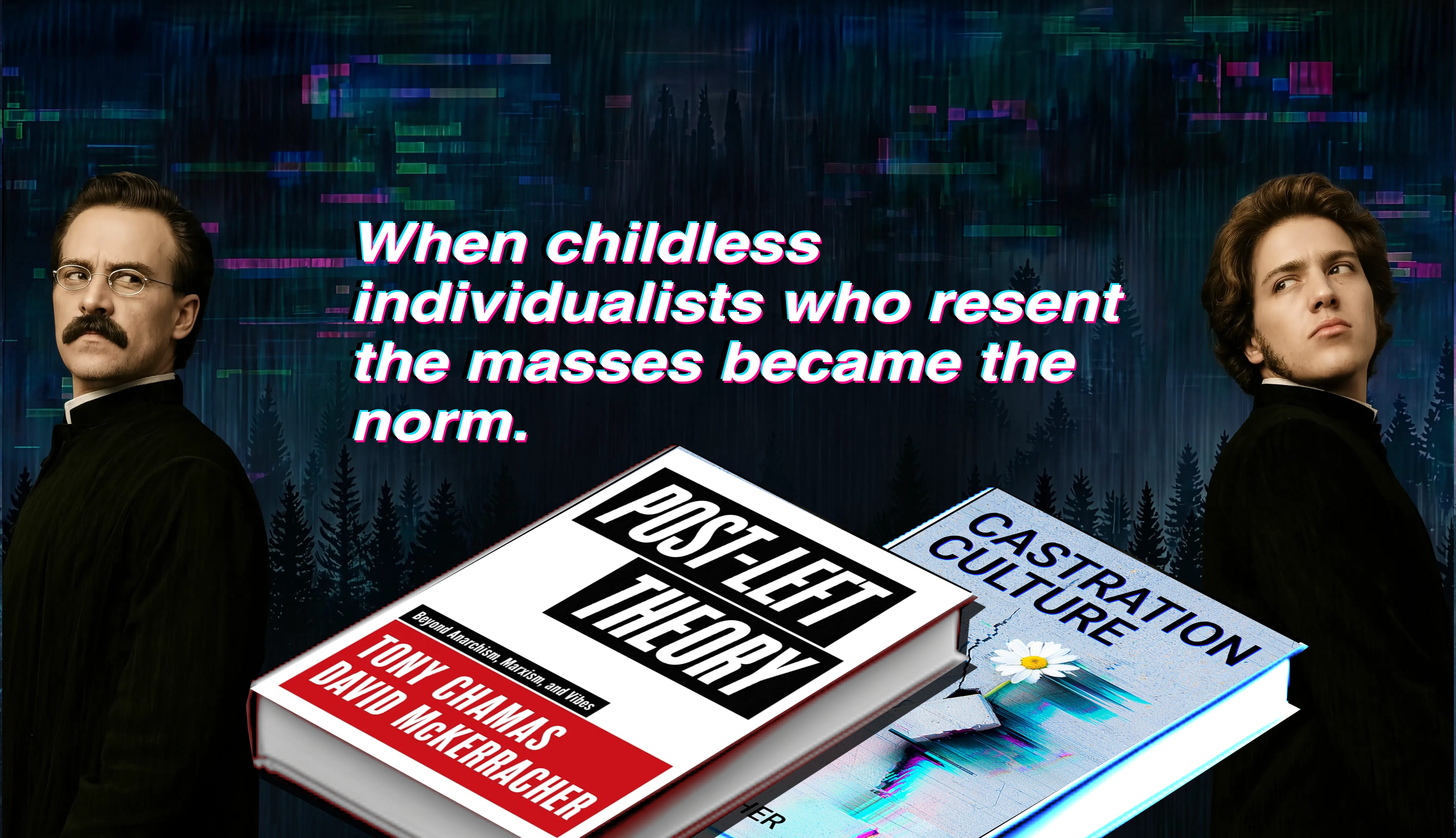
This piece and the ones before it are chapters in two books I am currently writing. The first is Castration Culture. The second, co-authored with Tony Chamas (Tony of 1Dime), is Post-Left Theory. In both, the argument goes further than anything I can develop in a Substack post. The current chapter goes on to develop a critique of the revolutionary subject as it has existed for both the Old and New Left, proposes the subject I take to be most serious and worth our time going forward, and addresses why the most visible reaction against the rebel priest class, the trad Orthodox turn that I’ve become sympathetic to yet am certainly not myself a part, inverts the problem without solving it. If you want the full argument, those books are where it will live.
In the meantime, the next piece in this series addresses the relationship between ideology, desire, and political change. If nobody wants what we are losing, then we have already lost it. The question is whether the wanting can be contested and the answer is one that refutes the old class reductionist cry for “no war but class war.” If you want to see that you better subscribe.
Thanks for reading.
This is part of the Castration Culture series. Part 1: The Natality Pill. Part 2: Castration Culture. Part 3: Why I Am Not Anti-PMC, as well as The Breakup Liturgy and Relationships Aren’t Colonized Enough, Actually part 1 and part 2.
If you want to attend an IRL event where we will be talking more about Castration Culture and Post-Left Theory, then check out TUCON26 and consider attending this August 27-29.
If you want to support this work and get special access to behind-the-scenes seminars that are the source of the theory, then consider becoming a member at theoryunderground.com/subscribe. If you want a sneak peak at the kind of stuff going on there, reach out direct via the direct messaging function here and ask. I’m happy to share a couple of recent sessions of the seminars and courses so you can get a sense for what it’s like.
Émile Durkheim, Suicide: A Study in Sociology (1897), trans. John A. Spaulding and George Simpson (New York: Free Press, 1951). Durkheim's analysis of "egoistic suicide" identifies protestantism's emphasis on individual conscience and the dissolution of communal bonds as a structural condition producing higher rates of self-destruction.
Angela Nagle, "Did Populism Start A 21st Century Anti-Clerical Revolution?" (Substack, 2021) was formative for my thinking here. Nagle uses the term "clerisy" to describe the secular moral teaching class that accrues power through producing and maintaining ideology, and frames populism as an anti-clerical movement against that class. My concept of the rebel priest class is indebted to her analysis while situating the priestly function within the material context of the PMC as described in the previous piece, and extends it into the phenomenological territory of desire, habitus, and the inversion of civilizational rules that Nagle's political-economic frame does not address. See also her "First As Tragedy, Then As Farce."
Immanuel Kant, "An Answer to the Question: What is Enlightenment?" (1784), in Practical Philosophy, trans. and ed. Mary J. Gregor (Cambridge: Cambridge University Press, 1996). Kant's famous opening: "Enlightenment is man's emergence from his self-incurred immaturity. Immaturity is the inability to use one's own understanding without the guidance of another."
Max Weber, "Science as a Vocation" (1917) and "Politics as a Vocation" (1919), in From Max Weber: Essays in Sociology, trans. and ed. H. H. Gerth and C. Wright Mills (New York: Oxford University Press, 1946).
Max Weber, The Protestant Ethic and the Spirit of Capitalism, trans. Talcott Parsons, introduction by Anthony Giddens (London: Routledge, 1992), 182.
W. E. B. Du Bois, "Of the Coming of John," in The Souls of Black Folk (Chicago: A. C. McClurg, 1903).
Norman Finkelstein, I'll Burn That Bridge When I Get to It! Heretical Thoughts on Identity Politics, Cancel Culture, and Academic Freedom (2023). DuBois passages from W. E. B. Du Bois, The Autobiography of W. E. B. Du Bois (New York: International Publishers, 1968), 390-95. Edited selection published in Underground Theory Volume II (Theory Underground, 2025) with permission from Finkelstein.
Rob Henderson, Troubled: A Memoir of Foster Care, Family, and Social Class (New York: Gallery Books, 2024). Henderson coined the term "luxury beliefs" to describe ideas that confer status on the upper class while inflicting costs on the lower classes.
The synthesis of Arendt's natality with Levinas's ethics of the Other is developed at greater length in my "The Natality Pill," Theory Underground (Substack), March 25, 2026. There I write: "The child is the self plus the other, both and neither, the subjective and objective joined in a being beyond both beings. A dialectical synthesis you can hold." For the philosophical sources: Hannah Arendt, The Human Condition (Chicago: University of Chicago Press, 1958), where natality names the capacity for genuine beginning that each birth inserts into the world, orienting human existence toward its start rather than its end; and Emmanuel Levinas, Totality and Infinity: An Essay on Exteriority, trans. Alphonso Lingis (Pittsburgh: Duquesne University Press, 1969), especially the sections on "Fecundity" and "The Son" (IV.B), where Levinas argues that the child is not a project or a possession of the self but the rupture through which the I encounters a future it did not author and cannot totalize.
No posts
Comments
Nothing yet. Say the first thing.
Sign in to join the conversation.