
This is a part of my Castration Culture book project. If you’re new here, that’s ok because each piece stands on its own. If you want, you can read the others here: The Natality Pill, Castration Culture, The Breakup Liturgy, and Why I Am Not Anti-PMC.
In part one, I introduced “the poly canon” (the cluster of books that start with and follow from The Ethical Slut) and I critique it with my concept of “timenergy” (which, in short, signifies large and reliably repeatable blocks of time-with-energy). I showed how this precious resource, timenergy, made scarce by the culture of capital’s reduction of our life’s purpose to labor power, is further jeopardized by polyamory as a lifestyle ideal. I introduced the virtuous circle between solitude (genuine being-with-oneself) and solicitude (genuine being-with-others), which is already a hard-won achievement in our busy lives. How much more difficult is it to achieve when we are in a committed loving relationship? Love introduces a new dimension of solitude (genuine being-with-one’s-significant-other) and solicitude (genuine socializing-with-one’s-significant-other). Polyamory not only undermines all of this, it also feeds off of the breakdown of the virtuous circle that is best understood through Heidegger’s vicious cycle of falling: ambiguous and non-commitally curious (therapeutic) idle chatter.1
That should be enough of a recap for you to continue on, but if you want to read Relationships Aren’t Colonized Enough, Actually pt. 1. it’s here:
·
Jun 18
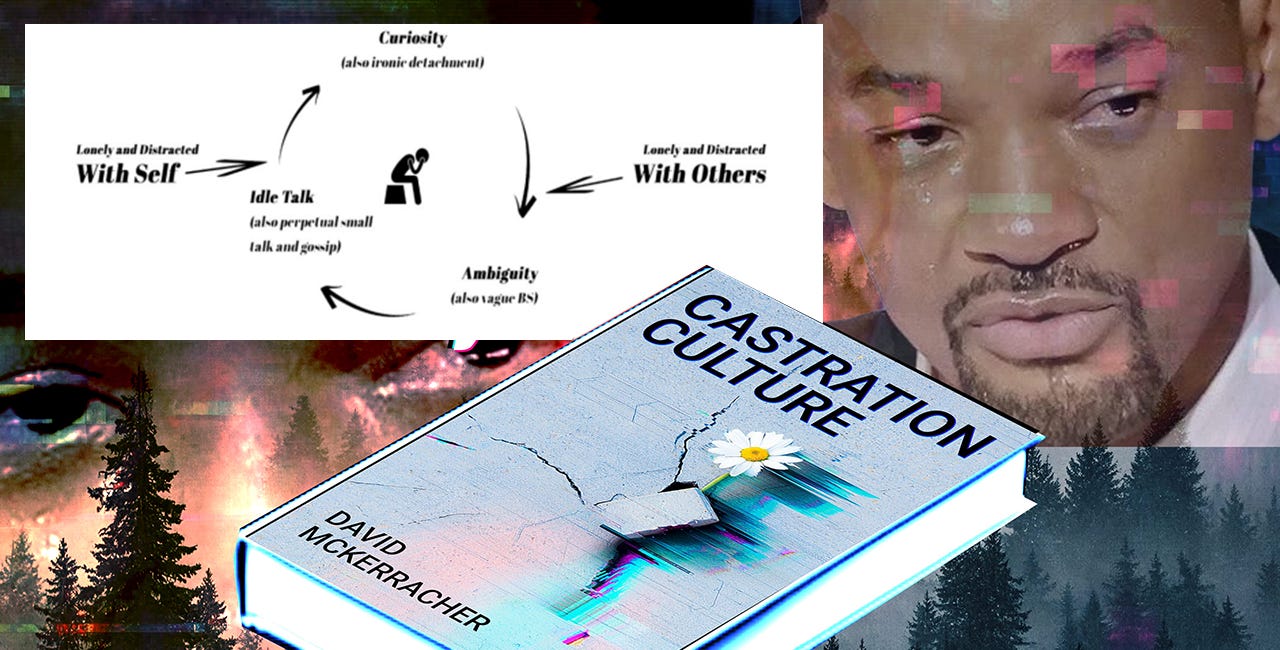
Polyamory has been on the rise, from a fringe lifestyle to a progressive virtue flex. It became impossible to ignore when Will Smith slapped comedian Chris Rock. We could all see there was something clearly wrong in that man’s eyes and heart. Soon after the rest of us, those who don’t follow this kind of thing, heard the rumor that his wife had gotten W…
When the poly advocates point to the failures of monogamy, the high divorce rate, the serial relationships, the disillusionment, they are not wrong about the symptoms. But they are wrong about the diagnosis. What they are reacting against is not monogamy. It is what Mary Harrington calls “Big Romance”: the modern model of partnership organized entirely around individualistic happiness, mutual fulfillment, and big feelings of love.2 Big Romance tells you that the purpose of a relationship is to make you happy. When it stops making you happy, it has failed. When the passion fades, when the reality of living with another human being reveals itself to be difficult and grinding and repetitive, the relationship has served its purpose and you are free to move on.
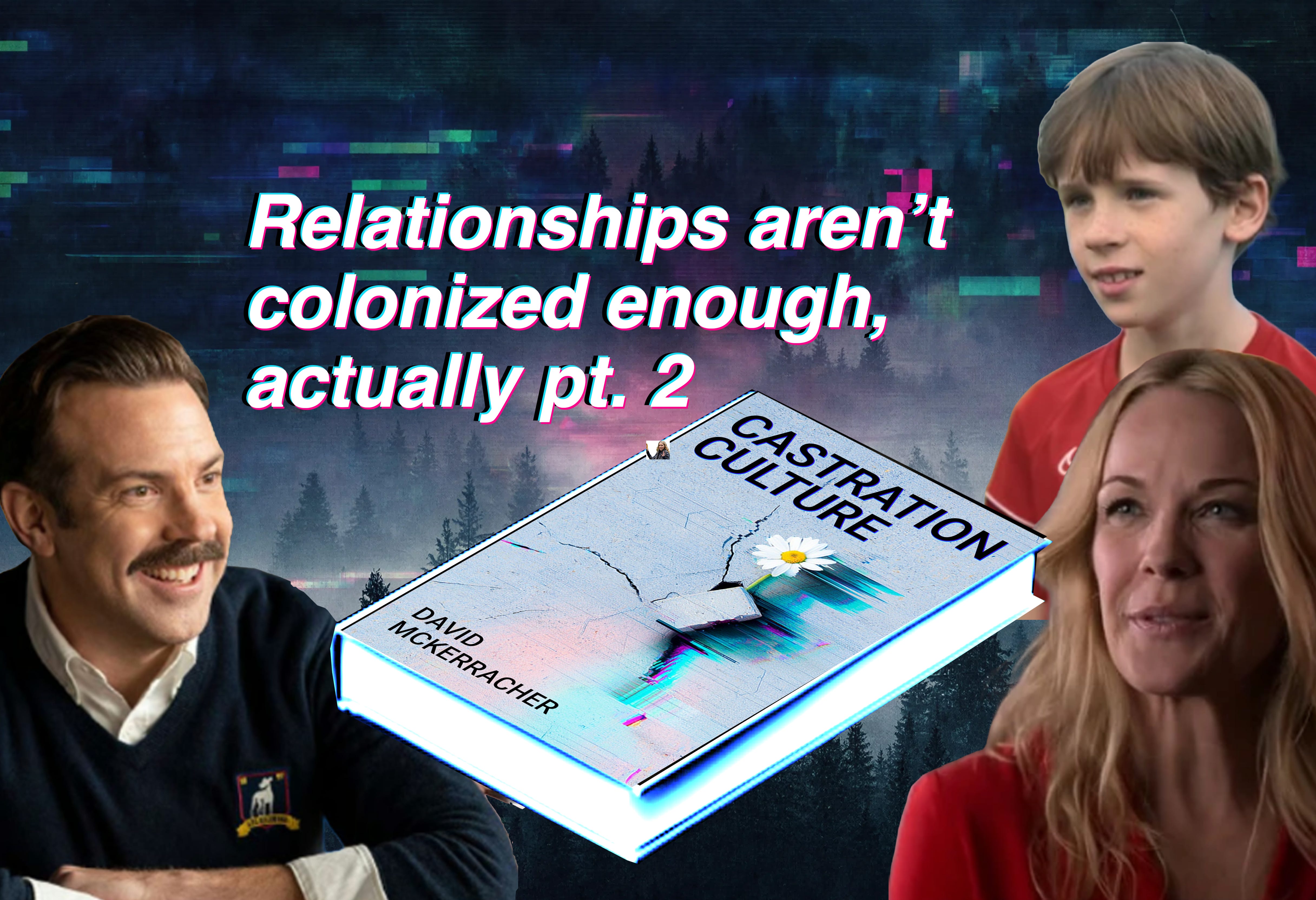
Just think of Ted Lasso’s wife in the popular Apple TV show Ted Lasso: the whole reason she keeps crying to him on the phone is that she doesn’t feel the same about him as she did in the beginning of the relationship, she’s just lost that special feeling for him.3 She “fell” out of love, and, good liberal progressive kind of guy that Lasso is, he just politely ushers himself out of her life by listening nicely and encouraging her to be true to herself, even though it’s obviously wrecking him — and more importantly, what about their son? As Them Before Us makes clear, one of the biggest issues with modern liberalism is how much it places parental rights and their will-to-pleasure ahead of what’s most important for the children.4
Serial monogamy is not the failure of monogamy per se. Rather, it is the necessary extension of Big Romance. Polyamory, or what they call “ethical non-monogamy,” is not the critique of Big Romance, but is simply its logical fulfillment. In a sense, we could just say that poly is serial-monogamy-maxxing. If one partner can’t make you happy, maybe three will. If exclusivity limits your fulfillment, remove exclusivity. If commitment forecloses possibility, keep all possibilities open forever. The poly framework is Big Romance with the last constraint removed.
As with all ideologies, we have to ask for whom is it most convenient. The answer here is cowards and sociopaths. Poly is convenient for people who do not have the courage to break up because that at least requires difficult decisions and even harder conversations. Just never break up and insist the other is being selfish if he or she is not ok with you being with others. It’s even more convenient for sociopaths and the one dimensional personalities who go along with them, but we’ll come back to that.
Decades before any of these poly books were written, Christopher Lasch wrote in Haven in a Heartless World (1977) that as social science “experts” intruded more into family life, the family’s vital role as a moral and social cornerstone disintegrated. The helping professions, in the guise of a “nurturing mother,” invaded the family, took over its functions, and undermined its capacity to provide for itself, thereby justifying the continuing expansion of the very services that had weakened it. “Public concern for the plight of the family,” Lasch wrote, “has commonly masked efforts to subject the family to new forms of outside influence.”5
The poly canon completes this invasion. What Lasch saw the helping professions doing to the family from the outside, the poly framework does from the inside. It replaces the family’s internal logic, i.e. commitment, sacrifice, hierarchy of obligations, deference to something larger than individual happiness, with the logic of the therapeutic marketplace, i.e. processing, negotiation, optimization, the primacy of individual fulfillment.
The Decolonizing Love account’s Relationship Agreement Generator is just the latest instrument of this invasion. The coaching session is the helping professional seated in your bedroom. The Jealousy Workbook is the social science expert telling you that your feelings about your own marriage are symptoms to be processed rather than signals to be heeded. They’ve essentially turned cuckoldry into a commodity, and if you care too much about appeasing their big (Left) Other, you just might be their target demographic.
The Natality Pill rearranges all of this. I wrote about the moment it hit me: the deep urge to start a family that nobody warned me was coming for me too.6 This deep urge is something people commonly say will hit most women as they approach their thirties. I had no idea it was also coming for me, a man. Nothing prepared me for the natality pill, which led to serious complications.
The natality pill made me realize that Big Romance, and the life I had built in its pursuit, is shallow. Of course happiness matters, but there is something more important than individual happiness. Sex is not the main point of an intimate relationship. The child is. Figurative or literal, it’s that nurturant self-sacrifice of the self-othering totality-rupturing future that you can only build with a spouse.
I asked earlier, What about the Lassos' son? The show never answers, because Big Romance has no answer. It has a vocabulary for how the adults feel and nothing at all for what the boy is owed. So their kid, Henry, becomes some aside in the plot rather than the priority around whom the plot would actually pivot. He is just prop for the egos of the adults, someone whom they relate to but never to such an extent that it would change their behavior in any substantial way. The idea of sacrificing for Henry cannot be taken seriously when sacrificing for the sake of Big Romance is the priority. What we see here is not a writing failure but the most transparent report of a framework in which the relationship exists to make the adults happy despite what is best for the child.
Natality, at the literal and not just figurative level, gets at the fact that we are called to love the child brought into existence through love. It’s the most amazing thing possible and capital’s culture of castration denigrates it while selling us the lie that we’ll never really want it anyway. Cultivating soil for intergenerationality is thus reduced to just one expensive consumer hobby choice among many others.
The figurative kind of natality that both Jennifer Banks and Hannah Arendt write about is based in the literal kind, but is the condition of spiritual fatherhood or motherhood, as well as our sense that the radically new can come from the seemingly self-same.7 Literal and figurative natality creates a rupture in being and turns upside down the horizon of the individual subject whose life is otherwise totalized by the will-to-pleasure. The emphasis of Big Romance on personal satisfaction and freedom, its false liberation that refuses anything that looks like binding oneself to others, is not necessarily against procreative natalism, but it is against natality in its much more noble sense that obligates oneself to self-sacrificing stewardship.
The poly advocates say they are just honest about how no one person can meet all your needs. But the “needs” they mean are sexual fantasies, not real needs. The real needs of life, care in illness, reliable partnership in child-rearing, someone who will be there when you’re old, someone who shows up when it’s not convenient, cannot be met by a polycule with a shared scheduling app to organize the lives of obsessive-compulsive negotiators.
Real needs don’t require you to have sex with the people who meet your more ordinary needs. You don’t have to sleep with your friends — in fact, you’re better off not doing so. Thank God we don’t have to sleep with our community. We need others, and they need us, in registers that have nothing to do with the erotic. What matters at the levels of family, friendship, and community are the networks of giving and receiving that make a life possible. Throwing sex into the mix obviously complicates things, which is part of why rich civic fabric forms only where there are hardcore parameters put around eros, in the defense of the kinds of relationships that can form in what I call “eros-free zones.”
If you want to know more about eros-free zones and why they’re essential for civilizations that help humans rise beyond the mud and living hand to mouth, and also beyond mere self-defense and conquest, but to actually empower humans to live lives of virtue, then you’ll want to subscribe because that chapter is coming later. You can also support this Castration Culture book project by pledging on the website, which is coming soon.
Thanks for reading part two of Relationships Aren’t Colonized Enough, Actually. Next I will take apart the move that makes the entire poly canon possible in the first place: the quiet redefinition of hierarchy as domination, structure as control, and any boundary you did not personally consent to as violence.
Notice what the protagonist of Ted Lasso is never once permitted to do: he cannot say stay. He cannot say you promised. He cannot say this is more important and I am not giving it up. In the moral universe of the show, a claim on another person is indistinguishable from the oppression of toxic masculinity. So Ted is performatively generous instead. This is how the culture of castration dresses up a man who has been neutered of his ability to bind himself.
The poly advocates' redefinition of binding and priority as oppression does almost all of the work. To this day, nobody has taken it head on. Doing so requires calling into question certain sacred idols of progressive left-coded spaces that are supposed to go unquestioned but that, if left unchecked, result in the kinds of confusion and harm perpetuated by the ideology of polyamory. If you want to read it, make sure to subscribe so it lands in your inbox.
P.S. I don’t make more than coffee-funds from Substack subscriptions. Those are appreciated immensely. However, if you want to truly support this work and get involved at Theory Underground, I have two ongoing courses and a seminar you might be interested in: Intro to Theory, The Philosophy of Stewardship, and my personal seminar called the David McKerracher Seminar. These, as well as a back-catalog of past courses, are available to members at TU. Become a member here: https://theoryunderground.com/subscribe
Martin Heidegger, Being and Time, trans. John Macquarrie and Edward Robinson (New York: Harper & Row, 1962), §§35–38, pp. 211–24 (H. 167–80).
Mary Harrington, Feminism Against Progress (Washington, DC: Regnery Publishing, 2023).
Ted Lasso, created by Jason Sudeikis, Bill Lawrence, Brendan Hunt, and Joe Kelly, aired 2020, on Apple TV+.
Katy Faust and Stacy Manning, Them Before Us: Why We Need a Global Children’s Rights Movement (New York: Post Hill Press, 2021).
Christopher Lasch, Haven in a Heartless World: The Family Besieged (New York: Basic Books, 1977).
David J. McKerracher, “The Natality Pill: Post-Vasectomy Baby Fever,” Theory Underground (Substack newsletter), March 25, 2026,
The Natality Pill
·
Mar 25
I know two guys in their twenties who, in the last five months, each got a vasectomy. This has had me thinking. As a guy who almost got one as well, multiple times, but instead is now becoming a father in his late thirties, I have a lot of feelings about this. So, suffice it to say that what follows is going to be both intimate and theoretical.
Hannah Arendt, The Human Condition (Chicago: University of Chicago Press, 1958); Jennifer Banks, Natality: Toward a Philosophy of Birth (New York: W. W. Norton, 2023).
No posts
Comments
Nothing yet. Say the first thing.
Sign in to join the conversation.