
Would a phenomenology of weight not be the reverse of a Newtonian physics? Instead of thinking in reference to objective force and motion regardless of yours or my own embodiment, it would focus on relative obstructions to one's will.
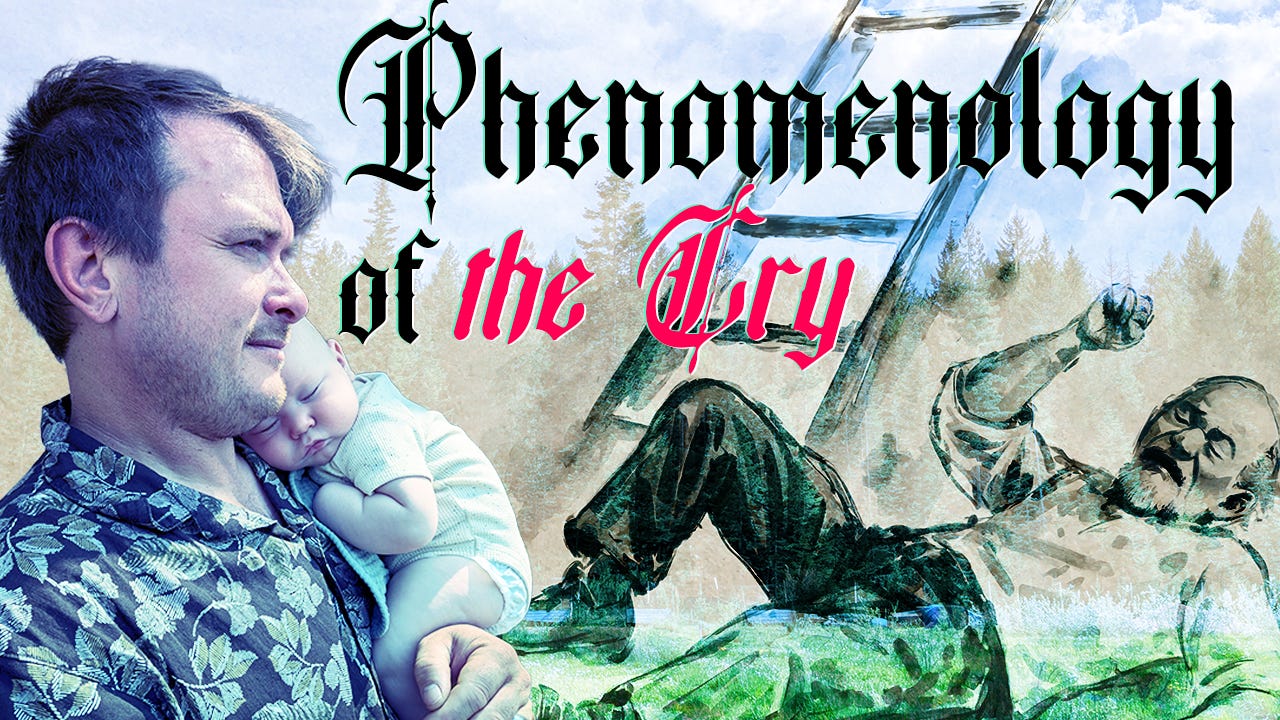
The three month old's body itself is the relative obstruction because the muscles aren't there yet and the head weighs so much... The 70 year old recovering from the fall off a ladder is in the same position.
In undertaking this phenomenology we would also not stop at the obstructions posed by the sheer weight relative to one's own strength, but also, in terms of what I'll just refer to as “attachment theory expanded,” the question of how reliably can you call on others to aid you in a given undertaking.
Newton's weight is precisely the quantity that stays constant across all these cases, where the barbell weighs 45 pounds whether I'm fresh or exhausted, three months old or seventy. Phenomenological weight is the one that varies: the same object is light in the morning and immovable after a twelve hour shift. Sartre had a term for this, borrowed from Bachelard: the coefficient of adversity. This is getting at the point that things only resist relative to the goals of a given project, e.g. the cliff is only steep for the one who intends to climb it. So a phenomenology of weight would take as its primary datum exactly what physics brackets out: the heavy-for-me-nowness of what I'm intending. This treats the objective kilogram as the derivative abstraction that it is, once you denaturalize what Husserl called our natural attitude.
I do not use “abstraction” as a pejorative though. This is meant in the most literal sense, as stark counter to the concrete. My examples (of the three month old and the seventy year old) are as concrete as it gets, something that will be known prior to cognition. In these examples, the body itself crosses over from being the transparent medium of the will to being one of the obstructions the will has to negotiate.
Normally I don't experience my head as heavy because the neck just carries it, the body is the "from which" of experience, not an object in it; when it crosses to the wrong side of the ledger, Drew Leder calls that dys-appearance. The infant and the convalescent both live in bodies that have become thematic, i.e. they show up on the wrong side of the ledger. The baby's head is probably the heaviest thing relative to available strength most of us will ever carry, or at least that we carried in common as a formative, yet consciously forgotten, experience.
Bringing in attachment theory here is my contribution. The closest phenomenology ever got to attachment theory was probably with Levinas writing about the face of the child, or Lacan, but he's more of a post-phenomenology project. Neither of these theorists is going to say what I'm arguing here: the unit of analysis for weight (as relative to will vs. force) was never limited to the individual body. Long before we gain a sense of self, indeed, before we even go through the mirror phase, we have already learned that we are or are not reliably held, that our needs get met, that our cries bring responses (and lack of response counts as a response in the sense that it is information about our world). The human will, prior to finding the body on its side of the ledger, either has its sense of solidarity with the (m)other, or is surviving in the lack thereof.
Quick little rundown on the basic rudiments of attachment theory: infants deprived of reliable holding and response, even when fed and kept clean, have much more difficult lives. Spitz famously documented orphanage infants who wasted away and died at rates approaching a third despite having their basic nutritional needs met, all because they were not getting sufficient touch.
Then there are the baby monkeys, given a choice between a bare wire surrogate mother that dispensed milk, and a soft cloth-covered one that gave no food, which spent nearly all their time clinging to the soft one. (If that doesn't move you, then wholesome theory is simply not for you.) The fact that these baby monkeys would rather cling to the soft mother over the one that dispenses food is taken as an empirical proof that contact comfort is a primary need and not just something associated with feeding.
In Strange Situation, Ainsworth argues that caregiver responsiveness in the first year sorts infants into secure and insecure patterns that are demonstrable by twelve months. Longer-term studies (Sroufe's Minnesota study ran thirty plus years) have found that those early classifications predict social competence, relationship quality, and psychopathology risk decades after the fact.
Now, I have my (determinism, class, and “wound”) critiques of attachment theory, especially of its popular versions, but the basic idea stands: the infant builds an internal working model (of what I'm calling summonability) from thousands of cry-and-response cycles built upon a baseline expectation of whether others respond when called out to. That internalized and embodied model becomes the template through which later relationships are read. When I said in my “Natality is not a natalism” piece that we are all born of a woman who was loved by a man who bound himself to her and lived in fidelity to that love, or else we are survivors of the lack [I need to find the exact quote] I was implicitly referring also to the fact that you either were held and responded to, or you’re living in the shadow of that neglect. (The nuclear arrangement means one person devoted to freeing the mother to respond; the village got the same result by substitution at both positions, tribe for breadwinner, many hands for the mother's solo responsiveness.)
My point is simply this: attachment theory gives ontic support for the ontological existentiale of dasein that Heidegger called mitsein. However, I don't stop there. We'll bring in additional ontic support for going beyond the individualism inherent to attachment theory: Dennis Proffitt's perception studies found that hills literally look steeper to people wearing heavy backpacks, and less steep when a friend is standing next to them. The mere reliable presence of another person changes the perceived gradient of the world. This suggests weight is disclosed not to the “I can” of the solitary will, but to something like the “we can” of the tribal will.
Secure attachment is the standing sense that my carrying capacity goes beyond the limits of my own muscles. My baby already knows this: his first tool for lifting his own head is his cry. And the seventy year old's real burden often isn't the ladder injury itself, but the collapse of summonability. This points to the sense that calling for help now costs more than the weight itself. I think this is worth going into more in depth, because it's the key to understanding how the body and mind work prior to our modern conceptual compartmentalization of the two.
If we take the injury and the isolation apart, you see they're two different weights: physical and… I am tempted to use the words social, psychological, and spiritual, each for different reasons, and then at the same time I want to avoid each of these for other reasons. We'll come back to the naming convention below. For now I want to drill into the distinction before showing that it undermines the very conceptual scheme we tend to assume.
The ladder injury is a physical obstruction: the torn muscle and broken ribs, whatever the damage, they heal or they don't. These are facts about the body's current capacities. The material fact of the body just means certain tasks now exceed its strength. But remember the expanded frame we just set up: carrying capacity was never just in the muscles. It's muscles plus summonability, the reliability with which the man can call others into his projects (the example I'm thinking of is a man, so I'll keep the pronoun, thank you). The cared for infant has almost zero muscle but near-total summonability. One cry and an adult appears. The healthy baby's effective strength is enormous because the “we can” answers instantly and without shame. The seventy year old is finding himself in the inverse position: the body is winding down.
There is still residual muscle — the biggest issue is that summonability has collapsed. It collapses from two directions at once. First, availability: the kids moved away, the wife may be gone, the friends are themselves frail. The network that would answer the cry has thinned out. Second, and this is the part I meant by “costs more than the weight itself,” the price of crying out has inverted. The infant's cry costs nothing. The old man's cry costs him his standing as an adult. At best it's about reputation, and at worst, it's about pride. Every request for help is liable to be experienced as an admission added to the record: I am now someone who needs help getting the box down from the shelf. Each summons converts him, in his own eyes and (he fears) in others', from helper to helped, from the one who carries to the one who is carried.
So he runs the calculation constantly, and the arithmetic usually comes out against asking. The box stays on the shelf. Not because it's too heavy in the physical sense, and not even because it's too heavy for his damaged body plus available help. It stays there because lifting it would require spending summonability, and spending it hurts more than doing without the box (why is it so costly? Is it just an ego thing? Or could it also be fear that the cry will go unheard? Maybe it’s a form of accounting, the desire to not use up one’s finite calls — becoming too much of a burden on others might mean they express frustration or start to avoid you). This is why old men climb ladders they shouldn't be on in the first place. The ladder is the cheaper option compared to the phone call.
That's the collapse: the world gets heavier not because his arms got weaker but because the social component of his strength now carries a toll he can't afford. The infant and the old man have the same weak body, but one lives in a world where everything is liftable because the cry is free, and the other lives among immovable objects because the cry has become the heaviest thing in the house.
This is where we have to bring in the way that capitalism takes the old fraternal, familial, and communal bonds of traditional society and replaces them with the commodity form, with the priority of exchange value over use value. The commodity is no longer purely about use, and neither is money — it's about exchange value. What this means in practice is that (and now this is where we really want to hone in) it's not just about commodities. At the level of the existential-phenomenological analysis, money relies totally on our primordial sense of summonability.
Before we ever experience money as an exchange value, we experience money as a use value for summons. You need someone to fix your toilet, you pay money to summon someone to fix it. Every need thus has a monetary price tag for summoning an exchangeable other with the requisite skill set for getting it done.
This replaces the familial, fraternal, and communal bonds of giving and receiving, the dependency networks, with isolated and supposedly independent rational economizing subjects. That kind of subject is, as Alasdair MacIntyre discusses in his Dependent Rational Animals, a product of a sort of philosophical failure to think the dependency inherent to the human. What MacIntyre is able to show is that philosophers have tended to bracket dependency out of the human's condition, when dependency is the steady through-line of a life, always present as a possibility even for the able-bodied, who might end up disabled at a moment's notice.
Money can help the mother. It can even help her free herself up, to some extent, from being in the position of having to constantly respond to the summonability of the infant. But money never guarantees that the paid caretaker will do as good of a job as she can, because she is the one who loves her child the most (something attachment theory as a field has shyed away from). Or at least she's the one most capable of loving her child, considering the fact that up until a certain point she really can't smother the child too much, whereas a nanny or any other family member has more obvious limits on the extent to which they are going to feel responsible for, much less be capable of responding to, the child.
In a similar way, the senior citizen entering the twilight of his life can pay others to show up. Yet he cannot pay them to love him. He might be able to pay them to treat him ethically, but he cannot pay them to actually respect him for who he has been. He cannot pay them to honor and cherish his memory.
This brings us back to the matter at hand: what is money able to replace, or stand in for, at the level of summonability?
It raises an uglier issue at the point that the senior is no longer capable of caring for himself and enters into, and under, the care of others. If those others are the inheritors of the estate, of the money, they now have a burden not just of caring for him, but of always feeling like they're not able to, because they have to look out for their own immediate economic interests. Suddenly the care of the elder is no longer a simple question of responsibility at the level of who is able to service what needs, which would be use value. Exchange value becomes more important: how much money can I make if I am focused on earning money instead of caring for his needs? It becomes a simple cost proposition, one that leads most to saying: I'm going to put him in a senior care facility. That's the level of exchange value. The family members are already likely alienated from the senior anyway, because the conditions of possibility for eldership were already undermined.
So who takes over? Paid caretakers. Professionals who do this full time, who care for the elderly in a more industrial model. The elder finds himself like a product on an assembly line, looked after by someone paid something like minimum wage to look after him while he is looking after all the others. Thus the human that starts out absolutely irreplaceable in the arms of the mother finds himself on a slow deathbed, while being tended to and cared for by people incapable of respecting, honoring, remembering, or caring for his psychological, spiritual, or social needs.
One might say: at least he has the comforting distance of the commercial relation, so that he doesn't have to feel the people who saw him at his supposedly independent level now seeing him in this state. In this sense, the senior might have a pride issue even then, preferring the senior care facility because at least the family doesn't have to see him at his lowest state.
This just brings us back to the question of summonability and the kind of lives that we live. What kind of life do you want to live? One where you are, towards the end, treated as totally exchangeable on an assembly line? Or one where you can be seen and heard, remembered and held, by those you cared for when you were able?
The hardest obstacle is not the value form of the commodity, nor the physical obstruction of the weight of one's own body. It's the weight of the ego itself: moving from a life whose pride was based in a career, in competence and independence, to the one who no longer has any of it.
I want to close this out by thinking about the existential weight of objects no longer as objects, but instead as inseparable from the ego, which is to say the social, spiritual, psychological weight of an investiture. It's an attachment, not to a default model of summonability within a trustful network of dependency, of giving and receiving, but rather an attachment to the false idol of the ego as radically independent subject, square with the world, capable of infinite replaceability.
Thanks for reading.
No posts
Comments
Nothing yet. Say the first thing.
Sign in to join the conversation.