
This is part three in a series that is responding to the ideology of “polyamory.” I’m writing this series because I am of the opinion that the dominant culture is not up to the task of defending itself against this worldview.
Poly’s advocates hide behind burnt out signifiers like “egalitarianism” and “progress,” while sometimes going so far as to claim that their workshops and consciousness raising work is “de-colonial.” If monogamy, structure, and a hierarchy of givens is “colonial” then my position is that relationships are not colonized enough, actually.
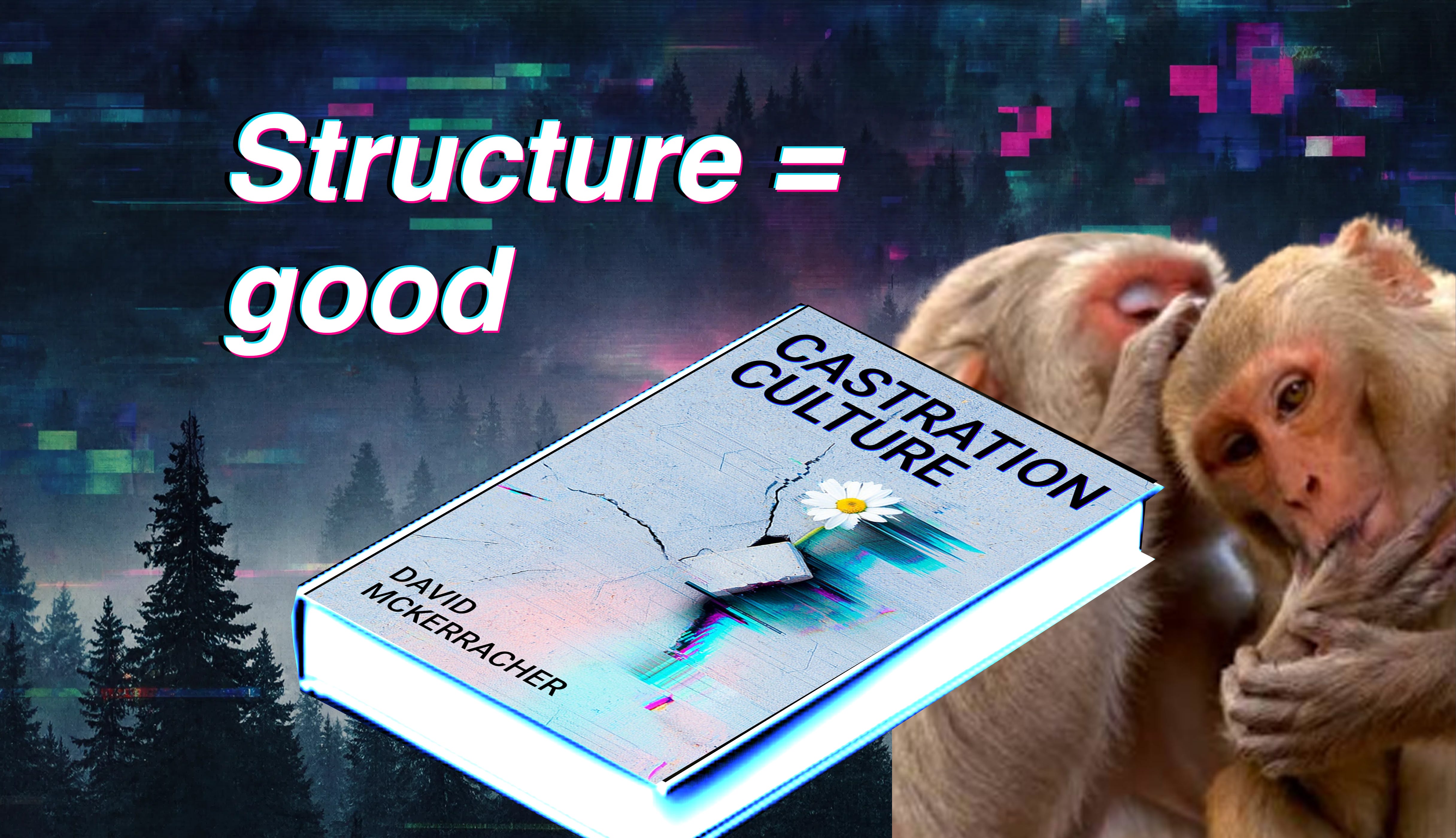
If you’re looking for a video essay that deep dives this topic, going beyond “why do they always look ‘like that’” into the data, the Reddit threads, and an intellectually humble sort of gut-level case against poly, then check out Andrew Briggs on this.1 What I bring to this conversation is a theory of the human that shows how their worldview is, ultimately, anti-human, anti-love, and anti-civilization, all in one fell swoop.
If you want to see how poly’s advocates don’t understand timenergy or the virtuous circle, and why polyamory is, in fact, impossible, you’ll want to read part one. If you want to know why Big Romance is the real disease that polyamory fails to cure, why the natality pill breaks the whole framework, why not all repression is bad, and how I know all of this from personal experience, you’ll want to read part two. This installment is about their definitional bait-and-switch and a bonobo origin myth. In both cases, it boils down to our fundamental understanding of what we are.
The poly canon only wins its arguments through the frames assumed and yet bracketed at the level of definitions: hierarchy just means domination, structure means control, and a boundary you didn’t personally negotiate is, in their telling, a terrible violence. If you’re a good progressive-left kind of subject who accepts the frames smuggled in by their vocabulary, then the debate is over before it begins.
In a live debate with a hierarchical polyamorous couple, Nick (of the Decolonizing Love account) defines hierarchical polyamory as “a ranking order where you control another relationship that’s not yours and you disallow the organic growth of a loving relationship.”2 To clarify, Nick’s debate is with another poly advocate, named Danielle. Both sides accept that polyamory is good, but Danielle thinks hierarchy is not necessarily bad and that it’s important for even poly people to have some form of structure. Danielle pushed back against Nick with: “Hierarchy in its purest form is a structure and a ranking granted for prioritization.” She’s right, for what it’s worth, but she shares too many of Nick’s assumptions and, simultaneously, lacks the theoretical basis to combat Nick’s frames, so he ends up controlling the conversation.
The 2014 book that became the poly movement’s practical bible, More Than Two, systematized this definitional heist. It argues against “couple privilege,” the idea that an existing couple’s needs should override a newer partner’s needs. Every person in a polycule (poly union) deserves equal voice. From this follow other theses including the idea that veto power is unethical, and any hierarchy is dehumanizing.
Try to put this into operation and a marriage of twenty years has no more standing than a relationship of two months. The accumulated understanding of a committed partnership gets renegotiated from scratch every time somebody new enters the picture. The children’s need for stability counts just as much as a new partner’s desire for “organic growth.”
I think cancel culture is the worst thing, and it tends to fester in these kinds of uber conscious niches of the rebel priest class. One particularly big scandal that surfaced in this region of the world had to do with Franklin Veaux, the original co-author of More Than Two. He got publicly accused by multiple former partners of emotionally abusive and manipulative behavior. When I first heard of this, I did not think, oh no, those poor victims, nor did I think, wow, the hypocrisy. I just thought, well, duh. I was, by this point, a seasoned veteran of such spaces. I considered myself a survivor of these relationships wherein any sociopath with some therapy-speak can walk in and then ceaselessly control everyone, not just emotionally, but also sexually.
What’s noteworthy about Franklin Veaux’s scandal was not that it was hypocritical, nor that the framework of rights and autonomy it is founded on did not stop its own author from doing the things it warned against. Regardless of the truth or falsity around the accusations, the point remains that nothing in his book’s framework has an answer for an emotionally manipulative personality other than more communication and more processing, which is exactly what the alleged victims say the abuse was running on in the first place.3
The deepest refutation of the anti-hierarchy framework comes out of a book about dependence and disability. Alasdair MacIntyre’s Dependent Rational Animals (1999) argues that nobody reasons his way into being an independent practical reasoner. MacIntyre says, “We owe to parents, especially mothers, to aunts, grandparents, and surrogates for these [faculties of reason] that care from conception through birth and infancy to childhood.” In other words, a child’s ability to reason is first something that is formed within a hierarchy of dependency.
The adult knows more than the child and only through that natural submission comes the capacity that the poly canon takes for granted as “autonomy.” So the attack on hierarchy in intimate life is an attack on the developmental condition of the very freedom being celebrated. Tear down the structures that raise the next generation and what you get is wreckage, not a world of freer adults.2
Edmund Burke wrote,
“We are afraid to put men to live and trade each on his own private stock of reason, because we suspect that this stock in each man is small, and that the individuals would do better to avail themselves of the general bank and capital of nations and of ages.” [What Burke called prejudice, in the old positive sense, is inherited structure carrying practical wisdom no individual could reconstruct alone. He said that prejudice] “renders a man’s virtue his habit, rather than a series of unconnected acts. Through just prejudice, his duty becomes a part of his nature.”4
What the poly canon files under “compulsory monogamy” and “the relationship escalator” are exactly that kind of bank Burke is referring to: centuries of practical experiment by millions across cultures and over the course of millennia, lessons people learned so we wouldn’t have to find out firsthand. Throw all that out, seek to reform what you never understood in the first place, and the chances are you might just find out the hard way. Poly advocates are trying to replace the storehouse of culture with coaching sessions and a workbook whose only operating assumptions are the radicalized modus operandi of capital’s culture of castration in the Liberal Rumspringa.
Sex at Dawn is the scientific-sounding backstop for the poly framework. Christopher Ryan and Cacilda Jethá argue that pre-agricultural humans lived in egalitarian bands where sexual access was shared communally, that monogamy came in with agriculture, property, and patriarchy, and that bonobos, not chimps, are the better model for ancestral human sexuality. On Instagram, The Decolonizing Love account retells the story: “Humans evolved as profoundly cooperative, egalitarian beings. Institutional hierarchy is a capacity we developed only 10,000 years ago, not a default we were born into.”
The empirical problems with this are severe and well documented. Lynn Saxon went through every “partible paternity” society the authors cite and found mate-guarding, sexual jealousy, pair-bonding, and paternity-related infanticide everywhere. The bonobo comparison is cherry-picked, since we’re equally related to chimpanzees, who guard mates, hold territory, and run hierarchies.5
The deeper problem is philosophical. If we grant Ryan and Jethá every anthropological claim, none of this tells us anything about how to live. We’re simply not the kind of animal that can take its directives from prehistory.
Arnold Gehlen’s word for what we are is Mängelwesen, deficient beings. Other animals come with instincts that match organism to environments. Obviously this is not the case with us. Our drives aren’t complete, which is what makes culture possible and also what leaves us exposed. Drives that instinct doesn’t direct have to be directed by something else, which is what Gehlen argues is the job of institutions. As opposed to our incomplete first nature, we can thus think of culture as second nature: the norms, roles, and expectations that attempt to do for us what instinct does for the bonobo. As Gehlen put it, “Control and limitation in the form of discipline are the price people have to pay for stabilization.”6
So when the poly canon strips away monogamy, hierarchy, exclusivity, and the escalator in the name of getting back to our natural selves, it is trying to return a de-instinctualized animal to an instinctual openness it cannot survive. The norms aren’t chains, they are life rafts. Norms, rules, law, structure, and hierarchy are all prosthetics for a species that cannot otherwise walk.
The bonobo paradise being romanticized is a condition humans tend to avoid because it doesn’t scale to anything that carries the goods of civilization. That’s not to say there’s nothing we can learn from smaller scale societies, but prescribing their ways of life for people belonging to a large-scale civilization is a category error at best.
A common counter to this move that would base what we ought to do in some primordial biological past is to argue that everything is socially constructed anyway, there is no human nature, so we can do just construct reality however we like. Leo Strauss caught the logical error in this decades ago: the historicist move that says “it was constructed, therefore it’s contingent, therefore it’s suspect!” eats its own foundation. The issue is it applies just as much to whatever you put in the old thing’s place. If a society of rank and order is a contingent social construction, then so is egalitarianism. If monogamy is just a historical relic, then so is polyamory, as well as “decolonization.”
This is a good start, but it doesn’t go far enough. I argue that a framework that cannot make qualitative judgments between orderings of life without recourse to societies that don’t scale across populations and through time hasn’t liberated anybody — nor has its critique risen to the level of anything actually damning for the culture above which it sits in judgement. They win nothing but a false sense of superiority that has lost its ability to think.7
MacIntyre puts the question differently: never “what did we do in prehistory?” but “what forms of life let human beings flourish now?” Monogamous pair-bonding, whatever its origins, is by now a socially established cooperative activity with its own standards of excellence and its own internal goods. What the poly advocates (and their liberal-left progressive normie cousins) cannot see or accept is that their worldview does not pass what I’ve been calling “the Pro-Civ Test,” i.e. it does not satisfy the criteria of bindingness, regeneration, intergenerationality, or the formation of subjects capable of virtue at scale, across populations, and over the centuries. I break this all down in my last piece titled Natality is not a natalism.
I’ll close on what I take to be the most damning thing that the anti-hierarchists tend to miss: attention is hierarchical. You cannot focus on two people at once. Every child learns this in their gut if they have siblings, i.e. mom or dad focusing on your brother or sister means they are not, at that time, focused on you.
Of course we can juggle multiple competing interests, but in the world of loving intimacy, things are more delicate. That’s because we are not things to be juggled, but hearts that have real needs. The idea that it’s oppressive to prioritize someone over another person is already ridiculous, but once you consider the basic phenomenology of attention, you will just feel sad for these people.
How in the world could anyone enter their twenties, not to mention thirties, without having registered the fact that real choices have to be made about who you spend your time, energy, and attention on? Anyone who would tell you that these are decisions that you don’t have to make is clueless, to say the least. At the point that they start telling you it’s immoral and oppressive (nay, an act of colonialism!), then you have to start wondering if they are not using psychological manipulation to get into your literal, or at least figurative, pants.
I’ll want to come back to the phenomenology of attention to move deeper into the phenomenology of love, with the help of Max Scheler’s Ordo Amoris (the order of the heart). However, I’ve been working my way through his corpus and do not feel up to using, much less expounding it, at this time. Stay tuned for a piece that will bring together Scheler and C.S. Lewis on the hierarchy of love.
In the next part of this series, I’ll show that the poly advocates are victims (and perpetrators) of the therapism trap. Their fetish is not even for good sex, but rather for ceaseless therapy-speak, endless process, a proceduralism of the one on one that dominates uber-blue spaces today (especially coffee shops across the U.S. and Europe). That’s all fine and good, I also like conversation. The issue is that it’s an elite discourse for a limited set of personality types that could only ever perform this kind of consciousness at a supreme distance from necessary labor and the work of regenerative reproduction. It’s no accident that it is cooked up in universities and goes on to pretty much only take hold for people whose lives are spent around laptops and caramel macchiatos.
Thanks for reading.
If you want to pay for my own coffee enjoyment, then consider becoming a paying subscriber.
If you want to read other pieces from my Castration Culture series, of which this series on polyamory is only one chapter, check them out here: Part 1: The Natality Pill. Part 2: Castration Culture. Part 3: Why I Am Not Anti-PMC, as well as The Breakup Liturgy, Why I Hate the Rebel Priest Class, and Relationships Aren’t Colonized Enough, Actually part 1 and part 2.
Decolonizing Love, Is Hierarchical Polyamory Unethical? Live Debate between Decolonizing Love and Openly Committed,Mar 18, 2023
Alasdair MacIntyre, Dependent Rational Animals: Why Human Beings Need the Virtues (Chicago: Open Court, 1999), 82. MacIntyre's argument in this book is that no account of the moral life can be adequate that doesn't explain how it is possible for beings "biologically constituted as we are." The starting point of ethical development is "our initial animal condition," and the path to independent practical reasoning runs through prior hierarchical dependence on parents and teachers.
Comments
Nothing yet. Say the first thing.
Sign in to join the conversation.