
(On the Grand Canal.)
Can we talk of repetition compulsion? Nancy Spector’s done it again. Spector was my classmate at CUNY Graduate Center and Chief Curator at the Guggenheim while I was there and for many years after. Until she put her foot in it.
The casus bully was Spector’s mistreatment of a Black curator named Chaédria LaBouvier during the planning for a retrospective of Jean-Michel Basquiat in 2019. Following an investigation by the Guggenheim’s Board of Trustees, Spector was volunteered out to “pursue other curatorial endeavors and to finish her doctoral dissertation.” (That’s Doctor Werner to you, Nancy.)
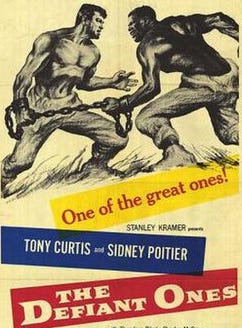
Now she’s stepped in it again. Where others fear to tread she’s curated two artists at the Venice Biennale, a Black artist and a White one, shackled by Theory like convicts in a ‘fifties feelgood movie:
And the angel is the Prada Foundation, who’ve lent Spector their umgepatsht palazzo on the Grand Canal:
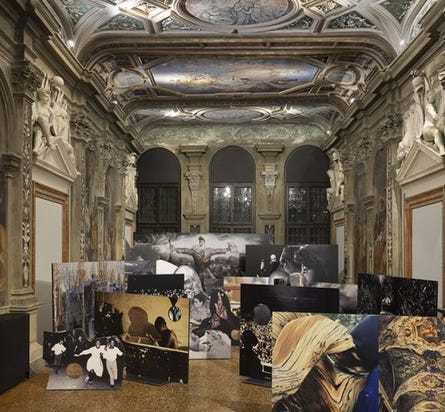
Richard Prince plays the white convict; Arthur Jafa has the Sydney Poitier part; Spector reprises her role as a “a tireless advocate for […] diversification,” to quote the Guggenheim’s severance statement.1 She’s stuck a Black artist and a white artist together because what’s Jean-Michel Basquiat without Andy Warhol? What’s Tonto without the Lone Ranger?
I can’t and I won’t vouch for Jafa, who was unknown to me, but Prince’s contribution is unconscionably racist in a way that cultured Europeans ignore because their own privilege rests on their unwillingness to recognize the divergent or convergent forms taken by racism on either continent. To recognize American racism in all its specificity would require them to recognize their own racism in all of its own. It took an American critic only a moment of reflection to figure out the allusion to the burned bodies of African Americans in the Prince sculptures that greet you in the courtyard:
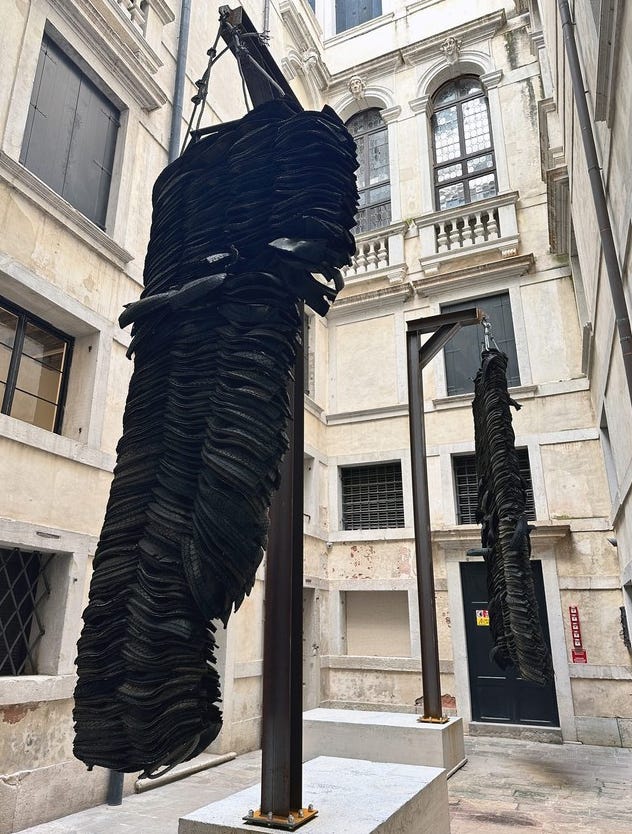
And you can’t get any worse, but it doesn’t get any better:

As this American critic put it, “the curator seems — almost perversely — unable to face (or at least name) the racial implications of her own curatorial conceit.”2
Freud would have agreed about the perversity: he wondered why people repeatedly made the same mistakes, as if enjoying their own humiliation. Perhaps the humiliation of others compensated for their own. Spector smuggles in her conceit with a number of buzzwords: “ethos of lawlessness;” “artistic piracy:” Gangsta Rap memes like those that white curators and white undergraduates love to apply to Jean-Michel Basquiat, the kind of thing that makes a Black curator see red.
But it’s Spector’s reference to Duchamp that’s our tip-off to the deeper roots of her perversion: Spector’s, Prince’s, and the institutions of Art:
“In his shift from making (having initially produced paintings in a Cubist mode) to taking (placing a commercially fabricated, inverted urinal in an exhibition framework), Duchamp modeled a kind of artistic piracy that constitutes the very DNA of […] Prince’s […] methodologies.”3
Find the misdirection. Duchamp’s creations are re-directions of use-value, sendups of the prevalent Kantian notion that the aesthetic value of a work of art (the use-value derived from its designation as a work of art) is a surplus entirely distinct from its exchange-value. With Prince, however, the distinction collapses, a fancypants way of saying that for Prince and peers a work of art exists for exchange-value alone.
Prince is a self-styled “appropriation artist,” meaning he borrows images from other artists and recycles them as his own with minimal inflection. The same qualities that make of any object a commodity (its aesthetic use-value in this particular case) are merely re-established as that particular “super-commodity” we call Art by virtue of the fact that they’ve been chosen, or discussed, or mildly modified by the artist, or the curator, or the critic. Talk of rope in a hangman’s house: it’s as if, instead of presenting their own interpretation of the meaning of a lynching—negative, I trust — the artist or curator had simply passed along an image of a lynching as a value-neutral observation.4 The value added to the art does not depend on its meaning, but on the fact that it’s been chosen.
The American judiciary saw through the game, and in January of 2024, after a decade-long lawsuit, they ruled against Prince in a suit for plagiarism. The courts did not buy Prince’s argument that his appropriation was a form of artistic expression; to the courts it was decidedly an economic move, and as such fell under the heading of “Effect of the Use,” meaning that Prince had not modified the original images, if ever so slightly, in order to make a point but to make a buck. Prince argued, obliquely, that this had been his intention all along—not to make a buck in itself, but to make the point that this is what artists do: make a buck by elevating a mundane image to the level of Gallery Art. “Appropriation artist” is cool-hand for “I steal, not because I’ve got something to say from a new configuration of elements (a bricolage, as Claude Lévi-Strauss would call it), but because the very process of piracy increases the financial worth of the object.” The value of a Prince has gone up considerably since he lost his case, or so I’m told: the use value of a Prince, to the Market, is that it justifies exploitation as an aesthetic. Tellingly, the image that brought Prince down (at least before the Court), is an image of a Rasta man smoking a spliff: Art pirates yes they rob I…
You could think of Spector as an appropriation curator. She and Prince have these things in common: they both got caught, and they got caught for doing the same thing. When you read LaBouvier’s own description of her experience at the Guggenheim the same type of behavior comes up again and again.
“There were signs throughout the show that Nancy Spector was trying to co-opt my work.”
“Loan letters asking for works did not properly present that the scholarship was my work or it was presented as if we discovered the scholarship together.”
“I was met w/constant retaliation for essentially refusing to give up ownership of my work. In a mtg when I said that I did not want to publicly release certain interview tapes, Spector said, ‘this is a work for hire’, forgetting I owned my copyright.”
“When I asked to speak to [the Director at the Guggenheim] he ferreted me off to HR.”5
Not a word about name-calling or cultural insensitivity, it’s all business as usual. As a former employee at the Guggenheim I understand: systemic forms of discrimination and bias are treated as mere organizational problems, which they are. As a former classmate of Spector’s I sympathize:
“...Nancy constantly attempting to erase me from my work and punish me for not handing over my work & agency.”
“Handing over my work.” That’s what graduate students do, on time. When I first applied to work at the Guggenheim, as a researcher, I was interviewed by Spector, who reminded me that we had met while studying with Rosalind Krauss at CUNY; and since I’d disagreed with Ros I couldn’t possibly want the job. At the time I believed that Spector meant to say I wasn’t aligned with Rosalind’s way of thinking, and thought no more about it. Now I understand what Spector meant. She meant I was an independent thinker. I wanted agency for myself. In the parlance: I was uppity.
No regrets, just apologies that it fell once more to a Person of Color to bring to light this side of Nancy, and of many in the art world. People like Nancy—I’ve known quite a few — don’t actively hate Black people, it’s just that they’ve been taught that Black people are easier to exploit, and when the exploiting gets harder the hate gets unleashed. The Supreme Court would argue that whatever LaBouvier confronted could not possibly have been racism since, for a determination of racism, the intentions must be racist, exclusive of all else.6 By the same token, Spector and Prince’s insistent recycling of racist tropes couldn’t possibly be racist because they’re in it for the art; meaning, for the money and the power indissolubly associated with art. Capital looks after its own.
On February 4, 1930, in Paris, the critic Walter Benjamin recorded in his diaries a conversation with the publisher Adrienne Monnier. Benjamin had confessed his own sense that something was lost when a work of art was mechanically reproduced: appropriated for social use. Monnier had responded that all reproduction involved a necessary reduction to the social sphere.7 Benjamin would eventually conclude that the process of mechanical reproduction shifted the locus of authority ( „die Autorität der Sache“) from the artwork itself to the process of its reproduction.8 A work of art could no longer be defined as an object independently produced by a solitary mind, it came to be defined by the process itself and those social forces that dominated that process, to the point of excluding the “concept of a magical aura of the ‘autonomous work of art,’ […] the magical element of bourgeois art.” [ „den Begriff der magischen Aura auf das »autonome Kunstwerk« […] des magischen Elements am bürgerlichen Kunstwerk“.9 Benjamin may have learned a thing or two from his friend Gisèle Freund, whose doctoral dissertation (published by Monnier) argued that photography had not become an art-form until nineteenth-century gallerists had decided to make it so through the process of reproducing copies of museum masterpieces, much as Prince argued before the courts that his own reproductions of commercially available art elevated them to the realm of Real Art.10
But the full implications of Benjamin’s argument did not come to the fore until addressed by his colleague Theodor Adorno in a letter of March 18, 1936. Benjamin and Adorno shared as common mental horizon in German Romantic philosophy, in particular the concept of the autonomy of art as both an epistemological and a moral endeavor. Art was the product of the Beautiful Soul at odds with its own time; the disconnect originated in the artist’s ability to see the World in a divergent way. For Adorno, the morality of Art consisted in the resistance of its formal content to the world as it was, its refusal to mitmachen, to get along with the powers-that-be, its insistence on preserving the aesthetic experience in the face of its social appropriation:
“Even in the most sublimated work of art there hides It should be otherwise. […] Yet this instance of will is conveyed by nothing other than the form of the work itself.”
„Noch im sublimiertesten Kunstwerk birgt sich ein Es soll anders sein. […] Vermittelt aber ist das Moment des Wollens durch nichts anderes als durch die Gestalt des Werkes…“11
By means of its depth — its dialectical complexity — Art offered resistance to the here-and-now. By surrendering to the demands of Society, by abolishing the unassimilable perceptual immediacy of genuine works of art, the system of the arts abdicated its ethical responsibilities. I’ve lost count of the times this question of moral abdication comes up in conversations among artists, and between artists and their handlers nowadays. Adorno certainly found Benjamin’s suggestion disturbing —disturbing enough that he sank Benjamin’s chances for getting his article on mechanical reproduction published.
By allowing artworks to fall in line with the need of capital alone, the machinations of a Prince or a Spector lead to the elimination of that which makes art worthwhile politically and ethically, and I know this will be hard to grasp for many of my former art students, for whom the very idea of resistance to the here-and-now comes across as a form of career suicide. For the authority of the object, Prince and Spector and so many others substitute the authority of the hustler. It’s all about the Benjamins.
WOID XXV-27f
June 29, 2026
Aruna D’Souza, “’Helter Skelter’ Can’t look America in the Eye,” Hyperallergic (June 16, 2026); https://hyperallergic.com/helter-skelter-cant-look-america-in-the-eye/ ; accessed June 23, 2026.
“Curator Nancy Spector Departs Guggenheim as Investigation into Basquiat Show Ends,” Artforum (October 8, 2020); https://www.artforum.com/news/curator-nancy-spector-departs-guggenheim-as-investigation-into-basquiat-show-ends-248623/ ; accessed June 23, 2026.
Nancy Spector, quoted in “Helter Skelter. Arthur Jaffa and Richard Prince.” Press Release, Fondazione Prada; https://www.fondazioneprada.org/project/helter-skelter-arthur-jafa-richard-prince/?lang=en ; accessed June 27, 2026.
Olivia Zinzi, “Appropriation or Art? Court Orders Richard Prince to Pay Damages in Highly Anticipated Copyright Lawsuit,” Center for Art Law (February 28, 2024); https://itsartlaw.org/art-law/appropriation-or-art-court-orders-richard-prince-to-pay-damages-in-highly-anticipated-copyright-lawsuit/ ; accessed June 26, 2026
No Quarter Will Be Given [Chaédria LaBouvier], Twitter, June 3, 2020 https://x.com/chaedria/status/1268381115338948608 ; accessed June 27, 2026.
Supreme Court of the United States, Mullin v. Doe consolidated with Trump v. Miot (25-1084); https://www.scotusblog.com/cases/noem-v-doe-3/ ; accessed June 28, 2026.
Jean-Maurice Monnoyer, « Notice », Walter Benjamin, « L’'Œuvre d’art à l’époque de sa reproduction mécanisée », Écrits Français, introduction et notices de Jean-Maurice Monnoyer avec les témoignages d’Adrienne Monnier. de Gisèle Freund et de Jean Selz (Paris: Gallimard, 1991), p. 149.
Walter Benjamin, „Das Kunstwerk im Zeitalter seiner technischen Reproduzierbarkeit.“ Dritte Fassung. Gesammelte Schriften II.2 herausgegeben von Rolf Tiedemann und Hermann Schweppenhäuser (Suhrkamp, 1991), p. 477.
Theodor Adorno an Walter Benjamin, 18 Marz 1936 in Walter Benjamin, Gesammelte Schriften II.3, p. 1002.
Jean-Maurice Monnoyer, « Notice », p. 153.
Theodor W. Adorno, „Engagement.“ Gesammelte Schriften, herausgegeben von Rolf Tiedemann, Band II (Suhrkamp, 2003), p. 429.
Comments
Nothing yet. Say the first thing.
Sign in to join the conversation.