
If you’re coming from the Ponte degli Scalzi or Riva de Biasio take the Fondamenta del Rio Marin o Garzotti (o Garzoti, depende), then cross the Rio Marin at the Ponte de Christo and turn right onto Calle de l'Ogio o del Cafetier, which you follow until it turns into Calle del Magazin. The Campiello will be on your right:
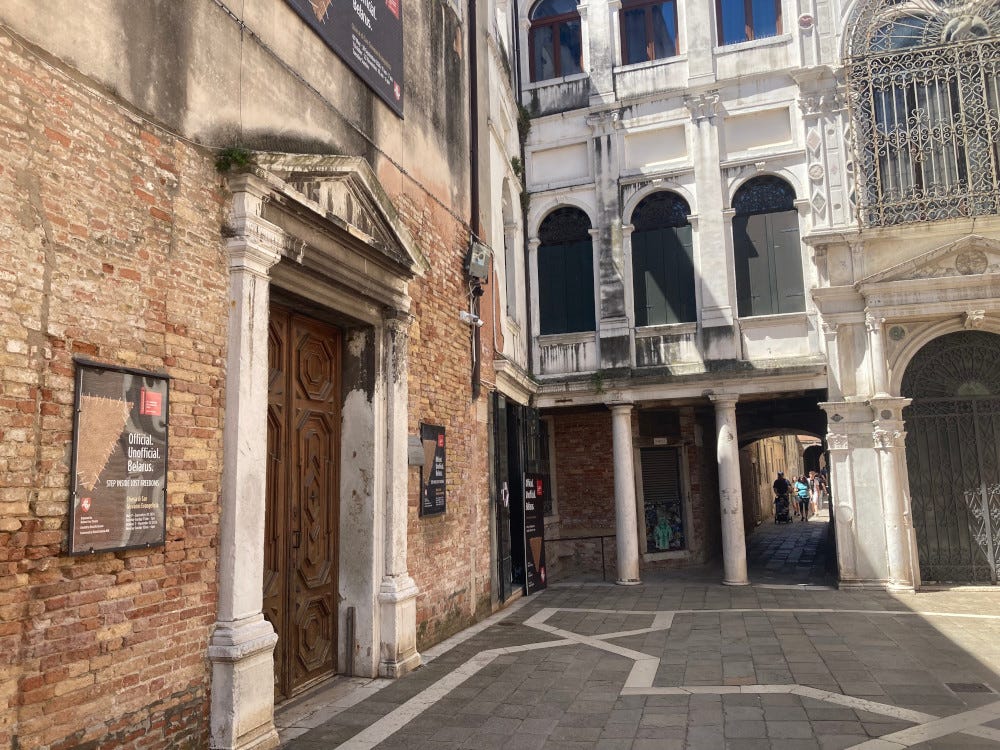
In theory, the Venice Biennale unfolds into November. In practice, a lot of it will have happened by the time you get there, no matter when you get there. Having happened before already is not, as some may fear, a reflection on their own marginalization, it’s a feature of the system of the arts, which is designed to create and enforce marginalization — a guy named Bourdieu had a lot to say about that. Besides, the Venetians practically invented marginalization—where do you think the word “Ghetto” comes from?
I’m thinking of the various events around the very beginning of the Biennale, in May: the lectures and the openings which are designed in one way or another, not to be happening but to have happened, to survive as buzz and reputation and a pamphlet in the bookstore, so badly printed on occasion that it’s illegible as well unreadable.
Also, I’m thinking of Performance Art, where an artist is shown to have taken over a space long after the artist’s left, leaving a bored under-35 to staff the space for the duration of the show, jetsam on the shores of Culture. The immediacy of experience that’s supposedly the fount of Modernism is immediate only to those inside the loop and those, far more numerous, who fantasize that their own affection for immediacy will put them there.
Not me. My life has been haunted by this sense that my experience is anything but immediate, a sense of being backstage at the theater: waiting in the wings before rehearsals; hanging stage lights in the early morning hours in an empty theater far West of Broadway; standing on a hundred-year-old stage of an empty theater in Ilheus, Brazil; standing to the left of Daniel Cohn-Bendit on the apron of the Odéon. It’s the tremulous mixture of fear and hope, the instability that comes of not knowing if the performance has long ended, or if it’s about to begin. Adorno understood this, though it ran against his crippling pessimism:
“Thoughtful people — artists as well — have not infrequently pointed toward a feeling of being partly there, of not playing along; as if they were not themselves at all, but rather a kind of spectator. [...] The inhuman aspect of this — the ability to distance oneself and rise above things by looking on — is, in the end, the Humane itself.”
„Reflektierte Menschen, und Künstler, haben nicht selten ein Gefühl des nicht ganz Dabeiseins, nicht Mitspielens aufgezeichnet; als ob sie gar nicht sie selber wären, sondern eine Art Zuschauer. [...] Das Unmenschliche daran, die Fähigkeit, im Zuschauen sich zu distanzieren und zu erheben, ist am Ende eben das Humane…“1
This follows on the passage about the loss of aesthetic options after Auschwitz. A few years back a critic wrote of the imaginary spaces of a new cultural tendency, as he saw it: Liminalism, “a type of emotional space that conveys a sense of nostalgia, lostness, and uncertainty..... spaces of transition - of becoming instead of being.” Sounds awfully good to me.2
The Shadows in Exile is staged in that sense of the word. The participants and organizers are associated with the Belarus Free Theatre, a troupe that’s been banned in Belorus and that’s been staging political interventions throughout Europe over the past quarter-century. The curators are at once the organizers and the performers.
Some effects that were intended may have been disappeared by the time I visited the show in Venice — the smell of incense, for instance, or perhaps I wasn’t paying attention. I was focused on the architectural setting, in a dark and undefined and very old religious space in which various objects have been placed to rhyme with the buildings’ original functions:
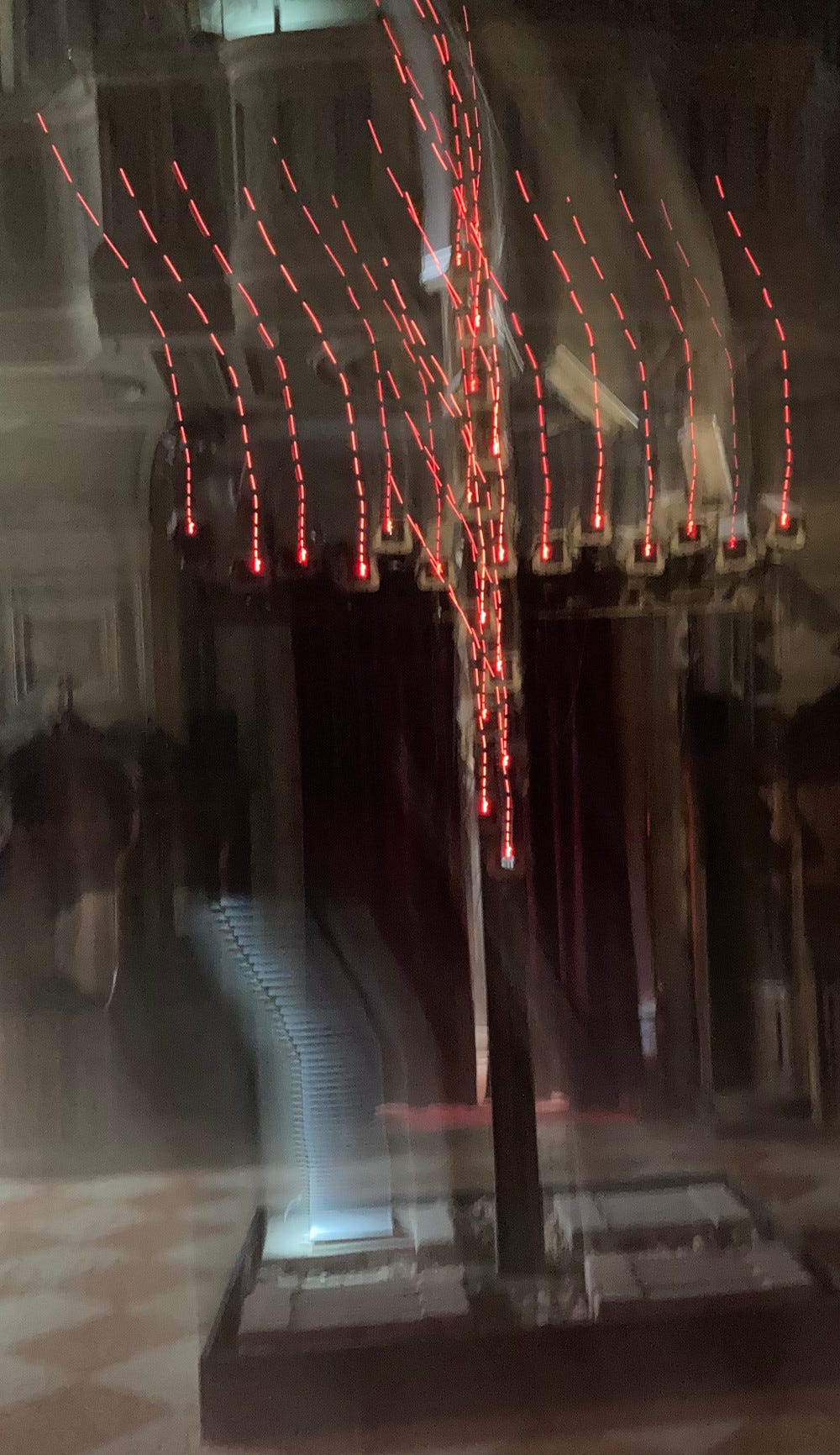
The original space wasn’t designed as a church, so far as I can tell. It was the meeting place for a lay brotherhood, starting in the thirteenth century, whose original mission was Salvation through Flagellation. The ceremonies have changed, the routines persist:
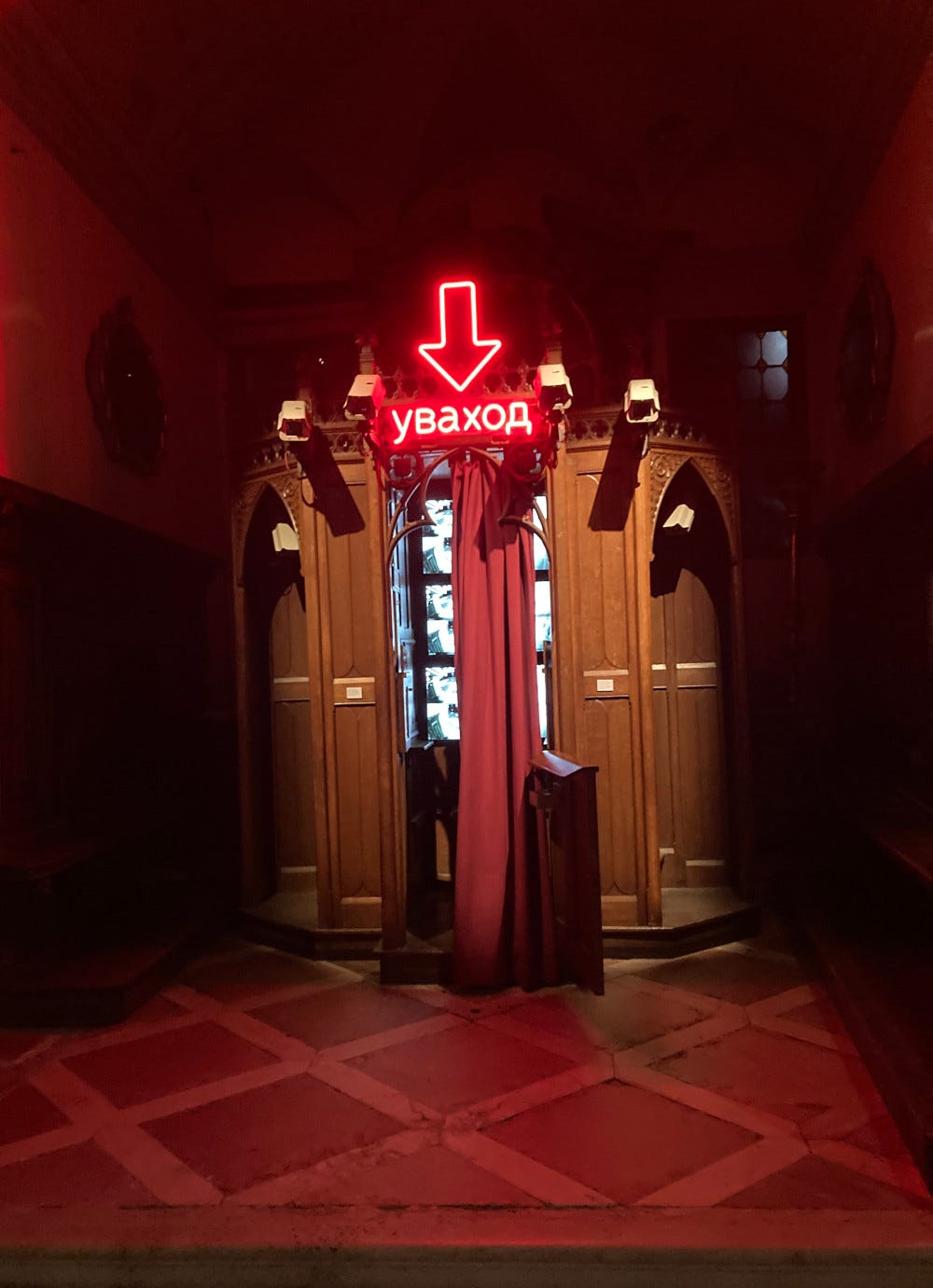
For those who don’t know, the most stultifying part of an interrogation is the routine. Not so much interrogations as the wait time before and after interrogations, the wait between the dredgings of our memory:
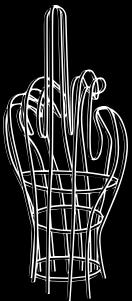
Vladimir Tsesler, Straw Spiders, 2026.
But it’s in the refusal to let go of memory, the insistence on making memory voluntary, that hope still lies:
Semyon Skrepetsky is dead. That’s his artist name, his real name was Robert Kuzovkov. On June 12, Skrepetsky marched in Berlin in a protest against Russian tyranny:
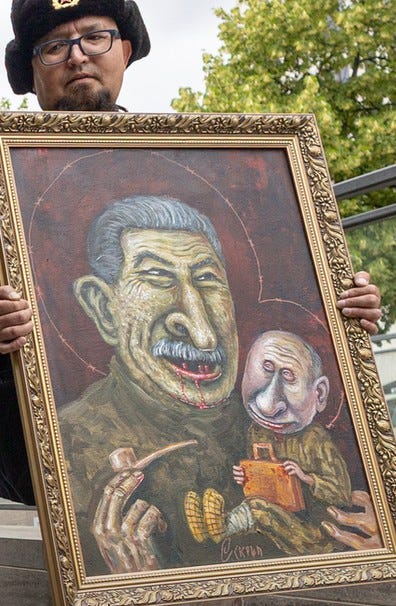
Three days later, in a small Polish town some twenty-odd miles from Belorus, Krepetsky was shot and killed by an assassin. Possibly two.
My job as art critic is to draw out the stylistic consistencies between Krepetsky’s work and the work of the Belorus Free Theater. The efficacy of Skrepetsky’s art, as measured, unfortunately, by the fact that it got him killed, does not rest on his use of an image of Stalin, but rather on the visual and cultural reference to the Hodegetria, the Russian tradition of representing the Virgin pointing, with her fingers, to the True One:

There can be no doubt as to which gave offense, the reference to Stalin, or the reference to the Mother of God. Likewise, with the Free Theatre, all power lies in the relationship of the elements to their historical setting. In either case, that of the Free Theater or of Semyon Skrepetsky, the work addresses head-on the constraints on its own reproduction, and those constraints are infinite, and those are the constraints we need to acknowledge, and to confront.
There is no white cube. I mean, sure there is, but why bother?
WOID XXV-27e
June 20, 2026
Theodor Adorno, Negative Dialektik (Frankfurt am Main: Suhrkamp, 1966), p. 353.
Karl Emil Koch, “Architecture: The Cult Following Of Liminal Space,” Musée. Vanguard of Photography Culture (November 2, 2020) https://museemagazine.com/features/2020/11/1/the-cult-following-of-liminal-space ; accessed June 20, 2026.
Comments
Nothing yet. Say the first thing.
Sign in to join the conversation.