
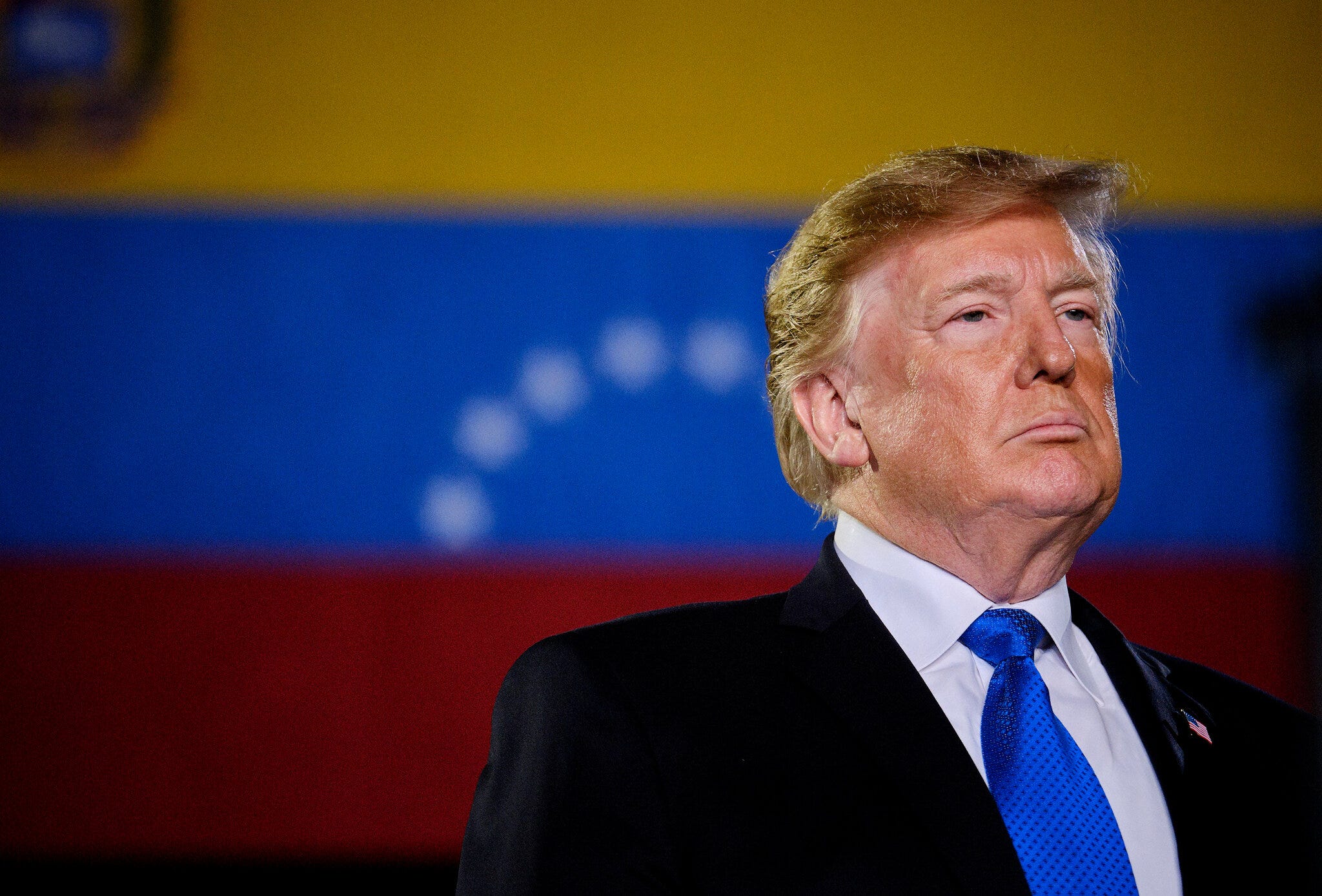
Tensions between the United States and Venezuela have been rising for years. Since President Trump’s first term and Washington’s recognition of Juan Guaidó, Nicolás Maduro has been treated as a personal and geopolitical adversary. More recently, U.S. forces have reportedly targeted suspected drug-trafficking boats at sea, and some officials have floated the idea of strikes on land, steps that could edge both countries toward open conflict.
There are plenty of reasons to condemn Maduro and Venezuela’s authoritarian socialism. Following the most recent contested election, the ruling party appears positioned to extend its hold on power beyond three decades. The country’s condition has driven an estimated 7.7 million people to leave, one of the largest displacement crises in the world, driven mostly by economic freefall, a billion percent inflation, and the shock of the COVID years.
On security, U.S. officials and analysts have long alleged links between elements of the Venezuelan state and transnational criminal networks, including the Cartel de los Soles and Tren de Aragua. Maduro and several high-ranking officials of the Venezuelan government are on most-wanted lists and indicted by courts in different American states for drug trafficking. DEA estimates suggest hundreds of metric tons of cocaine transit toward the United States annually, alongside smaller flows of fentanyl and heroin.
Taken together, these points might sound like a case for regime change. But there are stronger reasons not to start a war.
First of all, the only way for the United States to reach Venezuela would be an amphibious operation through the Caribbean, akin to what China would face with Taiwan: difficult at best, prohibitively expensive at worst. The Amazon blocks a southern approach, and the western route runs through Colombia, whose current government is friendly to Maduro.
After logistics, removing Maduro would be the easy part. Despite a welfare-dependent base that still backs him, many Venezuelans resent the regime, and most know at least someone who has fled in recent years. The army is small, poorly funded, and could well turn against Maduro if offered a better deal. A decapitation strike might take weeks and even draw cheers. However, the real danger comes after. Maduro’s administration overlaps with violent cartel networks. Like ISIS, these groups revel in sadism, broadcasting beheadings and executions. The Sicario films hint at how organized and ruthless these groups can be, and some even argue that these groups are worse than the terrorists in the Middle East. Mexican and Colombian investigations have documented acid vats used to dissolve victims as a common practice, Black Hawks being taken down, and there are even credible reports of small concentration camps in cartel territory.
A possible outcome would be a civil war reminiscent of Colombia’s conflict with the FARC and the cartels in the 1980s, brutal fighting that claimed thousands of civilian lives in both rural and urban areas. If cartels perceive U.S. intervention as an existential threat, they would likely fall back into the Amazon and wage a guerrilla campaign from terrain they know intimately: a Vietnam 2.0. Layer onto that the fact that any U.S. campaign would hinge on an amphibious operation, and the military challenge becomes even more daunting. A war in the jungle would also inflict irreparable environmental damage, fires, poisoned watersheds, and long-term ecological loss that outlasts any government.
Worse, the conflict wouldn’t stay contained. Venezuelan cartels are interlinked with other criminal and paramilitary groups, including networks in Colombia and Brazil with Amazon experience. That web could pull multiple actors into the fight and even inject a sectarian edge, with Brazilian evangelical cartels being known for killing catholics and closing down churches. Even Hezbollah could join: U.S. assessments describe Hezbollah-linked finance and logistics networks in Venezuela, including ties to officials in the Maduro government, connected to arms trafficking and money laundering. Most dangerous of all, Colombia, unlike Venezuela, a country of roughly 50 million with a large, capable military, could be drawn in if its citizens are killed, even if they are paramilitaries. Given Bogotá’s current leadership, which is openly anti-intervention and sympathetic to Caracas, the political fuse is already lit. One misstep could trigger the biggest war in a Latin American country since the Mexican-American War of 1846.
Moreover, with the 2026 World Cup set to be hosted across the United States, Mexico, and Canada, cartels could see mass fan gatherings as soft targets and attempt terror-style attacks on American citizens.
Because the cartels would fight as an insurgency, the war becomes a contest of endurance. By guerrilla logic, they “win” by not losing; unless every network is dismantled, they regenerate. That sets an impossible standard: the United States would have to find and neutralize dispersed cells across the Amazon, an objective as impractical as Israel’s challenge in Gaza, where even large operations haven’t produced a clean end state. Inevitably, the conflict would require peace, and even if most of the cartels were dismantled, the mere survival of remnants would be taken as proof that America “lost.”
Despite Venezuela’s refugee crisis, its demographic slide is still reversible. An American intervention could tip it the other way: more people would flee, more would die, and the damage could hollow the country out. With birth rates already below replacement, a deeper economic and humanitarian shock would accelerate depopulation. Venezuela’s economy is among the world’s most fragile; even small disruptions trigger chaos. If people struggled with malnutrition under Maduro, a war could bring Yemen- or Sudan-level hunger to some regions. Another bout of runaway inflation could finish off what’s left of the currency, leaving the people dependent on U.S. aid and trapping Washington in an Afghanistan-style quagmire, impossible to exit cleanly but unbearable to sustain.
So, even if there are reasons for “the good guys” to intervene and help Venezuelans against “the bad guy” Maduro, government good intentions often create the worst outcomes. Even in the best-case scenario, if Maduro is toppled, the cartels don’t vanish, and a new right-wing government could still preside over thriving drug routes to the United States. That’s why America should not launch another foreign war: the odds of getting dragged into yet another quagmire are simply too high, and the benefits too little.
No posts
Comments
Nothing yet. Say the first thing.
Sign in to join the conversation.