
While we wait for the imminent deal, this would be announcement number 38 by now, something else has captured the narrative over the last few days, something we discussed a few weeks ago as little more than rumors and which has now been confirmed. The Strait is leaking, and this is the real reason why prices feel so heavy. Even more interesting, and perhaps the first warning sign, were the spreads in Dubai and the physical premium, which has already fallen to its lowest level since the conflict began.
The news exploded this week, but this is far from being a one week event. These crossings under the warm cover of darkness have been taking place since early May, with ADNOC being the first to experiment with these shuttle operations using the recently acquired Sinokor vessels. At the time it was just market gossip. Iraq followed by launching a tender with discounts attractive enough to lure some questionable characters from the world of oil trading, but those ships, at least five VLCCs, entered and exited without major incidents. Kuwait loading cargoes was another market rumor, never fully confirmed because everything was handled through dark channels.
This week all of that was finally confirmed when ADNOC (UAE) and KPC (Kuwait) officially launched tenders to sell crude from the Gulf of Oman.
Iran knows what is happening in those waters. I know it, you know it, everyone knows it. But as long as they can maintain the narrative that they control the Strait, they can look the other way. It worked for everyone. The fact that they now have to openly market these “secret” barrels may actually reveal something more important, they cannot sell them through new “traditional” channels, state to state, because the major buyers, India, Korea and Japan, are already fully covered for the next few months.
We know about ADNOC’s 14Mb, KPC’s 8Mb and SOMO’s Iraqi offer. All of that has already been sold. It is no longer a problem price-wise.
But how much oil is actually getting out?
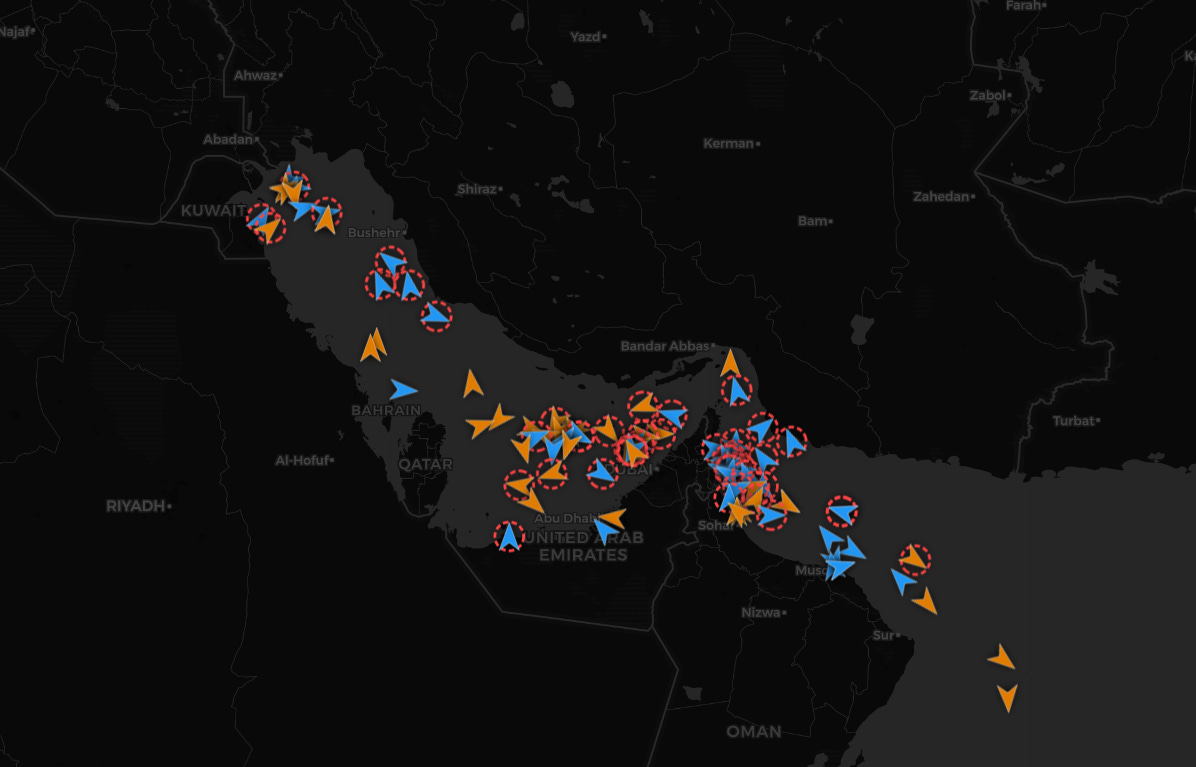
I ran a sweep of raw AIS data covering every VLCC in the Persian Gulf and Gulf of Oman, not to understand what we can see, but what we cannot see. More than half of all VLCCs are operating in dark mode, with over half having their transponders switched off for more than 24 hours, including Iranian vessels.
To identify the ships that are actually moving cargoes, I focused on vessels that disappeared less than ten days ago. They are probably no longer sitting where we last saw them and are likely the same vessels being used as shuttles, popping up on one side and then the other.
Looking at the data by operator makes the pattern even clearer, with distinct clusters emerging. In the ship tracker I built, if an operator is not classified as “Others”, it means those ships have either been operating in the area for over 100 days, effectively trapped, or if they show a large number of AIS-off days, they managed to escape.
Under those assumptions there are at least ten vessels directly linked to this trade. That does not mean ten VLCCs are loading and discharging every day, or 20Mnbpd. These ships cross at night, so immediately you cut operational capacity in half. Even then, there are delays once they reach the other side, waiting for the receiving vessel, which is often two Suezmaxes bound for India.
Being optimistic, each vessel can probably complete one dark transit per week.
2,000,000 ÷ 7 = 285kbd.
Multiply that by 10 VLCCs and you arrive at roughly 2.8Mnbpd, remarkably close to what many in the industry have been speculating (3Mnbpd)
That is what is happening inside the Gulf. Outside the Gulf we have slightly more visibility, only slightly, but by simply tracking reported fixtures we can see that the volume lifting cargoes around Fujairah and Oman is significantly greater than what should be available through terminals and pipelines alone.
The UAE is bypassing the Strait through the ADCOP pipeline from Abu Dhabi, with a maximum capacity of 1.5Mnbpd. Then there is Omani production exported through Mina and Sohar, estimated at less than 900kbd.
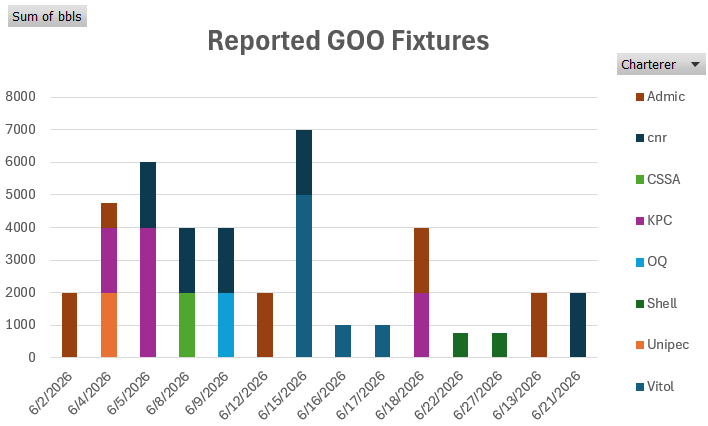
Looking at fixtures reported since early June, and only those that are actually reported, there are days reaching as much as 7Mnbpd, equivalent to three VLCCs and one Suezmax. On average we are running around 4.5Mnbpd for the coming days.
I want to emphasize the word reported.
Roughly 80% of Middle Eastern fixtures, and increasingly elsewhere in the world as well, are now being concluded off market, directly between shipowner and charterer without a shipbroker involved. The result is less transparency, less market depth and less information. We only discover these deals when ships mysteriously disappear from candidate lists or are already loading through STS operations.
A perfect example is the Kuwait program, shown in purple on the chart. The four tender vessels are right there. Some had already loaded before anyone reported them, and the market only found out on Wednesday.
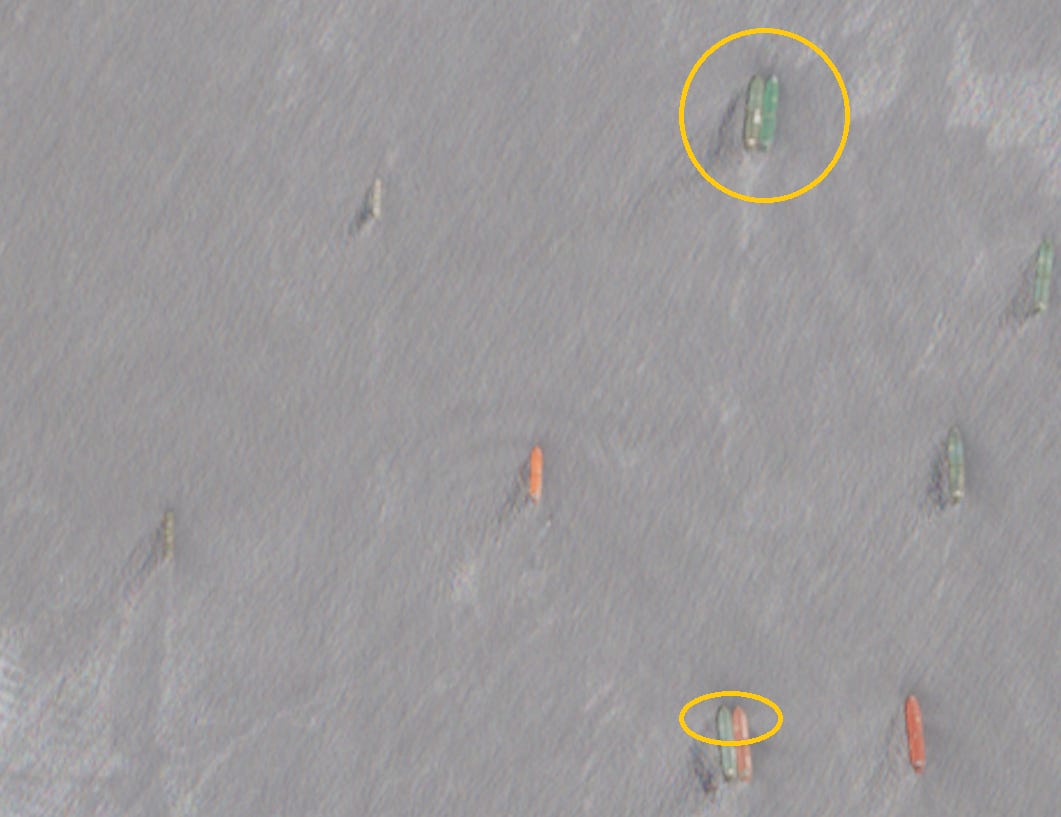
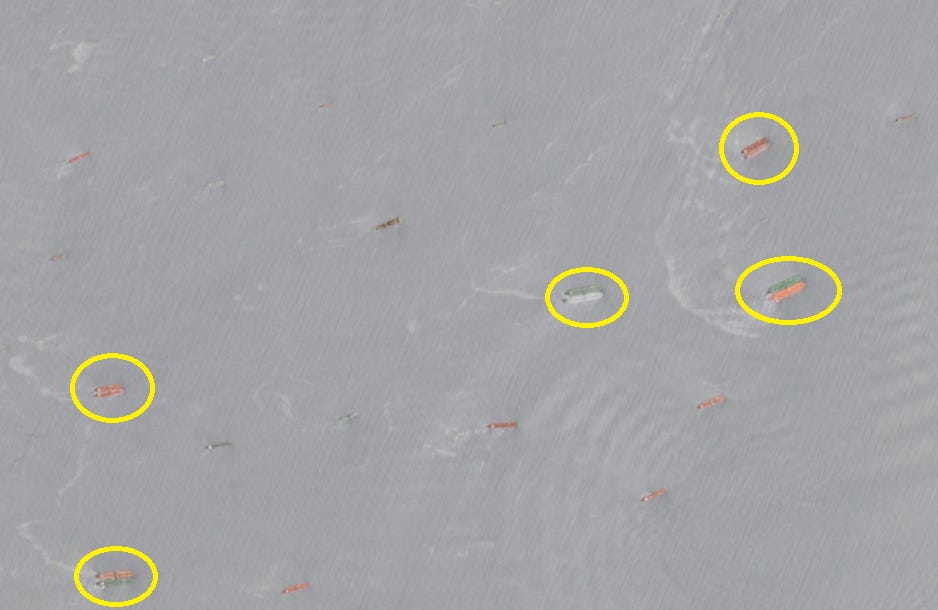
Where visibility improves is through satellite imagery. Using Copernicus SAR imagery, I performed a sweep across the Gulf of Oman on June 11, from Fujairah to Sohar, and found a quite few surprises.
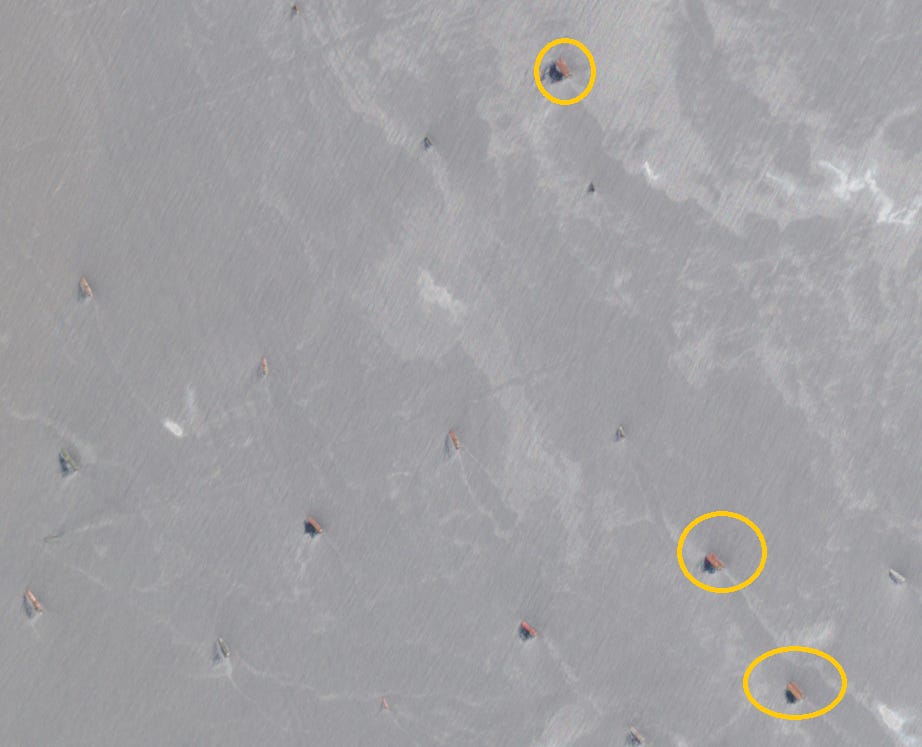
Around the Shinas and Sohar area I identified at least six STS operations, suggesting volumes may be even larger than currently estimated.
The math is not linear, six STS operations do not automatically mean 12Mnbpd, but it is clearly more than what is being reported. We could very well be approaching an additional 3Mnbpd, before even accounting for the barrels that escaped over the past few weeks and never showed up in public data.
Why conduct STS operations in Oman?
It is not a security issue. Iran has already demonstrated that it can reach targets in that area if it wants to. This is primarily a commercial decision. Buyers are using Oman futures as their pricing reference because delivery is specified in that range. It is no coincidence that trading volumes in Oman are hitting record highs while the Dubai benchmark is essentially dead. Barrels follow liquidity too.
The impact of these barrels has been felt for weeks and this is simply the confirmation. At the same time, it changes expectations regarding a full reopening of the Strait of Hormuz.
The original assumption was that all those trapped barrels would flood the spot market at once, crushing physical premiums and potentially pushing futures into contango.
There are no longer 100Mb trapped. The number is considerably less than half of that.
Production was expected to take months to recover to pre-conflict levels. Yet evidence is already emerging that output is increasing again, ignore the OPEC survey. Ras Tanura, Ruwais and Al Zour are already producing and exporting products. Granted, they are operating at roughly 60% of capacity, but they are running.
This is probably the beginning of a transition toward normalization, risk perception is clearly changing and incentives for GCC producers are changing with it. The posture is no longer defensive but increasingly aggressive, foreshadowing what may be coming next among exporters: if China does not react its a race to the bottom, better be first.
Comments
Nothing yet. Say the first thing.
Sign in to join the conversation.