
Here’s what I remember from the twins’ first year in their bedroom, and it isn’t the paint colour or the mobile I agonised over. It’s the bed. A bed that wasn’t even mine. Borrowed from my sister, dragged over from my mother’s house, from her old teenage room. Thank God I borrowed it, because I spent so many nights in there that I stopped counting.
I have this memory of lying in it, looking out of the window, watching the trees move slowly in the wind, so tired, with these two tiny creatures asleep on top of me, that I felt like I was watching myself in a movie. Any mother of twins will know exactly what I mean. I’d lay completely still, trying to rest, praying my then 2 y.o. wouldn’t wake up in the next room and wander in.
That borrowed bed saved my sleep, my sanity, probably my marriage.
And here’s the thing. That bed was not part of any plan. I didn’t research it. Nobody told me to get it. I borrowed it out of necessity and it turned out to be the single most useful thing in that room. More than the nursing armchair, more than the changing table, more than anything the articles told me I absolutely had to buy.

So a bit about me, because it matters for what comes next. I’m an architect with three children born in the space of twenty months (I’ll wait while you do the maths). I have set up and torn down and reorganised their bedroom more times than I’d care to admit in public. I’ve watched my friends do exactly the same. I’ve watched my nieces and nephews, some of them amost teenagers now, move through every phase I haven’t reached yet with my own lot. And being an architect, I couldn’t help reading the research on how children actually use space, which turns out to often be wildly different from what most of the advice assumes.
After all of that, here's what I think. An enormous amount of what gets written about children’s bedrooms is designed for a photograph. Gorgeous at ten in the morning in that soft natural light. A complete nightmare to live in at two in the morning. Most nurseries you find online were not set up by anyone who’d spent months awake in one. The reading corners and the play zones and the little study nooks are describing a version of childhood that simply does not match how real children behave.
What I want to tell you here is different. It comes from five years of getting this wrong and then slowly, getting it slightly less wrong. From watching enough children grow up to know which bits of the advice you can ignore. And from a borrowed bed that nobody, anywhere, told me to get.
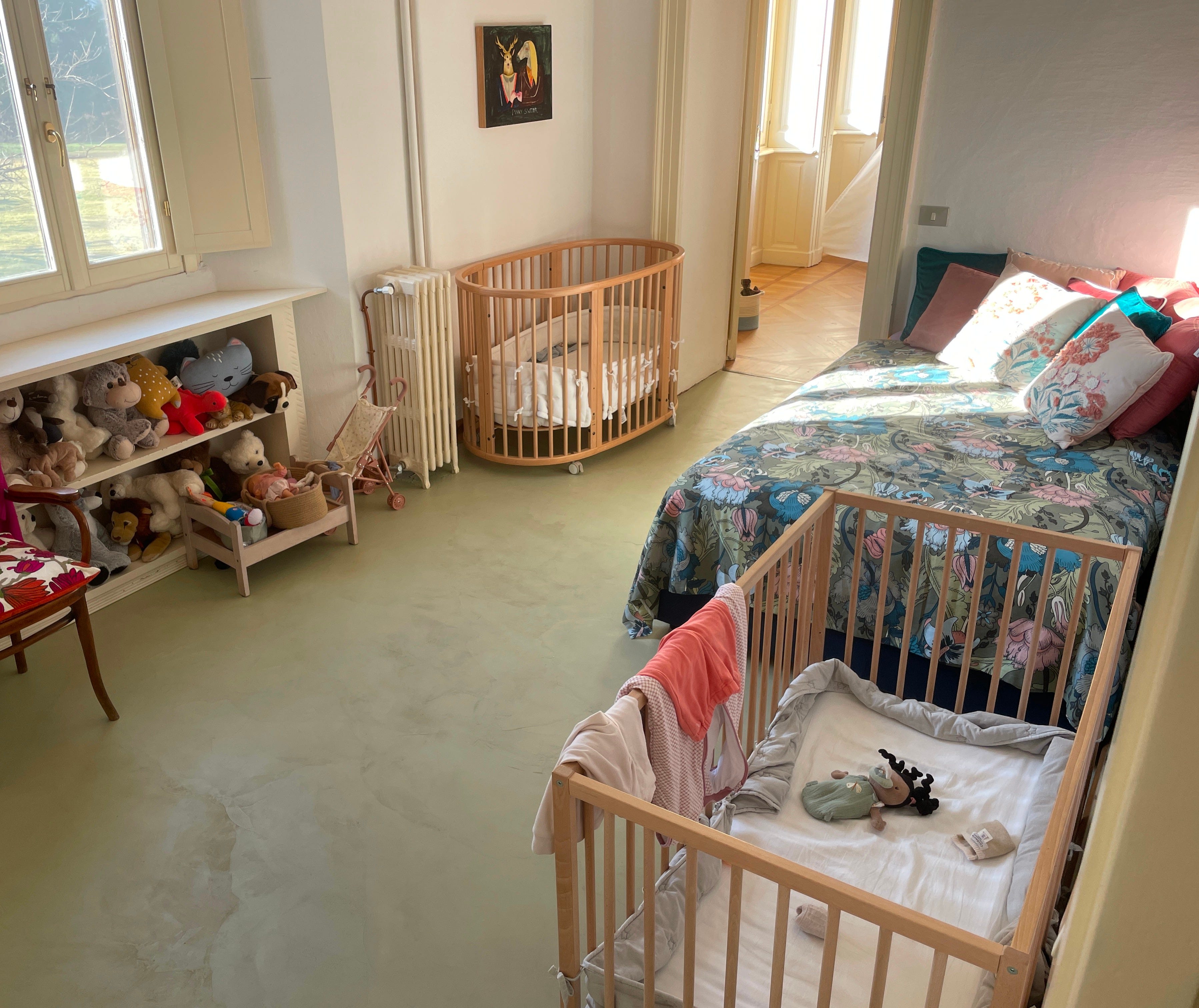
A children’s room changes more than almost any other room in the house. The newborn becomes a toddler, the toddler starts school, the child closes the door and becomes a person. Play keeps changing. Homework arrives. Friends start coming over. Almost everything in that room is temporary, simply waiting for the next version of the child.
None of that means the phases don’t matter. They all do. And I’m not arguing for sterile boxes that only function. Color it, wallpaper it, decorate it, make it as cozy and fun as you like. I do the same in my own home. All I’m saying is that none of that should come before the practical, smart functionality, or worse, at the expense of it.

Nobody tells you this, so I will. Until a child is two, maybe three, the room belongs to you. Not to them. You.
The baby does not experience the nursery. They do not notice the wall colour, the mobile, the crib you spent ages choosing. What they need is warmth, your smell, the sound of you. Everything else in that room is for you.
So treat it like what it actually is: a design brief.
The nursery is a room where an exhausted adult looks after a very small person, mostly in the dark, mostly on no sleep. So can you move through it at three in the morning without cracking your shin on something? Is the dresser at the right height, so your back does not hurt after every single nappy change? And is there somewhere for you to actually sleep for the nights when the baby is ill and your partner has to be a functioning human the next day?
Design the nursery for the person doing the work in it, not the baby.
That’s what the borrowed bed gave me. You cannot sleep in a nursing armchair, and there will be nights you need to sleep in that room. A daybed gives you that. Somewhere to feed lying down, somewhere to close your eyes for an hour while they sleep on your chest. And when that phase is finally over, it slides off to your study or your living room and sits there looking like it’s always belonged. The spot it was standing in is very probably exactly where the child’s proper bed will go in a few years anyway.
Same logic for the changing table. It does one job and then it’s done, usually by eighteen months. A tall dresser with a waterproof mat on top does precisely the same work, and then it’s just a dresser. For the next twenty years.
And one thing the manuals rarely put near the top of the list: sort out the dark. Proper blackout at the window, shutters or lined curtains, is worth more than almost anything else you'll buy for that room. A nursery you can black out for a nap at four in the afternoon buys you sleep, theirs and yours, which is the whole currency of this phase. Everything past that is optional.

Read enough about setting up a child’s room and sooner or later someone will start talking about zoning. A play area here, a reading corner there, a little study nook by the window.
When a child is one, the play mat is in front of your sofa. The toys are in the kitchen. The books are wherever you are, because they want to be wherever you are, always. You are not living your life in their bedroom, and neither are they, except to sleep.
The bedroom is not where childhood happens.
None of this means toys should take over the house. I don't want that either. The point is that the play system should be flexible, not the room. Young children play where the family is. A basket, a mat, something easy to carry from room to room works far better than dedicating permanent floor space to a play corner that sits empty most of the day. The point is that the play system should be flexible, not the room.
Give the toys one easy home wherever you want: low, open, reachable, the sort of storage a small person can reach without calling for you. Then make it easy for them to carry out whatever they want and set up wherever the family is, because that is exactly what they do. When they’re tiny it’s a mat unrolled on any floor. By three it’s a box of magnet tiles or Duplo hauled through to the kitchen. Toys change, but the habit stays the same: they play where you are, not where a floor plan tells them to.
The room stores the toys. It doesn’t stage the play.
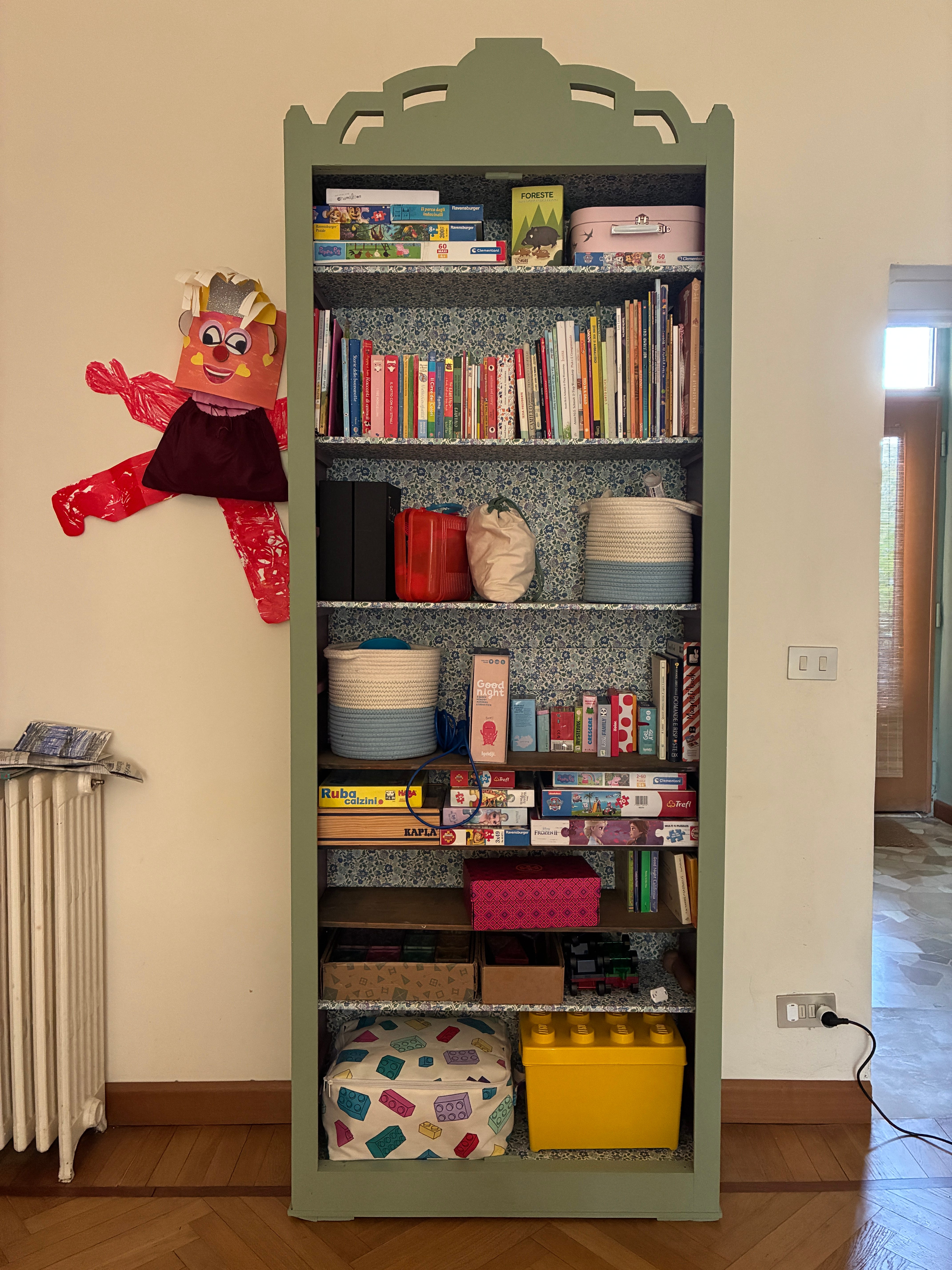

The moment children start school, everyone assumes it’s time for a desk.
At six, a desk is a surface where water bottles, hair clips and small unidentifiable objects go to gather. Homework happens at the kitchen table, next to you, for years longer than anyone warns you.
At seven or eight, the room starts shifting in smaller ways: storage at their height suddenly makes sense, they can find things and put them back, move around without shouting for you. Your presence shrinks. Theirs grows.
The desk only earns its keep at ten or eleven, when they can work on their own and want to do it in their own room. Buy it then. Not at the school gates.

If one thing in the room is worth getting right, it’s the storage. Not the exciting part, I know, but the part that decides whether the room works or wears you down.
The myth to let go of: cute children’s furniture. The themed toy box, the bookcase shaped like a house, the wardrobe sized for a three-year-old. It photographs beautifully, it’s outgrown in eighteen months, and half of it is too fiddly for the child to use, so you end up doing the tidying anyway.
What works instead is storage that grows with the reach of the person using it. The principle matters more than the product. Fix a tall unit to the wall if you like, but put drawers at the bottom rather than shelves, because drawers are what a small child can actually work, and they start young: all three of mine pick their own clothes from the bottom two drawers before school. Put what you want them to reach at their height, the rest up high until they grow into it. You are building adult storage from the start and letting them climb it as they get taller. The goal throughout is simple: they can find their things, and put them away. Ownership of the mess is the real prize.
So buy the boring, adaptable thing. Neutral units, adjustable shelves, drawers low down. Less adorable in the newborn photos, still working when they’re fifteen.

Now, you can do whatever you like with the colours, the theme, all the little details that make a nursery feel like a nursery.
The problem is permanence. A built-in unit. Custom storage. A door position, if you’re lucky enough to still have a say. These things are hard to undo, and they will still be sitting there, immovable, when your child is fifteen.
So before you commit to any of it, ask yourself one question. Where does the bed go?
Not the crib. The eventual full-size bed, 90-120 by 200 cm, or two or three of them if that’s the way things are heading. A bed is big, and in most rooms there is only one, maybe two, if you are lucky three, places it can physically fit, decided entirely by where the fixed elements are (windows, doors, radiators, etc). Find those positions before you build anything fixed. The crib can happily sit in the future desk spot for two years. When the moment comes, the swap is easy.
What is not easy is standing in the doorway realising the gorgeous built-in you commissioned is planted exactly where the bed now needs to go.
Sleep is the one function that never changes in that room.
Because here’s the whole thing, really. From the day the child arrives to the day they leave. Everything else, play, study, friends, homework, who they’re becoming, comes and goes in phases. Sleep stays. So lock that position in first. Then build everything else around it.

A room with children in it is always running a little behind. You set it up beautifully for one version of them and they’ve already moved on to the next, ungrateful little things. So build the permanent things well, leave room for what’s coming, and let the rest follow them around the house. Do the structure while they’re small and it’s still yours to do, then get out of the way.
Years later, I don’t remember most of the things I thought I had to get right. But I do remember the borrowed bed. The one thing nobody told me to buy turned out to be the thing that made the room work, because it was chosen for the life we were living, not the room we imagined we'd have.

Thanks for reading Off Camera! This post is public so feel free to share it.


Three kids in 20 months taught me this: homes need to evolve with us.
I’m Francesca, Italian architect. I practiced for over a decade and ran a small floral art atelier for a while. Then my first boy was born, and less than two years later, the twins arrived.
With three small children, shaping space became both more urgent and more chaotic. I keep adjusting, moving things, reassigning rooms, rethinking storage. Homes have to keep up with life.
Here, I write for parents who are fighting their homes every day, pouring everything I know about spaces, routines, and the beautiful mess of family life into every post.
If any of this resonated, subscribe so you don’t miss the next one. And if you know someone whose home is working against them instead of with them, share it with them.
💬 If something in your home isn’t working and you want to talk it through, send me a DM and I’d be happy to help.
No posts
Comments
Nothing yet. Say the first thing.
Sign in to join the conversation.