
When your children fight, you are sure your family is the worst one. Everyone else looks like they are living a relaxing life and yours are the ones screaming over a towel. With a bit of common sense we know we are all in the same boat, some of us just have a bit more water coming in. It depends a lot on the age gap and on the character of the children. Mine are very close: my eldest, and then the twins twenty months later, so three kids, two boys and a girl, almost on top of each other. At that distance the ordinary things, brushing teeth, grabbing a towel, putting your clothes away, all become a reason to fight. This is the system I put in place to give the fighting less ground to stand on. I really believe design can do this for us. It can smooth the day and hand the children a bit of autonomy.
A while ago I wrote about my entrance, and the category of objects nobody designs for: the things that belong neither inside nor outside, that have a next step but not yet. The bag to return to a friend, the permission slip, the library book and so on. They are not clutter, they just have nowhere to live for their temporary nature, so they pile on the nearest surface. The fix was to give them a place that is not the floor. More on that here.
Clothes have their own version of this in-between. Worn once, not dirty enough to wash, already used so not suitable to fold back into the drawer. In my own bedroom I handle these with two wooden clothes valets that I found in a second-hand shop. With the children it is harder, because there are three of them, and three of everything is where the fighting starts. So here is what I did, object by object.
On the windowsill in their room, three baskets: same weave, same size, same everything. On the front of each one I tied a little wooden letter, and that letter is the only difference between them. Inside go the clothes that are in between.
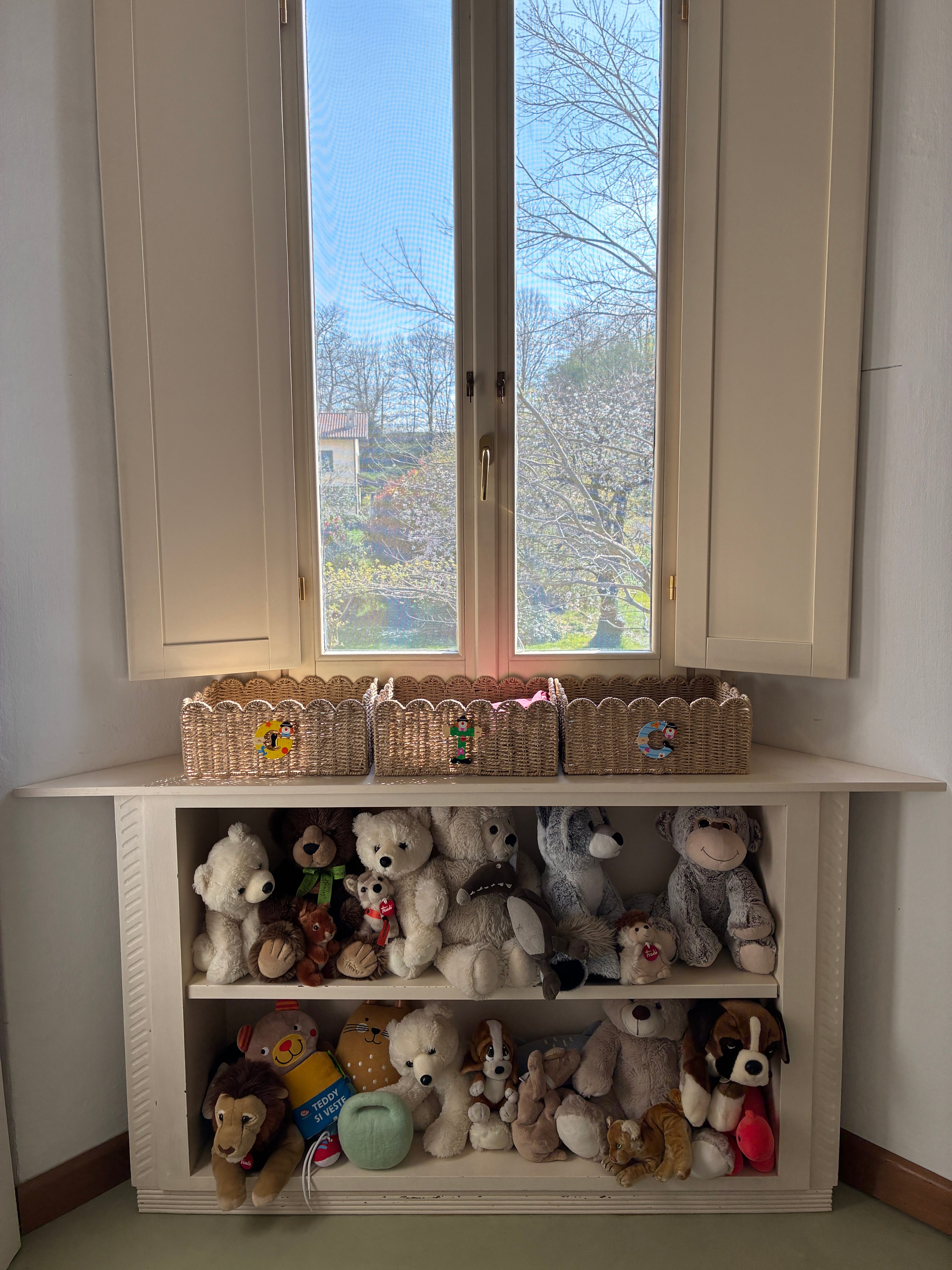
In winter it is the leggings and the jumper from yesterday that still have one more day in them, the almost-clean pile that has nowhere to go in a normal wardrobe and ends up on the floor in every other house.
In summer it is swimsuits. The preschool camp fills the garden with paddling pools, so every day is a t-shirt and a bathing suit, everything comes home muddy and gets washed at night, and the clean suits wait in the baskets where each child grabs their own in the morning, straight on after sunscreen.
The contents change with the season, but the basket doesn’t. Them being identical is the whole point.
The principle
Make everything the same, then give each child one mark that is only theirs. Identical takes away the fight. The mark gives them their own.
Here is the part I most want you to take from this, because it is a design idea and not a parenting trick.
When you take the friction out of a shared space, you take the friction out of the family that shares it.
A room where three small children negotiate who owns what is a room that manufactures fights. It is not their character, it is the setup. If two things are almost the same but one is a little nicer, closer, newer, you have handed them something to argue about. When everything is the same and each thing carries its own mark, the argument has nowhere to land. There is nothing to want that your sibling has, because yours is right there, with your letter on it.
It helps to know why this hits so hard when the children are close in age. There is an eldest, of course. But nobody in this house is mature enough yet to be the bigger person, to let the other one have the nicer cup and not mind. So the design has to do the work that maturity will do later.

These are the small ones by the bidet. If you are not Italian, the bidet is the low basin next to the toilet. Almost every bathroom here has one, and you find them across Spain, Portugal, Greece and much of South America too.
For small children it turns out to be the perfect sink at exactly their height. It gives them real independence in the early years, when reaching a normal tap means a stool. (It also gives them a lot of water to play with, which means a lot of mess. There was a period, when the twins were two, that I had to lock the bathroom door with a key
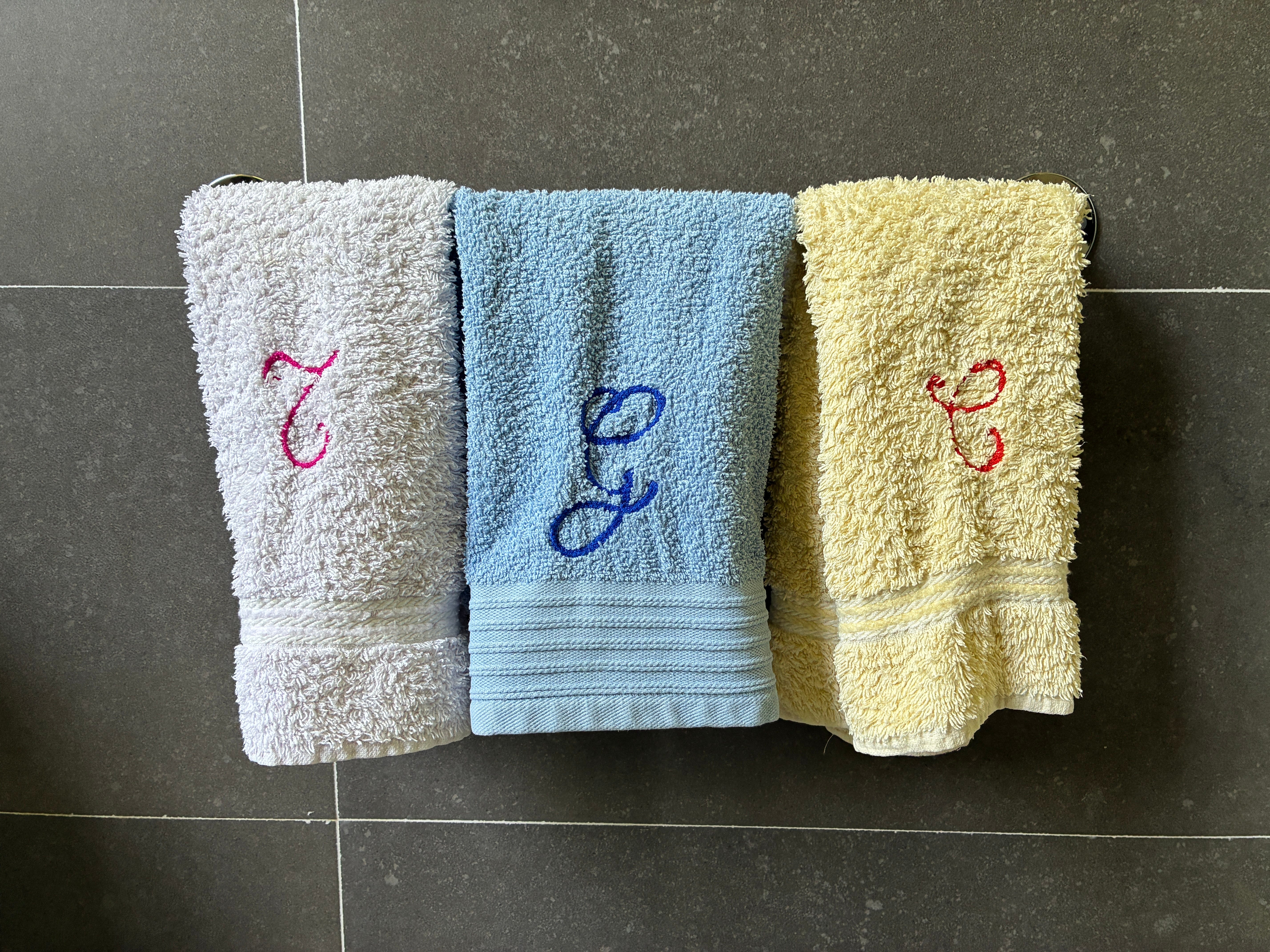
)I did not buy matching towels. I took the towels I already had at home, all different colours, and brought them to a lady in town who embroiders initials. An hour and a few euros and each child had their own.
If I were starting from zero I would do it the other way around, and this is the part worth stealing: let each child pick one colour and keep it forever. In my house the girl goes for pink every single time. My eldest, blue. Choose the colour first and you never have to embroider anything. The colour becomes the name.
Blue for my eldest, green for my youngest. That was the system for a long time and it worked. Then my youngest decided he had to have the tiger at all costs, which was already the other one’s colour, so they swapped.
Now every morning I have to stop for a second and remember whose is whose.
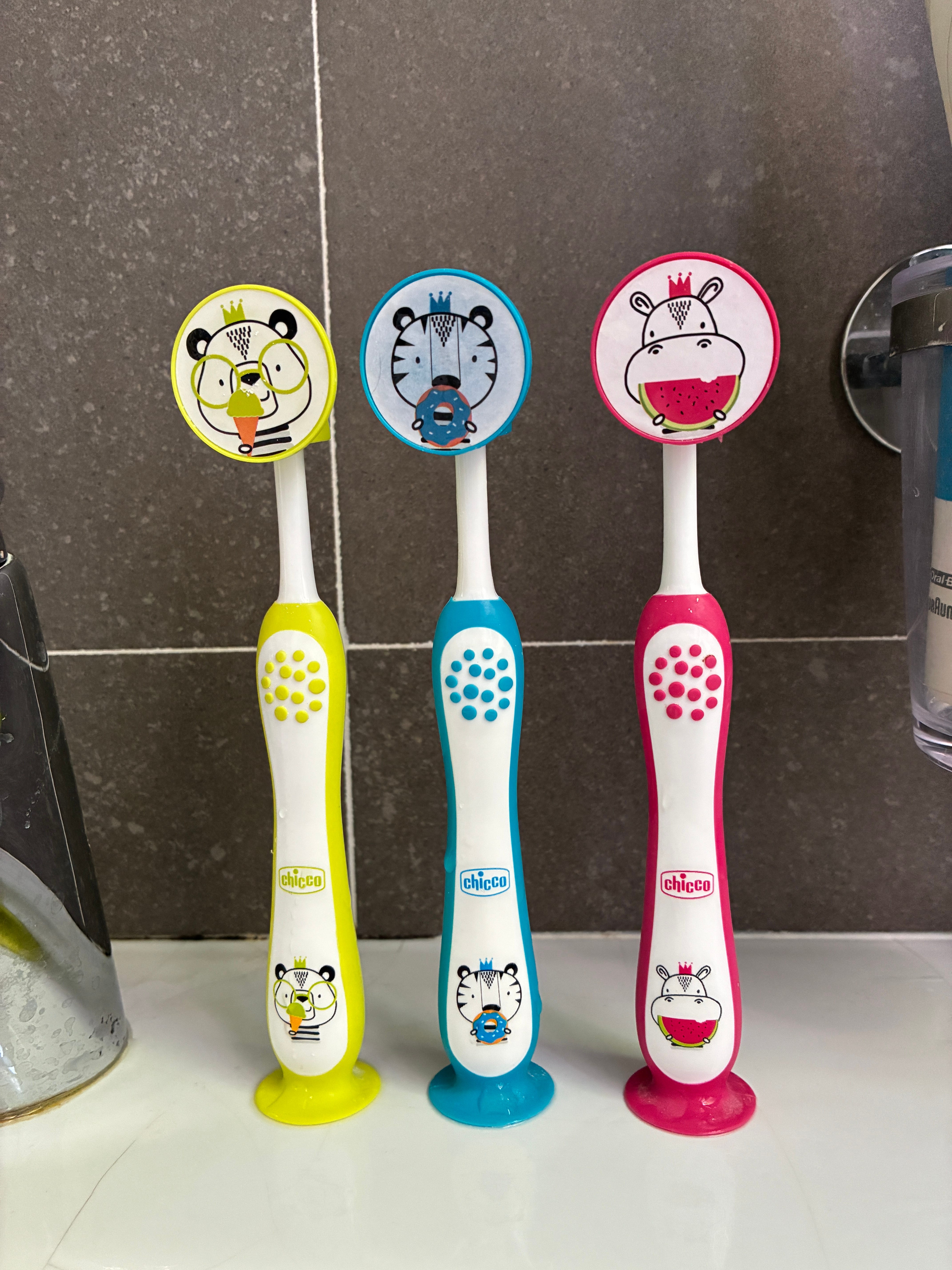
I could have said no and kept my clean little system, but I decided not to. The system is supposed to serve them and not the other way around. When a three-year-old cares that much about a tiger, the tiger wins. Consistency is the goal, not a religion.
I change the brushes every couple of months, and look for a new character each time so brushing teeth feels like a small event instead of a fight.

Preschool worked this out before I did. Every child gets a knitted symbol, and it is not a letter, it is a picture. My eldest is a lobster, my youngest is a sun, my daughter is a daisy.
The clever part is that the same symbol follows them everywhere: on the backpack, the towel, the bib, the napkin, the little cupboard where they leave their things when they arrive. They can find what is theirs in any room, before they can read a word. In a pile of twenty identical backpacks, a lobster is faster than a name.

That is really the engine under all of it. The mark has to be something a child can read before they can read. A colour is the best one, because it needs no label and no explaining. A two-year-old can pull their own towel off the rail, grab their own swimsuit from the basket, find their own bag on the hook, and none of it has to go through me.
It cost me three wooden letters, an hour with the embroidery lady, and the habit of buying the same colours on purpose.
For a house with three children in it, that is the cheapest peace I have ever bought.

Thanks for reading Off Camera! This post is public so feel free to share it.


Three kids in 20 months taught me this: homes need to evolve with us.
I’m Francesca, Italian architect. I practiced for over a decade and ran a small floral art atelier for a while. Then my first boy was born, and less than two years later, the twins arrived.
With three small children, shaping space became both more urgent and more chaotic. I keep adjusting, moving things, reassigning rooms, rethinking storage. Homes have to keep up with life.
Here, I write for parents who are fighting their homes every day, pouring everything I know about spaces, routines, and the beautiful mess of family life into every post.
If any of this resonated, subscribe so you don’t miss the next one. And if you know someone whose home is working against them instead of with them, share it with them.
💬 If something in your home isn’t working and you want to talk it through, send me a DM and I’d be happy to help.
No posts
Comments
Nothing yet. Say the first thing.
Sign in to join the conversation.