
Dear reader,
Sometimes a corporate announcement looks boring because the interesting bit is buried under a lot of corporate wallpaper. That may be the case with VRRM’s latest announcement.
On 26th August 2026, VRRM announced that it had renewed its relationship with Hertz for another five years. VRRM will continue to provide toll and violations management across Hertz, Dollar and Thrifty in North America.
So far, so dull.
The more interesting bit was this:
VRRM and Hertz will also explore connected-vehicle tolling and artificial intelligence to improve customer convenience and reduce operational complexity.
At first glance, that doesn’t sound particularly revolutionary either. After all, Hertz’s cars are already connected aren’t they? So what exactly is new?
Yes. The opportunity is not to make Hertz vehicles connected. It is to use that existing connectivity differently. Today, rental-car tolling is still fundamentally a back-office process. A Hertz vehicle passes a toll point. The toll operator identifies the vehicle through a plate or transponder. VRRM then works out which rental agreement was active, processes the toll, reconciles it and eventually gets the charge onto the customer’s account.
Broadly:
Rental vehicle → toll gantry/operator → VRRM matches the vehicle to the active rental agreement → Hertz/renter billing
That works. But it is largely reactive. The toll happens first. The processing happens afterwards. Connected-vehicle tolling potentially changes the architecture. Instead of VRRM sitting primarily behind the transaction, VRRM can sit inside the customer journey. The vehicle becomes part of the transaction itself.
That gives VRRM the opportunity to move from: “We process your tolls.”
to: “We provide the transaction layer between the vehicle, the renter and mobility infrastructure.”
That sounds like a subtle distinction. Economically, it may be anything but.
This was my first reaction too.
After all if VRRM is making the same toll appear on a customer’s infotainment screen 30 seconds after it happened rather than three days or three weeks later, then I am not especially interested.
30 seconds is a better user experience. What if it’s 30 seconds before? You’re approaching a toll, what do you want to do?
What if “slightly sooner” is not the full ambition?
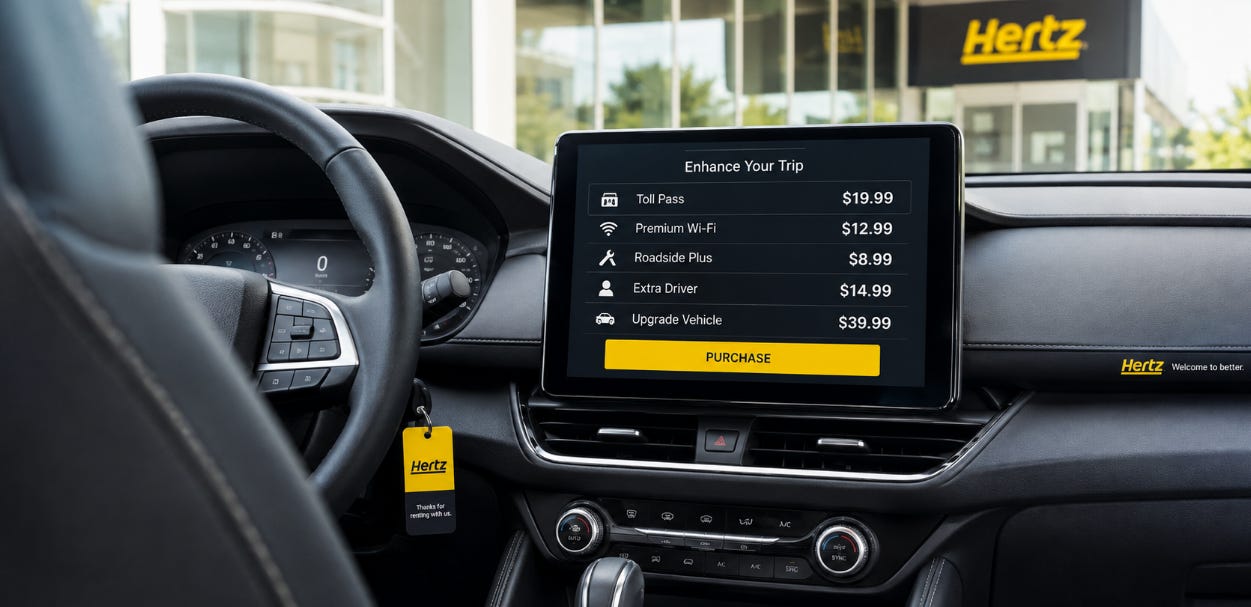
Earlier this year, VRRM launched something called AutoKinex Virtual Agent, specifically aimed at rental-car companies. The product is designed to sit within the vehicle’s infotainment system and allow the renter to select additional services from inside the car. That can include things such as:
tolling;
prepaid fuel;
protection products;
potentially other ancillary services.
And suddenly the Hertz announcement starts to make more sense. Importantly, neither company has said Hertz will deploy AutoKinex Virtual Agent. I am joining two pieces of Verra’s strategy: the launch of its in-car rental product and the commitment to explore connected-vehicle technology with Hertz. That is a plausible connection—but currently it is my inference, not a disclosed implementation plan.
The potential proposition is not simply:
“We’ll show tolls faster.”
It is potentially:
“We’ll move part or all of the rental counter into the vehicle.”
That is much more interesting.
Rental companies increasingly want customers to avoid the counter.
“Brace yourself Ethel. No not that. We’re at the Hertz Rental office. We’re going to be given the hard sell. Brace yourself girl”
From a customer perspective, that is great.
Book the car. Find it. Get in. Drive away. No hard sell. No sell whatsoever.
Great. But not great for Hertz. The rental counter has historically been an important sales channel. It is where the customer gets asked:
Do you want tolling?
Do you want prepaid fuel?
Do you want insurance and additional protection?
Do you want an upgrade?
Do you want this?
Do you want that?
If the customer bypasses the counter entirely, Hertz removes the friction, but it also removes an upselling opportunity. That is where VRRM’s proposition potentially becomes clever. What if the customer no longer visits the counter, then put the sales counter in the car.
Imagine the customer gets into a Hertz rental in Florida. The infotainment screen says:
“Activate tolling for this rental?”
Or perhaps:
“You are approaching toll roads. Activate nationwide tolling?”
Perhaps even adopting the voice of a Harry Enfield character if you don’t:

“Ooh you just went through a toll without an upgrade. That’s a $100 fine. I don’t believe you wanted to do that! No, no, no, no, no!”
Or maybe even via the licencing of a range of character voices. Yoda, Gandalf, Darth.
“Luke, if only you knew the power of Hertz unlimited tolls”,
“Unlimited Tolls is like the flame of Arnor - you SHALL pass!”,
“Uncertain, the future is, but certain is your need for a toll upgrade my young padawan”
Then later the more prosaic: “Would you like to prepay fuel?”
Or: “Add protection?”
And potentially, in time:
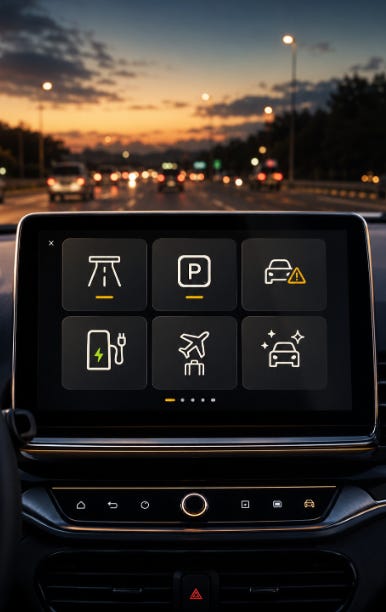
“Pay for parking?”
“Activate EV charging?”
That changes the role VRRM plays. It is no longer only processing tolls after the event. It is helping Hertz monetise the rental while the rental is actually happening.

Because VRRM’s existing rental-car business is already transaction-driven. Commercial Services earns revenue when transactions are processed. That means more adoption matters. Suppose 100 Hertz customers rent vehicles. Perhaps 40 currently use Hertz’s tolling proposition.
The other 60 might:
decline;
bypass the counter;
not understand the product;
decide they do not need it;
only realise later that they are driving into toll-road territory.
brace themselves (Ethel) against the hard sell. The answer is no, and I’ve no idea what it was you were selling?
Now imagine VRRM’s AutoKinex Virtual Agent which can prompt those customers at the exact moment the product becomes relevant.
Perhaps toll-product adoption moves from:
40% → 45%
or
40% → 50%
Perhaps far higher. It could be potentially meaningful.
VRRM does not need Hertz’s fleet to grow. It doesn’t even need total rentals to grow.
It simply needs a greater percentage of existing rentals to monetise. That is an important distinction.
Meanwhile, Hertz could reduce counter congestion and the amount of employee time consumed by manual checkout and ancillary-service administration.
This is effectively a conversion-rate problem. Selling tolling when the customer books a car weeks before travelling may not be particularly effective. Selling at the point of handing over keys might also be ineffective (Brace yourself Ethel)
Selling tolling when the customer is literally sitting inside the vehicle approaching a toll booth is different. The product becomes contextual. Relevant. Immediate.
You could call it point-of-need selling.
And that is potentially valuable to both parties. Hertz gets more ancillary revenue. VRRM gets more transaction revenue. The customer gets a more convenient experience. That creates much better alignment than VRRM simply trying to increase the price of toll processing.
This is particularly interesting because VRRM has recently had to accept worse economics from its major rental-car customers. The new Hertz and Avis arrangements were agreed at lower pricing than their predecessor contracts.
That was one of the reasons VRRM’s revised 2026 outlook and guidance disappointed and its share price tanked -70%
The bearish interpretation is obvious: The rental-car companies have bargaining power. They squeezed VRRM - and not in a good way. Toll-processing business is commoditising. Margins go down. End of story.
But there may be another interpretation. What if VRRM accepts lower economics on the mature product because it believes it can expand the relationship elsewhere? What if fighting over the scraps from Longshanks table isn’t where the real opportunity exists.
The old relationship might have been:
Toll customer → toll transaction → VRRM revenue
The new relationship could become:
new digital ancillary transactions
lower operating costs
wider mobility commerce**
**Lower toll economics per customer × higher product adoption
That does not mean the repricing was good. It clearly was not. But it raises the possibility that the reset is the beginning of a broader relationship rather than simply evidence of structural decline.
This is where AutoKinex becomes much more important than the Hertz announcement initially suggests. VRRM’s longer-term connected-vehicle proposition extends beyond tolls.
The platform has been positioned around mobility transactions including:
tolling;
parking;
fuel;
EV charging;
road-user charging;
potentially congestion charging and other mobility payments.
This is where the strategic ambition starts to change.
VRRM does not necessarily want to remain a toll administrator. It wants to become the payment and transaction layer between the vehicle and the infrastructure around it.
That can potentially look like:
Vehicle
↓
VRRM
↓
Toll road
Parking
Fuel
EV charging
Road-user charging
And rental cars are an interesting proving ground.
Why?
Because VRRM already knows:
the vehicle;
the rental company;
the active rental agreement;
the renter;
the toll infrastructure;
the payment workflow.
That is a lot of the puzzle already assembled.
Hertz is particularly attractive because it operates a huge, constantly changing fleet across multiple vehicle manufacturers. That creates complexity.
But complexity is precisely where VRRM should be useful.
If AutoKinex can work across a large Hertz fleet (and nothing has been formally announced to this effect - please note the word IF) consisting of multiple OEMs, multiple vehicle models and millions of rental journeys, then it becomes a much more credible product elsewhere.
That could include:
other rental-car companies;
fleet-management companies;
corporate fleets;
leasing companies;
OEMs.
Hertz therefore potentially provides more than revenue.
It could provide validation.
This is the biggest unanswered question.
We know VRRM already monetises tolling on a transaction basis. We also know its AutoKinex consumer offering can charge service fees around mobility transactions.
What we do not yet know is exactly how the Hertz arrangement will work.
There are several possible models.
VRRM could earn:
1. A software/platform fee
Hertz pays VRRM for access to the technology.
2. A transaction fee
VRRM earns each time the renter activates or uses a service.
3. Revenue share
Hertz and VRRM split the economics from incremental ancillary sales.
4. Some combination of all three
That could be particularly attractive because once the technology is deployed, incremental transaction revenue may come with relatively low incremental cost.
But there is currently no disclosure showing what VRRM gets.
That means I would not put any AutoKinex/Hertz revenue into a base-case forecast today.
Not yet.
Suppose Hertz, Dollar and Thrifty generate 25 million rental transactions annually.
None of the following inputs is company guidance, and I have found no public evidence for the assumed rental volumes, adoption rate or unit economics. This is a sensitivity exercise designed only to illustrate how the economics might scale.
Suppose 40% of those rentals currently monetise through VRRM tolling.
That would mean:
10 million toll-product customers
Now suppose AutoKinex improves adoption by only five percentage points.
That produces:
1.25 million additional customers
If VRRM were to generate an incremental $8 of net revenue from each additional tolling customer, that would imply:
$10 million of additional annual revenue
Again, these are illustrative numbers. We do not know the actual Hertz volumes or economics. But it demonstrates the principle. Small improvements in adoption can matter when the installed customer base is huge. And then there is the possibility of additional commerce.
Suppose VRRM earns just $1 from five million additional in-car ancillary transactions.
That is another: $5 million revenue
It does not require bullish assumptions before you start getting into potentially material numbers. I would think about the Hertz opportunity in three scenarios.
Connected-vehicle tolling mostly improves customer experience. Hertz gets operational efficiencies. VRRM’s legacy toll economics remain lower. Incremental monetisation is minimal. That would make the announcement little more than strategically useful PR.
AutoKinex improves toll-product adoption. The customer can activate services inside the vehicle. Hertz reduces operating friction and the manual workload associated with counter-based sales and checkout. VRRM earns incremental transaction revenue. That could plausibly offset some or all of the economics lost through the recent contract repricing.
Hertz adopts AutoKinex as a broader in-car commerce platform across Hertz, Dollar and Thrifty. The vehicle becomes a sales channel for:
tolling;
fuel;
parking;
EV charging;
protection products;
other mobility services.
VRRM participates economically in those transactions. And once the model works at Hertz, it can be replicated elsewhere. That would be much more significant.
The market currently thinks of VRRM primarily as: toll processing software + traffic cameras
That may prove too narrow. What VRRM appears to be trying to build is something closer to:
vehicle identity + payments + mobility transactions
That is a much bigger idea.
The difficult part is that the old toll business is easy to understand. A vehicle uses a toll road. VRRM processes the transaction. VRRM gets paid. The AutoKinex opportunity is earlier and less proven. The market is therefore unlikely to give it much value until actual commercial contracts start appearing.
And that may be exactly why it is interesting.
There are several things I would now watch closely.
First, does Hertz actually deploy AutoKinex, rather than merely “explore” it?
Second, does VRRM disclose transaction volumes or adoption rates?
Third, does AutoKinex begin appearing with additional rental companies or OEMs?
Fourth, does Commercial Services return to growth after the recent Hertz/Avis repricing?
And fifth — perhaps most importantly — does management ever disclose how AutoKinex monetises?
Because that is where the investment thesis either becomes real or falls apart.
At first I thought the Hertz announcement amounted to: same toll, same bill, but slightly faster.
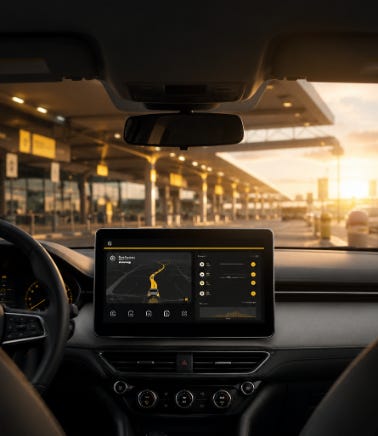
If that were the case, I would not care. But on reflection I now think the potential opportunity is more interesting. VRRM is trying to use the connected vehicle as a new point of sale.
A disappearing rental counter creates a problem for Hertz because it removes a place where high-margin ancillary products were historically sold. AutoKinex potentially puts that sales channel inside the rented vehicle. For Hertz, that may increase ancillary revenue and reduce operating complexity. For the renter, it may make tolling and other services easier to understand and activate. Buy at the point of need and not at the point of bracing oneself (Ethel).
For VRRM, it could mean more transactions, greater product adoption and eventually a much larger role in mobility payments. There is an important caveat. The Hertz announcement says “explore.” It does not say deploy. There is no disclosed pricing. There’s no transaction economics. There’s no launch date. No revenue target.
So I am not changing my base-case numbers yet. But I am changing how I think about the optionality. The bear case remains that rental-car customers have squeezed VRRM’s legacy toll economics.
The bull case is that VRRM will use those same customer relationships to evolve from toll administrator into the transaction layer for a connected vehicle.
That is a much bigger opportunity.
And if Hertz becomes the first large-scale proof point, the rather boring five-year contract renewal announced this week may eventually prove to have been considerably more important than it first appeared.
And does this apply just to its Commercial Segment? Why would this not extend to VRRM’s Government Solutions and its Parking Solutions segments too?
The most obvious adjacency is Parking Solutions: if AutoKinex can identify the vehicle, connect it to a payment method and settle a toll, parking becomes a logical additional transaction. Government Solutions is less direct, although Verra’s relationships with transport authorities and its experience processing violations could contribute data, compliance and infrastructure connections. The opportunity is therefore potentially cross-segment.
One AutoKinex system to rule them all, one platform to bind them, one way to manage vehicular commerce (including fines and parking), and in the darkness bind them.
Regards
The Oak Bloke.
Disclaimers:
This content is for educational and informational purposes only. It does not consider your personal circumstances and is not financial, investment, tax, legal, or professional advice. Nothing here is a recommendation, offer, or solicitation to buy, sell, or hold any investment. Investing involves risk, including the loss of capital. You are solely responsible for your own decisions
Micro cap and Nano cap holdings might have a higher risk and higher volatility than companies that are traditionally defined as “blue chip”
Comments
Nothing yet. Say the first thing.
Sign in to join the conversation.