
*this article was released to YouTube on the 22nd August.
Dear reader
People saw the words revenue down/EBITDA down and panic sold this morning*. Little surprise that HTG reported disruption from the Middle East segment.

I didn’t panic. In a deft manoeuvre I bought more at 381p. Why?
Was it due to what Stock commentators said? What did they say….. I’ve no idea what they said. You’re out of luck if you wish to comment on the comments about the comments. I’ve no comments about the comments.
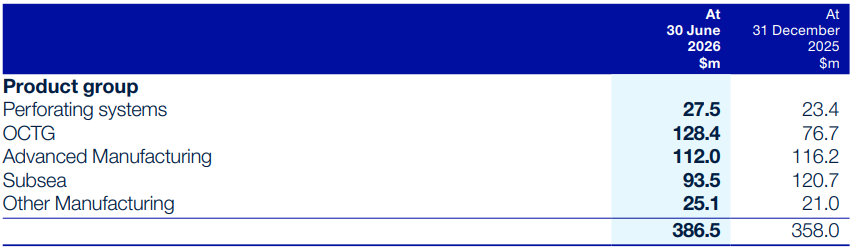
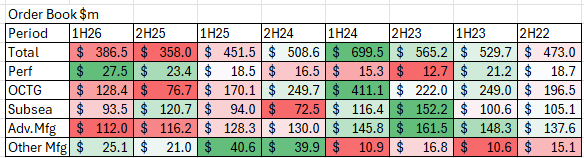
HTG is targeting increasingly ambitious growth through its Hunting 2030 strategy. And that was where my eyes were focused. Yes, the $386.5m order book had fallen by 14% over 12 months but it was also up 8% since 31/12/25.
My eyes were focused on margins achieved. The fact that Subsea is at eye-catching 21.7% margins in 1H26, while Perf is at a much better 8.5% margin relative to its history.
But we see drops elsewhere…..
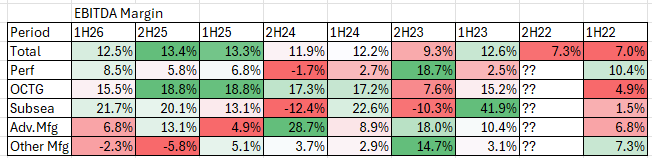
…Temporary drops if HTG commentary is to be believed due to Order Phasing and a 2H26 rebound is forecast.

In any case, I could see impressive growth in Subsea (nearly 100% in a year) and in Perf (nearly 50% growth) while dips in OCTG was dragged down by EMEA restructuring (caused by ex-Minister of Zero Milli) and KOC’s decision to rerun their tender pushing the work into 2027, as well as a strong comparative 2025 when KOC orders did not recur.
Disruption in the Middle East means two things: First I’m treating the impact as a HTG extraordinary cost in 1H26; second I’m treating as an opportunity for 2027 and beyond. Should I be so forgiving? To assess the value of this value you need to look past noise.
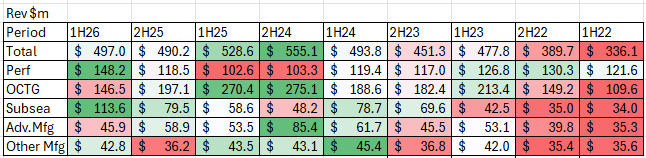
Combining margin and revenue we see Subsea delivered 40% of profit up from 25% in 2H25 and 11% of profit in 1H25. When HTG delivers a rebound in OCTG combined with continued performance in Perf and Subsea you can see a credible path to a +50% EBITDA growth to $100m (or $200m annualised) in 2027 and with a revenue growth by 2030 to $2bn EBITDA would growth further to $260m-$300m.
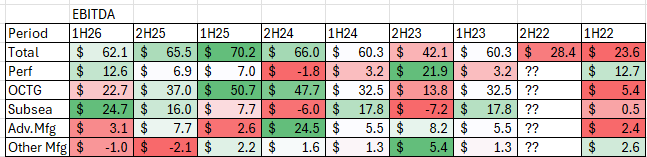
In the short term in 1H26 Revenue fell by 6% and EBITDA declined from $70m to $62m. So is this just short-term noise.
Guidance meanwhile is for $75.9m-$78.9m 2H26 EBITDA so +22% to +27%

To achieve an overall 13% EBITDA margin in 2026 HTG would need to achieve $564m of sales in 2H26. Can the business deliver +$67m revenue vs 1H26? The order book at 30/06/26 is not full to bursting although we are told of a stock build in anticipation of a rebound in work in the commentary. Contract assets are double their level yoy but $69.5m isn’t a vast sum of WIP. So nothing in the numbers at 30/06/26.

However Order book growth for OCTG is +67% in 1H26 and that’s without the KOC award. The Group’s tender pipeline remains robust at c.$1.0 billion.
HTG believes its six-year relationship with KOC, technical collaboration and supply-chain qualification leave it well placed to win further work. HTG entered 2026 guiding to EBITDA of $145–155m. That has now been reduced to $138–141m because the KOC tender process is being rerun, delaying approximately $10m of anticipated EBITDA for 2026. The order was originally tendered in April 2026. KOC has verbally indicated that it will launch an accelerated re-tender during 3Q26, with an outcome expected approximately one month later.
Factor that back in and you add a potential order of $300m+ revenue/$39m+ EBITDA margin (assuming HTG receives the whole order) and that potentially triples the OCTG order book and doubles the overall forward orders.
Of course “well placed” is not the same as “contracted”, and there’s uncertainty.
So to summarise HTG’s earnings engine is changing. Subsea and Perforating Systems are growing strongly.
Add to that that OCTG is rebounding without KOC and adding KOC later in 2026 would transform HTG’s forward orders for 2027+. I see it as potential upside with a reasonable probability.
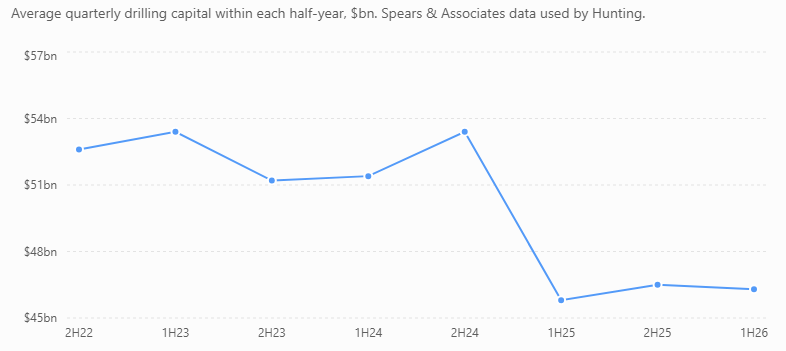
In any case, with drilling capex running at depressed levels where will this go in 2026+ other than up?
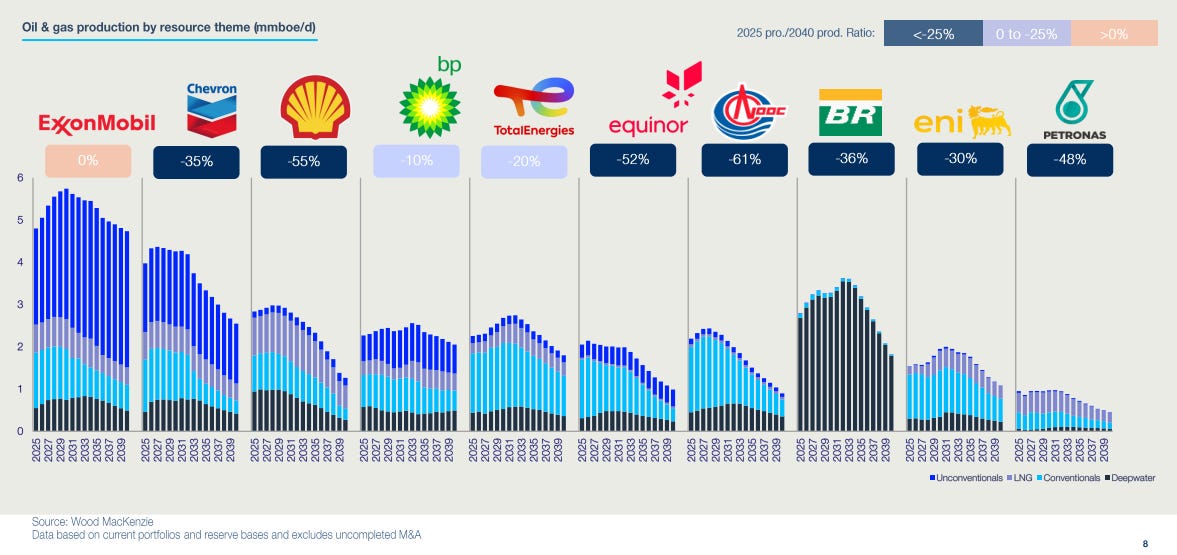
Especially when you consider every Oil & Gas Major except Exxon faces severe depletion in the next 15 years. Will the world recommit to Net Zero? So far it hasn’t, the pace of change is far slower and reductions of oil demand non-existent. Even if Oil demand peaks the shrinkage of resources is occurring at a more rapid pace.
Let’s get into the segments next.
Subsea was the standout performer in 1H26. HTG spent seven years repositioning this business towards higher-value equipment used in deepwater developments, subsea production and offshore decommissioning. The benefits are now becoming visible.
The group secured $63.5m of titanium stress-joint orders for ExxonMobil’s Guyana operations. These orders will be delivered in 2027, providing something HTG has historically lacked: higher-margin revenue with multi-year visibility.
The existing Subsea Spring operation performed strongly, while Flexible Engineered Solutions—acquired for ~$65m in June 2025—made a good contribution.
The FES acquisition expanded HTG’s exposure to FPSO developments and brought margins comfortably above the group average. It also complemented HTG’s existing stress joints, valves, couplings and subsea intervention equipment.
The appeal is not simply higher revenue.
It’s higher margins too. For good reason: Deepwater and subsea projects involve long planning cycles, high technical requirements and substantial costs of failure. Once equipment has been qualified for a project, customers are unlikely to replace a trusted supplier merely to save a few dollars.
Complexity creates greater pricing power, stronger customer retention and better revenue visibility than the more commoditised parts of OCTG. Subsea therefore appears capable of improving not only the amount Hunting earns but the quality of those earnings.
The risk is that investors extrapolate one strong period too quickly. Subsea remains project-driven, revenue recognition can be lumpy and offshore developments are still exposed to delays, sanctions, cost inflation and political intervention.
Nevertheless, this Hunting 2030 deliverable is delivering: Orders, revenue and margins are visible.
Perforating Systems also performed ahead of expectations.
HTG gained further US market share while recording strong sales in Australia, Argentina, Indonesia and Saudi Arabia.
HTG Titan was once heavily dependent upon the US shale cycle. Expanding internationally makes the product group less reliant upon any single basin while allowing Hunting to sell proprietary technology into markets where modern unconventional completion techniques are still gaining adoption.
HTG’s equipment is generally mission-critical but represents a relatively small proportion of the total cost of drilling and completing a well. Failure can be extraordinarily expensive, while the saving achieved by selecting a cheaper but less reliable component is comparatively trivial.
That dynamic supports premium pricing where HTG can demonstrate performance, reliability and technical differentiation.
The old HTG depended heavily on activity volumes. The new HTG increasingly sells mission-critical technology to customers who cannot afford get it wrong.
HTG describes itself as a precision engineering group serving energy and other end markets. The “other” still requires a magnifying glass.
Non-oil-and-gas revenue increased from $37.7m to $38.0m—growth of less than 1%. It represented just 7.6% of group revenue.
HTG supplies components into aviation, defence, space, power generation and medical applications, while its trenchless business provides equipment for underground infrastructure.
These markets may provide attractive optionality, but they have not yet diversified the group in a financially meaningful way. HTG remains overwhelmingly an oil and gas equipment company.
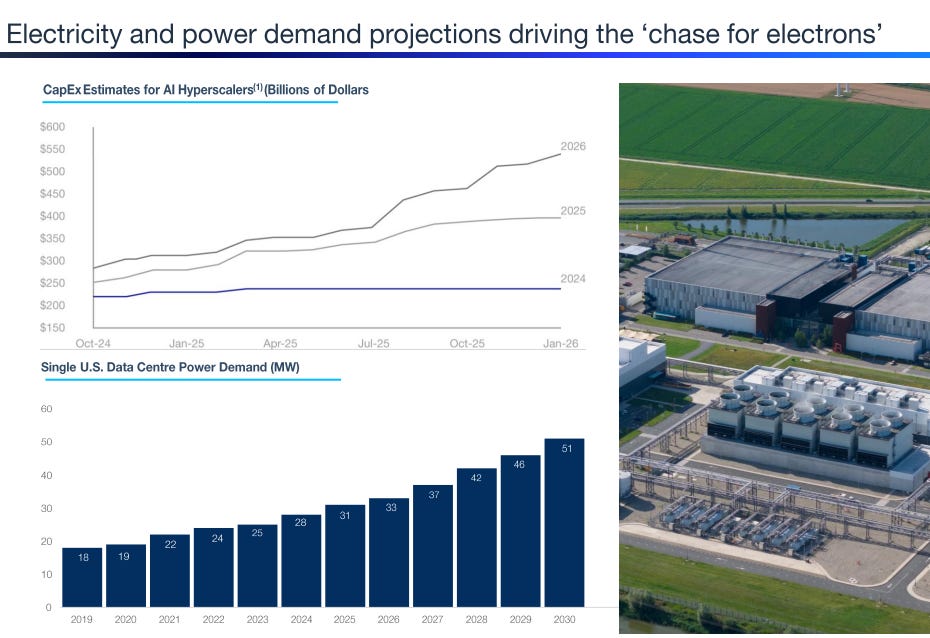
This was one of my original criticisms. Rather than focus on the knitting, HTG appeared poised to spend money pursuing fashionable adjacencies. A closer inspection reveals the macros of Space Technology, energy security and rising power demand provide substantial opportunities within HTG’s existing core competencies. Uplifts are projects for 2H26. Little surprise when you consider the power demand build out we see going on.
Hunting acquired Organic Oil Recovery technology in March 2025 for $18.2m.
OOR uses naturally occurring microbes to improve oil recovery from mature reservoirs and to reduce water cut (which then requires disposal). The potential attraction is obvious: helping customers extract more oil and fewer byproducts from existing wells without the cost and risk of drilling new ones could generate attractive margins and recurring demand.
Commercialisation is progressing:
customers are sampling or field-testing the technology;
a Permian operator Buccaneer (ticker LON:BUCE) achieved a doubling of production in well-test results;
a master service agreement was signed with a Brazilian customer;
initial Brazilian injections are expected during H2; and
positive test data has been reported in North America and the North Sea.
Positive anecdotal results and tests - but not yet large-scale commercially proven.
The distinction lies in repeat orders, revenue, margins and customer adoption. Field tests are a necessary step, but they are not the investment return.
Yet this is a business segment HTG sees as potentially worth at least $100m revenue a year at at least 50% EBITDA
$50m EBITDA would be a +40% contribution to today’s EBITDA. OOR remains potential upside. It carries no weight in HTG’s valuation.
HTG’s EMEA restructuring is nearly complete.
Facilities in the Netherlands and Norway have closed, while Fordoun in Scotland is due to close in September thanks to ex-Minister for Zero Milli. Operations have been transferred towards lower-cost or higher-growth locations, including the KSA, the UAE and Indonesia.
The original programme sought ~$11m of annualised savings, and management expects EMEA to return to profitability during 2H26.
A further group-wide cost programme is intended to deliver another $15m of annual savings by the end of 2027. This includes shared-service initiatives in Europe and North America and a broader review of selling, general and administrative expenses.
Together, these savings are meaningful relative to current EBITDA.
But savings might not translate to incremental profit. Some may be absorbed by wage inflation, lower volumes, pricing pressure or investment elsewhere.
The useful proof will be whether the restructured businesses generates sustainable margins.
The relevant market for HTG is the supply of high-specification, precision-engineered equipment to global oil and gas operators and service companies.
Each force is scored according to industry attractiveness:
5/5: weak competitive force and therefore favourable.
1/5: powerful competitive force and therefore unfavourable.
Overall: 15/25
HTG competes with large multinational oilfield-service groups, specialist engineering businesses and lower-cost regional manufacturers.
Competition is intense in commoditised products such as standard OCTG. Customers can tender large orders globally and use competing suppliers to pressure prices.
However, rivalry is weaker in HTG’s more specialised niches.
Titan’s proprietary perforating systems, Subsea Spring’s titanium stress joints and FES’s specialist FPSO equipment require engineering expertise, certification and proven field performance. The cost of failure is high, creating a preference for established suppliers.
HTG strategy is therefore rational: move away from products where competition centres predominantly on price and towards those where qualification, intellectual property and reliability matter more.
Entry barriers are substantial.
A new competitor requires specialised manufacturing facilities, skilled engineers, intellectual property, quality-control systems, industry certifications and—most importantly—a credible record of equipment performing safely in demanding conditions.
Qualification can take years. Customers are reluctant to risk a multimillion-dollar well or subsea project by using an unproven component supplier.
New entrants can still emerge through technological innovation or lower-cost manufacturing, particularly in less specialised products. Customers may also support alternative suppliers to avoid overdependence upon incumbents. But across Hunting’s higher-value product groups, trust is not manufactured overnight.
HTG depends upon specialist metals, electronic components, explosives, skilled labour and external manufacturing capacity.
Titanium, nickel alloys and other high-specification materials can be costly, volatile and sourced from a limited number of qualified suppliers. HTG’s decision to purchase materials ahead of expected 2H26 activity contributed to the $58m working-capital outflow during 1H26.
That illustrates both the operational and financial power of the supply chain. HTG may need to commit cash long before it receives payment from the customer.
Its scale, global manufacturing footprint and ability to pass some input costs through to customers provide partial protection, but not immunity.
HTG sells to some of the world’s largest oil companies, national oil companies and oilfield-service groups.
These customers are financially powerful, technically sophisticated and capable of placing very large orders. They can run competitive tenders, delay projects, demand qualification work and impose exacting contractual terms.
The KOC re-tender is a perfect demonstration. HTG may possess a six-year relationship and extensive technical credentials, but the customer can still restart the process and shift anticipated earnings between financial years.
HTG gains protection where its products are proprietary, highly qualified or operationally critical. Nevertheless, the balance of negotiating power generally rests with the customer.
The immediate substitution threat to a titanium stress joint or perforating gun is relatively low. If a customer intends to develop a deepwater field or complete a shale well, it requires suitable equipment.
The larger threat is substitution away from the underlying activity.
Renewables, nuclear power, storage and electrification may reduce long-term demand for oil and gas. Improved recovery from existing fields could also reduce the requirement for new drilling—although OOR gives HTG some participation in that trend.
Against this, energy demand is growing, decline rates require continuing investment and AI-driven data centres are increasing electricity requirements. Governments are also placing greater emphasis upon energy security and domestic supply.
Oil and gas equipment faces a long-term substitute threat, but the timing remains deeply uncertain.
HTG does not operate in an easy industry.
Its customers are enormous, technically sophisticated and able to delay orders with material consequences. Input costs can be volatile, working-capital requirements are substantial and the underlying investment cycle remains exposed to oil and gas prices.
However, HTG possesses genuine barriers to entry in its more advanced products.
Qualification, engineering expertise, patents and a record of reliable performance protect its specialist niches. The continuing shift from commoditised OCTG towards Subsea and proprietary Perforating Systems should therefore improve HTG’s competitive position.
The Five Forces analysis supports the strategic direction.
The remaining question is whether the financial returns will justify the capital required to complete it.
HTG generated a $5.4m operating cash outflow and negative free cash flow of $27.8m during 1H26.
That compares with an operating cash inflow of $90.8m and free cash flow of $66.2m during 1H25.
The principal movement was working capital:
1H25: $25.8m inflow;
1H26: $58.0m outflow;
Year-on-year reversal: $83.8m.
Management attributes the outflow to forward material purchases at HTG Titan and Subsea, together with increased receivables following revenue recognised during the period.
In other words, cash has supposedly been invested in stronger second-half trading rather than disappearing through poor underlying economics.
That explanation is reasonable - but it also needs proving.
HTG expects total cash and bank balances to recover from negative $19m at June to positive $50–60m by year-end. That requires a six-month improvement of between $69m and $79m. Some of this should arrive naturally as inventory becomes revenue and receivables are collected. A stronger second-half EBITDA will also help.
However, if order delivery slips or customers delay payment, HTG could finish the year with more inventory, more debt and another explanation about timing.
The cash-flow recovery is therefore one of the most important tests for 2H26.
During 1H26, Hunting spent:
$32.6m on share buybacks;
$11.6m purchasing treasury shares;
$10.1m on dividends; and
$8.8m settling the UK import-duty provision.
The working-capital outflow accounts for much of the remaining movement.
The first buyback was at a 20% discount. For a technology company you don’t typically value the technology as being “worth book”. You just don’t. You say what’s the value of the technology. It’s my belief that the earnings potential is evident.
Today, HTG’s market capitalisation is approximately £589m, while its $863m of net assets at 1H26 translate to roughly £645m. The shares therefore trade at a 10% discount. I’m very happy they continue with buybacks boosting long-term ROE.
The share price fell sharply due to a disappointing result: Revenue, EBITDA, adjusted earnings, free cash flow, order book, net assets and ROCE all deteriorated during 1H26. Full-year guidance has been cut, the group has entered net debt and a large second-half recovery is now required.
Subsea is performing well, but remains project-dependent and is exposed to risk. Perforating Systems remains exposed to North American completions activity. OCTG still depends upon large customer tenders. Non-oil-and-gas diversification remains negligible, and OOR has yet to demonstrate material commercial revenue.
Meanwhile, management continues to assess acquisitions while spending cash on a buyback that until the drop on result was at approximately book value.
HTG may be spending shareholders’ money faster than it can create cash.
Subsea has delivered a genuine step-change in performance.
Higher-margin, multi-year Guyana orders improve visibility.
Perforating Systems is gaining market share internationally.
EMEA restructuring is nearing completion.
The order book has recovered from $358m at December to $386.5m.
The product mix is moving towards more technically differentiated niches.
Group revenue and EBITDA declined.
The KOC order gap has persisted.
FY26 guidance has been reduced.
Free cash flow turned negative.
Net cash became net debt.
ROCE fell.
The discount to book value disappeared.
Non-oil-and-gas diversification remains insignificant.
The clock has advanced operationally but gone backwards financially.
The next twelve months must answer four questions:
Can Hunting deliver $75.9m to $78.9m of EBITDA during H2?
Will the $58m working-capital investment unwind as promised?
Can it secure the KOC retender without sacrificing margin?
Will Subsea growth translate into sustainably higher group returns?
Until then, the transformation remains partially proven.
I was wrong about a FY25 guidance miss that I claimed was “nailed on”. It nailed it - just - delivering $0.7m over the bottom of its guidance.
But the knockout 1H26 rebound performance has not materialised. The third Gulf War did instead. Adjusted earnings declined, cash flow reversed, the balance sheet weakened and FY26 guidance has now been reduced. That does not mean HTG’s strategy has failed.
Subsea is becoming a higher-margin, longer-duration earnings pillar. Perforating Systems is expanding internationally. EMEA costs have been reduced and the order book has improved since year-end.
HTG is becoming a better business. At 381p per share vs a NAV of 445p a share I was happy to get a 64p discount when I believe the technology makes this worth more than 445p. Or put another way on a probabilistic basis I see a base valuation of 5X earnings implying a loss of 21p from my top up price (and Zero pence from the price this was included in the picks for 2026)
But where according to the Oakbloke Valuation Methodology the possible upside is 3X and the weighted outcome is around 570p.

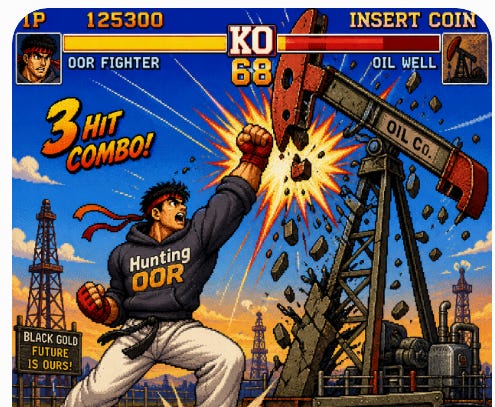
The knockout performance didn’t arrive. But Hunting is changing which fist it punches with - and the next round should tell us whether that is enough to win on points.
And maybe it will be the ultra bullish 5% scenario and a Sho-ryu-ken! superpower uppercut effect from commercial proof on OOR.
Regards
The Oak Bloke.
Disclaimers:
This content is for educational and informational purposes only. It does not consider your personal circumstances and is not financial, investment, tax, legal, or professional advice. Nothing here is a recommendation, offer, or solicitation to buy, sell, or hold any investment. Investing involves risk, including the loss of capital. You are solely responsible for your own decisions
Micro cap and Nano cap holdings might have a higher risk and higher volatility than companies that are traditionally defined as “blue chip”
Comments
Nothing yet. Say the first thing.
Sign in to join the conversation.