

Dear reader
What’s the most hated stock in the world? A company that sells Road Safety equipment? That stuff is even more hated than Traffic Wardens. Poor Uncle Bryn. So where better to look for beaten-up stocks?

What can bring home the Bacon? What’s got the market in a Soap about VRRM and got the knives out for it? How can we get fatter returns than Tom? Oi! I ‘eard that. And are we going to Eddie in the water name-checking these four protagonists or just get on with it!
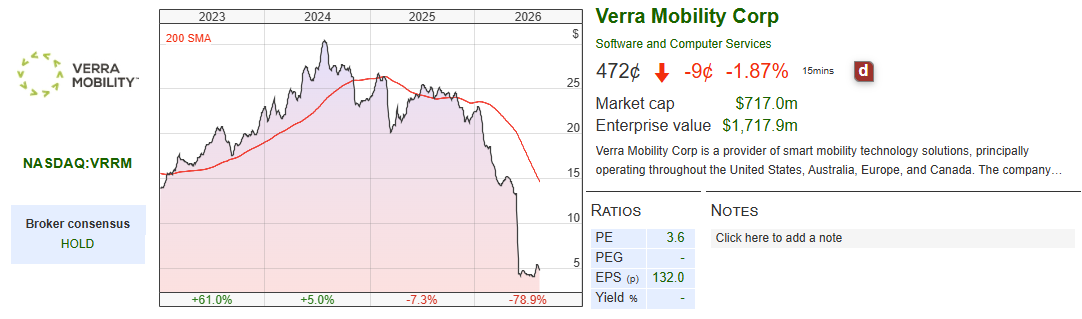
$717m market cap Verra Mobility (ticker NYSE:VRRM) operates what looks, at first glance, like a remarkably dull collection of tolling, traffic-enforcement and parking businesses.
VRRM delivers via three segments: First, toll management for Rental Car Companies and Fleet Management Companies, second municipal traffic safety tech and thirdly ANPR parking management systems or ALPR in the US - Automated License Plate Recognition.
But dig deeper.
Very high recurring revenues. Extremely high margins in its core Commercial business. Long-term government contracts. Significant switching costs. And a rapidly growing Government Solutions operation.
But alas. Avis.
More on that later.
Let’s introduce VRRM. The share that punishes drivers that go Vrrm Vrrm Vrrm.
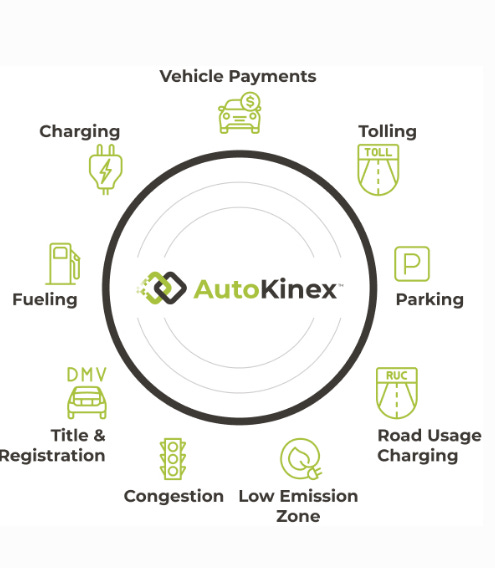
Commercial (48% of revenue) - The Commercial Services segment processes millions of tolling/violation transactions for major rental and commercial fleets, generating high-margin fee revenue tied directly to travel volume both in the USA and Europe. It also deals with “title and registration” given that there are 50 different “DVLA’s” in the USA (one in each state) and that a vehicle might be hired/leased and therefore transferred between state jurisdictions. Let VRRM deal with that for you. VRRM operates a deeply embedded near-monopoly in the USA.

Government Solutions: (44% of revenue) (speed cameras, red-light, and school bus cameras) benefits from long-term municipal contracts and bipartisan regulatory tailwinds for automated traffic enforcement. There are high switching costs for its customer which create a deep moat.
Parking (8% of revenue). VRRM’s proprietary software, transaction processing, and hardware technologies provide customers with solutions to manage and monetise parking and enforcement operations. In 2025, it processed approximately 180 million transactions at the sites of 1,775 customers. There are other companies that compete in this space.
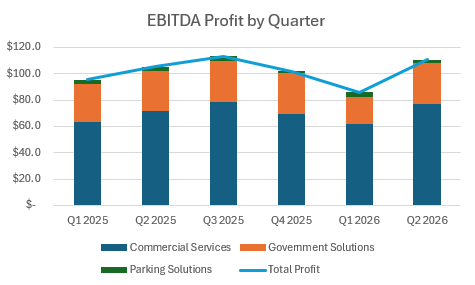
Revenue has doubled over the past four years but flattened in 2025 and now in 2026 it is forecast to drop year to year with EBITDA earnings down 10%. Why?
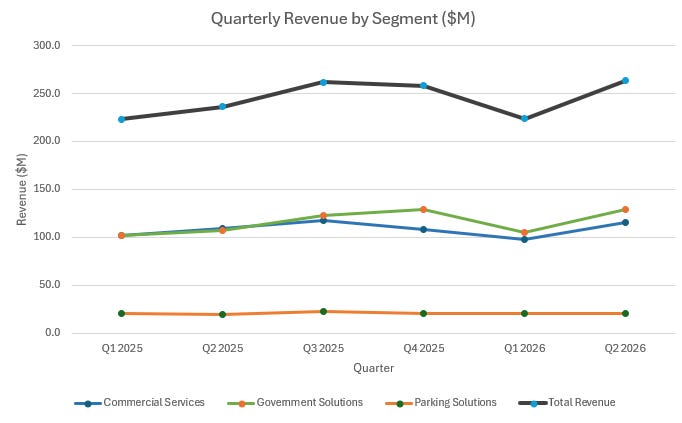
$400m EBITDA for a $717m company (and a $1.7bn Enterprise Value)
So where’s the hate coming from?
Hate? Don’t you mean despising? At $4.72 down about 80% in the past year could this be any less loved?
Termination of the Avis Budget Contract: The primary catalyst for the stock collapse was the notification that Avis Budget Group will terminate its long-standing commercial tolling and fleet mobility services contract. Avis accounted for over 10% of total company revenue and represented a significant, high-margin piece of the Commercial Services business segment.
Severe Financial Guidance & Outlook Cuts: If the Avis contract were lost this would massively affect annualised revenue and segment profit.
Customer Concentration Risk & Erosion of the Bull Case: The unexpected termination caught management off-guard following prior assurances of contract extension negotiations. This exposed severe customer concentration risks in its Commercial Services division, destroying investor confidence in the predictability and safety of its cash flows.
Wall Street Downgrades & Analyst Re-pricings: Equity research firms (including Deutsche Bank and Baird) issued rapid downgrades and slashed price targets. Analysts raised questions about potential contagion risks—specifically whether other major fleet and rental car partners might follow suit or push for far more aggressive pricing terms.
Legal and Class-Action Headwinds: Shareholders launched legal investigations and class-action lawsuits regarding the communication surrounding the Avis contract negotiations. The risk of prospective litigation and regulatory scrutiny further weighed down the equity price.
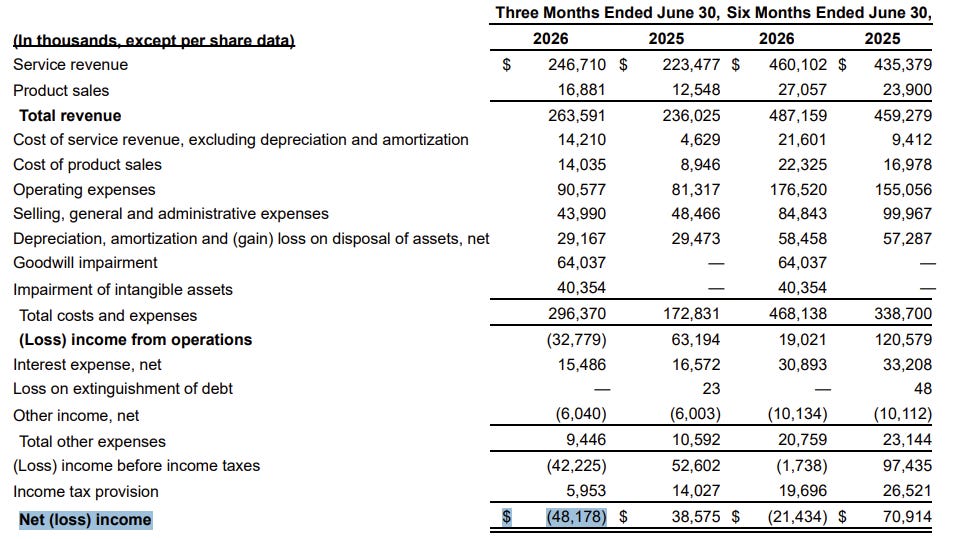
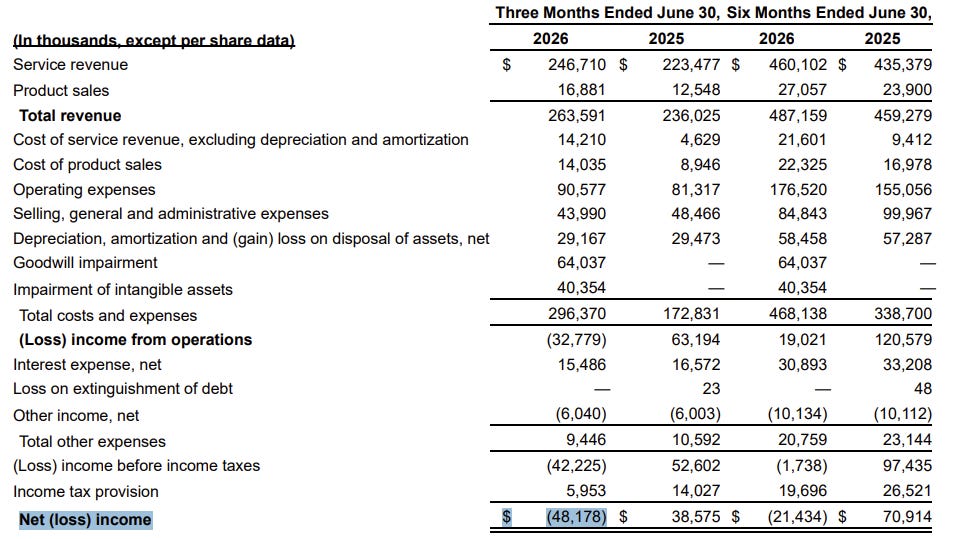
It turned loss making and “lost” -$48.2m in 2Q26
The original contract was terminated. What happened subsequently is that VRRM and Avis reached a framework for a new seven-year agreement, to 2033 with the operational terms still being finalised at the July 28th announcement. VRRM explicitly says the economics will be "materially less favourable" than the old agreement.
Are other customers under threat? No. Hertz is contracted until 2031 and Enterprise has a long-term multi-year master service agreements that typically extends on staggered schedules.
Did Avis play chicken with VRRM? To replicate the complexity of toll management could be a large and complex project. You couldn’t “make do” with stop gap solutions. If Avis had committed to do that work to replicate VRRM’s system would it have agreed a lower rate? Unlikely. So effectively VRRM now knows two things. One that its commercial customers called their bluff. Second that the attraction of building that replica system just became a whole lot less attractive for Avis. The project ROI was lowered when VRRM’s margin was cut. That improved the moat, ironically, forestalling a future attempt.
So the severe financial guidance and outlook cuts were averted. Not that the market has realised. Has the renegotiation had an impact? Sure. Let’s analyse that.
The prior Avis contribution was an estimated $140m revenue / $122.5m segment profit. Let’s assume the profit was now halved to $61m which is also the reduction that fits to the timing/guidance. I estimate Commercial Services now operates at roughly 59% margin on a normalised basis following the Avis reset.
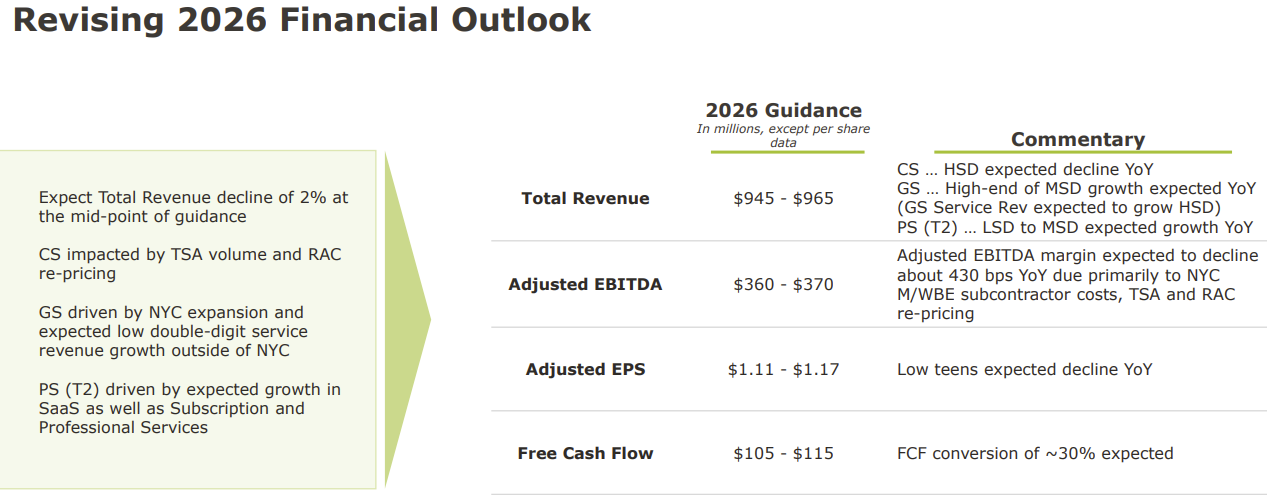
This renegotiation meant 2026 guidance was revised slightly downwards from an EBITDA of $405m-$415m to $360m-$370m. A $35m-$55m drop. The thing is there’s not much to hate about $1.11+ EPS for a share costing $4.72 is there?
It gets better.
VRRM can’t claim to have won a $1bn contract in 2026. No, only a measly $998m contract. Wait, what?
In its latest results (2Q26) Red-Light camera installations drove revenue growth of +17% YoY and +8% growth outside of New York City.
Capital expenditures (purchases of installation and service parts and property and equipment) are guided at $135 million for 2026 relating primarily to camera installations and MOSAIC implementation.
VRRM has been selected for the California speed enforcement program, which makes it the technology partner for all six California cities authorised under Assembly Bill 645. LA is by far the biggest component of the pilot while cities like San Francisco and Oakland are operating smaller scale deployments, Los Angeles brings 125 camera sites online along high-injury corridors. Implementation is underway, with full rollout across LA’s 125 targeted corridors slated to be operational by the end of 2026.
Government Services is growing rapidly albeit with a lower EBITDA margin than Commercial. GS achieved mid-to-high-20s vs about 66% for Commercial.
Current 2026 guidance implies a consolidated Adjusted EBITDA margin of approximately 38.7%. Within that, I estimate Commercial Services at roughly 59% segment margin following the Avis reset, with Government Solutions materially lower due to one-off implementation costs.
The market is obsessing over the customer VRRM nearly lost. Meanwhile, the Government Solutions business is building another growth engine - in the major metropolis of the West and the East Coast.
Government Solutions has lower margins than Commercial today, but it has a different characteristic: growth is being driven by regulatory adoption rather than the renewal economics of three large rental-car customers.
Meanwhile the 2Q26 results also revealed that Commercial Services grew YoY revenue by +6% driven by RAC tolling while Parking Solutions grew +1% YoY.
VRRM reported a statutory loss of $48.2m in Q2. That looks horrific until you look underneath it.
What happened is the $64m question, eh? In 2Q26 VRRM impaired its Parking segment. That’s why it made a statutory loss. Of $64m.

2026 profits are also depressed by large depreciation ($49.5m) and ($58m) amortisation charges. There is another accounting quirk that may be obscuring the economics.
Capex for 2026 is estimated at $135m while Depreciation is $49.5m suggesting the expansionary capex is $85m per year. That Capex is fee earning.

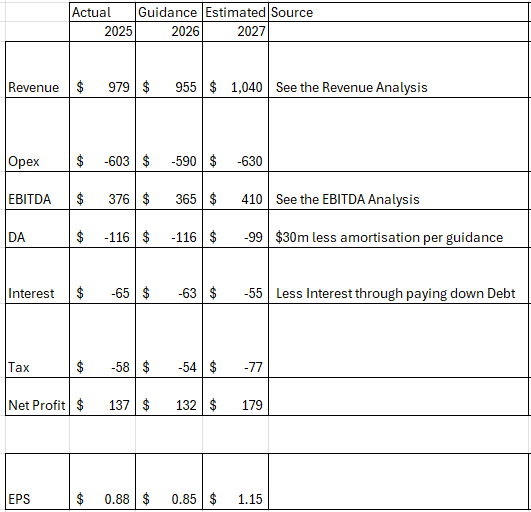
The EBITDA to Net Profit bridge included $66.4m of amortisation in 2025, and is forecast to be $58m in 2026. The market probably hasn’t realised that the amortisation drops away to $28m next year. See the forecast below:
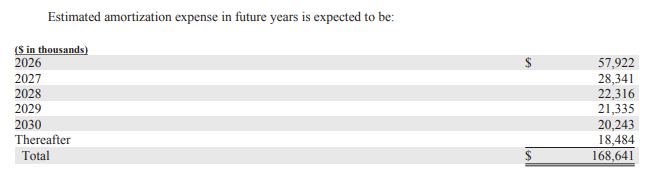
It doesn’t create cash. But it does mean that statutory earnings should receive a meaningful mechanical uplift as amortisation declines. For a company trading on a very low multiple of adjusted earnings, that matters.
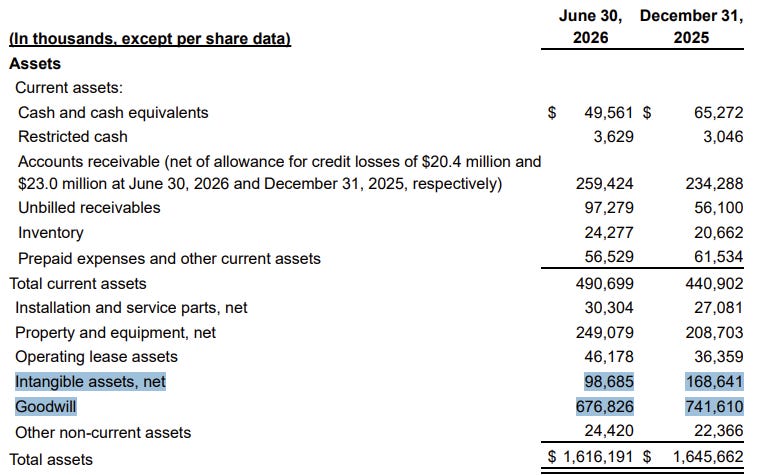
Consider that intangibles went from 55% of assets to 48% of assets in the six months to end of June 26. Property and Equipment rose by 20%, installations by 10% and operating lease assets by 25% and those are income-generating assets. The balance sheet is becoming less dominated by acquisition-related/intangible assets that require amortisation and more reflective of tangible fee-generating operating infrastructure.
The real investment question isn’t: “Is 2026 good?”
It’s “what does VRRM look like once the Avis reset has fully washed through?”
Latest 2026 company guidance is:
Revenue: $945–965M
Adjusted EBITDA: $360–370M
Adjusted EPS: $1.11–1.17
FCF: $105–115M
Using the midpoint: $955M revenue / $365M EBITDA / $110M FCF
My 2027 estimate through the natural revenue growth of commercial albeit at new rates, the contract roll out of New York and Los Angeles supports a base case revenue of ~$1.02–1.06bn / Adjusted EBITDA~$415–425m / EBITDA margin~40% / Adjusted EPS~$1.05–1.15 / FCF~$135–150M
2026 was the reset year. In 2027, Government growth, improving Government margins and a stabilised Commercial business can push EBITDA back above $400M.
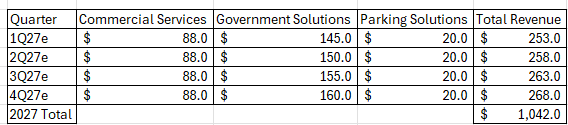
$1.04bn of revenue is arrived through a small 1%-2% growth in commercial (in the latest result yoy it’s 6%), and my estimate of the revenue for GS which is guided, and assuming Parking is static.
A 60% margin is maintained for Commercial, GS moves back to 29% with fixed costs dropping away and Parking is static.
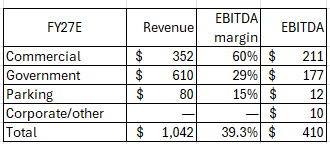
Commercial:
On a smaller, ~60% margin, highly profitable
Government:
Growing revenue. A growing ~29–30% margin, with follow on growth in California where the contract offers long-term recurring revenues with high switching costs.
Parking:
Written down, flat, potentially stabilising.
The full P&L would look something like this. Notice net profits jump substantially. That’s not supposed to happen to stocks falling by 80%.
So far you’ve heard the EBITDA story, but VRRM has $1B+ of net debt, so EBITDA alone isn’t enough. Let’s start with the 2026E EBITDA: ~$365M
Now let’s consider what leaks out and what reaches owners.
EBITDA
↓
cash interest
↓
cash taxes (100% depreciation allowance under the OBBBA)
↓
capex
↓
working capital
↓
FCF ~$110M
The company currently guides to only $105–115M FCF in 2026.
Can FCF recover toward $140–150M in 2027?
There are four factors governing this:
The pace of the Government Solutions roll outs in NYC and LA
EBITDA is affected by one-off implementation costs
working capital not becoming a persistent cash drain
replacement capex (depreciation)
The roll out in NYC is scheduled over 2026 and 2027 with a tail in 2028. The LA pilot programme is being rolled out in 2026. Only bad weather would delay this (and has) although VRRM have caught up to their schedule.
The one-off implementation costs will still be ongoing in 2027.
Maintenance of units is via a local minority-owned firm (Morgner Construction Management) which is handling the physical installation work so this is an external subcontractor cost to VRRM each year, and part of the new NYC contract.
Working Capital in Commercials involves prepayments of tolls, insurance and reimbursables from the RACs and FMCs so appears to rise in line with activity. There is not a similar requirement on the GS segment where the business is capex heavy but working capital light. So working capital as a proportion of operational cash flow should fall in 2027.
We know that historical depreciation was ~$50m in 2025 and is guided as ~$63m in 2026. That appears to approximate to a 6-7 years replacement cycle ($13m incremental and $85m of estimated expansionary capex). Crucially the NYC contract is where NYC own the equipment. So there is no meaningful depreciation on the NYC contract.
How I get to $140m-$150m FCF for 2027:
$110m midpoint recurring per 2026 guidance
$22m-$24m of one-off implementation costs in 2026 that depressed FCF which won’t recur in 2027.
$10m full year impact LA Cameras
$10m full year impact new NYC Cameras
$0m assumes nothing for growth in commercial or growth in parking (despite these being 6% and 1% Y to Y in the latest results)
This is a $717m marcap and $1bn of debt so a $1.7bn EV.
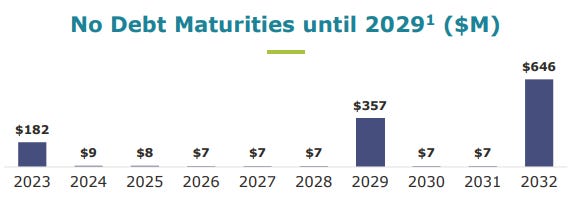
So based on the midpoint guided EBITDA VRRM are valued at a:
~$1.7bn / $365m = ~4.7× EV/EBITDA
And against a ~$420m 2027 EBITDA estimate:
~4.0× EV/EBITDA
Now consider the flywheel:
EBITDA recovery → FCF recovery → debt reduction → lower interest → higher earnings → lower leverage → potential multiple expansion.
VRRM is on track with large moats to achieve a leveraged recovery.
Cumulative FCF 2026-2030 could by 2030 substantially deleverage VRRM while supporting expansionary and maintenance capex.
Risk 1 — Avis is worse than we think
The new seven-year arrangement has materially less favourable economics, but the financial terms aren’t fully disclosed.
The 67% dropping to ~59% Commercial margin assumption is therefore an estimate based on guidance where I’m assuming ceteris paribus - that Avis is the sole reason for the guidance change. Perhaps it isn’t.
Risk 2 — Government margins don’t recover
This is probably the biggest operating risk. The 2027 model needs Government Solutions to move from its current low/mid-20s margin economics toward the high-20s where it was before.
If implementation costs aren’t actually one-off, and margins remain around 20–22%, the $420m EBITDA case becomes considerably harder to achieve.
Risk 3 — Capex remains structurally high
This is the biggest cash-flow question.
If VRRM needs lots of capex every year just to maintain the existing earnings base, the equity is worth substantially less than if much of that spending is expansionary capex. We know the depreciation policy is 3-7 years and we appear to see based on the 2025 results and 2026 guidance an indication that depreciation is 7 years. NYC is buying and paying for the equipment for its $998m contract so there’s no depreciation to worry about there.
A post-pilot California contract (if it happens and no upside is assumed) is particularly important here because VRRM owns the relevant infrastructure.
Risk 4 — leverage
$1bn of net debt isn’t trivial.
If EBITDA falls towards $300m while FCF drops below $100m, the flywheel slows dramatically.
Management then faces the classic leveraged-company dilemma:
Invest for growth, pay down debt, or optimise existing infrastructure.
You can’t maximise all three.
Risk 5 — customer concentration
The Avis episode demonstrated that the concentration risk wasn’t theoretical.
Even if Hertz and Enterprise remain firmly contracted, investors may reasonably decide that VRRM deserves a discount because of the future bargaining power of its largest customers.
(Despite the bargaining power of VRRM as a monopsony supplier)
That discount may never disappear completely.
VRRM’s own guidance implied an adjusted EBITDA margin of approximately 40% in 2026 before Avis intervened.
Q1 2026 delivered 38%.
Q2 2026 also delivered approximately 38%.
And at least some of the margin pressure is related to implementation and subcontractor costs associated with the Government rollout.
So I think the market is looking at the wrong year.
2026 is the reset.
2027 is the test.
The thesis doesn’t require Commercial Services to return to its old economics.
It simply needs Commercial to stop getting worse.
The major Commercial customers are now locked into multi-year arrangements.
Historically, Commercial has grown around 6% and generates exceptional margins.
I’m assuming that Commercial growth slows materially, although there’s no sign of that.
I’ve assumed Parking does nothing.
I’ve assumed no new major contracts.
I’ve assumed Government Solutions simply rolls out according to plan and margins recover towards the high-20s.
I’ve assumed there is no continuation of the California programme beyond what is already visible in my numbers, and in the risks.
There is no heroic assumption about new business.
And yet the model can still produce approximately $420m of EBITDA and $140–150m of FCF in 2027.
At today’s valuation, that puts the business at roughly 4× forward EBITDA.
If the debt starts coming down, the earnings recover and the market begins to believe that the Commercial business has stabilised, the valuation mechanism becomes self-reinforcing.
EBITDA → FCF → debt reduction → lower interest → higher earnings → lower leverage → potentially higher multiple.
That’s the flywheel.
VRRM isn’t risk-free.
Avis has demonstrated that.
The $1bn leverage is real.
The Government margins need to recover.
Capex needs watching.
Underneath the battlefield dressings is a business with high recurring revenues, enormous switching costs, long-duration government contracts, exceptionally high Commercial margins and a growing Government Solutions operation.
The market is pricing in a wounded animal.
I’m interested in what the business looks like once it’s healed.
Because I believe this deep-moat, cash-generative business could deliver compounded flywheel returns from here.
Regards
The Oak Bloke
Disclaimers:
This content is for educational and informational purposes only. It does not consider your personal circumstances and is not financial, investment, tax, legal, or professional advice. Nothing here is a recommendation, offer, or solicitation to buy, sell, or hold any investment. Investing involves risk, including the loss of capital. You are solely responsible for your own decisions
Micro cap and Nano cap holdings including FTSE250 companies might have a higher risk and higher volatility than companies that are traditionally defined as “blue chip”
Comments
Nothing yet. Say the first thing.
Sign in to join the conversation.