
I’m looking for a sign of fire. People.
I take a glance at the time on my phone. Ten-thirty at night. The gates close at midnight. I have a bit of time, but not much.
The rail track next to my apartment complex is jagged and uneven—two heavy parallel lines with horizontal strips of wood, that appear endless into the blackness. In between the lines are small whitish rocks, knocking softly against each other at my every step. I was expecting brighter scenes. More fire, more people. Instead I find only sad ashes, heaps of grey dotted along the steel lines.
I look around and find it darker than usual. Normally there’s more light from the strip of shops on the left side of the rail, but most are closed now. My eyes struggle to see their details in the dark. I can feel the rocks poking through my sandals. Worried that I may trip, I turn on the flashlight on my phone and check the ashes and the rail as I walk.
They must be tonight’s ashes. I heard they clean the ashes every day, leaving the burning spots clean in the morning. I’m not sure if I believe that. Who is tasked with sweeping ashes at an abandoned rail track? Sounds like a fake job.
Then in the distance, a small glow of fire, its yellow light a halo on the wall. I rush and jog toward the glow, a rustle sounding from inside my backpack. It is so quiet that all sounds coming from me seem amplified: the rattle of the rocks at my feet, the rustle of the paper at my back. I hear the noisiness of my own breathing, alternating with the regular beat of my heart.
On a closer look I find that it’s only two lonely red candles. Their tiny flames flicker in the soft wind of the night. I need a proper fire, a burning spot, a tribe of people. My backpack feels heavy—the way worldly things pull you down to the ground. They need a flame to carry them up, and it’s in my hands to ensure that. I continue my quest.
Then there it is, in the distance. A surer, bigger glow of fire. I rush again, faster this time; the crack-crack sound of the rocks follows faster too, like the drumbeat of a battle.
I can see it now. The tribe of people squat around it—a family of dad, mum, and daughter. I feel so relieved to see the mirage, half-running in their direction.
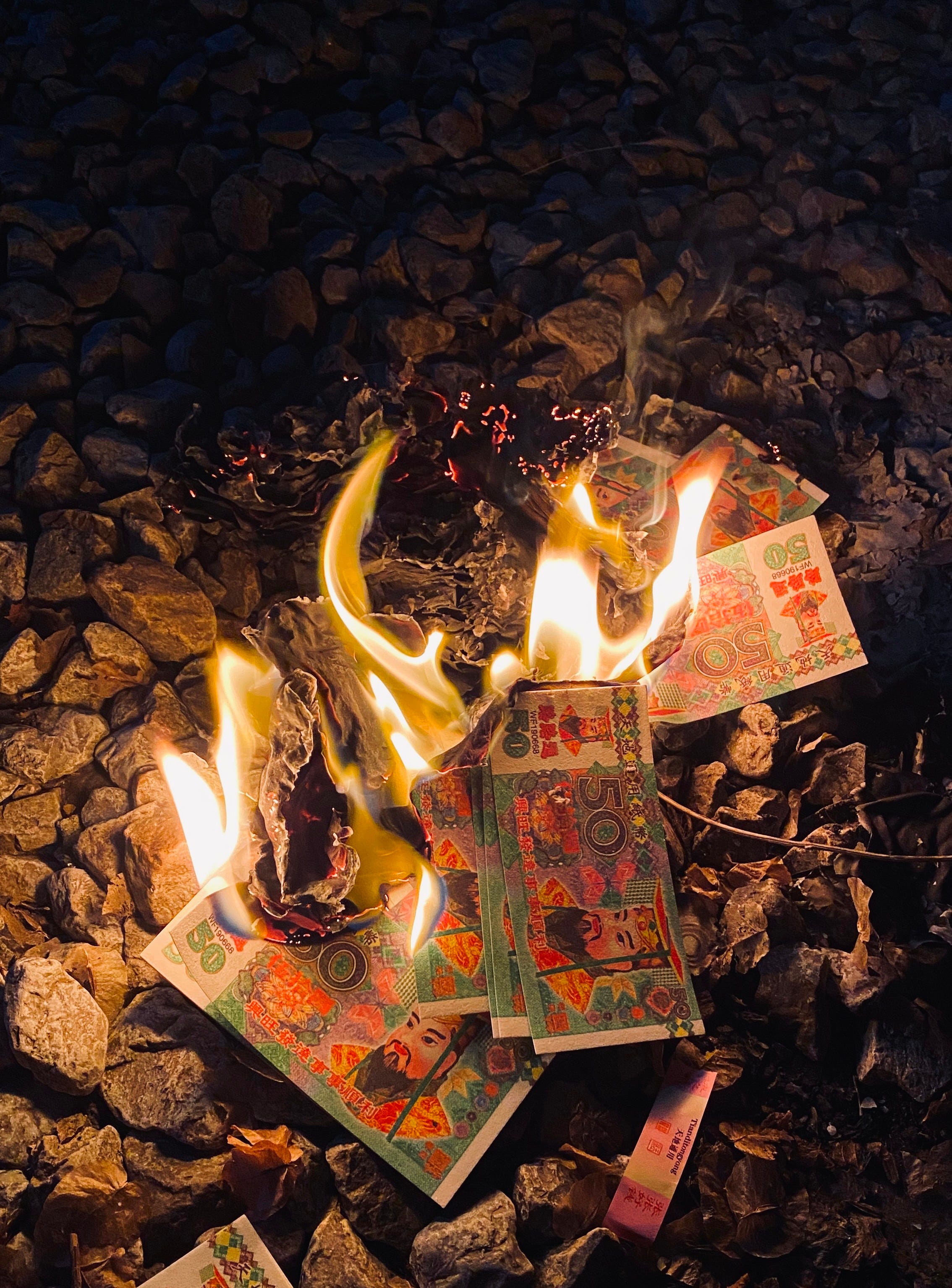
From my backpack I take out a stack of paper money, the sign of the tribe, proof I’m one of them. I insert myself into the circle and shove the stack toward the flame. The family flinch.
“No, no. You can’t burn here,” they say, waving me away. “This is our family’s fire. You start your own fire.”
I’m knocked back, my cheeks burning, both by the fire and the closing of the circle. Trying to clarify, my Chinese comes out slow and blunt, their Chinese rapid and sharp. I don’t understand every single word, but I understand what rejection looks like.
I stand there, confused and uncertain, rocking on the balls of my feet, looking at them. I don’t know where else to look; there’s nobody else on this track as far as the eyes can go. People tell me you burn where people burn, where the flame is. Have I got the wrong message? They also say, everything needs to burn before midnight. That’s the rule.
They sense my confusion, my foreign-ness, my newness to the whole ritual. As if I come from another world—which is true in many ways. The dad and daughter don’t even look at me; I am a ghost to them, invisible. But the mum melts a little—like all mums—and she suggests that I start my own fire at an empty spot. Not where the grey ashes are.
My eyes dart back and forth. To their fire, and to the darkness. To the piles of ashes along the rail track. The intuition is to pick a spot with the grey ash; it’s already been deemed as a decent spot after all. But she says, pick a fresh spot. Don’t pile on someone else’s dead.
So I walk around in a circle, like a puppy looking for just the right spot to pee—a little step to the left, a little to the right, back and forth. Finally deciding that a spot is as good as any, I make an imaginary mark—X marks the spot—and squat. There, among the white rocks in the shy, dim light, covered by the shrubbery so it’s not too windy, just steps away from the family.
My small lighter flickers to life, like the first man with fire—or woman. I pour out the stacks of paper money from my bag, onto the ground. The different denominations and colours are scattered against the white-rock background. The picture of the Heavenly King smiles on the crisp notes, fresh out of the factory of the earth, to send to the other dimension—the currency of the dead.
I split the stack of joss paper money apart, and press the tiny flame close to the first small bunch. The flame seems to catch for a second—then it goes poof.
I click and click my lighter again. Ten times, twenty times. It goes poof every time, the desperate spark too weak to start a fire. As if the spark and the paper are in a fierce battle, the paper wins every time—so stubborn it refuses to burn. How can it be so hard to burn paper? I don’t understand. And what am I doing here? Is this all real?
My fingers are hot and sore from the failure of the lighter, while I sniffle from the cold that starts earlier in the day. My heart beats faster, and I feel sweat on my neck and back, in contrast to the breeze of the cold summer night.
“I can’t start the fire,” I say to the family, admitting my defeat. “Can you help me?” There is no please in Chinese. I wish I could say it—many times. Please, please, please help me. I’m running out of time. If I fail now, nothing will be delivered, and everything is for nothing. It must be over eleven by now. The gates close at midnight.
A pause hangs in the air. They look at this pitiful foreigner and probably wonder: Does she even know what this is all about? I wonder if they can tell that my belief is not watertight—it’s shaky and wavering, like the battle between the spark and the paper. But somehow, a flash of connection forms, and they understand. We’re all here for the same thing.
“Wait until we’re done, okay,” the mum says. “We’ll help you then.” I breathe a sigh of relief.
So I squat and watch them, the family of three. They're burning a mishmash of things made from paper—joss paper, cardboard, empty delivery packages with names and addresses still slapped on them. An empty white package catches the fire very quickly as they chant in a low voice, like prayers in a temple: “Yeye, Grandpa, hope you are well. This is for you. Be well, yeye.” A quiet family ritual around a fire, with me, a stranger observer, waiting outside the circle.
The track walks along a wall—colourful with paintings of Kunming scenery. I hear the railway goes all the way to Vietnam—or Myanmar. One of those. They built it wanting to go to one place, but changed their mind and went to another. I don’t know how far the trail goes. Once I followed it for about an hour but it went to a bad part of town, so I turned back. Since then I have walked the rail many times, passing universities, shops, night markets, but never past that last point.
Several minutes later, they’re done. The mum keeps her promise and shows me how it’s done. She has a stronger lighter, the kind with the flame that shoots straight up like a gas torch. She holds a bill of paper money upright, and immediately it catches fire and burns with conviction. In that second, my eyes burn too, with hot tears, as a mix of relief and gratefulness bubbles to the top.
“Here, you can take it,” she says, giving me her lighter. I thank her vigorously: 谢谢, xiexie, looking the other way to hide my tears. Then they leave — like ghosts.
Just me, the fire, and the paper money now. And the last thing that I’ve been keeping from them—the letter.
People have been burning for a month now, during the time when the realms of the Heaven and Hell are open and connect with the realm of the living. Earlier in the day, I thought we had more time. I woke up groggy from a nap to tame the cold, only to be told that today is the last day of 中元节 Zhongyuanjie—the Ghost Festival. Finish all your business by midnight.
I sit on the parallel steel line and start my own ritual, as I burn paper after paper. The fire licks, like a small dragon, and I feel the heat on my face, in my breathing down my nose. Sometimes the smoke goes too far into my lung, and I cough. Occasionally, the fire dims into glowing embers, but I don’t panic; I know how to restart it now. At times the fire grows a little angry, and chunks of paper are swallowed all at once by the curl of the yellow-red flames.
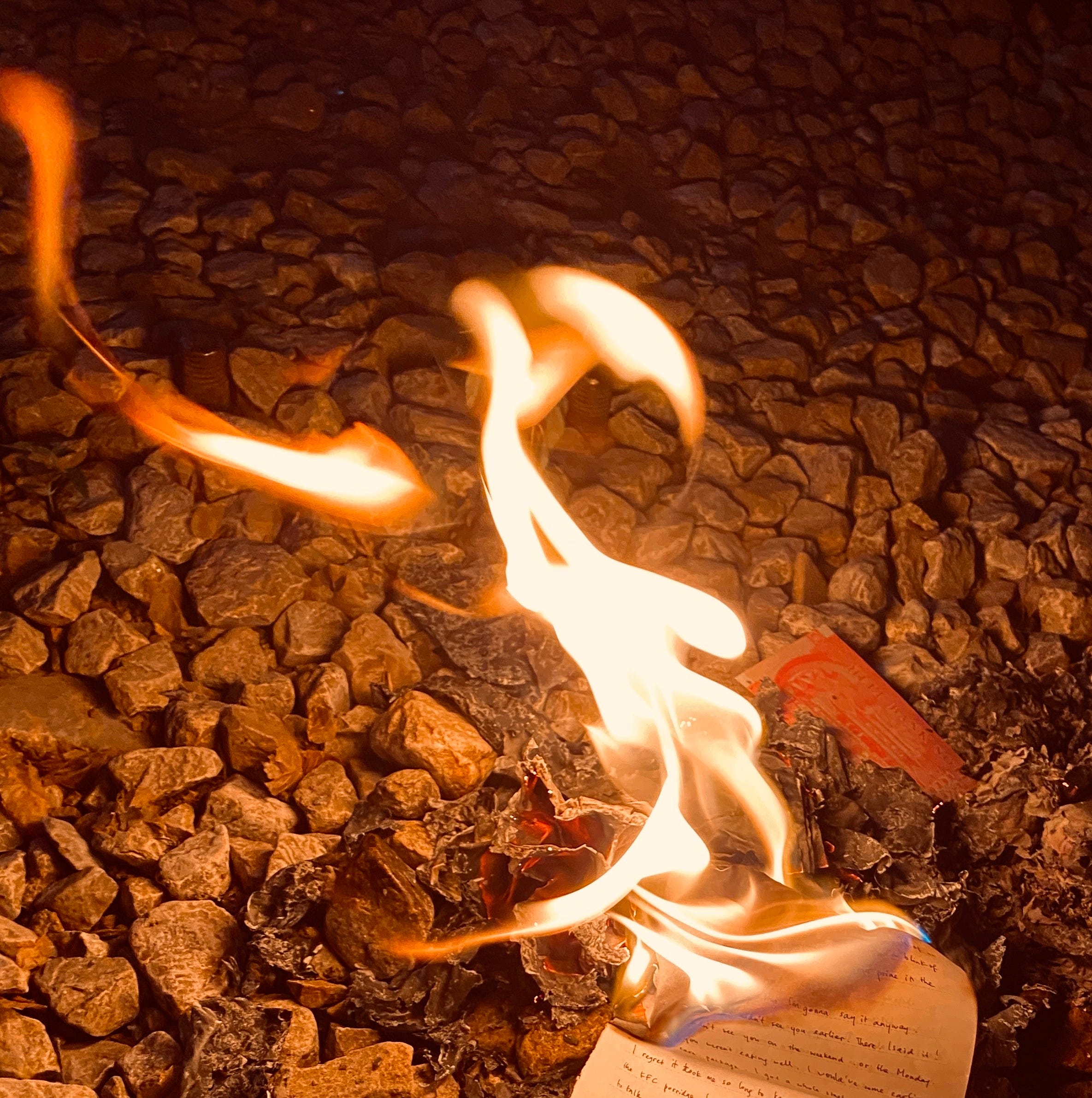
When the fire is burning solid, I finally throw in the letter I wrote earlier in the afternoon. The penned words on the lined off-white papers are quickly enveloped by the blaze, turning black, into ashes, their micro bits flying in the air. I imagine the ashes being brought into another world and, over there, turning back into words, like heavenly magic.
The smoke rises in ribbons of white, curling and tumbling up north to the sky. Like it’s got somewhere to go, but not in a rush kind of way—a whisper in a white smoke, a message in a bottle. Go words, flow, and find the person you’re meant to claw, and tell them these strings of wishes, the beads of round words, the clackity of the characters. How could mere lines on paper embody the language of loss? I always wonder at the power of words.
I said—wrote—I’m sorry. Again. I’m sorry I was too late. It’s silly to feel regrets after everything is over and done with. But I can’t help it; it’s the overwhelming feeling I have. I can’t do anything about it, only acknowledgement.
But I’m not late now. I’m just in time.
I don’t believe in heavens or eternal life—they’re mere fairy tales to me. But in this land, I’ve grown to like the Dao idea of past lives, of crossing the bridge, drinking the soup of forgetfulness, and being reincarnated back into the world. Though liking and believing are two different things.
People are scared to disappear, as if their souls are never here. But I’m one of those people who don’t mind going poof into the ether. After this life is done, I’d say, thank you for all that, and merge back into the universe, among the planets and the stars.
Isn’t that the best way to live? To think that this life, is the only life that matters. One chance. One shot. Go for it with all your might. Be silly, be brave, make mistakes. Love. Live. Die. Don’t think about what’s next. There is only now.
The Chinese believe that the paper money works as an afterlife currency. They burn other things too: gold nuggets, phones, houses—all made from paper, sent as provisions for the dead in the other world.
Sounds both silly and practical at the same time. Leave practicalities to the Chinese—the masters know how to do it best. Tonight, I don’t wonder whether I believe or not. I just do what needs to be done and follow the order: from colourful paper, to the tongue of the glowing flame, to the black and grey ashes, to the smoke rising up to the sky. Repeat. Regrets, wishes, sadness, memories—rising up to the sky. Repeat.
How did I get here? How did I end up burning paper money alone, burning a letter filled with regrets, in the middle of the night, at an abandoned rail track for a dead friend?
The things China makes you do.
I brush the ashes from all over my clothes and walk home, feeling like I too have somehow crossed to another world, and back.
Author’s note: This is my true experience of Zhongyuanjie in Kunming, just four days after my friend’s death — a ritual I was honoured to witness and participate in, and a memory I will forever keep in the jar.
Paper Wife is part of the Between Worlds series. Each piece can be read independently, but if you’re so inclined to read the full series, they are:
Comments
Nothing yet. Say the first thing.
Sign in to join the conversation.