
Hey readers,
I’m in Pittsburgh for my subscriber event – basically a day and a half of urban exploration. What follows are some reflections from Day One of the tour.
Andy Warhol grew up in Pittsburgh, but after he graduated from Carnegie Mellon, he moved to New York City to launch what would become one of the most celebrated careers in 20th century art.
Warhol felt he had to move to access New York City’s creative community. But were Warhol alive today, would he feel the same pull? Or could he find enough opportunity and fellow artists in Pittsburgh?
On the first day of our tour of Pittsburgh, I came to imagine that a new generation of artists might not only stay in Pittsburgh — but that artists from outside the city might move there for its burgeoning art scene.
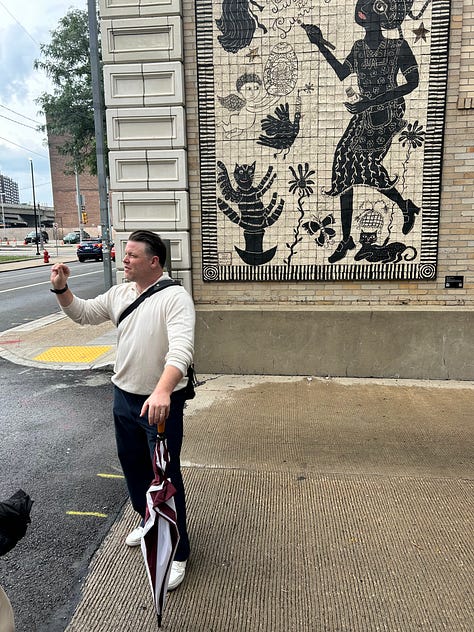
Our first stop on the trip was to the Andy Warhol Museum which hosts a considerable archive of Warhol’s work and possessions. Since opening in 1994, the Warhol has become an anchor institution for Pittsburgh’s North Shore. In 2022, the Warhol launched a new initiative to rebrand six blocks surrounding the museum as the Pop District, and with sizable support from local philanthropies, to build a larger cultural campus.
Some of the ambitious plans have begun to roll out. First, the Warhol has used art and placemaking to help revitalize the surroundings.
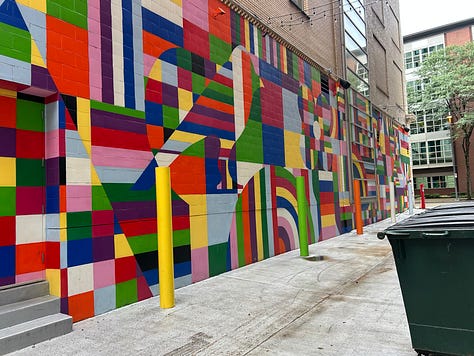

In particular, “Silver Streets,” an installation conceived by landscape architecture firm, Merritt Chase, featuring a mural “Over the Rainbow” by Typoe, has turned a previously nondescript alley into a destination. The silver street references the many silver surfaces and pieces of furniture in Warhol’s New York City studio, known as The Factory.
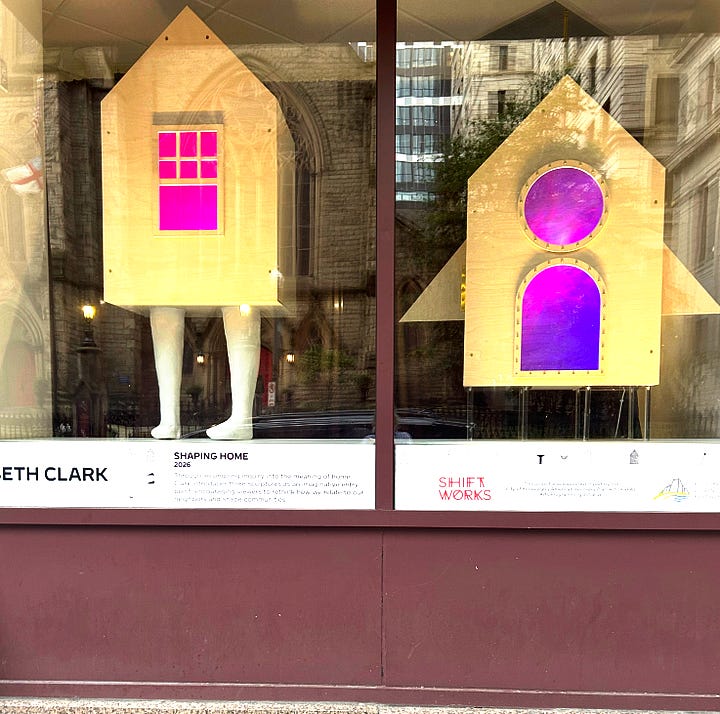
While the Warhol is adding to the artsy character of its own neighborhood, it’s not the only entity using public art to enliven Pittsburgh’s streetscape. Throughout downtown, the nonprofit Shiftworks has installed artworks in 53 vacant storefronts as part of the Partnership for Downtown Pittsburgh’s Vibrancy Initiative. Many of the storefront installations were really high quality, and I found myself moved by the message they carried: art is critical to Pittsburgh’s vitality and future, not just a pretty placeholder. Indeed, Shiftworks has integrated art into community development through artist residencies, used art as a tool for civic engagement, and launched a creative corps that serves as a workforce development program for artists.

Back over in the Pop District, Dan Law, Associate Director at the Andy Warhol Museum shared the vision for The Warhol’s expansion — not only in terms of physical space in the Pop District, but in its offerings to the community.
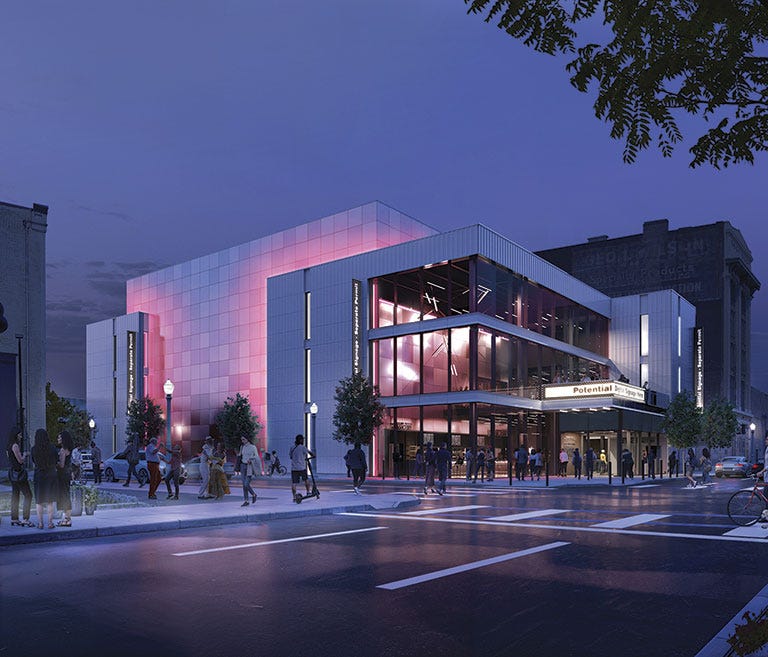
In the museum’s engagement with the surrounding community, the Warhol found that residents were seeking jobs with family sustaining wages, after school activities for children, and more arts programming that isn’t just 9-5 when most people are at work or school. In response, the Warhol plans an expansion on current surface parking lot to create a new venue, called the Factory Creative Arts Center. The new building will host concerts, as well as serve as an event space for public programming and private events, such as weddings.
To address the need for after school activities for neighborhood children, The Warhol has created a dedicated ground floor space called the Pop District Print Lounge where teens can create screen prints like Warhol himself once did.
But perhaps their most ambitious undertaking is the Warhol Academy. We headed up into a neighboring building to see the Pop District HQ, where students can take classes and budding entrepreneurs can co-work.
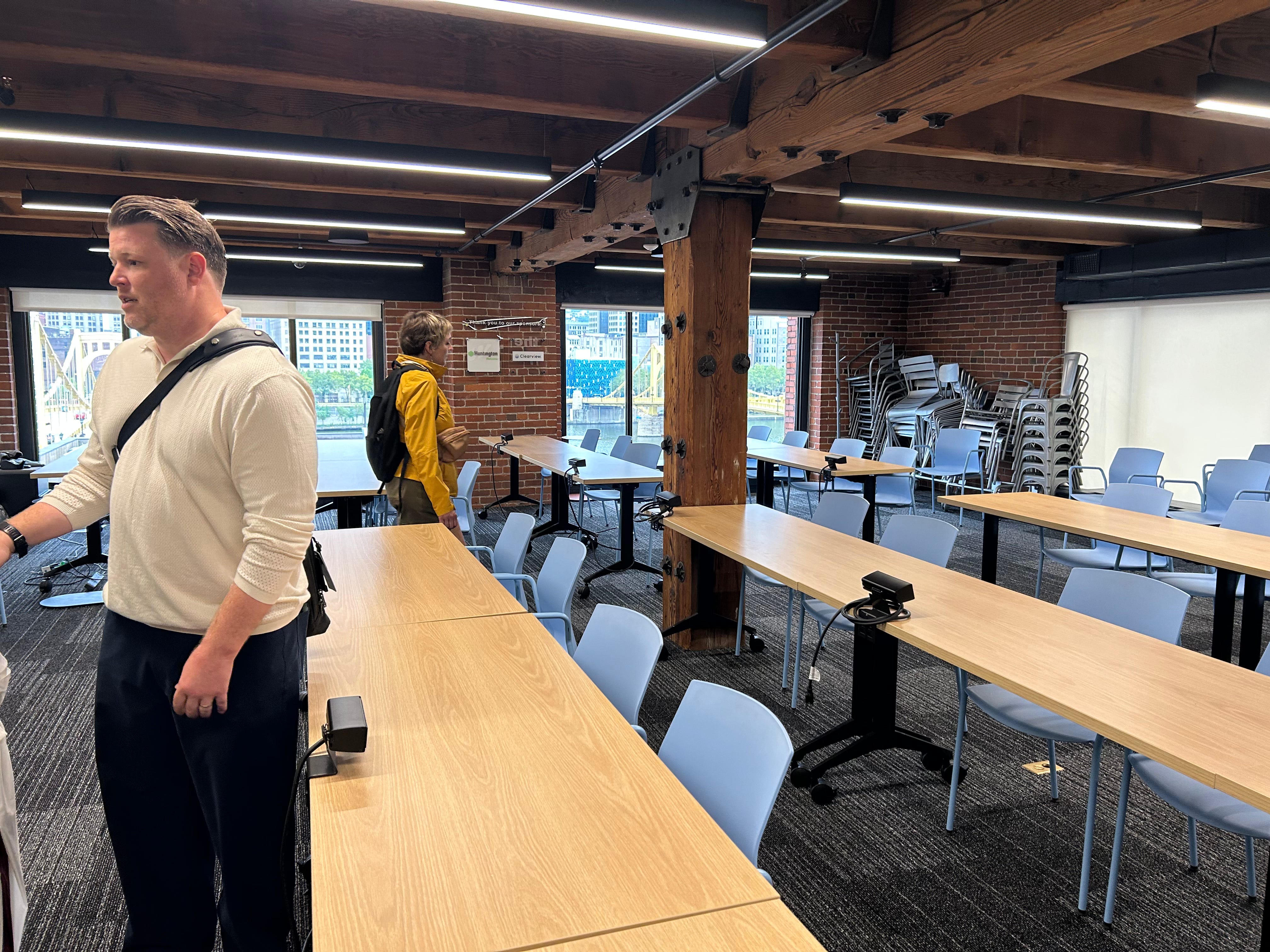
The Academy prepares students for careers in creative and technology fields. These programs — whether a teen DJ program or a digital content creation fellowship — are all free. At a time when people are questioning the expense and value of higher education, programs like this one are taking the cost out of the equation, and reaching people who are eager to learn new skills. As of 2024, more than 400 people had participated in these varied programs, with hundreds more since.
After leaving The Warhol, we made our way down to the Allegheny riverfront to experience Shore Thing, a barge project by the nonprofit, Riverlife. Launched last year, Shore Thing helps people not just access the river, but linger alongside it. Despite many people using the river for recreation, there’s no easy place to grab a drink or an ice cream or just a place to relax along the river. Shore Thing solves that and when I returned to it on Wednesday afternoon around 6pm, I found it packed with people lounging alongside the riverfront.

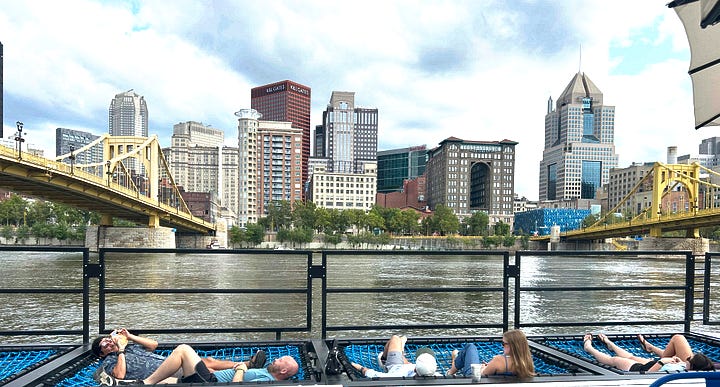
Riverlife’s Director of Planning and Projects, Gavin White, shared the challenges of getting the barge built — cobbling together funds from the Allegheny Regional Asset District and foundations, getting permitting, retrofitting a shipping container to serve food and drink, powering it with renewable energy. But he also focused more on the positives, such as forging partnerships around programming. No surprise, arts groups, such as the August Wilson African American Cultural Center and Attack Theatre among many others, have brought a really fresh set of activities — music, writing, craft and more to the barge.
This year, Shore Thing features a shade sail by Alejandro Franco and Kelly Jimenez’s art collective, La Vispera. The team assembled colorful discarded plastic on marine vinyl to create a piece that looks like a stained glass rose window in a church.

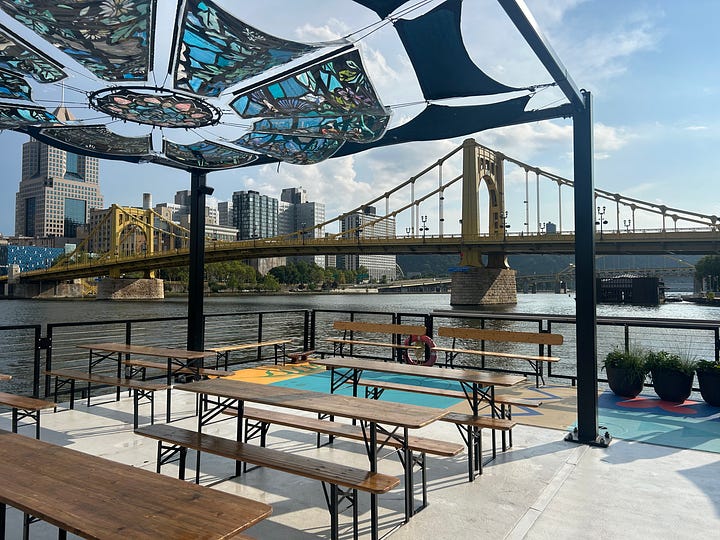
We met with La Vispera’s Franco, whose work is also showcased in a storefront downtown, and he noted that it’s hard to get commissions until you have gotten those early jobs to show your work off. Pittsburgh has given him that opportunity.
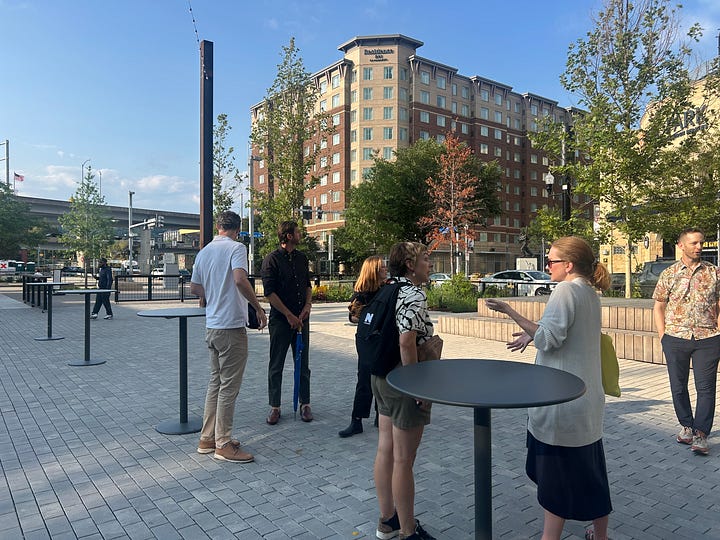
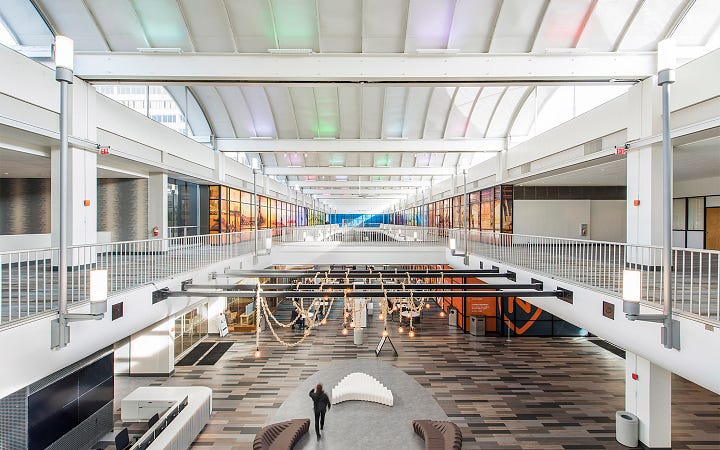
This remark echoed a comment made earlier by Nina Chase, of Merritt Chase, that Pittsburgh’s spirit of experimentation rewards emerging practitioners. We wrapped up the evening walking past one of Merritt Chase’s new projects, a plaza across from the Pirates’ stadium, which is also being retrofitted to engage pedestrians at the street level. New market-rate housing is filling in the block. Then we checked out Nova Place, a former mall turned into a co-working space with food hall. All of these bets on quality of place are adding up to not just a more compelling neighborhood, but a sign that an arts community can be connected to a stadium district and an office park.
As I walked back to my hotel downtown, I meandered through the cultural district where many of Pittsburgh’s key performing arts organizations are based. Especially as downtown shifts away from commercial office buildings toward residential — a transition that is proving slow and a bit painful — cultural organizations are buttressing downtown, providing the foot traffic at night and the visitors who go out to dinner or after concert drink.
Warhol left because Pittsburgh’s economy centered on hard industry, offering little infrastructure for the artistic community. These days, Pittsburgh’s focus on art, quality of place, and creative livelihoods is providing artists with reasons to stay. It’s hard to say if these efforts would have been enough for Warhol, but perhaps more importantly, they’re aimed at the next generation who might otherwise leave.
Much more to come about what we saw in Day Two!
This work is only possible because a few people subscribe with each post. If you enjoy my writing, please take a minute to upgrade to paid to keep it going.
Comments
Nothing yet. Say the first thing.
Sign in to join the conversation.