
In the first installment, I discussed the evidence for the loss of real childhood, and the harm it causes the rising generation. I named four points about risk that are important to consider: Real World Experience is Better, Children are Anti-Fragile, The Risk of Kidnappings by Strangers is Extremely Rare, and Safety is Not the Point. There were a couple long paragraphs copied here in THIS post, from Jonathan Haidt’s book, describing how why children need free and unsupervised play, especially outdoors and with friends — in places where they need to negotiate, and where they need the real possibility of failure and harm. Somehow, I lost those paragraphs and don’t have the time to find and retype them right now. So, on to the rest of the post…
Kids don’t engage in this kind of play as much as they used to — we know that. What keeps kids from it? Overprotective parenting, and smartphones. Both of these are “experience blockers” – in different ways they block kids from having a classic childhood – the type we were made for, and that our societies have always allowed to children.
Let’s talk about the smartphones first, and my first point about risk: REAL WORLD EXPERIENCE IS BETTER. By this, Haidt means that it’s better for children’s happiness and growth, in many, many ways.
Let me give you Haidt’s stereotypical division of REAL vs. VIRTUAL experience. [pg 9]
- Real world experience is embodied. Virtual world experience is disembodied.
- Real world experiences are synchronous. We get feedback immediately from the people around us. Virtual world experience is asynchronous. Interactions can be separated by hours or days. Even when one has stopped engaging in it, someone else may be participating directly with something you said.
- Real world experiences are one-to-one or one-to-several. Virtual world experiences are often one-to-many, in which an individual’s actions may be seen by thousands of strangers.
- Real world experiences have a high bar for entry and exit — we play with people we know personally, and have a lot personal investment in the relationship. It can be hard to enter a group, and we don’t want to leave it. Virtual world experiences often have a low bar for entry and exit. It is easy to drop in, make a post, and leave. It is easy to block people we don’t like. There is little personal investment in any given relationship.
Now, the fact that the VIRTUAL WORLD is not as good for kids should come as no surprise. Whatever problems there are in the real world, it was made by God. It has been developed by generations of men and women with consideration for the good of posterity. It has solved so many problems. The virtual world, on the other hand, is a recent invention, and is significantly controlled by institutions who make their money by stealing and holding your children’s attention and selling it to the highest bidder.
Smartphones as Substitute
Another element of the REAL WORLD is that reward is not so cheap and easy. Humans work well when achievable goals are somewhat – but not impossibly – out of reach. This is a spur to growth, to persistence, to diligence, to cleverness. In the virtual world, the candy of easy entertainment is placed in front of every child, within the simplest reach. The whole design of DESIRE to WORK to COMPETENCE to REWARD is short-circuited.
NATURAL DESIGN
DESIRE – WORK – COMPETENCE – REWARD
Desire must pass through hard work to competence to get other rewards.
CHEAP AND EASY REWARDS
DESIRE – work – competence – REWARD.
The design is short-circuited.
What does all this have to do with letting kids be unsupervised? How does our current attitude put them at greater risk? Well, kids want risk and adventure – and they WILL find it, no matter what we do. They want to be unsupervised. If we don’t allow it them in the real world, they will find it for themselves – in the virtual world.
Now let’s talk about overprotection in the real world, and my SECOND POINT about risk: CHILDREN ARE ANTI-FRAGILE.
There is a common distinction made between materials that are fragile and materials that are resilient. The china teacup is fragile — it will break under moderate stress, so we must protect it. The plastic cup is resilient — it will not break under moderate stress, so we don’t worry if we drop it.
A modern author, Nassim Taleb, has distinguished a third category, which applies to many living systems — anti-fragile. An anti-fragile system is one that is made stronger by moderate stress. Here are two classic examples.
The immune system, if exposed to germs, will develop the capacity to resist infection and disease. If a child is thoroughly protected, though, his system will not develop the capacity, and thus be highly susceptible to illnesses that most people shrug off.
Plants, grown naturally in the outdoors, are exposed to fluctuations of temperature, and varying degrees of wind, and thus develop a stiffness and strength. They may have a few spots here and there for their trouble, but they will be strong. Plants grown in the greenhouse, however pretty, will wilt at the first gusts, or especially hot days or cold nights. This is why gardeners say that one must “harden off” a greenhouse plant — giving it a little exposure, and then protecting it, for a few days until it has developed its resistance.
Frequent, low-level stresses – REAL stresses, and ones that children are NOT saved from, but have to overcome on their own – make them stronger. Some stresses, of course, can be too great – it is good to bruise, and maybe even to break a leg. It is irrecoverable to LOSE a leg. But there are plenty of moderate stresses that we HAVE expected from kids, from which we now protect them.
Related to anti-fragility – the overprotective attitude also teaches our intrinsically rational kids that the world is a thing to fear. And THAT prevents wonder, adventure, and learning.
DISCOVER vs. DEFEND MODE, and the Optimal Relationship
One can divide the way we approach the world into two fundamental modes – DISCOVER mode, and DEFEND mode.
Discover mode is when we are open for new opportunities, easily engaged, ready for wonder, and with a sense of our own competence and potential mastery.
Defend mode is when we are on the lookout for threats, easily closed and protective, afraid, and with a sense of our own weakness and potential loss.
Here is how Haidt describes the NORMAL way of children in the world, who DO need some safety — but not too much. Here’s how it works.
We See This – Kids Need Risky Play, and Real Challenge
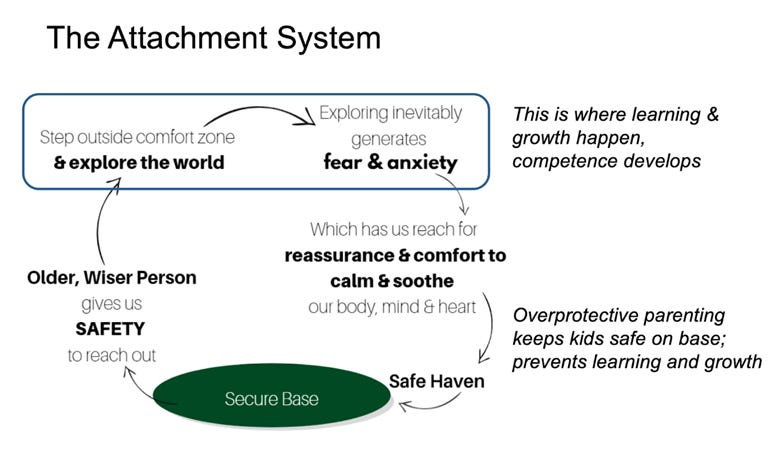
We understand that this is how healthy children play. They seek out the next level of risk – ALWAYS – because they have a natural desire to grow in competence, and the overcoming of danger and challenge.
We see this on the playground. Little kids love to go down the slide, but once they get a little older, they try to climb on the outside of the playground. Older still, they get their thrills by walking on top of the monkey bars — or the swingset!
Honestly – things that are too safe are just NOT fun. And this is a GOOD arrangement. As kids grow, they seek out the next level of risks, which they enjoy. They get cuts and bruises. They get lost for awhile, and are afraid. They face the things they are afraid – not the terrors, not the great responsibilities of adulthood – the smaller threats and challenges that are suited TO THEM. And in so doing, they suffer – like cuts and bruises, and maybe even a broken bone – real suffering! – but they grow stronger. SO when they DO face the terrors and adult challenges, they are strong enough. This is anti-fragility. This is the design.
What does this have to do with unsupervision, and the Anxious Generation? Well, kids are overprotected, and so they don’t learn. They remain weak and afraid. And that’s what our world is making RIGHT NOW.
In the next installment we’ll dive into the data about the actual threat of kidnapping by strangers. It is extremely rare - and I’ll show you how you can be convinced of this, too.
No posts
Comments
Nothing yet. Say the first thing.
Sign in to join the conversation.