
Listen to the latest episode of the News Block below.👇
CLARITY Act Faces Critical TestAlright, everyone, welcome back to the News Block.
Bitcoin held up surprisingly well this past week despite another escalation in the conflict between the United States and Iran over the weekend.
Oil prices moved sharply higher as the two sides exchanged additional attacks, yet Bitcoin is still hovering just below $65,000 at the time of recording.
And while geopolitical uncertainty continues to dominate the headlines, another potentially major catalyst for the digital asset industry is approaching in Washington.
NYDIG recently called the CLARITY Act “the most important forward catalyst for the industry.”
That may sound like an exaggeration, but the bill could finally establish a comprehensive federal framework for digital asset markets in the United States.
It would help determine which assets and activities fall under the SEC, which fall under the CFTC, and what rules apply to exchanges, stablecoins, custody, tokenization and decentralized finance.
The House passed its version last year with strong bipartisan support. Then, in May, the Senate Banking Committee advanced the bill by a vote of 15 to 9.
But getting it out of committee was the easy part.
The bill now needs enough support to clear a 60-vote threshold in the full Senate, and the biggest remaining obstacle is an ethics provision that would limit the ability of senior government officials and their families to profit from digital assets while serving in office.
That issue became even more contentious after President Trump’s latest financial disclosure showed that he earned more than $1.4 billion from his family’s crypto ventures in 2025.
Two Democrats who helped advance the bill out of committee, Senators Ruben Gallego and Angela Alsobrooks, have said they will not support final passage without meaningful ethics restrictions.
President Trump met with Republican senators and senior White House officials on Thursday to discuss possible language. But as of this weekend, there has been no public announcement of a bipartisan agreement.
Stablecoin rewards have also been a major sticking point.
Banks want Congress to close loopholes that could allow exchanges or affiliated companies to pay yield on stablecoins because they fear digital dollars could pull deposits out of the traditional banking system.
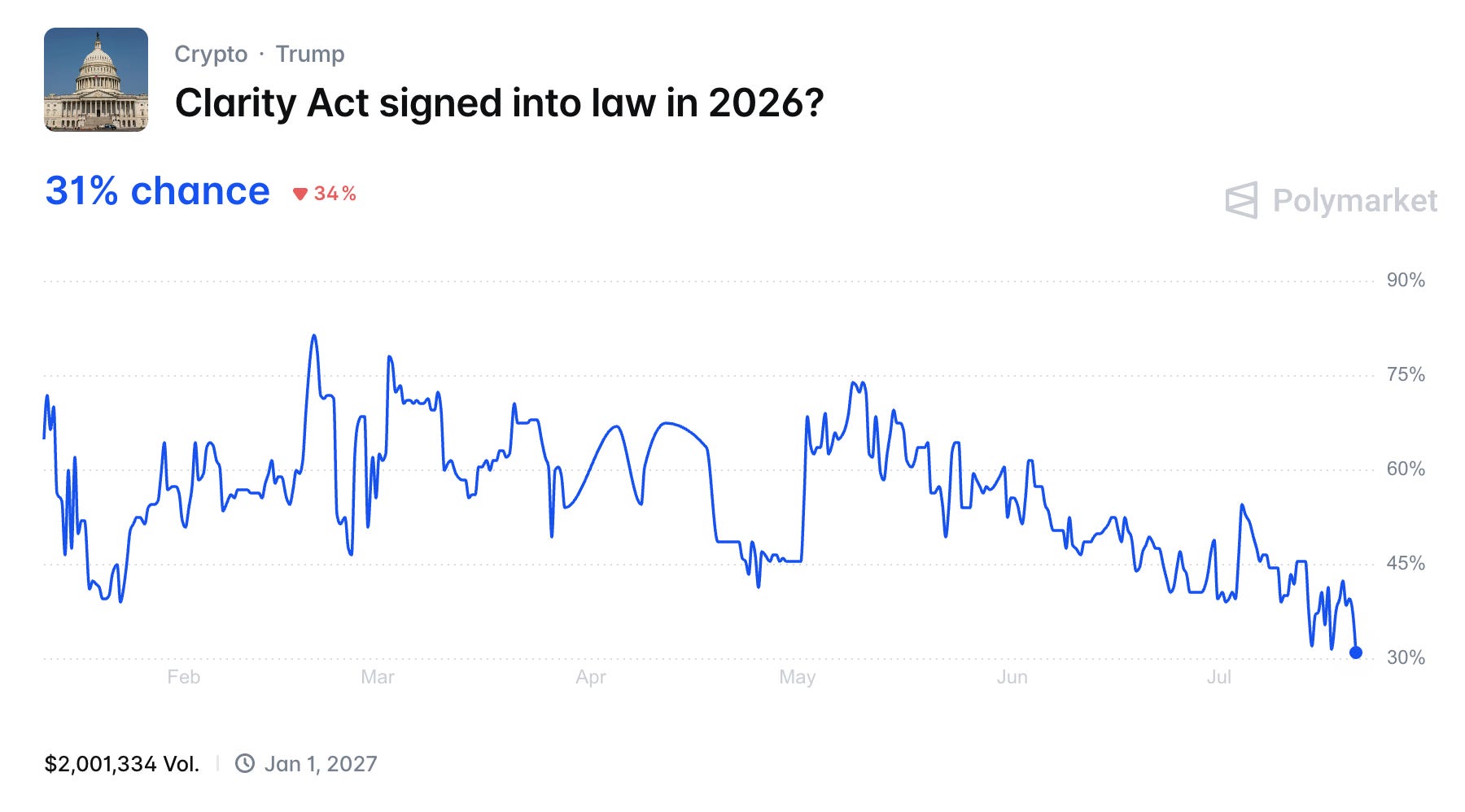
With the ethics issue still unresolved and time running out, prediction markets recently put the odds of the CLARITY Act becoming law this year at just 31%.
Senate Majority Leader John Thune wants action before the Senate leaves for its summer recess on August 7.
That makes the next few weeks critical.
If lawmakers cannot reach a bipartisan compromise before then, the path becomes much more difficult as Congress turns to a government-funding deadline and the November midterm elections.
And even if the bill passes the Senate, any changes would still need approval from the House before it could reach President Trump’s desk.
For Bitcoin, the direct impact would be smaller than it would be for altcoins, exchanges and other crypto companies.
Bitcoin is already widely treated as a commodity and already has regulated futures and spot ETFs.
But passage would still matter.
It could make it easier for regulated banks to custody Bitcoin, execute trades and integrate it more deeply into lending, collateral and prime-brokerage markets.
More importantly, it would replace rules that can shift from one administration to the next with durable legislation passed by Congress.
If the CLARITY Act fails, the industry would remain dependent on SEC and CFTC interpretations that could be challenged in court or reversed by a future administration.
After nearly a decade of regulation through enforcement and constantly changing interpretations, Congress now has a narrow window to establish lasting rules for digital assets in the United States.
If lawmakers miss it, what NYDIG called the industry’s most important forward catalyst could become another missed opportunity in Washington.
The News Block is powered exclusively by Ledn.
Ledn is the global leader in Bitcoin-backed loans, issuing over $9 billion in loans since 2018, and was the first to offer proof of reserves. With Ledn, you get custody loans, no credit checks, no monthly payments, and more.

Visit LEDN.io to learn more.
The Debate Over BIP-110 Proposal Intensifies Now let’s turn to the fight happening inside Bitcoin itself.
The debate over BIP-110 escalated this weekend and has become one of Bitcoin’s most divisive internal battles since the block size wars of 2017.
BIP-110 is a temporary, one-year soft fork designed to make it harder to store arbitrary data, including images and tokens, on the blockchain.
Supporters say that data burdens node operators and pulls Bitcoin away from its core purpose as money. Critics say changing Bitcoin’s rules to discourage certain uses would cross a dangerous line.
Michael Saylor and Lyn Alden both came out against it this weekend, but for different reasons.
Saylor believes it is dangerous because it would change Bitcoin’s neutral rules to discourage disputed uses. Lyn believes it is premature and would not meaningfully stop spam.
Saylor made his case in a 110-point essay titled “110 Reasons BIP 110 Is a Bad Idea,” calling it the “Bitcoin Iatrogenic Proposal,” meaning a treatment that causes more harm than the condition it was meant to fix.

His core point is that Bitcoin cannot read intent.
The network cannot know whether data represents an image, a contract, a proof or a future application. Saylor argues that targeting transaction structures could restrict legitimate uses, close off paths for innovation and set a precedent for using consensus rules to police disputed activity.
He believes unwanted activity should be handled through the fee market and voluntary policies adopted by miners and node operators, rather than by changing consensus for everyone.
As he put it:
“Bitcoin does not need guardians of purity. It needs guardians of neutrality.”
Lyn reached the same conclusion from a more practical angle.
She argues that BIP-110 would not materially reduce spam. It would mostly push the same data into other parts of transactions, potentially in ways that are less efficient for the network.
OP_RETURN, she explained, is not the cheapest place to put data. It has simply been one of the least harmful. Restricting it does not eliminate demand. It changes which bucket the spam goes into.
Lyn also rejected claims that Bitcoin faces an emergency and could fail unless the fork passes. Bitcoin already has a block-size limit and fee market constraining how much data can enter the network.
She noted that BIP-110 is less than a year old, lacks broad consensus and relies on an implementation with only one maintainer.
She remains open to better proposals and supports people’s right to attempt a fork. But before changing Bitcoin’s rules, she wants evidence that the problem is serious, the solution would work and more important improvements would not be disrupted.
As she put it: “If it could change easily, I’d sell it.”

Her broader concern is that this fight is distracting Bitcoiners from larger threats to privacy and usability, including expanding financial surveillance. She compared it to focusing on paper cuts while someone is swinging a machete. And for anyone who wants to hear Lyn unpack her position on BIP-110 in more detail, I highly recommend checking out my recent interview with her.
The next test comes in early August. BIP-110 can lock in early if 55% of miners signal support, but signaling remained below 1% as of this weekend.
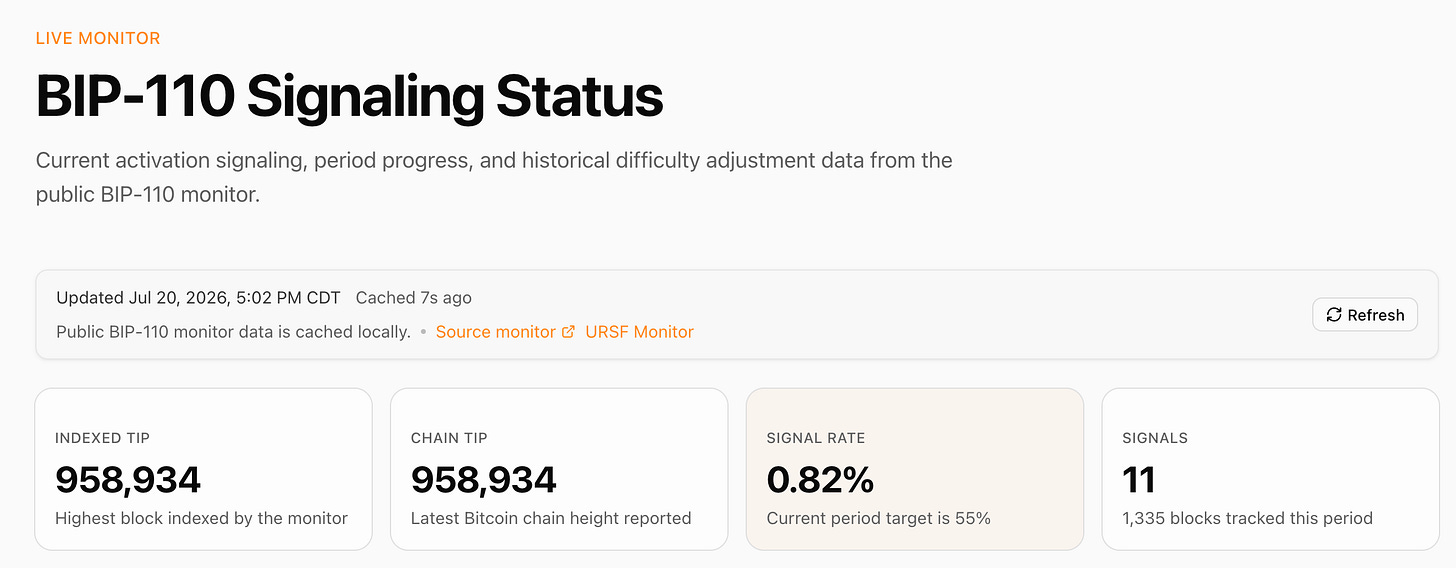
That shows BIP-110 is nowhere close to broad miner support. Enforcing it without broad agreement could leave supporters on a small minority chain.
August will show whether support grows or the proposal remains isolated.
There is no CEO, board or central authority that can force a change through Bitcoin. Developers can propose rules, miners can signal and node operators can choose their software, but the broader network ultimately decides what it recognizes as Bitcoin.
That process is slow and messy. But in a world that never stops changing, Bitcoin’s resistance to change is one of its strongest and most distinctive traits.Bitcoin Bear Markets Are For Building Before we go, a quick rapid-fire round of stories that caught my eye.
We already mentioned Lyn Alden. Apparently, weighing in on BIP-110 was not enough to keep her busy, because she also helped launch a new company called Orange Juice alongside my friend Jeff Booth, Nico Lechuga, Andi Pitt and others.

The company raised $40 million and plans to acquire, improve and permanently own cash-flowing American businesses, then reinvest the profits into additional acquisitions and a Bitcoin treasury.
It is another example of the different business models emerging around Bitcoin — this one anchored by durable cash flows from operating businesses.
A big congratulations to the entire Orange Juice team!
Citadel Securities, one of the world’s largest market makers, also invested $400 million in Crypto.com, valuing the exchange at $20 billion.
It’s just another signpost that major financial institutions continue investing in digital-asset infrastructure despite the recent price action.
Prices may be down, but serious capital is still allocating and building for the future.
And finally, the U.S. Treasury sanctioned four wallets tied to Iran’s central bank, and Tether froze roughly $131 million in USDT held in those wallets.
An important distinction: these were stablecoins, not bitcoin.
Tether can blacklist an address and prevent those tokens from moving. Bitcoin has no issuer with a freeze button.
Stories like this highlight the fundamental difference between digital dollars and truly permissionless, censorship-resistant money.
Until next week, keep stacking.
- Nat
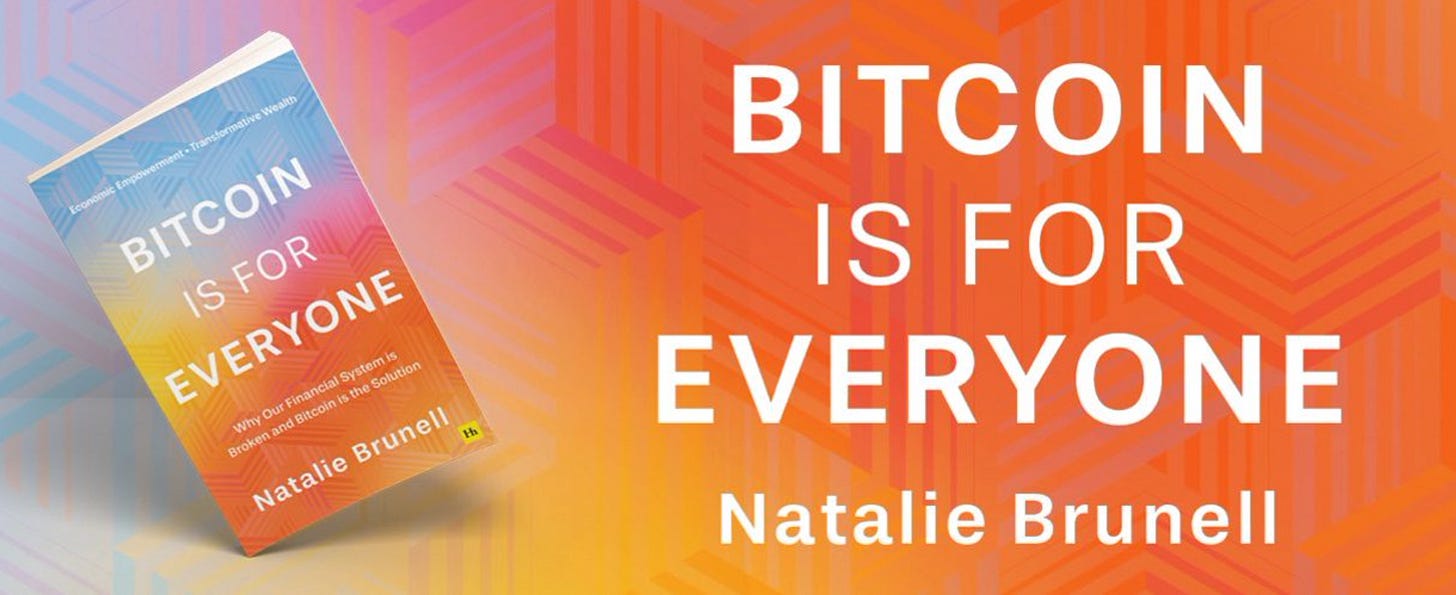
PS - Make sure to grab a copy of my new book, “Bitcoin is for Everyone.” I’ve written an approachable book on Bitcoin and the traditional financial system, perfect for your friends and family who are still learning about it.
If you enjoyed reading this post, you should consider subscribing to the News Block.
This week on Coin Stories, Natalie sits down with Julian Liniger, co-founder and CEO of Relai, Europe’s leading Bitcoin-only exchange, live at BTC Prague.
After onboarding more than 100,000 Europeans to Bitcoin, Julian has a rare, ground-level view of who’s actually buying and it’s not who you’d expect. He shares what his data reveals about everyday people turning to Bitcoin, why European savers feel squeezed, why retail interest has gone quiet, and where he thinks the price goes from here.
We discuss:
Who’s really buying Bitcoin in Europe, and why it’s older, more ordinary people than anyone expected
Why so many Europeans are turning to Bitcoin to escape high taxes and a rising cost of living
Why retail buyers have gone quiet, and what tends to bring them rushing back
Julian’s honest read on whether the worst is behind us, and his forecast for the next bull market
How Relai grew into a leading Bitcoin exchange across Europe, and its plan to one day go public

Links to Items Mentioned in this Issue:
NYDIG: What Happens If CLARITY Fails
Crypto Bill Faces What Could Be Final Test Over Trump Conflicts of Interest
‘Positive’ Meeting With Trump on Ethics Raises Hopes for Passage of CLARITY
Polymarket Traders Cut CLARITY Act Passage Odds to Record Low
High-Level White House Meeting Said to Be Planned to Hash Out CLARITY Act
Phong Le Announces Strategy’s Banking Adoption Index
Saylor Urges Bitcoin to Reject BIP-110 in 110-Point Essay as Soft Fork’s August Showdown Approaches
Michael Saylor Says Proposal to Clean Up the Blockchain Is a Bad Idea
Michael Saylor: 110 Reasons Bitcoin Needs Guardians of Neutrality
Lyn Alden on Why BIP-110 Doesn’t Materially Reduce Spam
Lyn Alden on the Motte-and-Bailey Marketing Around the Fork
Lyn Alden: “If It Could Change Easily, I’d Sell It”
Lyn Alden on the Bigger Threats to Bitcoin’s Privacy and Usability
Jeff Booth, Lyn Alden and Team Raise $40 Million to Build a Bitcoin-Powered Permanent Capital Company
Inside ORANGE JUICE: A New Model for Buying Businesses and Building a Bitcoin Treasury
Citadel Securities Makes a $400 Million Bet on Crypto.com at a $20 Billion Valuation
Tether Freezes $131 Million After U.S. Sanctions Iran Central Bank-Linked Wallets
No posts
Comments
Nothing yet. Say the first thing.
Sign in to join the conversation.