
Behold this magnificent totem of The American Century, recently spied in a Lake Tahoe cabin:
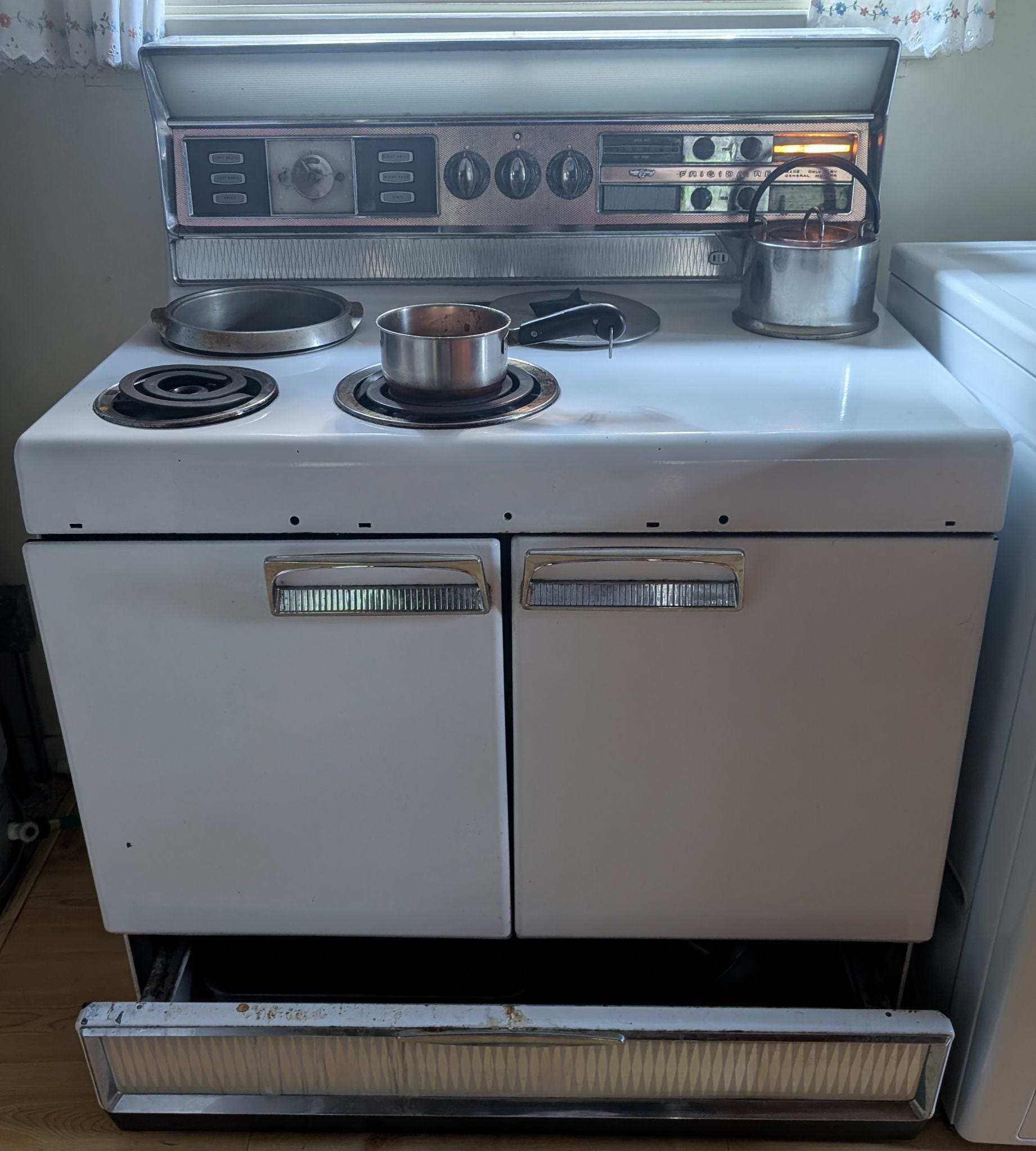
It’s a 1956 Frigidaire Imperial electric range, renowned for its fast-heating coils, and for the most part still cooking away during my recent encounter.1
There is much to admire, not least a sunken burner in the left rear, devoted to deep frying. Note the illumination panel and the control lights, which resemble the headlights and the dashboard of a 1956 automobile.

The base has a drawer like the roomy trunk of a car. Best of all are the controls for the heat coils, like the knobs on a car radio, with a sliding indicator. “Lo,” “Med,” and “Hi” are like stations on the radio dial:
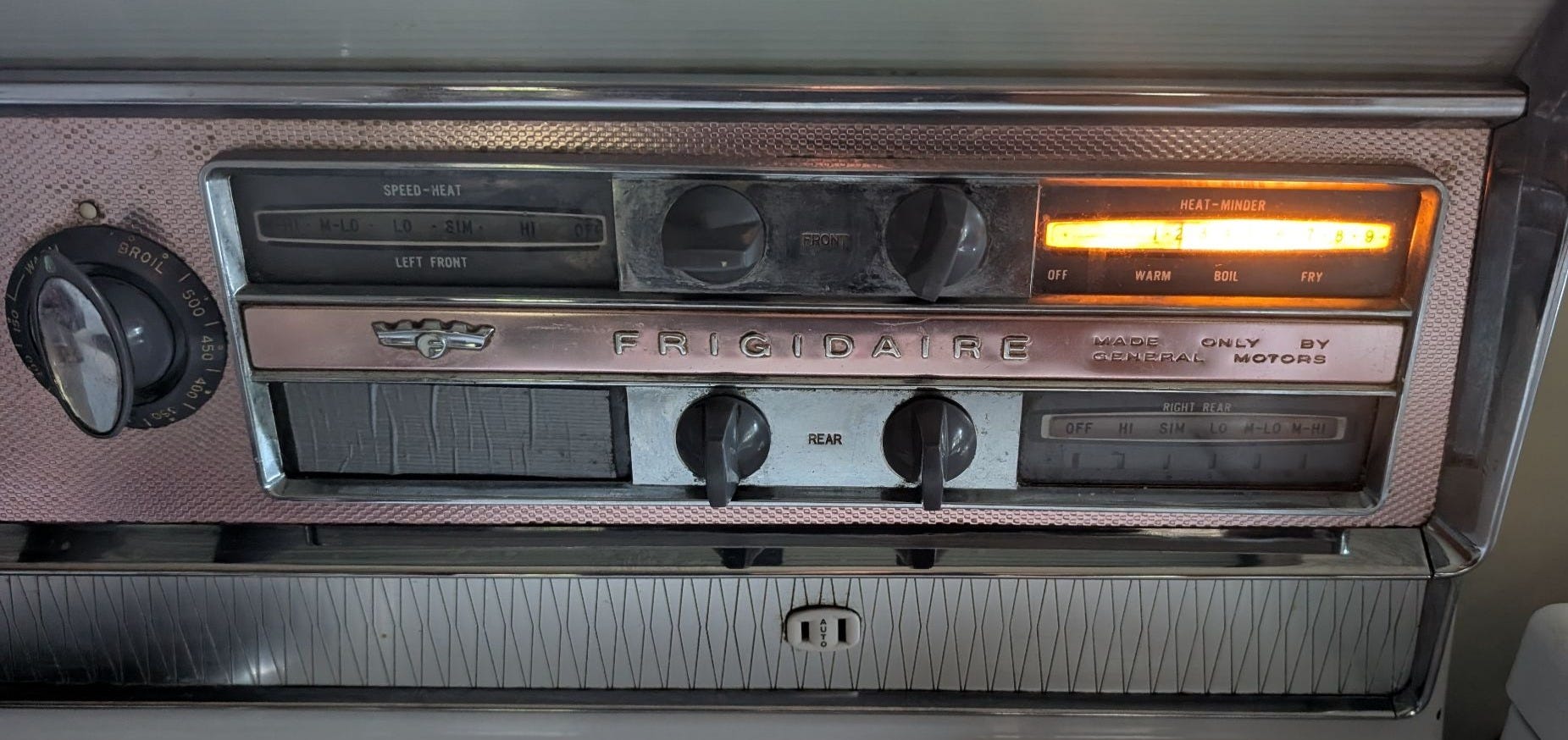
Look closely, and you’ll see that Imperial is “Made only by General Motors.” The Frigidaire logo even looks like a car emblem.2 Like a car of the time, this stove is solid steel, and weighs a ton. The oven doors pull down vertically, but have handles like those on a contemporary Chevy.
Anthropologists looking at exotic societies pay inordinate attention to food, not simply because its acquisition and consumption is essential, but because it reveals social roles, how a culture experiences comfort and safety, religious rituals (take Catholic communion, a Passover Seder, or Ramadan), and power. Turns out it says a lot about more familiar cultures, too.
Food is a window on how people really live, sometimes in ways you wouldn’t expect - my 1975 “Joy of Cooking” has instructions on how to skin a squirrel, along with recipes for armadillo and beaver tail.3 Food technology, the home appliances of food, does the same.
This Imperial entered the mid-fifties kitchen, when women did most of the cooking and cleaning. The housewife of the time wasn’t just getting an appliance. She was getting her own car, at a time when superhighways, modern suburbs, fast food, drive-in movies, and rock and roll on the car radio were transforming everything.
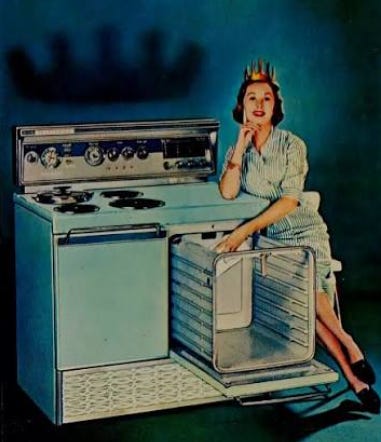
As in the car world, the idea of freedom was a huge selling point. Ads for the Imperial proclaimed it “freedom from slavery.” A nicely-dressed lady with a crown could simply lean over and sponge down the greasy walls of the pull-out oven walls. Her unfortunate counterpart with a lesser brand, meantime, still wore jeans and a kerchief as she knelt down to scour.
The Imperial is the apex stove of a bygone era. Everything was about to change. Freedom was indeed on the rise, but in ways those copywriters didn’t expect. Married women, a famous sociologist wrote in Fortune Magazine, were starting to enter the workforce in significant numbers. By 1971, 40% of married women worked, a consequence of the pill, second-wave feminism, an increase in office jobs and greater economic necessity.
Home appliances adjusted to a new food routine. In 1956, TV dinners had only been around for two years. McDonald’s had begun franchising the year before. Pizza Hut was two years away, and Chinese food was regarded as an exotic niche, not something you toted home from work as a matter of course. Most food was still prepared and cooked at home.
By 1970 fast food was abundant. At home, stoves had self-cleaning ovens and the revolutionary microwave oven had appeared. The value, the promise of freedom, was more space, energy efficiency, and less time cooking - all in avocado-colored enamel. General Motors sold Frigidaire in 1979; by then stoves had given up imitating cars, and aspired to be a domestic version of office machinery, suited to a more distributed family life.
It’s estimated that women cooked and cleaned up food for over two hours a day in 1956. In 2003, the first year the Census Bureau started counting how we spend our time, it was 1.2 hours a day for women who still focused on cooking. For the overall population, it had fallen to 30 minutes daily.
Strangely enough the time spent on food has increased since then - insignificantly for women who focus on their stoves, and lots more for everyone else. What changed?
For 20 years, design has been dominated by the smartphone. Some of this comes from the captivating look of the phone, all that glass and smooth metal. Cars themselves have come to resemble phones, with lots of touch screens and voice commands. Even the new light-emitting diode headlights, which entered the market at almost the same time as the first iPhone, are a more powerful version of a smartphone flashlight.
But it’s not just the look. The phone is designed to connect with us. One of Steve Job’s genius moves was to insist the I-Phone arrived fully charged, so immediately out of the package you pushed a button and the machine said “Hello.” It was like a person, eager to engage with you. Cars have become like that too, with fobs that unlock and door handles that emerge as you approach. These machines are saying “hello,” and yearn to learn more about you.
Within a year of the I-Phone’s creation, with the rise of smartphone apps, phones didn’t just engage; they observed, learned, and personalized themselves for you. Phones achieved this partly through the apps each person chooses, partly through the consumer surveillance in which the apps engage, and partly through the ways advertisers (and governments) use that data to work better with you (“better” here is a relative term.)
Thus, a phone that’s mass-produced on a scale of billions becomes, within a month of use, a highly personalized object. Not only in the type of apps a customer has selected, but in the data generated on that customer, and the relative economic value companies can extract from that data. Companies build their business plans around that valuable data.
And stoves? Check out this modern Samsung “Smart Freestanding Electric Range”:
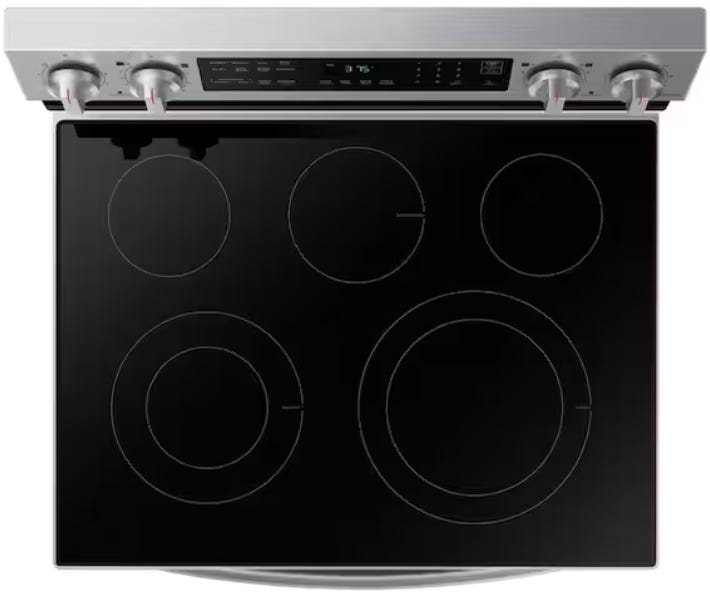
It’s got touch screen controls, lots of glass, and a WiFi connection so you can manage the cooking via voice control, using your phone. The fryer is still there, but now it’s an air fryer, so fried food is now a “smarter” and healthier choice.
Samsung’s stove offers “SmartThings Cooking,”4 available on iPhone and Android devices when you open a Samsung account. “Makes meal planning a seamless process. Search, plan, purchase and prep weekly meals via the SmartThings app,” the manufacturer says, “personalized recipes based on preferences, what’s on hand and recipe search history so you can plan meals for your family more efficiently…create shopping lists and add missing ingredients directly to your grocery cart for at-home delivery.”
That last feature alludes to the most dramatic change of all to the American way of food: The kitchen in our pockets.
We bring home an unimaginable number of cuisines - not just burgers and pizza, but Chinese, Thai, Ethiopian, Vietnamese, Peruvian, and a hundred more. Whatever you want, logged and tracked for future “convenience.” Perfect for the phone era, the dawn of mass individuality.
But for all the convenience of this automated, disembodied cooking, there’s a small but notable backlash. Going back to the Census numbers, in 2025 women who cook in a dedicated way spent about the same amount of time at it compared to 2003, but for the overall population the daily amount of time spent cooking is up 40%. What’s up?
It could be the popularity of watching cooking shows.5 It could be the rise of specialty items: air fryers are now a standard oven feature, and a modern Frigidaire range has been rated “Best For Pizza Lovers,” for those seeking renown for their ability to outdo the delivery service. In defiance of the disembodied digital world, cooking feels “real” - and the digital world has lots of ways to make reality happen for a would-be cook.
On that Samsung stove, the knobs are outsized and bulky. That’s the way stoves look on TV cooking shows, strong and industrial. In wealthy homes, restaurant-looking gas ranges with eight burners are a status symbol, though I’ve yet to see them all in use in someone’s home. In an era where entertainment flows seamlessly from screens into life, cooking has also become high-level role play.
Home cooking could be on the rise because of COVID, though the trend was underway for several years before that. The deep COVID influence was on food delivery, which exploded during the pandemic and is still growing. Besides cooking as entertainment, the most likely causes are the large number of people now working from home, and a tougher economy.
And what, in all this, to make of the rise of Artificial Intelligence? Appliances are already getting more sensors, including cameras, to notify the humans when a dish is done, or to prevent overcooking. Notifications and interactions will rise, since chatbots have already prepared people to talk to speakers, laptops, and phones as if they are people. Why should stoves miss out on the fun?
AI is likely to become a single personalized agent that moves among all of the devices, connecting your stove-top life to your music and your work, all rising up as needed. The trick will be to make people feel like key players in the creation of physical delight, the best pizza chefs around.
And since we live in an age of consumer-centric surveillance, our AI will be monitoring us in the friendliest way. In a voice that’s assuring yet subservient, it will make sure we each have it our own way, with the eternal promise of freedom, control, and bounty.(Any takers on that old stove, let me know.)
Two of the burners and one of the ovens need repair, and the owner wants something smaller. If you know someone who wants to repair this beauty, be in touch.
Probably no coincidence, in 1955 the Chrysler company came out with a car called The Imperial. Sick burn, 1956 General Motors appliance marketing team.
Since you’re wondering:

Apparently it’s now smart to call everything “smart.”
Michael Pollan argued the exact opposite in a famous 2009 article, but he may have written too soon. The minutes spent cooking at home, which had declined for some time, were beginning an increase that continues today. Maybe it took time to catch on, maybe it was some other unforeseen effect from the rise of smartphones, since cooking videos could now be easily called up in the kitchen.
No posts
Comments
Nothing yet. Say the first thing.
Sign in to join the conversation.