

Chevy never has to name the door handle. It’s a door handle. But the moment you build software that simulates a car, a workflow, a workspace, a process, you suddenly have to name the pieces of that simulation.
Tech is a vastly more named environment than the physical world, because it is intangible. Technology is constantly relying on names to orient people to the digital world.
This makes our work as namers much more difficult. You’re constantly inventing new experiences that don’t exist in physical reality but because humans’ baseline of understanding is rooted in that, you often need to reference it to make something palatable and understandable. This is why so much of tech naming is verbal skeuomorphism— naming digital things after physical ones, the way a “desktop” has a “folder” and a “trash can.”
And that explosion of naming surface area inflates the temptation to over-name. Everybody wants their widget christened. Jim laid it out:
“The more technical the company, the more difficult it becomes to actually brand or name anything successfully. There’s a lot of unnecessary debate, largely influenced by their engineering-led cultures. Product teams come to the table with a name already baked in, and naming strategy is often an afterthought.”

The counter-discipline is Jim’s button example:
“Send me the top three benefits this button provides. I’ll use those to craft three viable name options, from which you can pick whichever one you want. We’re not going to trademark this button, or market it. But you’ll have something to reference in messaging and documentation.”
Choosing a low-effort, low-investment, barely-there name type for a low-stakes object is itself the expert call.
When I asked Jim what “naming at scale” means to him, he said:
“Fitting the naming approach to the naming need. You can go super descriptive, you can go super creative, and you can go five or six different ways in between. What’s the right approach for that very specific challenge somebody’s facing? I think that’s what people really need to know.”
This is it. This is where tech naming gets genuinely difficult. It’s the needle-threading. A name has to be broad enough that it won’t expire the second the roadmap shifts, yet specific enough to actually make the function clear. Physical-product categories rarely have to thread that needle so finely, because they have other things to lean on: shape, shelf, material, a hundred years of category convention. A water bottle is a water bottle. An insurance portal is... what, exactly?
Tech has to carry more of that load in the name itself, while the buyer is being bombarded with far more names than any shopper in the physical aisle. So the art of discernment — real name here, mere label there, nothing at all over here — is the whole job.
An hour into our chat, Jim introduced a perfect metaphor:
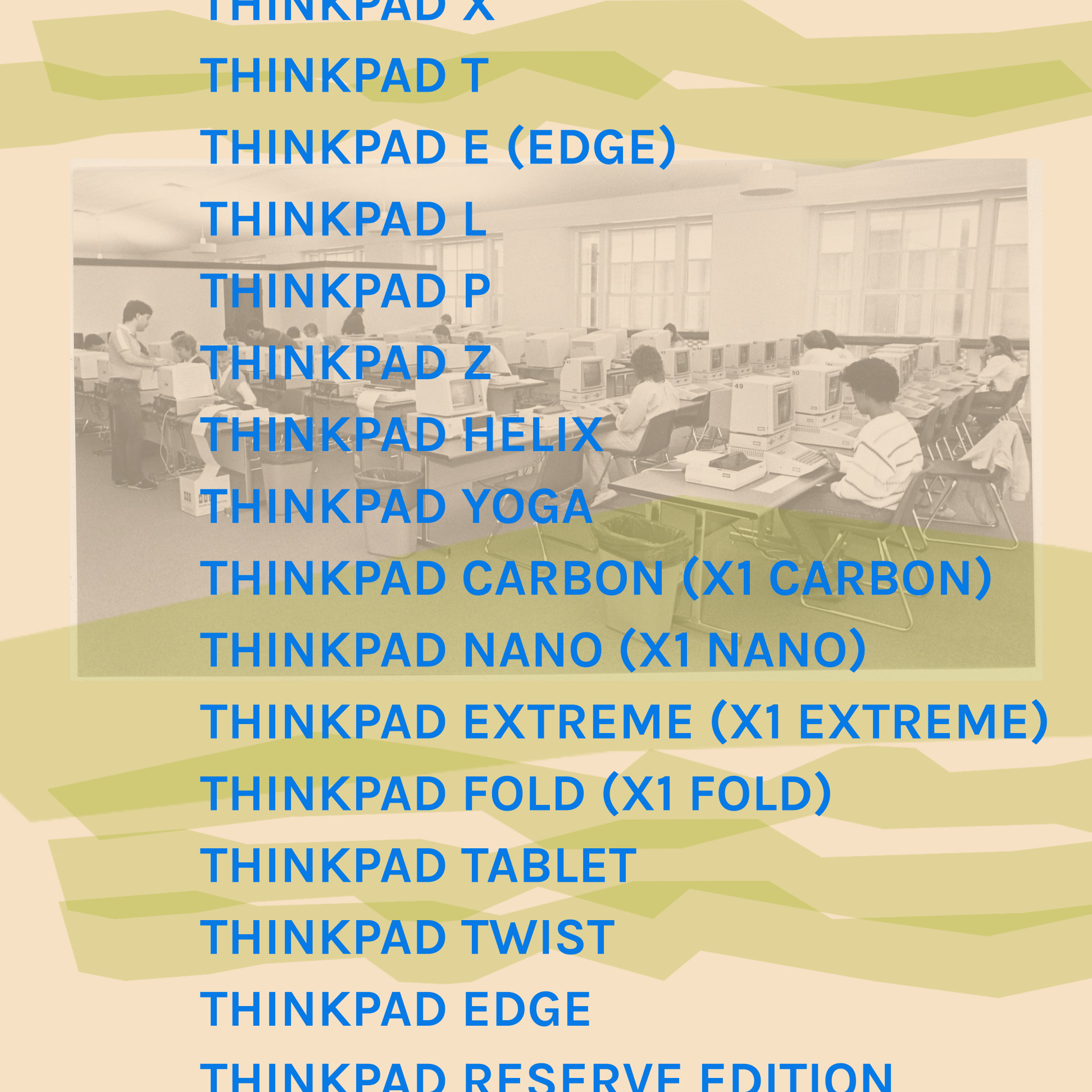
“I know what a ThinkPad X100 is. I know what the zeros mean — the last zero tells me it has an Intel processor instead of an AMD one. But I lived in that world. I have the decoder ring. If I have a ThinkPad Edge or a Lenovo Yoga, I don’t need the decoder ring to know what that product is. I get a sense of it from the name — especially if I marry the name with an image of the product.”

Every name either hands the buyer a portrait or it hands them a decoder ring. ThinkPad X100 is a cipher — perfectly information-dense if you’re the kind of person who buys 10,000 laptops at a time, and totally opaque if you’re not. Lenovo Yoga paints a picture of who you might become: it bends, it folds, it does poses.
And you’d better know which kind of buyer you have, because you’d better know which one is willing to use the decoder ring.
A lot of people think of brand naming as a hunt for the best name — the cleverest, the spiciest, the one that makes the room gasp. But at scale, that’s simply not how it works. At scale, naming is a research-backed organizational run through a minefield.
The real question is not what kind of name will sound/feel good, it’s what kind of job does this name have to do? Technically you could start naming without answering that question and try to “solve it through creative exploration” [shudder] but that is the least efficient route and because you’re likely naming 6 things this week, we all know efficiency is of the essence.
Jim built a career directing naming and brand architecture across three of the most engineering-heavy companies on earth — Lenovo, Microsoft, and Intel. He has named things you’ve heard of (Lenovo Yoga) and perhaps more heroically, approximately ten thousand things you will never, ever think about (more on those later).

Before The Naming Group develops a single name on any project, we figure out what type of name is needed and the client signs off on the type before any creative work begins. Very generally, “name type” runs along a spectrum:
Descriptive — the name is the thing. Cars.com. Intel AI. The name does the explaining for you.
Suggestive — the name leans on the thing without spelling it out. Lenovo Yoga. Chase Sapphire. It evokes, it hints, it gives you a feeling and a foothold.
Empty vessel — the name means nothing until the brand fills it. Hulu. Pure container.
And there are a handful of gradations in between. Every name sits somewhere on this line, and where it sits is not a matter of taste. It’s a matter of the name’s job.
Each region of the spectrum has a cost and a benefit. Descriptive names are instantly understood and nearly impossible to own — you can’t really trademark the obvious, and the ones that are still mostly obvious but not legally descriptive get scooped up fast. Empty vessels are ownable, flexible, and trademark-friendly, but you have to pay to fill them with messaging and ad spend. Suggestive names split the difference.
When talking about this on LinkedIn, a former client, Kendall Bazan, VP of Revenue | Head of Sales and Marketing at Groundfloor Finance, commented on it re: the strategy we built when renaming Fund that Flip to Upright:
One of my favorite parts of working with you all at The Naming Group was mapping out the landscape of industry names and discovering a wide-open opportunity in the “suggestive” category. A revelatory moment! I still reference that scale all the time.
So the name type spectrum isn’t a menu of vibes. It is a spectrum of GTM strategy. Picking the right point on it for the specific challenge in front of you is the most important first step in any naming project.
The enterprise IT buyer purchasing ten thousand ThinkPad T425 units by model number does not want the decoder ring removed. The alphanumerics are a feature for them– dense, precise, sortable. That is the correct name type for that buyer, and “improving” it with a warm evocative name would actively make their job harder.
But the small-business owner or the consumer who sees the laptop as an extension of themselves? They will never take the time to learn what the last digit means. Their job is not to decode your portfolio. For them, Lenovo Yoga and ThinkPad Edge are the right type.
John Elliott, our Head of Strategy, recently shared with me research on why these buyers respond to different name types. In essence, some buyers decide on the merits, and some decide on the signals — what persuasion researchers call central vs. peripheral route processing, and what B2B buying literature describes as the difference between technical and economic buyers.
The deeply technical buyer (the engineer, CTO, or analytics lead) decides on the merits, which means the name is, in the research’s blunt phrasing, largely inert. It can’t win them; it can only get in the way. So for a technical audience the question flips from “what does this name communicate?” to “what does this name not foreclose?” Does it stay legible and credible, and avoid the try-hard association that makes a serious engineer roll their eyes.

The business leader signing the check decides on the signals — for them the name is a trust shortcut (”safe choice,” “category standard”), a genuine lever, and an expensive one to get wrong. One name cannot do the same job for the engineer and the business leader at once, and in B2B tech, where both sit on the same buying committee, knowing which lever is even live for which buyer is the entire ballgame.
“Those people who’d been buying ThinkPad X-series for fifteen years were going to keep buying them regardless of the name — they go by model number. We had to do something to set ourselves apart from everyone else. We saw what Apple was doing with MacBook Air, MacBook Pro — no numbers, no letters. So we emulated that.”
This is the exact parallel to what Porsche did when it moved off pure alphanumerics — the old 911 faithful kept buying, but Cayenne, Macan, and Boxster opened the brand to an entirely new universe of people. Naming didn’t dilute the brand, it expanded it by matching the type to a new audience.
Look at what Dell just did. At CES 2025, Dell retired distinct, decades-old legacy brands — Latitude, XPS, Inspiron, Precision — and replaced them with a tiered system built on Apple-flavored modifiers: Dell, Dell Pro, and Dell Pro Max.
Adopting this structure makes use of an existing cognitive shortcut in the buyer’s head. Consumers are already fluent in Apple’s Pro / Pro Max ladder. They intuitively grasp the hierarchy, the price progression, the value story — without having to research or remember what a “Latitude” is versus an “Inspiron.” Dell didn’t have to teach a new ladder. It piggybacked on one the entire market had already memorized.
As with any good Naming at Scale post, I need to point out the human biases that get in the way of our work.
Almost everyone—founders, executives, engineers, product marketers, your client’s clien—walks in with the same default setting for “good name”: clever, evocative, catchy. More creative is more better. The fun part of naming, the part people feel they’ve earned after months of hard work, is the christening. The big reveal. The moment they get to be a little creative to cap off all that labor.
I’ve written before about the christening impulse and why corporate structures can incentivize it: that nearly irresistible pull to bestow a Real Name on a thing you’ve poured yourself into. It is deeply human and it is one of the most expensive instincts in the building.With nearly 40 combined years of combined naming experience, Jim and I have landed in the same spot:
The most effective naming is often deeply unsexy.
Sometimes you don’t need a name. You actually need a label. The most effective naming practitioners are masters of this discernment, in knowing which register the moment actually calls for.
“A monkey can name a product. You give a monkey a typewriter, it’ll come up with something. An engineer or a product manager can come up with a name. But they don’t know the art of it. They don’t know the science of it. They aren’t even aware there’s a science behind it.”
This is also why I feel that naming at organizational scale is the last AI-proof bastion of this field. You could easily replace “monkey” with “AI” in the above quote.
When Jim got to Intel, the company was trying to tell the market two specific, urgent things: we’re back in automotive (after being in and out of the category three times in a decade), and we do AI too (in a world that thinks “AI chip” and says “Nvidia”).
When the job is recognition, when you need the market to instantly understand a thing it doesn’t yet associate with you, descriptive directness beats sexy/spicy/evocative every time. So Intel built what they called category brands: Intel Automotive. Intel AI. Not creative. Extremely direct. And precisely correct.
“You don’t have to decode it. If it had been, Intel Fibonacci, you’d have to tell a whole story alongside it to explain what it is. We didn’t have to do that with Intel AI. It was very direct. What better way to hit them over the head with a hammer and say, hey, we do AI too?”
The clever name would have made the job harder to explain a category it was already behind on. The unsexy one did the work and got out of the way.
Similarly, and something we talk a lot about at The Naming Group is the timescale of a name. Some names should be built to get out of the way in a few years. We’re in a weird spot with AI right now where we need to be signaling it but in a few months/years referencing “AI” directly is going to be hella outdated. Trust me. It’ll be like driving by a motel with a sign out front that says “COLOR TV… WITH REMOTE!”

The smartest descriptive naming is built knowing it may need to fade and be absorbed as the category matures.
With that in mind, a more descriptive name like Intel AI is easier to morph and change, whereas a name that has an identity built around it anchored by a suggestive name is much harder to pivot away from.
There’s a third force that isn’t discussed much that was pushing Intel toward the descriptive end worth naming explicitly: risk appetite. Intel had been badly burned by trademark conflicts years earlier. That cost the company millions. So legal had become extremely conservative:
“By the time I arrived, about 80% of our names were leaning descriptive from the start. Going creative or evocative was rarely an option due to the perceived risk.”
This matters because it means name type isn’t only shaped by taste or even by the job (as it should be), it’s shaped by, for better or worse, organizational realities. If you’re leading naming at scale, it pays to be friendly with legal so you can understand how much risk the organization can stomach.
So we end where we started — the decoder ring and the spectrum.
Mastery of naming at scale means diagnostic before it’s creative: who’s holding this, what does it need to do, how much risk can we carry, and how loudly does it actually need to speak? Get those right and the creative development and decision-making gets dramatically easier. It pays to clear away the wrong options. Namers can come up with richer, sharper options because they’re not naming all over god’s green acre. Decision-makers have a reduced cognitive load because they’re not even considering major groups of names.
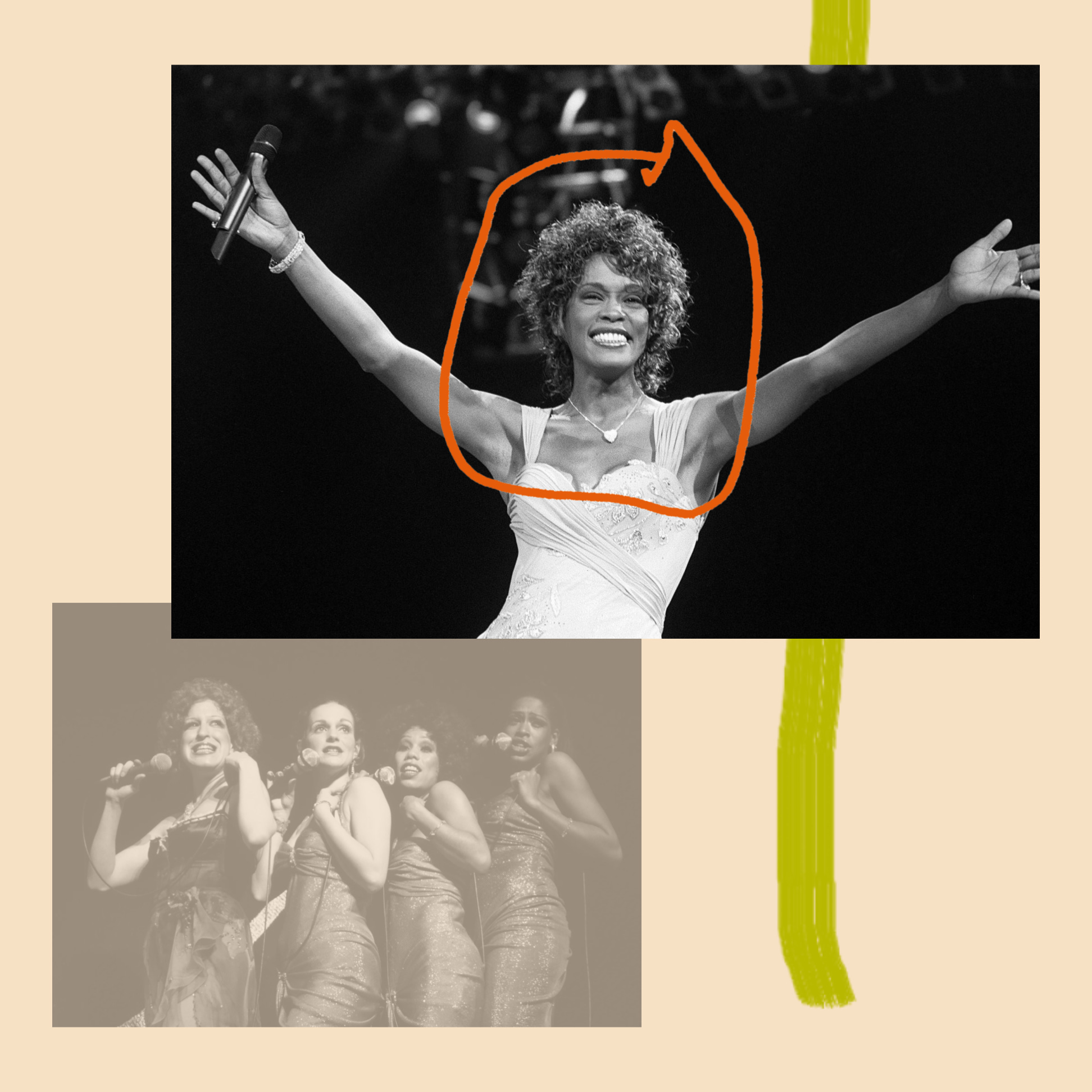
Because I can’t resist another metaphor: Some names are lead singers and some names are backup singers. Some should draw commentary on their very existence — that’s the job. Others should be overlooked entirely, blending into the harmony so the product can sing. The disaster is a backup singer demanding the solo, or a lead buried in the mix.
I told Jim that this is the part clients find most surprising. When you’ve done the upfront work right — when you’ve spent more than half the engagement just defining the job description for the name — the names themselves should arrive feeling almost anticlimactic.
I’ve always said: when you finally land on a name, it should actually feel a little unexciting. It should make the room nod and go, “Yeah, that’s what we said it would do.”
No posts
Comments
Nothing yet. Say the first thing.
Sign in to join the conversation.