
“Civilizations are built on surplus.”— Will Durant
In the summer of 1865, a state geologist named Henry H. Eames was dispatched into the wilderness of northeastern Minnesota to investigate rumors of iron-bearing rock. The region was largely unmapped, sparsely populated, and considered far removed from the centers of American commerce. Vast forests stretched across the landscape. Wolves outnumbered settlers. The Civil War had only recently ended, and the nation’s attention remained fixed on rebuilding a fractured republic rather than exploring its distant northern frontier.
Eames returned with samples that would help launch one of the greatest mining regions in American history.
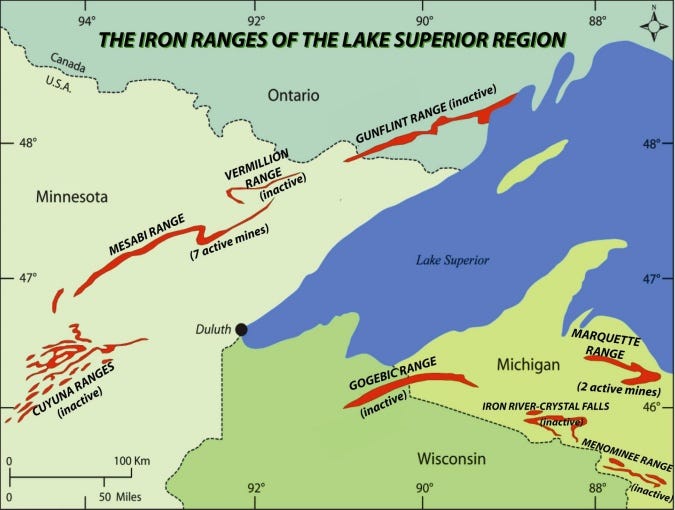
Over the following decades, prospectors, surveyors, and mining companies pushed deeper into Minnesota’s interior. What they discovered transformed the state and, eventually, the nation. The Vermilion Range, followed by the Mesabi and Cuyuna ranges, contained extraordinary concentrations of iron ore deposited nearly two billion years earlier when much of North America lay beneath an ancient sea.
The timing could not have been better. America was entering the age of steel. Railroads stretched westward across the continent. Cities climbed toward the sky. Factories multiplied. Bridges, ships, locomotives, and industrial machinery consumed unimaginable quantities of metal. Minnesota supplied the raw material that made much of it possible.
By the early twentieth century, The Iron Range had become one of the most important mineral districts on Earth. Ore trains departed the mines in endless succession. Great Lakes freighters carried Minnesota iron to steel mills from Duluth to Pittsburgh. The region helped build the industrial foundations of American power, providing the material that armed Allied forces during two world wars and supported the manufacturing boom that followed.
For generations, the geology of northern Minnesota was viewed through a single lens. The Iron Range existed to produce iron. Everything else was secondary. Geologists searched for additional ore bodies. Mining companies chased copper, nickel, platinum group metals, and other mineral deposits hidden beneath the ancient rock formations. The assumption was simple: the value of the region lay in the metals locked inside the ground.
It turns out the rocks may have been hiding another secret entirely.
Comments
Nothing yet. Say the first thing.
Sign in to join the conversation.