
The incredible thing about going to a book convention is that you’ll inevitably encounter a writer whom you never could have discovered online in a million years. While the digital algorithm is preoccupied with feeding you more of what you already have, the joy of chance is finding the thing you never knew you wanted, the delightful surprise of some gem you didn’t even know existed.
Of Dust & Demons by Martin Shannon is one such surprise gem. I had the pleasure of meeting Martin at AuthorCon VI, and we immediately hit it off due to a shared love and admiration of Clive Barker. As such, it was inevitable really that I would check out his work and find a few books that took my interest.
Of Dust & Demons drew me not just because of its cool premise, but also because of its dedication:
To the 90s. I miss your music, your optimism, and your magick.
As a child of the ‘90s, I had to take a look.
Of Dust & Demons is, unsurprisingly, set in the ‘90s. It follows a seal breaker called Jackson Miller. If you’re unsure what a seal breaker is, think demonhunter John Constantine mixed with occult detective Harry D’amour, and you’ll have a pretty good idea. Jackson sends bad things back to where they came from; but the catch is he has to make sacrifices to do it.
Jackson is a fascinating character, equal turns heroic everyman, flawed antihero, wise-cracking action hero, and sorcerous poet. This might seem like an overly eclectic mix, but we soon realise there is a good reason why Jackson is like this. He’s broken too many seals. This has taken a physical and psychic toll on him. Yes, it’s granted him power, but it’s also driven him to the edge of madness and back again.
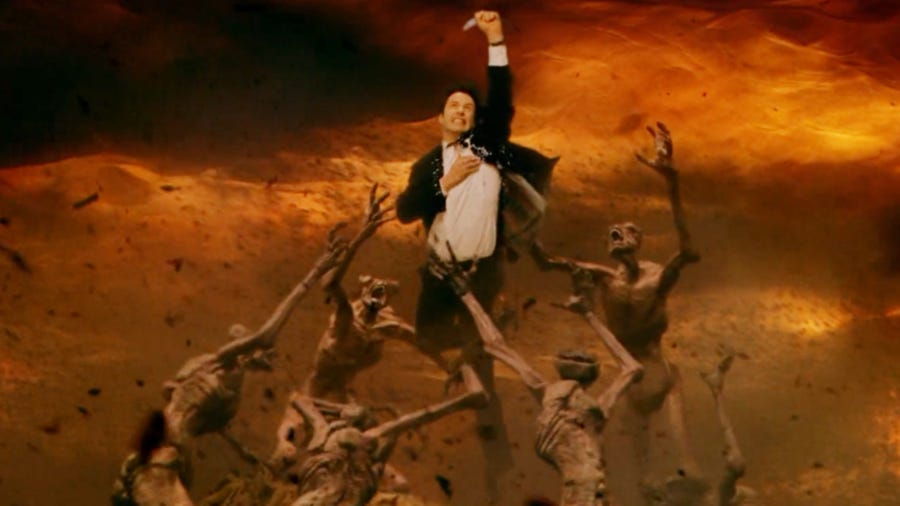
Enter Rachel. Rachel is a client, a bad-ass goth girl who’s taken her revenge fantasy too far and summoned an actual demon. Having gotten cold feet, and realised what she’s done, she’s brought in Jackson to sort out the problem. But Rachel isn’t just a damsel in distress, and Jackson soon realises he could use someone with her skills, combined with youth and optimism, to help him. It’s a classic Holmes and Watson relationship, master and protege, although like Conan Doyle before him, Shannon plays delightfully with this trope, and sometimes we aren’t sure who is teaching who.
One of the central themes of Of Dust & Demons is consequences. Learning to live with them. Dealing with the fallout. We make decisions every day. We try to make the right ones. But more often than not, we are making Hobson’s choices. We’re damned either way. All we can do is hope for the best, hope our decisions are more right than they are wrong, while knowing that every decision carries with it the weight of consequence.
Shannon says that he misses the optimism of the ‘90s. But despite the book being set in the ‘90s, it screams more into our present day fin de siecle, our fear of everything blowing away like so much nuclear dust, and more than that, that the fragile web of our society will come undone, and all the really beautiful, good stuff of life will die, never to be reclaimed. This isn’t a horror novel in the traditional sense—our heroes are too powerful for that—but there is a deep and dark fear underlying everything. And that’s what drives the plot of Of Dust & Demons so frenetically to its epic conclusion.
This is a story about a pair of people desperately, desperately trying to fix an increasingly broken world. Each new decision they make only seems to make things worse. In the hands of another writer, the escalation would actually become frustrating, but Shannon is so deft with his character-work, and thus we sense the good—if misguided—intentions behind the decisions, we sympathise with their plight.
One other important thing for me to mention is the relationship between the big and the small. Good writers are usually good at one or the other, but truly great writers get the big stuff and the small stuff right. Shannon is one of those great writers. The small stuff—the little details about Jackson’s apartment, the way Rachel is dressed, the smells and sights of Florida—are all there, bringing the thing to life. But the broad strokes are also dazzling. If I had to pitch this book to an agent, I’d say it was Constantine meets Grady Hendrix. But even that does not do it justice, because where Shannon’s work really steps away from both of those is in its fecundity of imagination.
Fantasy authors could learn a thing or two from Shannon’s world-building. There are no run-of-the-mill demons here. Instead, there are terrifying entities worthy of a Barker novel. The two encounters that stick out most in my mind are The Unnamed, who hunts those who’ve become lost to themselves and wears the dreaded “Coat of Personalities”, and The Weaver, “She of Spun Deceit”. Shannon writes the encounters with these powers so vividly you feel you are having a religious experience. And despite the wit and word-play of his characters, Shannon isn’t afraid to dial into real, mythically resonant poetry. In one of the closing scenes, Jackson—who has been on an odyssey that has reshaped him in so many ways—pronounces:
“I am the Bringer of Dust. I am the Wings of Finality, the Duchess’s Right Hand. I am the last man you will ever see.”
I have chills just thinking about it. Notice how he uses a sneaky, secret rhyme (“finality” with “ever see”) to make that third line hit like a freight-train. Also, the juxtaposition of highly poetic imagery with something so ominous and prosaic again amplifies the power of the line. This is real writing.

Speaking of which, the novel is full of spine-tingling moments. In one scene, a character’s memories are devoured by a mind-eating Weavelick—horrible parasites that feast on memories—as an act of revenge. As the Weavelick enacts their vengeance, they proclaim, “May you hate the man you become.”
What a curse to bestow!
This brings me to my penultimate point: many books claiming to be occult horror novels very quickly expose themselves as knowing nothing at all about the world of the occult. Even very prestigious and famous writers seem to think magick is all about Satan-worship and wearing cloaks. Shannon, on the other hand, shows he understands what magick is really about: belief, intention, will, metaphor, and love. He understands the phantoms and eidolons we create are realer than steel. The best example of this is to be found in the “character” of Marcy Preston.
Clive Barker famously wrote,
“in any fiction, no matter how ambitious its scope or profound its theme, there [is] only ever room for three players. Between warring kings, a peacemaker; between adoring spouses, a seducer, or a child. Between twins, the spirit of the womb. Between lovers, Death.”
Marcy Preston is the “third figure” of the story, despite the fact we never actually meet the “real” Marcy Preston. She is a mental construct that appears in different guises and goes through many iterations as Jackson and Rachel evolve. This might seem far-fetched, but in fact, it is oh-so believable. Don’t we all walk around with characters in our heads? Voices, idols, mentors, friends—some of them no longer with us.
Not only this, her presence achieves two important things. Firstly, it points to the occult truth I previously mentioned: that the ghosts in our brains are realer than anything in the “outside” world. They influence us. Whisper to us. They determine who we are (if we let them).
And secondly, it introduces that mysterious third element that somehow rounds and completes the picture. Id, Ego, Super-Ego. Father, Son, Holy Ghost. Spirit, Matter, Desire. Marcy Preston is the completion of the occult trinity that makes this book come alive in so many ways: by humanising Jackson, by showing Rachel’s background, by proving a foil and antagonist, and by finally leading us to the union with the Shadow Self. It’s frankly a masterstroke, and takes the novel to another level.

If I have one criticism of Of Dust & Demons, it’s that it took me a little while to get into. The first two Parts are written more like episodic adventures, little self-contained escapades in Jackson and Rachel’s world that help us get to know the characters. Thus, there is perhaps slightly too much recapping and the stakes aren’t immediately apparent.
But from Part 3 onwards, this changes. We're introduced to an incredible villain (or two) and the noose of the plot suddenly tightens about our necks. From that point on, the pace and sheer imaginative exuberance does not let up. For context, the book is in 20 Parts, so it really is only a small chunk to get through before the Weavelick—I mean book—sinks its teeth in your brain runnels.
Of Dust & Demons has become a favourite book of mine; it's easily one of the most absorbing reading experiences I've had in a long time, and I found myself meditating on it long after it was finished.
If you want to get your hands on this book, then listen carefully. Martin Shannon is a rare-book author, which means he only produces limited print runs, he’s not on Amazon, and you can only get stuff from him directly. Therefore, if you want your copy of Of Dust & Demons, you need to click the link below and shop from his website.
And if you need any more incentive than what I have already given you, consider that the book is illustrated by John Cobb! Check out a small sample of his gorgeous work below!
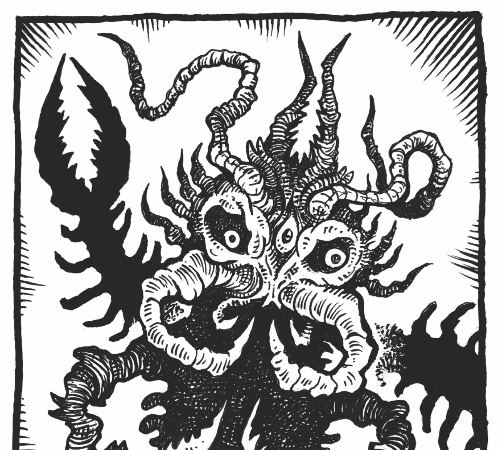
That does it for now. If you’ve read this far, my sincere thanks. If you enjoy discovering new authors, and reading about horror and fantasy, then please consider subscribing to my Substack. It’s free!
Comments
Nothing yet. Say the first thing.
Sign in to join the conversation.