
Rosalind Picard is a professor at the MIT Media Lab and one of the leading researchers in affective computing, the science of building technology that understands and responds to human emotion. In a 2021 paper published in Communications of the ACM, she noted something that stopped us in our tracks.
After years of research drawing from psychiatry, neuroscience, and psychology, and after studying what people wish they had done differently at the end of their lives, the finding is consistent across cultures, education levels, income brackets, and professions. Almost nobody, looking back, wishes they had achieved more. What they wish, nearly universally, is that they had invested more deeply in their relationships.
Not the patents. Not the promotions. Not the presentations or the publications or the personal milestones. The relationships.
This is not a sentiment. It is a data pattern. And neuroscience has spent decades building an explanation for why it keeps appearing.
The brain is, at its core, a social organ. It did not evolve in isolation. It evolved in groups, and its regulatory systems are built around the assumption of connection with other people. Research by John Cacioppo at the University of Chicago, sustained over two decades, established that loneliness and social disconnection activate the same threat-response systems as physical danger. The isolated brain is a brain in a low-grade state of alarm, with elevated cortisol, increased inflammation, and disrupted sleep (Cacioppo and Hawkley, 2008). The effects are not metaphorical. Sustained loneliness is associated with a measurably higher risk of early mortality than obesity or physical inactivity.
The Harvard Study of Adult Development, one of the longest-running studies in the history of psychology, followed the same group of men across more than eighty years of their lives. Its conclusion, published across multiple decades of follow-up data, was unambiguous: the quality of a person’s close relationships was the strongest predictor of health, happiness, and longevity in later life. Not wealth. Not professional status. Not even physical health at midlife. Relationship quality (Waldinger and Schulz, 2010).
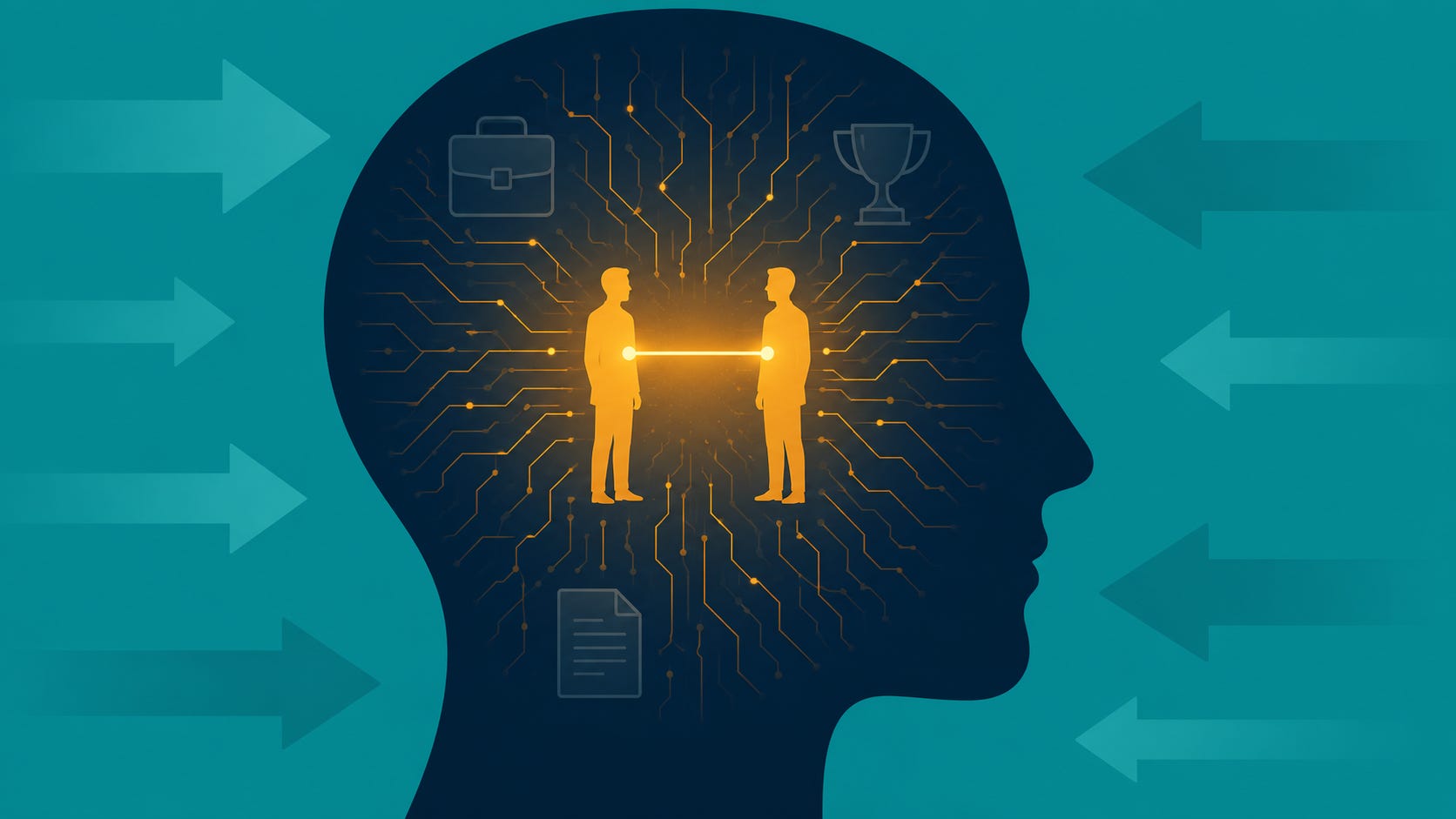
On the neurobiological side, close social bonds trigger the release of oxytocin, which reduces amygdala reactivity and lowers the physiological stress response. They activate the brain’s reward circuitry through dopamine and opioid pathways. They support the regulation of the autonomic nervous system through what Stephen Porges has described as the social engagement system, a set of neural circuits specifically evolved to allow humans to co-regulate each other’s physiological states (Porges, 2011). In short, other people are not just emotionally important to us. They are neurobiologically necessary. The brain uses relationships to regulate itself in ways it cannot fully achieve alone.
The brain did not evolve to function in isolation. It uses relationships to regulate itself in ways it cannot achieve alone. Loneliness is not just an emotional state. It is a physiological one.
There is a painful irony in the deathbed finding. The things most of us spend the majority of our waking hours pursuing, career progression, financial security, status, productivity, are rarely the things we end up feeling mattered most. And yet the reordering almost always happens too late, or at least later than it needed to.
Part of the reason for this is structural. Achievement is measurable. You can count the promotions, the salary increases, the projects completed. Relationships are harder to quantify and easier to deprioritise precisely because they do not announce their value in numbers. The deep conversation you did not have because you were busy, the friend you did not call back, the evening you did not put your phone away: none of these register as losses in the moment. They accumulate quietly.
There is also something worth naming about how modern life is organised. Many of the environments we spend the most time in, workplaces, commutes, screens, optimise for individual productivity rather than social connection. This is not a moral failing on anyone’s part. It is a structural mismatch between the conditions human brains evolved to thrive in and the conditions most of us actually inhabit.
Understanding that relationships are not a nice-to-have alongside a productive life, but are in fact the primary substrate of a healthy nervous system and a meaningful one, changes the calculation. It reframes time spent with people you care about not as time taken away from something more important, but as the thing that is most important, with everything else arranged around it.
Comments
Nothing yet. Say the first thing.
Sign in to join the conversation.