
I will start by providing the exact section of Chapter 9 of Article 5 and follow by exhibiting how the changes would look like. Any visible changes in the result will be in italics or have a strikethrough to exhibit that it is no longer included in the document and not replaced.
This article will be long (because these Article 5: Chapter 9 sections are lengthy), so if you would like to skip the fully fledged out changes scroll (a lot) to the section titled What does this mean for us?
I will explain the purpose of each change and how the power can be abused at the end.
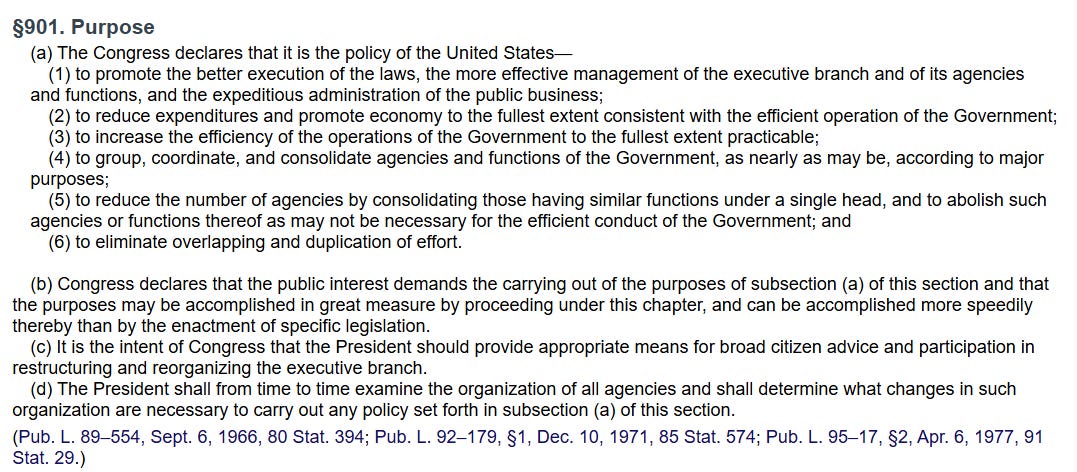
(a) The Congress declares that it is the policy of the United States—
(1) to promote the better execution of the laws, the more effective management of the executive branch and of its agencies and functions, and the expeditious administration of the public business;
(2) to reduce expenditures and promote economy to the fullest extent consistent with the efficient operation of the Government;
(3) to increase the efficiency of the operations of the Government to the fullest extent practicable, including the elimination of operations determined to be unnecessary for the execution of constitutional duties;
(4) to group, coordinate, and consolidate agencies and functions of the Government, as nearly as may be, according to major purposes;
(5) to reduce the number of executive departments by consolidating those having similar functions under a single head, and to abolish such executive departments or functions thereof as may not be necessary for the efficient conduct of the Government; and
(6) to eliminate overlapping and duplication of effort and
(7) to reduce the number of federal employees;
(8) to amend rules, regulations, and other requirements for the purpose of decreasing the cost and difficulty of compliance thereof, and to eliminate unnecessary and burdensome rules, regulations, and other requirements; and
(9) to eliminate government operations that do not serve the public interest.
(b) Congress declares that the public interest demands the carrying out of the purposes of subsection (a) of this section and that the purposes may be accomplished in great measure by proceeding under this chapter, and can be accomplished more speedily thereby than by the enactment of specific legislation.
(c) It is the intent of Congress that the President should provide appropriate means for broad citizen advice and participation in restructuring and reorganizing the executive branch.
(d) The President shall from time to time examine the organization of all executive departments and shall determine what changes in such organization are necessary to carry out any policy set forth in subsection (a) of this section.
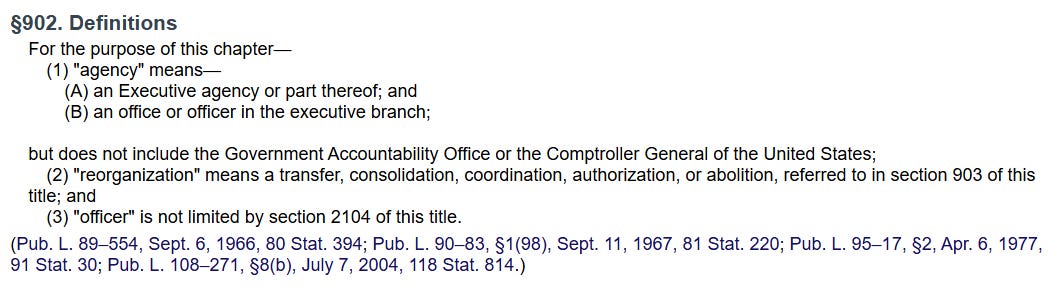
For the purpose of this chapter—
(1) ‘executive department’—
(A) means—
(i) any executive department, agency, or independent establishment of the United States or any corporation wholly owned by the United States; and
(ii) an office or officer of the executive branch; and
(B) does not include the Government Accountability Office or the Comptroller General of the United States.
(2) "reorganization" means a transfer, consolidation, coordination, authorization, or abolition, referred to in section 903 of this title; and
(3) "officer" is not limited by section 2104 of this title.
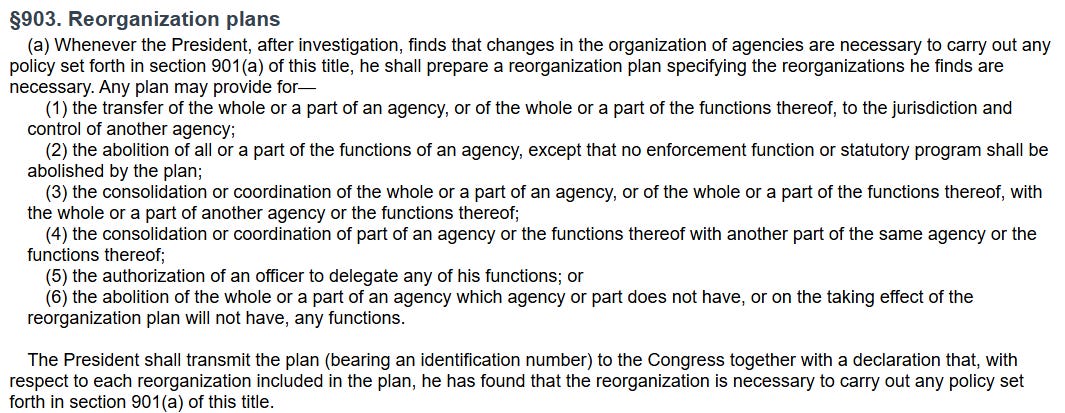
(a) Whenever the President, after investigation, finds that changes in the organization of executive departments are necessary to carry out any policy set forth in section 901(a) of this title, he shall prepare a reorganization plan specifying the reorganizations he finds are necessary. Any plan may provide for—
(1) the transfer of the whole or a part of an executive department, or of the whole or a part of the functions thereof, to the jurisdiction and control of another executive department;
(2) the abolition of all or a part of the functions of an executive department, except that no enforcement function or statutory program shall be abolished by the plan;
(3) the consolidation or coordination of the whole or a part of an agency, or of the whole or a part of the functions thereof, with the whole or a part of another agency or the functions thereof;
(4) the consolidation or coordination of part of an agency or the functions thereof with another part of the same agency or the functions thereof;
(5) the authorization of an officer to delegate any of his functions; or
(6) the abolition of the whole or a part of an agency which agency or part does not have, or on the taking effect of the reorganization plan will not have, any functions.
The President shall transmit the plan (bearing an identification number) to the Congress together with a declaration that, with respect to each reorganization included in the plan, he has found that the reorganization is necessary to carry out any policy set forth in section 901(a) of this title.
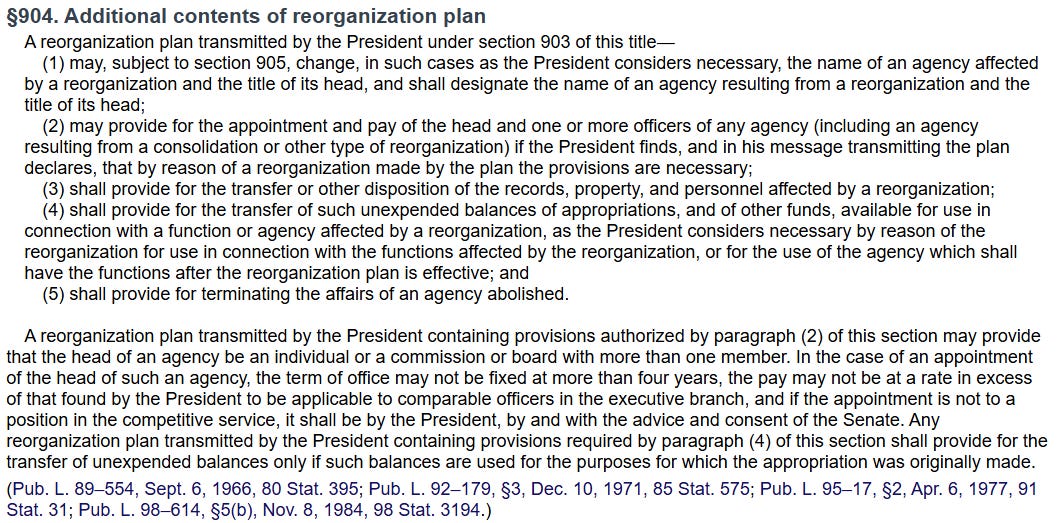
A reorganization plan transmitted by the President under section 903 of this title—
(1) may, subject to section 905, change, in such cases as the President considers necessary, the name of an executive department affected by a reorganization and the title of its head, and shall designate the name of an executive department resulting from a reorganization and the title of its head;
(2) may provide for the appointment and pay of the head and one or more officers of any executive department (including an executive department resulting from a consolidation or other type of reorganization) if the President finds, and in his message transmitting the plan declares, that by reason of a reorganization made by the plan the provisions are necessary;
(3) shall provide for the transfer or other disposition of the records, property, and personnel affected by a reorganization;
(4) shall provide for the transfer of such unexpended balances of appropriations, and of other funds, available for use in connection with a function or executive department affected by a reorganization, as the President considers necessary by reason of the reorganization for use in connection with the functions affected by the reorganization, or for the use of the executive department which shall have the functions after the reorganization plan is effective; and
(5) shall provide for terminating the affairs of an executive department abolished.
A reorganization plan transmitted by the President containing provisions authorized by paragraph (2) of this section may provide that the head of an executive department be an individual or a commission or board with more than one member. In the case of an appointment of the head of such an executive department, the term of office may not be fixed at more than four years, the pay may not be at a rate in excess of that found by the President to be applicable to comparable officers in the executive branch, and if the appointment is not to a position in the competitive service, it shall be by the President, by and with the advice and consent of the Senate. Any reorganization plan transmitted by the President containing provisions required by paragraph (4) of this section shall provide for the transfer of unexpended balances only if such balances are used for the purposes for which the appropriation was originally made.
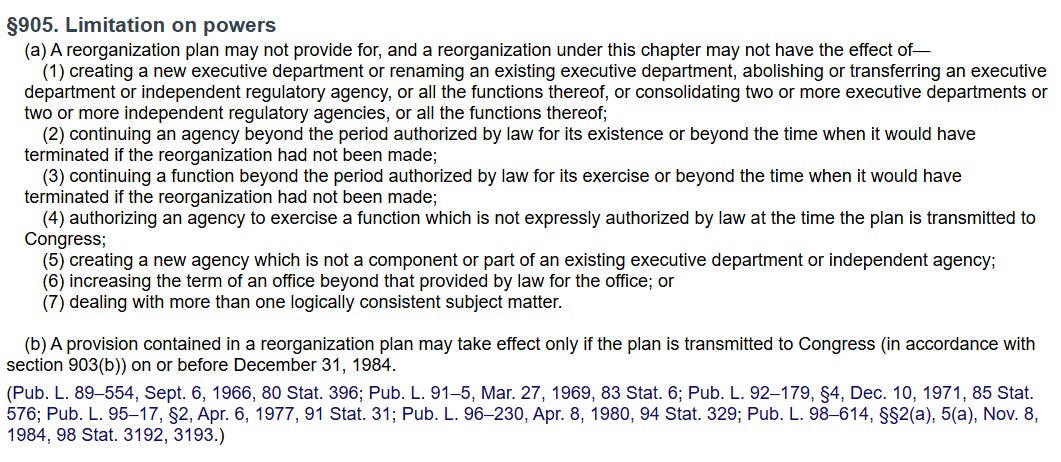
(a) A reorganization plan may not provide for, and a reorganization under this chapter may not have the effect of—
(1) creating a new executive department or renaming an existing executive department, abolishing or transferring an executive department or independent regulatory agency, or all the functions thereof, or consolidating two or more executive departments or two or more independent regulatory agencies, or all the functions thereof;
(2) (1) continuing an executive department beyond the period authorized by law for its existence or beyond the time when it would have terminated if the reorganization had not been made;
(3) (2) continuing a function beyond the period authorized by law for its exercise or beyond the time when it would have terminated if the reorganization had not been made;
(4) (3) authorizing an executive department to exercise a function which is not expressly authorized by law at the time the plan is transmitted to Congress;
(5) (4) creating a new executive department which is not a component or part of an existing executive department or independent agency;
(6) (5) increasing the term of an office beyond that provided by law for the office; or
(7) (6) dealing with more than one logically consistent subject matter; or
(7) creating a net increase in the number of federal workers or a net increase in expenditures.
(b) A provision contained in a reorganization plan may take effect only if the plan is transmitted to Congress (in accordance with section 903(b)) on or before December 31, 2026.
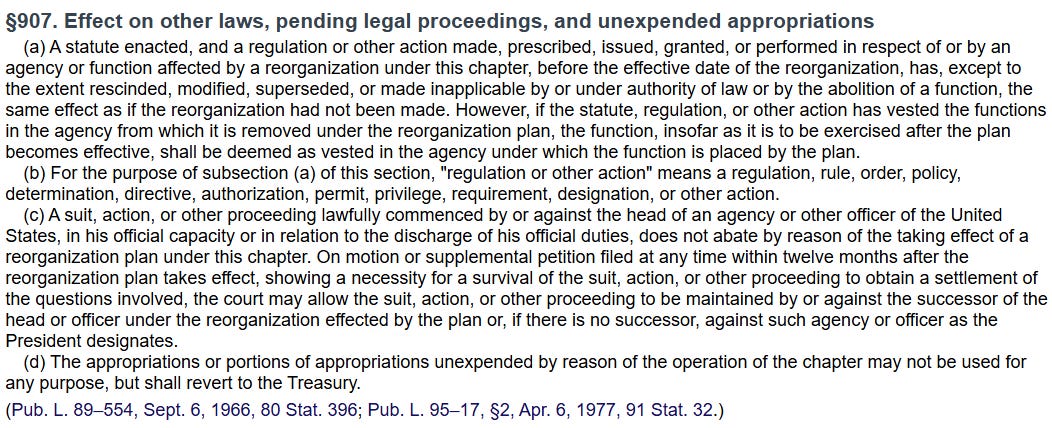
(a) A statute enacted, and a regulation or other action made, prescribed, issued, granted, or performed in respect of or by an executive department or function affected by a reorganization under this chapter, before the effective date of the reorganization, has, except to the extent rescinded, modified, superseded, or made inapplicable by or under authority of law or by the abolition of a function, the same effect as if the reorganization had not been made. However, if the statute, regulation, or other action has vested the functions in the executive department from which it is removed under the reorganization plan, the function, insofar as it is to be exercised after the plan becomes effective, shall be deemed as vested in the executive department under which the function is placed by the plan.
(b) For the purpose of subsection (a) of this section, "regulation or other action" means a regulation, rule, order, policy, determination, directive, authorization, permit, privilege, requirement, designation, or other action.
(c) A suit, action, or other proceeding lawfully commenced by or against the head of an executive department or other officer of the United States, in his official capacity or in relation to the discharge of his official duties, does not abate by reason of the taking effect of a reorganization plan under this chapter. On motion or supplemental petition filed at any time within twelve months after the reorganization plan takes effect, showing a necessity for a survival of the suit, action, or other proceeding to obtain a settlement of the questions involved, the court may allow the suit, action, or other proceeding to be maintained by or against the successor of the head or officer under the reorganization effected by the plan or, if there is no successor, against such executive department or officer as the President designates.
(d) The appropriations or portions of appropriations unexpended by reason of the operation of the chapter may not be used for any purpose, but shall revert to the Treasury.
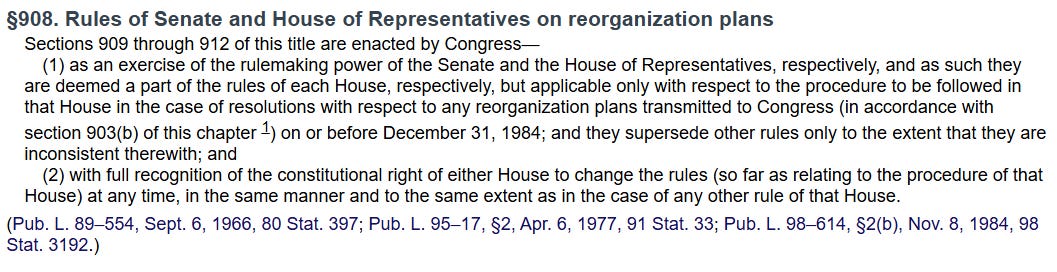
Sections 909 through 912 of this title are enacted by Congress—
(1) as an exercise of the rulemaking power of the Senate and the House of Representatives, respectively, and as such they are deemed a part of the rules of each House, respectively, but applicable only with respect to the procedure to be followed in that House in the case of resolutions with respect to any reorganization plans transmitted to Congress (in accordance with section 903(b) of this chapter 1) on or before December 31, 2026; and they supersede other rules only to the extent that they are inconsistent therewith; and
(2) with full recognition of the constitutional right of either House to change the rules (so far as relating to the procedure of that House) at any time, in the same manner and to the same extent as in the case of any other rule of that House.

For the purpose of sections 908 through 912 of this title, "resolution" means only a joint resolution of the Congress, the matter after the resolving clause of which is as follows: "That the Congress approves the reorganization plan numbered transmitted to the Congress by the President on , 20 .", and includes such modifications and revisions as are submitted by the President under section 903(c) of this chapter. The blank spaces therein are to be filled appropriately. The term does not include a resolution which specifies more than one reorganization plan.
Starting with §901, the edits in paragraph 3 enable the government to eliminate any agency or operations if it deems them unnecessary to MAGA’s interpretation of the constitution.
Further, they replace the term “agency(ies)” with the term “executive department(s)” to establish that any current agency is under the control of the executive branch.
The added 7th paragraph states that the purpose of this policy of the United States is to reduce the number of Federal employees further suggesting that the goal is to consolidate all power to the Presidential position.
The additional 8th paragraph states that the purpose of this policy is to decrease “the cost and difficulty of compliance thereof” regarding the rules, regulations, and other requirements that may be amended. Moreover, they are planning on eliminating any rules, regulations, and other requirements that they deem “unnecessary” or unhelpful to their cause.
Moving onto the §902 which replaces the term “agency” with the term “executive department” — a common theme throughout the revisions.
It goes on to define this as any group (corporation, agency, independent establishment) in the United States, and any office or officer of the executive branch is under the control and ownership of the United States completely.
Excluding Government Accountability Office or the Comptroller General of the United States from this definition. This allows the administration to dismiss the “Non-Partisan and fact-based” reporting on the conditions of different agencies through audits and investigations without being associated with this particular office which enables them to continue to spread propaganda and disinformation.
§903 continues to swap “agency” for “executive department” but has one extremely concerning change. §903(a)-2 is read as followed: “Whenever the President, after investigation, finds that changes in the organization of executive departments are necessary to carry out any policy set forth in section 901(a) of this title, he shall prepare a reorganization plan specifying the reorganizations he finds are necessary. Any plan may provide for— (2) the abolition of all or a part of the functions of an executive department, except that no enforcement function or statutory program shall be abolished by the plan”
The bill introduced will strike through “except that no enforcement function or statutory program shall be abolished by the plan” which suggests the plan that they, likely, already have written up is planning to defund or abolish the law enforcement, and agencies that enforce rules, regulations, other requirements, and statutory laws.
§904 and §907 simply continue to swap the term “agency” for “executive department” which really drives home the purpose of changing the term.
§905 is a big one.
Deleting the whole first paragraph removes the prohibited actions of creating, abolishing, renaming, transferring, or consolidating executive departments or independent regulatory agencies from the abilities of the reorganization plan that the President must submit.
Indicating, again, that the goal here is to consolidate all the power to the executive branch or even more likely, just the President.
They then reestablish paragraphs 2-7 as paragraphs 1-6.
An additional paragraph is created which prohibits the plan to include creating a larger federal workforce and prohibits any plan that includes an increase in expending on goods or services.
The purpose is to lower the federal workforce to as little as possible, continuingly consolidating the government, and also to avoid any financial expenditures which is another method of consolidating wealth for the wealthy.
Near the end of this section, they simply change December 31, 1984, to December 31, 2026, which means that any law or statute that is contained within a reorganization plan will only take effect if it is communicated with Congress by December 31, 2026. This indicates they have a fully-fledged out reorganization plan already.
Again, in §908 the date December 31, 1984, will turn into December 31, 2026.
§909 swaps out the preset 19__ for year into 20__.
I appreciate that you’re still reading, I just have one last thing to say.
We need to make this knowledge more available, more widespread, and more emphasized.
Tell your friends, your family, and your followers to read up and speak out.
This bill is quite literally the Enabling Act of the Nazi Regime which allowed Hitler to acquire dictatorial powers.
We are experiencing more win’s day by day, but the market is falling off a never-ending cliff worldwide. We need to stay informed and aware of what they are planning because we are still a few steps behind.
The Great Depression was one of the main factor’s fascists used to gain control in the 1930s.
Keep on fighting.
Keep on educating.
Keep your future on your mind when you decide what to do.
From Martha Van W.
No posts
Comments
Nothing yet. Say the first thing.
Sign in to join the conversation.