
Over the next few weeks we're doing something a little different… instead of looking at genres, we're looking at the people who made them. Pre-code comics had some extraordinary artists working across wildly different styles, and their stories are as interesting as anything in the comics they produced.
We’re starting with science fiction, a genre that, in the pre-code era, attracted some of the most technically ambitious artists working in comics. It produced work that the Library of Congress has described as among the most significant science fiction illustrations of the 20th century, and ended not because it failed, but because the Comics Code made honest science fiction essentially impossible to publish.
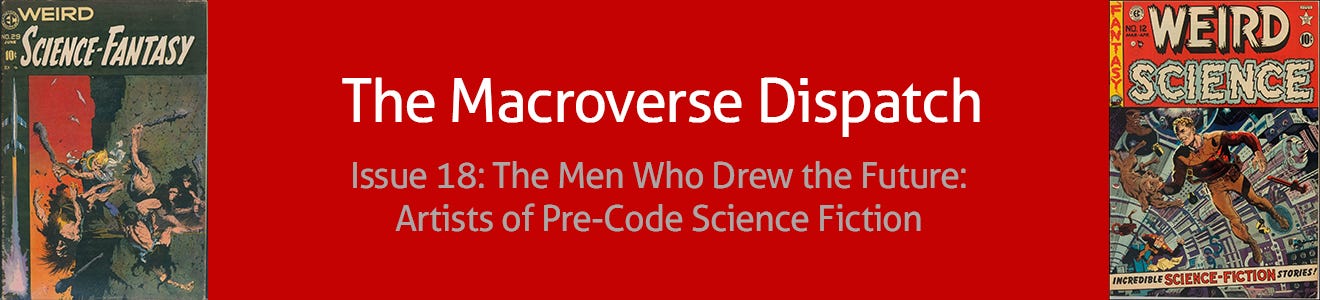
The key venue was - like so many of these genres - EC Comics. Between 1950 and 1955, Weird Science and Weird Fantasy (and their merged successor, the incredibly unimaginatively named Weird Science-Fantasy) assembled a roster of artists that reads like a roll call of everyone who mattered: Wally Wood, Al Williamson, Frank Frazetta, Reed Crandall, Joe Orlando, George Evans and more. These were not house artists working to a template... EC gave them genuine creative latitude, paid well by the standards of the day, and wrote stories specifically with individual artists in mind.
The results remain extraordinary.
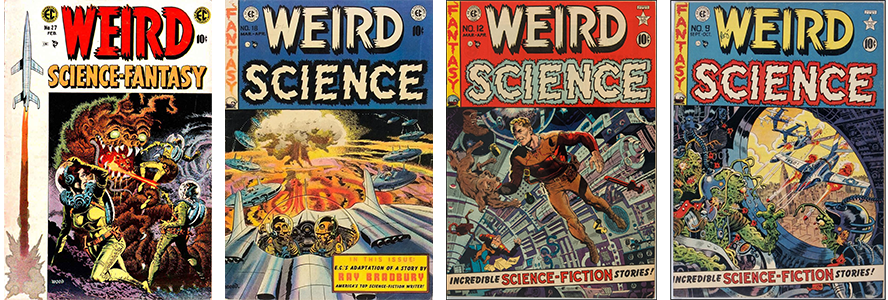
Wallace Wood earned the title “The Dean of Science Fiction Artists” for his work on EC’s books, and the title is not an exaggeration. He grew up in Minnesota, served in the Merchant Marines during the war, and spent the late 1940s in a shared studio in Manhattan’s Upper West Side with fellow artists Harry Harrison, Joe Orlando, and Sid Check. They studied the work of their contemporaries obsessively - Frazetta, Mort Meskin, Joe Kubert - and the discipline showed. By the time Wood arrived at EC in 1950, he was fully formed as an artist.
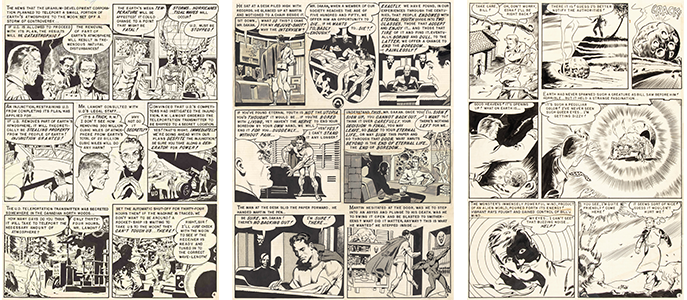
Wood, the title’s leading artist, took over as Weird Science‘s regular cover illustrator in 1952, as well as contributing two stories per issue. His science fiction interiors were technically meticulous in a way that had almost no precedent in comics: detailed machinery, convincing zero-gravity, alien landscapes rendered with extreme care. The storytelling was equally accomplished, with his page compositions moving the eye with a cinematic fluency.
Sadly, he also had a well-documented self-destructive streak. He worked constantly, drank heavily, and eventually lost the sight in one eye in the 1970s. He is also famous for his dictum - “never draw anything you can trace, never trace anything you can cut out, never cut out anything you can photocopy” - which reads as the philosophy of a man who understood the economics of creative labour better than most of his publishers. He died by suicide in 1981, aged 54, having produced a body of work that the field has never adequately memorialized.
Frank Frazetta’s pre-code comics work is not the work he’s remembered for. The paintings that defined his reputation - the Conan covers, the Tarzan paperbacks, the Molly Hatchet album art - came later, after he had largely left comics behind. But his EC work is extraordinary in its own right, and understanding it changes how you see the later career.
Beginning his professional career in comics in 1944 at the age of 16, Frazetta worked at Bernard Baily’s studio alongside future EC artists Graham Ingels and George Evans. He moved through several publishers before arriving at EC in the early 1950s, where he frequently collaborated with Al Williamson, the two artists co-pencilling and co-inking pages in a way that was unusual for the industry.
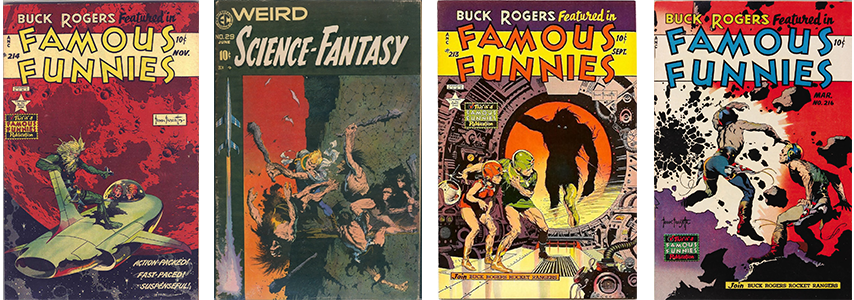
His most celebrated pre-code work was the Buck Rogers cover illustrations for Famous Funnies #209-216… eight consecutive covers of what Tripwire Magazine described as “superlative film poster standard masterpieces, brimming with fluid, filmic art of the highest calibre.” These are Frazetta at his purest in the comics form: the draftsmanship is extraordinary, the compositions dynamic without being chaotic, and the figures brimming with physical specificity - weight, momentum, the sense of actual bodies in actual space - that most comics artists of the era weren’t attempting.
His most famous single comics image was a cover originally done for Famous Funnies that was initially rejected due to its extreme violence, but was ultimately used for the final issue of Weird Science-Fantasy. Publisher Russ Cochran later described it as “the most outstanding cover ever put on a comic book.” If you’ve seen it, you understand why. If you haven’t, find it.
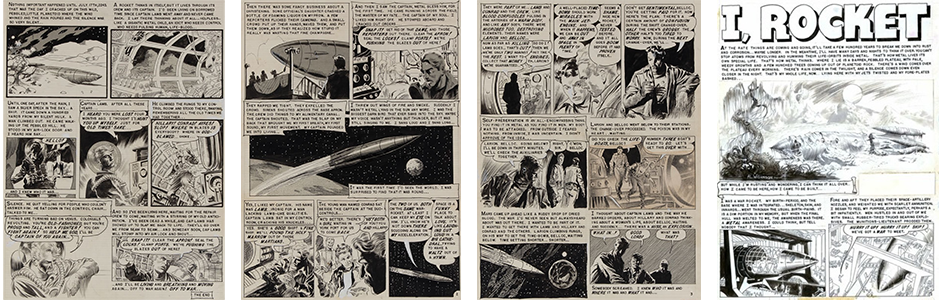
Al Williamson is the member of this group most frequently described as underrated, which is a strange thing to say about someone whose EC science fiction work was praised by Jack Kirby, Alex Raymond, and practically everyone else who saw it.
His most notable EC works include “I, Rocket”, in Weird Fantasy #20 (Aug. 1953), co-pencilled and co-inked with Frank Frazetta; and “50 Girls 50”, in Weird Science #20 (Aug. 1953), co-inked by Williamson and Frazetta. Both stories have been cited as stylistic breakthroughs, moments where the combination of Williamson’s classical draftsmanship and Frazetta’s raw energy produced something that neither could have managed independently.
His EC work has been called “illustrative flamboyance”... which sounds like faint praise until you understand what it means in context. Where Wood was precise and architectural, Williamson was romantic and atmospheric. His science fiction wasn’t about technology; it was about people in extraordinary circumstances, rendered with an almost old-fashioned love of the adventure story that sat oddly and brilliantly against EC’s typically cynical plots. He is known for his collaborations with a group of artists known as the “Fleagle Gang”. They shared reference materials, inked each other’s work, and produced a body of illustration that had more in common with the Golden Age of adventure illustration than with the disposable comics market they were technically working in.
EC’s science fiction comics were never able to match the popularity of their horror comics, but Gaines and Feldstein kept them alive using the profits from their more popular titles… They believed in the work in a way that wasn’t entirely commercially rational.
The Code didn’t have a specific clause targeting science fiction the way it targeted horror (or Good Girl). What it did was remove the moral seriousness that had defined EC’s approach: the anti-racist allegories, the anti-war stories, the genuinely provocative ideas embedded in genre packaging. Without the ability to challenge, science fiction comics became adventure stories with spaceship decorations. The artists who had made the EC books what they were moved on: Wood to Mad and later to his own alternative publications, Williamson to Flash Gordon and eventually Star Wars adaptations, Frazetta to paperback covers and eventually to painting.
The genre never died, but it never quite recovered the ambition of those five years at EC.
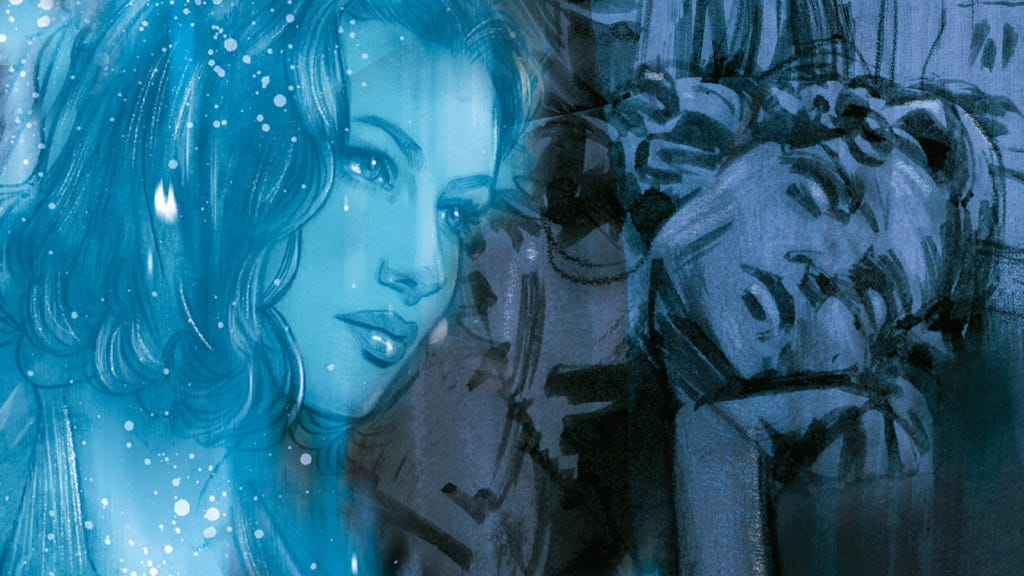
A restless ghost from the 1960s enlists a grieving man to carry her bones across the country in a final attempt to reunite with her husband. But even the afterlife has rules, and breaking them could incur a fate worse than death.
Doug Wagner (Plastic, Narco) calls it “A haunting love story about ghosts, road trips, and letting go” and his word is enough for us.
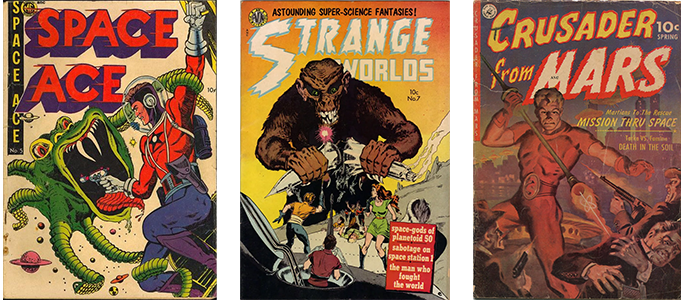
Classic pre-code science fiction pulp comics. An incredible array of stories from the pre-eminent artists of the age… enjoy!
Have a great week!
And, as always, keep buggering on…
Adam & Team Macroverse
No posts
Comments
Nothing yet. Say the first thing.
Sign in to join the conversation.