
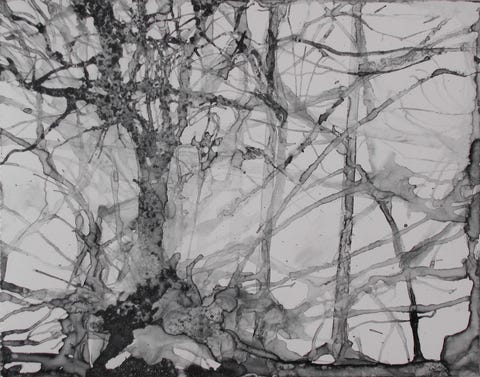
A note from the author: This month, my article Sleepers for Seekers appears in Fretboard Journal issue #59. The essay is accompanied by a work from artist Donald Groscost. Over the last fifteen years my friendship with Don has informed nearly every part of my life, providing a north star in times of darkness, a compass in times of confusion and a coconspirator in times of seeking. It is with that timely prompt, and the perennial struggle of worker-writers to keep creating in the face of uncertainty that I share this essay. It was originally published on May 30, 2017. I’ve made some updates.
I met Donald on a Sunday morning in the dead of a crystalline New York winter. An ambitious dalit in the thralls of restlessness, the new friendship and mentorship was a welcome departure from the professional self-immolation of my early twenties. The second, and final time that I lived in Brooklyn, my literary career had recently progressed from a couple newspaper clips to a botched internship, sporadic demolition work and a part-time gig toasting bagels.
Over a decade my senior, Donald was fifteen years removed from the sort of professional vagary I was only beginning to understand. Joseph Campbell's proverbial helper, he was well-established and steadfast in his process. Don was the first artist I met who beat the system and didn’t need to brag about it. His blue-collar was real and so was his work ethic. He went about his business with the piety of a Hermann Hesse novel and the pragmatism of a Fugazi lyric. Artist, musician and expert fly fisherman—all three titles earned. All titles that are to be taken very seriously.
Over the last seven years a winding conversation has carried us through an often collaborative and always analytical friendship. Central to the mentoring side of our friendship are never-ending evaluations of the creative life and a deep, often startling, examination of our shared journey. Through these discussions, I’ve found a process driven credo that continues to sustain my life as a worker-writer.
One evening, lost in a self-defeating tirade, I rattled off a list of bulbous validations that clumsily commodified my definition of success. The sort of list that has more to do with ascending class than creating art. Dead pan, Don told me, for the first of many times, “The greatest reward is afforded by the work itself.”
In the years since, it has become a mantra. Anytime my reason for writing drifts from my focus on the work to dreams of great reward, these words serve as a creative beacon, calling me back to shore. Writers write. Painters paint. Dancers dance. It’s actually that simple, everything else is just that, everything else.
“It’s a blue-collar job. You get up, pack your lunch, go to the studio and push paint around.” - Donald Groscost
Big paychecks are great, and everybody loves when they get a like, comment or share, but the reward for doing the work, is getting to do the work. Simply put, if you write every day, your reward will be continuing to write every day. Landing a publishing deal and getting a literary agent is only going to result in getting to, or having to, spend more time writing. We may never be able to write our way into accolades and mass attention, but we can certainly write our way into more writing. And if the goal is to write, then continuing to write is an achievement.
Have you ever watched an acclaimed artist sand drywall putty while telling a story about selling an entire collection of work at a recent show in Spain? Fitted with goggles and a dust mask, I watched Donald plaster, sand, prep and paint a giant gallery wall over the course of a 10-hour workday—a task that is well below his skill level and professional standing. We worked as art handlers together, he the Head Preparator, and myself a general laborer. Regardless, we performed the same task and at the end of the day he only had one comment, “There is always something satisfying about covering a surface with paint.”
Being an artist isn’t special. We aren’t a special class of laborer. We are all workers chained to a wage system, and understanding that is essential to continuing our creative pursuits. As a writer or artist in the working class, our work and skill is of no more value than anyone else’s. We are to create out of the desire to create, not the expectation for worldly admiration and reward. All labor deserves dignity, and every laborer is entitled to the value they produce. A day putting paint on a wall, and a day putting paint on a canvass are both part of the same life’s work-a life dedicated to creation. Even when we aren’t doing our work, we are doing the work.
Why should a writer have to handle art or wash cars, demolish apartments or drive a box truck? These are the sorts of entitled questions that haunt professional artists. After all, if you were that good, wouldn’t you make enough from your writing to only write? As a woking class writer, you already know this to be bullshit, but that doesn’t mean that self doubt doesn’t come for us all.
For blue-collar writers and artists, financing our work is an inherent part of the creative pursuit. There is no telling where the last job will lead or the next job will come from. Whatever menial job you find yourself doing, it is all part of sustaining the creative life, that is to say, it is all part of the creative work.
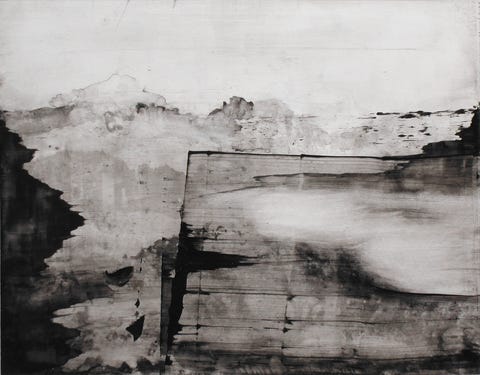
Getting paid to make art is one definition of being a professional. Another is only making money from art, or art related endeavors. But this sort of binary logic can become crippling. We all love the image of the reclusive, prolific artist, too wildly inspired to balance a checkbook, and maybe you will be, but it isn’t realistic for most of us. If we want to sustain a creative lifestyle we must figure out how to finance both our creativity and our lives. In a capitalistic society, raising capital is part of every job description, being an artist is no exception.
Making the money that affords you the ability to keep creating is a creative process and part of our job. Don was the first to suggest that the solution is to approach the financial requirements of our work and life with the same creativity that we approach the work itself. Living on as little as possible, while making as much as possible in as little time as possible tends to be the most liberating equation. However, even that isn’t available to everyone in equal measure, uniformly throughout life. More often we have seasons, ones where we art handle, others where we get to be the editor of a magazine, and another where we deliver mail. Throughout all these stages of life and work, our identity need not change, nor does our value. Even though the way we are perceived will swing wildly, even the way we are treated will see drastic highs and lows, but our function, or focus, and our ability need not waver. The same artist who sold out a show in Spain applied paint to a gallery wall. The same skilled hand held both brushes.
When you see it all as part of sustaining the creative life it puts the days spent painting a house, or digging a ditch in perspective. Making $100 on Monday painting a house affords the ability to spend Tuesday painting a canvas. Instead of seeing it as a binary, the freedom comes from non-dualism. It is all part of life.
To sustain a creative life we must maximize our time to be creative while maintaining basic financial stability—no matter how lean of an operation you are running. Yes, our Bourgeoisie peers don’t have to face those same obstacles, but for us, it means working to keep working.
Have you ever heard the idea that the audience finds you? Don has told me that one thousand times. Bob Dylan lays claim to a nearly identical quote. And despite story after story about artists gaming the algorithm, being PSYOPs and all the rest of it, for blue-collar artists without a bankroll, it is the. option we much continue to believe in.
The sustainability and the resource to keep going, keep creating and see your vision through is a daily fight. Charles Bukowski said, “Endurance is more important than truth.” It takes endurance to still be creating in the face of mounting fiscal pressures and economic uncertainty. It is an obstacle that artists with black Amex cards don’t face, but one that working class artist must solve before ever even putting pencil to paper, let alone seeing a project through to completion.
The business of creativity is just that a business. It is as intriguing and inspired as any vocation. It is also as exhaustive and exploitative as any other labor. While some may be born with a built-in solution for funding their creativity, the rest of us need to create a self-reliant approach that affords the continuation of our work. And we all need a friend, helper and mentor to remind us that the work is the reward, financing is part of the creative pursuit and it’s still a beautiful day to dig a ditch.
As Don would say, in his best Kwai Chang Caine impression—”Yes grasshopper, The path to enlightenment is enlightenment. Keep doing the work.”
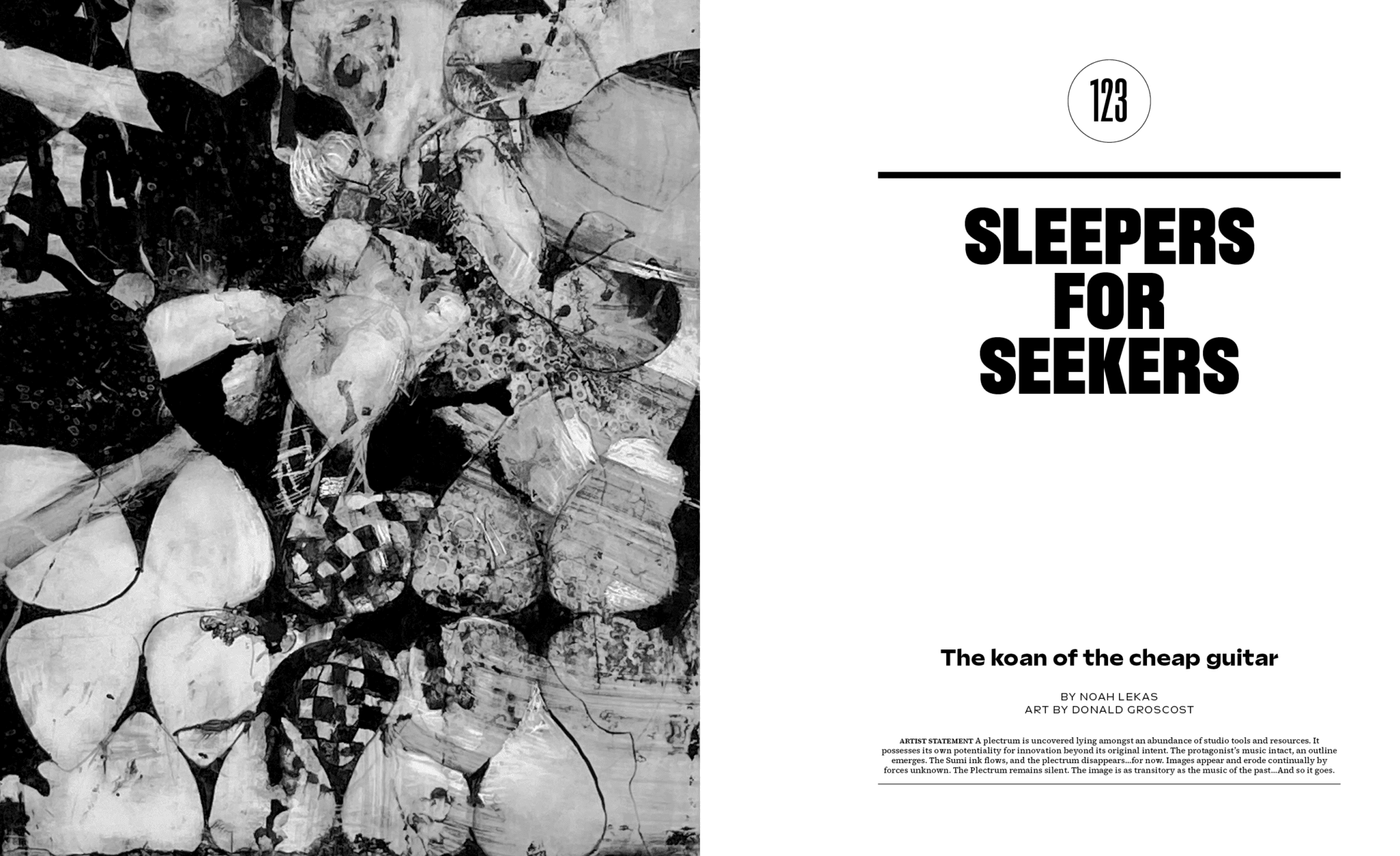
The Sleepers for Seekers essay is only available in the print pages of the quarterly Fretboard Journal #59, pick up a copy.
No posts
Comments
Nothing yet. Say the first thing.
Sign in to join the conversation.