
Recently I had dinner with six alums from GE’s Aviation business. All were spectacularly successful leaders who built a great industrial business and have thrived in retirement. They had become founders and investors; even farmers. It is joyous to work with people you like and respect.
We stay connected to each other for life. John Chiminski and I serve on a start up board together. John was a talented Healthcare operator who I met in 1996. He was one of the most talented executives I had ever seen. He resigned in my office in March 2009…the day we cut the GE dividend. A bad day. He asked me, “will we speak again?” I said, “yes, but not soon.” He went on to do a great PE gig with Blackstone, taking Catalent (life sciences) public, and serving as its CEO. After 10 years, we finally spoke again and we remain great friends today. Life is long; surround yourself with great people.
I feel like I have lost a connection to GE. But I always stayed engaged with our people, even current employees. Hundreds have reached out over the years. I had the chance to watch GE leaders become exceptional public company CEOs; while many others have become CFOs, GCs, and HR leaders. I continue to play the role of sounding board and coach to many. I am proud of them and want them to succeed.
Business leadership is an evolving art. When I began teaching at Stanford, I read multiple books on CEOs and leadership. Most are not good. Jack Welch was a great CEO, but his books never captured his magic. Elon Musk is a game-changing leader. No book from the early 2000’s predicted his style of success. It is hard to learn from a person without a contemporary context; “rearview mirror analysis” is uninspiring.
Fortunately, I was able to bring CEOs/Founders to class, including many with GE heritage. Watching leaders was helpful to show students a variety of styles. I wanted them to see the “gritty stuff;” how leaders make decisions, solve problems, and build culture. Watching “GE-bred” CEOs, alongside my students, allowed me to see them through fresh eyes, and with the perspective of the next generation. My students learned from the GE CEOs who were humble and open and curious and diverse and competent.
How Do You Develop A CEO?
No person really sets out to be a CEO, and no company has a charter to develop them. However, GE was intentional about recruiting and development and exposure and performance and ideas...the output created some really good leaders.
Making it through a system to become a CEO...or even becoming a founder...emanates from an internal fire. This looks like ambition, but it is really something different. Leaders want to get the most out of their potential, leave it “all on the field.” They don’t fear criticism or judgment. Becoming a CEO is where you end up, not the goal. Getting there is just the beginning.
I allocated one-third of my time to developing leaders. I watched how they spent their time, made decisions, and treated people. The results are the easy part. You try to prepare them for any environment; you can’t count on “tailwinds.” Fellow CEOs view leadership through a different lens than the pubic. They understand the task, learning more from the approach than the outcome. They recognize the role of luck. My favorite leadership book remains “Shoe Dog.” Phil Knight didn’t say “look at me.” Rather he told a story: “This is what I tried, what do you think?”
The current generation of GE leaders have flourished in great numbers, more than 100 becoming public company CEOs. In 2002 after my first leadership meeting, a veteran GE VP said to me, “We don’t need to know how the company works, we just want you to have some of Jack’s ‘magic beans,’ so the stock goes up.” I resolved to develop leaders who understood this world and believed in ideas.
Initially, start-ups don’t have the luxury of developing leaders. But scaling requires a “leadership culture,” where more people want more responsibility. Founders , eventually, will recognize and develop the best talent. Good CEOs (or founders) will invest in human resources to develop a plan to get the most from their talent. I worked hard with my HR leader, Susan Peters, to develop the following:
TLV Tips:
Build a system where people receive specific feedback and measure improvement...from an early age. Make every meeting a performance review. This sounds basic, but almost never happens.
Be intentional about a career path ... one that is broad and diverse. This is easier for companies than start-ups. But even leaders who want an entrepreneurial path should direct a zig zag career toward competency. Learn the right skills.
Take risk…no one is completely ready for a job. Everyone – at some point - will have imposter syndrome. Bet on people with capacity and desire. Looking back, most of my mistakes were backing the “safe choice.”
Simulate personal risk. Corporate life is different than the founder world; you operate with a net. Nonetheless, you must force leaders to make decisions, to risk “blame.” It only gets tougher. A common failure mode for people at the top is an inability to make decisions.
Make every peer encounter a competition, even among friends. Keep people sharp and be willing to criticize (even in public) in the spirit of improvement. Exhibit a sincere desire to help people achieve their best.
See how they fill spare time. When you are CEO, you control the agenda. If a senior leader fills their schedule with busy work, they will become a lousy CEO. Identify those who embrace new methods or ideas.
Be completely honest about tragic flaws. It is “kind” to say, “your time is up.” At the top, flaws become more obvious and basic: selfishness, judgment, courage, intellect.
Build confidence until you can’t. Encourage learning and risk taking. Most times when I removed a leader they had given up on themselves.
At an early age, make them respect the world. Context is learned on the job and is essential for a CEO.
Let them go. This was hard for me. Understand that everyone has their own desires and will find their own path. Some will leave. Strive to keep your alumni close. They help build a leadership brand. Have a bench: when a good person left, fill the job quickly; that gives your team confidence.
Always be present when they need a friend.
While we put systems in place to develop talent, my most important message was “Be yourself.” A good CEO is comfortable in their own skin. I never expected them to be loyal to me, but rather to be committed to their own ideas.
Who Wins?
Multiple styles can win. As I have watched leaders prosper, I have tried to build a mental model for success. I selected a segment of leaders to build a composite (15 out of 100+). Here is a family tree; most of these leaders I have known for 20+ years.
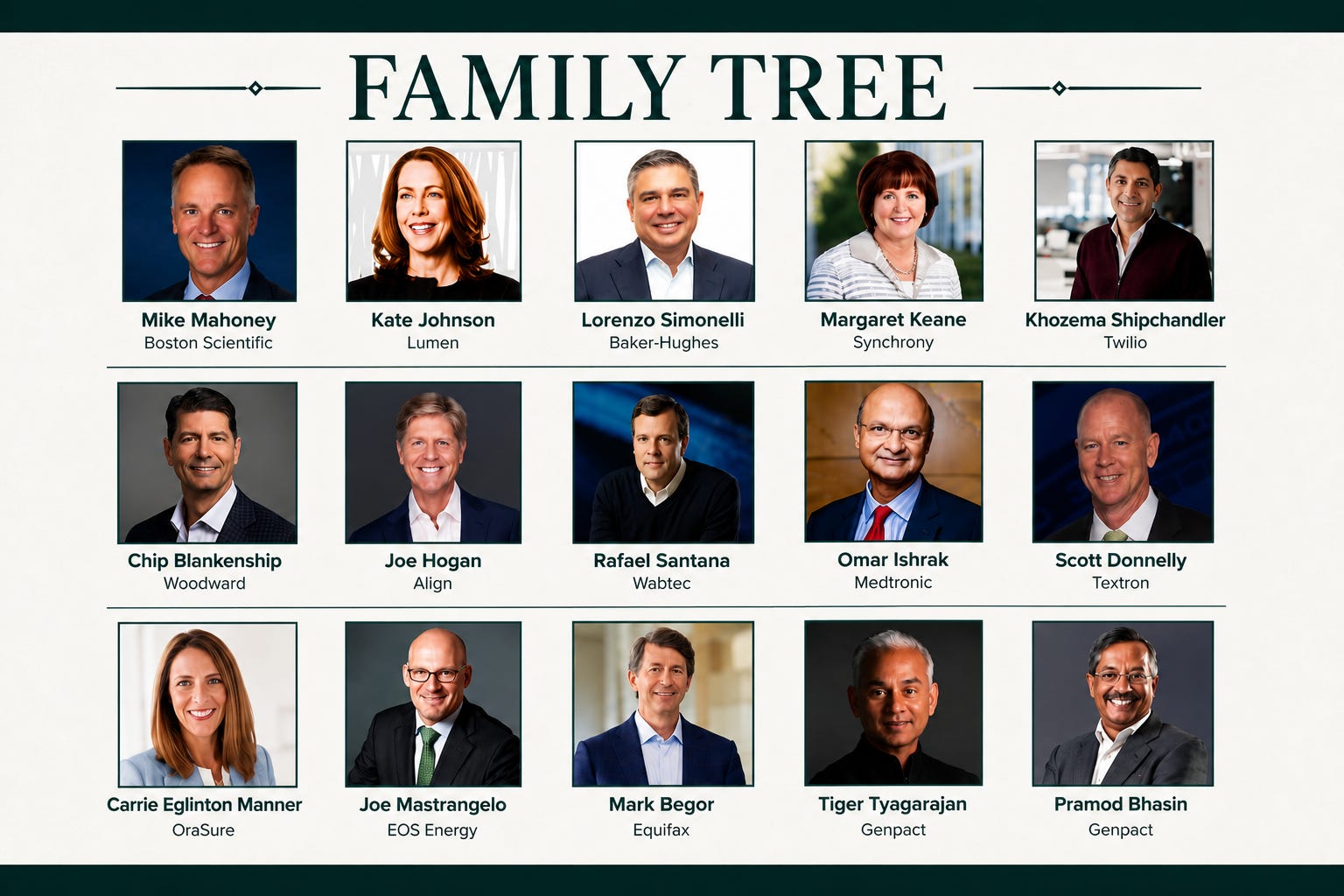
Mike Mahoney, Boston Scientific (Personal Vision)
At a young age, Mike had a vision for himself to lead at the highest level. He became a master of blending innovation with customer needs; willing to take personal risk. Always bet on himself. A tough-minded optimist. Humble.Kate Johnson, Lumen (Change Agent)
A very smart engineer who could walk into any room...from GE to Microsoft...and lead. Curious and comfortable in her own skin. Kate is a “change agent” that people trust and follow. It is rare to find someone who is fearless and funny…smart and tough. That is Kate.Lorenzo Simonelli, Baker-Hughes (Capacity )
100% pure determination and a global road warrior. Has mastered the energy market, becoming an industry thought leader. He is willing to take the big swings without perfect information. Able to juggle multiple balls; excels in moments of ambiguity. Willing to “stand apart” when he thinks he is right. Frequently success is a simple equation: Capacity for work x desire to work.Margaret Keane, Synchrony (Culture Builder)
People first...a dedicated culture builder. She led her team/customers through the financial crisis and a spin-out. She is immensely motivational through competence and grit. No bullshit...no “look at me”... just substance.Khozema Shipchandler, Twilio (Clarity)
A brilliant systems thinker, tough minded, and decisive. Kho has immense operational intensity and uniquely ties discipline to strategy. Able to pivot from CFO of GE in the Middle East to CEO of Twilio. Bet on him to win in the AI age because he links innovation to outcomes. A great recruiter. He can see the next move.Chip Blankenship, Woodward (Depth)
A “PhD operator”...can design jet engines and sell appliances. Leads through detailed understanding of every task...data driven. Chip packages product and process skills. This is rare. In an Aviation sector with sloppy supply chain, Chip stands out.Joe Hogan, Align (Curious)
An athlete, actually a decathlete. His superpower is learning. Joe has transcended multiple industries...plastics, healthcare, automation and consumer. Always curious about markets and tech. Leads from a market point of view. Able to recruit great talent.Rafael Santana, Wabtec (Fearless)
Excelled in every tough job. He grew from a process engineer in Minas Gerais (Brazil) to the board room. Comfortable in new markets and every situation. Has built huge performing businesses in places like India and Kazakhstan. A great manager through volatility and cycles.Omar Ishrak, Medtronic (Innovator)
”A Ph.D. “product picker”...with deep healthcare domain knowledge. Comfortable in every geography and with changing technology. Develops a common languge inside diverse teams. Very unique listening skills and complete trust of customers. Always several steps ahead.Scott Donnelly, Textron (First Principles)
A deep engineer and logical operator. Applies a “product first” mindset ... even in a conglomerate. Works “high to low.” Tough to BS. Scott was a CEO for 15 years, always remaining curious for the next idea. Sweats the details, but can elevate. Scott manages the extremes...very intense and very fun.Carrie Eglinton Manner, OraSure (Energy)
Leading a turnaround in a diagnostics company that flourished during COVID but cratered afterwards. Huge passion and energy. Positive in the face of crisis. Can listen and talk at the same time. Believe it or not, this is a skill. Long runway.Joe Mastrangelo, EOS Energy (Problem solver)
Built some of the biggest product businesses in the energy sector…LNG, H Turbine. Super, super intense and passionate. He is incapable of accepting the status quo. This is required to drive change in established industries. I’m sure he makes his board sweat from time to time; that is the job of the CEO!Mark Begor, Equifax (Operator)
One of the few “generalists” who can excel in most industries. Able to cut through the noise. Detail oriented, but can elevate to lead strategy. A good human who drives accountability. Super high energy; constant communication and touch with team.Tiger Tyagarajan + Pramod Bhasin, Genpact (Translators)
Tiger and Pramod created a “GE diaspora” in India. They brought a strong lasting culture that now sits in hundreds of Indian companies...best of GE and country. Intense and fun; always searching for the next idea. This is the power of globalization.
Was there a common path? All were discovered and tested early. Most worked outside their home country. They had good coaches and mentors. All led through tough cycles. They benefited from the conglomerate structure. As a result, they became deep and broad at an early age. All are “characters;” you could spend hours with them and never get bored. They let their personalities be a part of their leadership style.
How are they different? They come from different areas and life stories. Lots of public schools; no “Ivy Leaguers”. Some are charming and others are “screamers.” There is no common starting point...they come from every function and personal background. They were the product of a meritocracy where all could succeed.
They share some similarities that are worth “coaching.” These are the traits you observe when you watch them:
+ They are quick...there is a short cycle between learning and action.
+ They are clear...they break through the noise with a “point of view” and focus.
+ They lean forward...able to pivot toward trends and cycles…pick what is next
+ They are decisive...leveraging integrity and judgement to take risk.
+ They are humble…they work hard, taking nothing for granted.
+ They are disciplined...know how to sweat the details.
+ They can take a punch...each has failed and survived.
+ They are motivators...accountable personally and with their team. Great people follow them. They have fun.
+ They are competitors...All love to win. Each builds a culture unique to their company and their style.
They are also great teachers. It is not essential that CEOs know how to teach, but it helps. Bringing them into the classroom has two benefits. First, they are transparent and reflective about their journey. More importantly, they show that staying with one company has the benefit of friendship and mentorship for a lifetime.
I was trained to be a professional manager, but I didn’t want to train professional managers. Does that make sense? We live in a “sea of ideas” not just numbers. These great leaders reflect that thinking. I am perfectly comfortable letting people be my legacy.
Conglomerates have become unpopular. This is more of a function of capital markets than lessons in excellence. The GE structure and culture created a lot of great leaders. Let’s see what takes its place. Let’s keep exploring.
Comments
Nothing yet. Say the first thing.
Sign in to join the conversation.