
Recently, I had dinner with a business school dean. She asked me, “What was it like following Jack Welch?” Is the right answer:
a) Really, after 25 years?
b) What do you think? How would you like to follow Elon Musk?
c) It was joyful!
“C,” of course, is the right answer. Beyond having fun with it, this question made me think.What is the best way to learn from great leaders?
Over your career, you develop a style. It is a composite of family values, education, and career lessons. But an important component is learning from each other. Good leaders become students of other leaders. The trick is to find one thing to learn, follow the super-power. Leadership is a “one-act play.” In other words, lessons must fit your style and context. There was a lot to learn from Jack Welch, but you can’t mimic his style. All the “mini-Jacks” failed.
Today there are a lot of great business leaders on the scene. Each has a superpower worth learning: Jamie Dimon (sense for risk); Elon Musk (growth @ scale); Mary Barra (cool under pressure); Tim Cook (discipline); and Roger Goodell (peer leadership). Jack was the best communicator I have ever seen.
The Best Communicator
Jack could make a big company small. He could go “low to high”... from the factory floor to the board room. He was pervasive and could enter your life any day. He was tough in the most human way possible. He was explosive. He was fun.
Like with all great leaders, much has been written about Jack. Business authors tend to be “haters” or “sycophants.” As a result, we tend to get a list of behaviors to study, but few penetrated to his essence. For instance, he created a number of memorable concepts, including: “Bottom 10%,” or “4E’s,” and #1/#2. Books are filled with fawning references to these ideas, many of which faded quickly. But that wasn’t what his team followed. We followed his voice.
And it was a memorable one. Jack was 5’7”, spoke with a squeaky stutter and a thick Boston accent. You don’t need an operatic voice to be a good communicator. In Jack’s case, this voice was connected to two blue lasers for eyes. The contrast was effective.
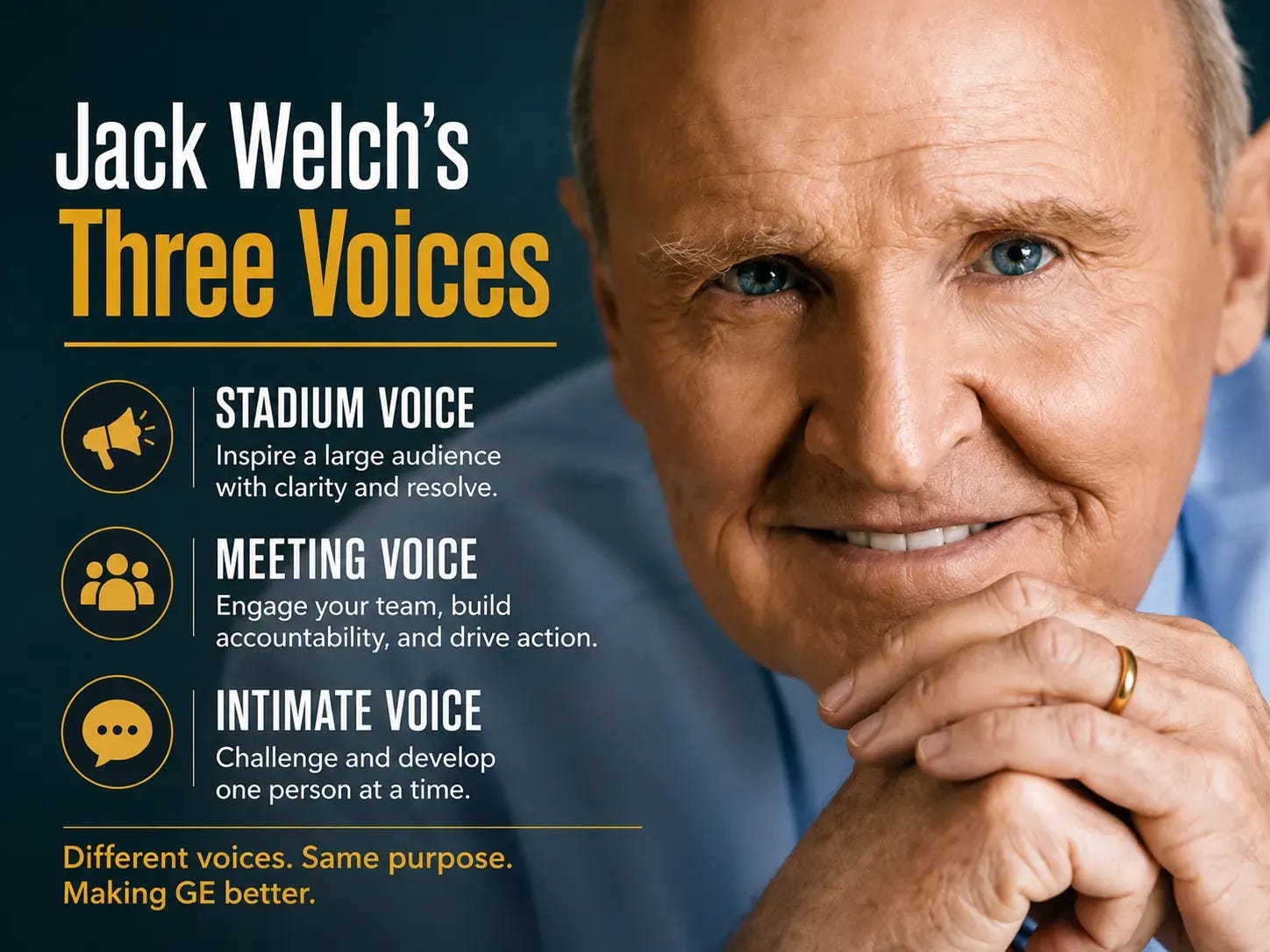
Jack’s formula: Learn to speak with three voices.
1) Stadium Voice...Deliver simple messages with clarity to a large group. Use a tone that is more resolute than kind. Know that you must follow words with action to build trust. Understand your platform and role; you are a business leader.
2) Meeting Voice...Connect with a team for the purpose of learning or building accountability. Use a versatile tone. Screaming is OK; so is laughter. The output is meant to drive action.
3) Intimate Voice...Challenging and honest for the purpose of making you better. Comments are professional, not personal. You are teaching in real time. Each voice would use a different tone, unique vocabulary, and range from serious to funny.He was completely informal and could be (very) profane. But all was done for the purpose of making GE better.
Stadium Voice
Stadium Voice was clean, simple and blunt. It was rarely accompanied by charts or stories. He would challenge, cite best/worst practices by name. It wasn’t unusual to be called out for credit or criticism in front of hundreds. Thick skin was a requirement. He was specific.
We launched a big process initiative...Six Sigma...to a room filled with GE officers, the top 150 leaders in the company.
To get started, we had a four-hour presentation on statistics from the Six Sigma founder, Michael Harry. It was brutal. The subject matter was dense...he was a terrible presenter...all of us had a million things going on. No one would dare look at their phone. I was a math major and could follow a few equations. Most had no fucking idea what he was talking about. I was exhausted.
At the end of the day, Jack went to the front of the room and said:
“I can see it in your eyes...you think this is crazy. Get off your fucking ass and learn it and do it. I believe it will make GE better. I will give you 60 days to get started and then review. Some of you will question our intent; you will get fired. Let’s go.”
It was great. So clear. No time was spent on “what do you think?” Large organizations want direction.
One mistake I see in tech is that leaders love to cross over into being “social philosophers” in big settings. Does anyone think that “Don’t be Evil” had any role in the success of Google? Or was it their superior technology and competitiveness? This is particularly true in the AI wave. Simple words lead to trusted actions. More words – flowery words (ie “Claude Constitution”) - don’t build trust. I listen to Andy Jassy, he has the best “Stadium Voice.” You know what Amazon thinks, and what they will do. Jack could always describe the “what and the where and the why,” without stumbling through things he couldn’t control. The audience mattered more than his own ego. He knew that words only framed actions...actions spoke loudest to big groups.
When you are in front of a big group, be sparse and clear. It is OK...even desirable...to be provocative. Change is hard, performance is hard; “nice” is not important. Years later during COVID, I would compare Jack’s style with leaders trying to explain layoffs to their team. There is nothing philosophical about layoffs. Deliver the message.
Importantly, Stadium Voice conveys a dimension of time and context. Leaders give you a flashlight – here is what must happen next- and a North Star- this is what is important forever.
Meeting Voice
First, let me say that the world would be better if half the meetings were cancelled. Most lack purpose. To gather people, you should be learning or building performance.
Meeting Voice leads with questions. With Jack, no presentation survived the first chart. Exchanges were like presenting to a hurricane. He would get to the substance, the problem, the decisions. Next came engagement. Everyone got access to the conversation, either as a teacher or as a performer or a teammate. Last comes consequence. Why were we here? What is next? What did we learn? Who is accountable? Every meeting was a three-act play; everyone had a part. Today, I sit through a lot of crappy meetings, even board meetings. Remember, substance over process. Make something happen.
When I was running the GE Healthcare business, I brought the Catholic Healthcare Leadership Committee to HQ. In those days, the Catholic systems ran 40% of the U.S. healthcare market. This was important.
Their leader came from The Sisters of Bon Secours. We sat down to breakfast and she said:
“Mr. Welch, are you afraid you will go to hell for laying off all these people?”
My heart sank...shit. I hadn’t seen that in the briefing document. Then I saw a MasterClass of leading and communicating:
“Sister, I don’t think it is fair to lie to people, do you?”
This led into a 30-minute conversation on culture and commitment to people. Then:
Sister: “Mr. Welch, how would you manage people without financial incentives?”
Jack: “You stymied me on that one, sister.”
Over the next 90 minutes, everyone spoke. Jack went to a flip chart to draw an organization concept...how to run a matrix. He asked the sisters to read a few paragraphs of his investor letter. We talked about PCBs in the Hudson River. Jack was charming and tough-minded. Everyone was energized. It was a great meeting.
Central to Meeting Voice is the “art of asking questions with the desire to get the right answer.” Jack didn’t want to stump or embarrass people. He wanted to win.
We walked our guests to the elevator after the meeting. Jack and the sisters hugged. The door closed and he said to me:
“Your inventory was the worst in the company. Get it fixed!”
I replied, “What happened to the charming Jack?”
He said, “They have more control over my future than you do.”
The important part of Meeting Voice is to have the tone to match the substance. I served President Obama; everything was “even-keel.” I worked for Jack; nothing was ever “even-keel”. If Jack had been running the disastrous Obamacare roll out, people would have been flying out of the second-floor window of the White House. It works.
Ask more questions than you answer. Engage everyone, while challenging their ideas. Reach conclusions. Drive a sense of mutual accountability; there is a consequence for good and bad. Try new techniques; go around the table and ask what people think...one by one. Success: Everyone wants to be in your meetings.
Intimate Voice
Every interaction with your boss should be a performance review. You want to speak with a desire to make people better, a combination of honesty and directness and context. There are always these waves of philosophy, things like “radical candor.” It can feel like “let me be an asshole.” They come and go. All that matters is making people better.
Jack was blunt, but he knew where you were, what you could control. He would identify gaps and what you should learn. One on one, he could wrap tough messages with a human voice. He wanted you to get better.
I worked in the Appliance business during a major product recall. It was brutal. I was 32 years old and watched a business and team implode. I was running the service business while we repaired three million refrigerators. This cost the company $500 million. Our business was losing money and customers and the team was splitting. It was a mess.
I was at GE headquarters board room with my boss to review the final reserve. There were four of us and 20 of the “HQ crew.” I felt like a gladiator in a Roman coliseum; not many walked out. My boss and the CFO got fired in the first 30 minutes. Literally fired. They were delivering bad news but had no plan. Then it was my turn to review the repairs, what we were doing, and how we were making progress. Regularly, I would go into homes to fix compressors. That fascinated Jack. I spent 90 minutes responding to tough questions with brutal answers. But I knew my shit. At the end he said, “Jeff, your answers are crappy but well understood.”
I got home that night and told my wife, “I am going to get fired. Let’s figure out what we do next.” She cried; we had a baby at home. The next morning, I got to the office and my assistant said, “Mr. Welch is on the phone.” My stomach dropped. Jack said:
“You were great yesterday. Look, I’m not happy, but let’s get the product fixed. Take care of the customer at all times. Think about what you learned. Problems happen in business. Your job is to fix them, not feel sorry for yourself. I don’t want you to feel relief, I want you to learn. Besides, you are more valuable to me now.”
GE was a big company. It is easy to think of yourself as a group, that your individual performance isn’t important or differentiating. But when the leader intervenes to speak to an individual – regardless of company size – then everyone thinks they matter.
You want a tough boss. They are not assholes. They give you specific guidance on how to get better. You can only get better when you are uncomfortable and challenged. They make your relationship human, not just professional.
As a leader, your style is a composite. Some of your puzzle pieces come from others. Many people confuse the meaning of “authenticity;” it doesn’t mean doing whatever the hell you want. An authentic leader has a responsibility to the team, to their own personal improvement. Good leaders learn and own their style, they are always trying to get better.
TLV Tips:
Practice an external schedule. Great communicators see and experience a lot. They travel and are well read. They learn context and have a broad view. Too many leaders are “conference room warriors.” They can’t convey spirit or passion.
Work on your communications...now. I was lucky because I worked for a company that drilled communication skills at an early age. Most of you aren’t that lucky. Hire good communicators...speak with intent. Most presentations I sit through are poor. The first skill we teach in my training course (Performance Acceleration Journey) is communication. It is fundamental.
Learn how to watch. Sit back and observe others; how they speak and interact. See what works. Keep a leadership journal. Take notes on effective phrases or styles or interactions. Get off your phone and watch.
Practice. There are very few natural communicators. Try different phrases and see how people react. Think about what you want to convey before a meeting. Run your agenda.
When you get a chance to speak, take it. I gave a college commencement speech and I took my daughter. She said to me, “I wish I could speak like you.” I told her: “This is my 10,000th speech!” You will learn.
Understand the power of Intervention. Don’t let communication rest on protocol or die in the lawyers office. Trust your gut and go direct. Good communication makes everyone feel connected because you are breaking through the bureaucracy.
Be effectively outrageous. Driving change requires provocation. I told my team that there were two ways to get fired at GE. Not listening to Jack or listening to him too much. It is ok to be memorable. Clarity. Fewer words; fewer charts; less time. Particularly with big organizations: less is more.
Very few people own their words. By this I mean they are thoughtful, they say what is on their mind, they say it in a way that people can understand, they are accountable for their ideas. We would be better off with fewer consultants. Peers you respect the most own their words; the ones you hate are whispering in the hallways.
Jack Welch was such a force, but my students really don’t know who he was. The new tech leaders have taken his place. That is too bad. Part of the AI future is communicating its impact with clarity in human terms. Jack could do that.
It was a challenge to follow Welch but over time, I appreciate him more, not less. Over the years, he said some tough things about me; but I loved him. He belongs on your “wall of fame” as a Master of Communication. He could motivate a huge company to trust and follow him.
I was lucky; I had a chance to learn every day. I could witness good and bad leaders through wild economic cycles. Watching others made me better. You are surrounded by people who have value, most with a superpower. Don’t copy them...learn from them. Let’s keep exploring.
Thanks for reading The Long View! This post is public so feel free to share it.
Comments
Nothing yet. Say the first thing.
Sign in to join the conversation.