
On the morning of Monday 13 July, I was sitting down to finish this week’s edition. It was going to be about sport, economics and whatever had caught my attention over the previous seven days.
By lunchtime, none of that mattered.
Instead, I was in an operating theatre at King’s College Hospital undergoing emergency brain surgery.
Without any warning, I suffered a life-threatening brain haemorrhage caused by an arteriovenous malformation, an AVM, a rare tangle of blood vessels that I had apparently lived with my entire life without knowing it existed.
Over the following days, I underwent several neurosurgical procedures. The first relieved the pressure on my brain and removed the bleeding and blood clots. Further surgery allowed the doctors to identify the AVM and eventually treat the underlying problem.
The surgeries were successful.
After several days in intensive care and then on a neurosurgical ward, I began the much slower process of recovery. That has meant relearning some very ordinary things: moving properly, standing, eating, washing and gradually becoming more independent.
There is still plenty of rehabilitation ahead, but the direction of travel is positive. Every day brings a little more strength and movement.
I remember remarkably little about the first few days. Most of what I now know comes from the diary Gina kept while I was unconscious and recovering. Reading it afterwards has been surreal and at times extremely difficult. It has also left me with an overwhelming sense of gratitude.
The paramedics got me to hospital. A porter noticed that my condition was deteriorating and found the emergency team. The doctors put me into a coma, diagnosed the bleed and operated to save my life. The surgeons then returned to theatre until they were confident they had dealt with its cause. Nurses cared for me around the clock while Gina, our families and our friends somehow held everything else together.
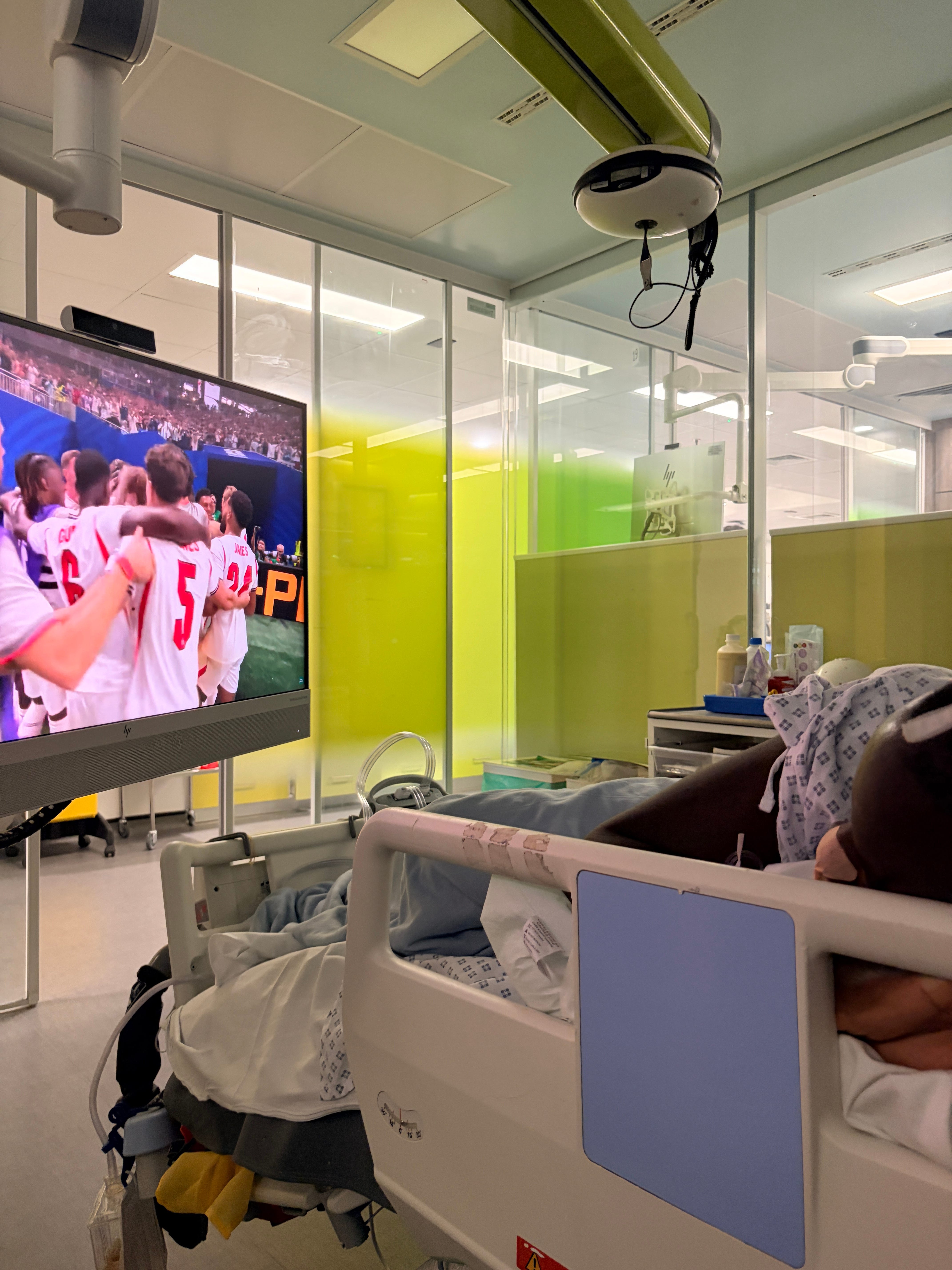
I owe all of them more than I can adequately express here.
I would also like to thank everyone who has sent a message, checked in or simply wondered where I had disappeared to. Your patience and kindness have meant a great deal to both of us.
As you would expect, spending an unexpected stretch in hospital gives you time to think. Once I was well enough to watch sport again, I returned to a familiar question.
What is sustained sporting success actually worth?
Which led me, perhaps inevitably, to Spain.
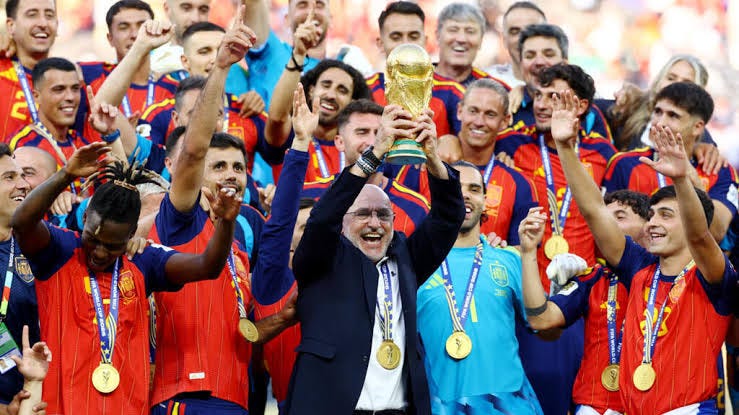
On Sunday 19 July, while I was still in hospital, Spain beat Argentina 1–0 after extra time to win the 2026 Football World Cup.
It was Spain’s second men’s title, following the team of Xavi, Andrés Iniesta and Iker Casillas in 2010. More significantly, it completed something no country had previously achieved: Spain became the first nation to hold the men’s and women’s FIFA World Cups at the same time.
The women won their World Cup in 2023. The men followed three years later. Spain’s men had also won the Nations League in 2023, Euro 2024 and Olympic gold in Paris. It is difficult to construct a more convincing period of international football dominance.
Yet sporting dominance and financial dominance are not necessarily the same thing.
Winning the World Cup produces an enormous prize. But how enormous is it when measured against the finances of a modern football federation?
FIFA initially announced that the 2026 world champions would receive $50 million in prize money, compared with $42 million for Argentina after winning in Qatar in 2022. Each participating country was also due $1.5 million for preparation costs.
FIFA subsequently increased the wider distribution to participating associations. Preparation funding rose to $2.5 million, alongside $10 million in qualification money and additional subsidies covering delegation costs and ticket allocations. The champion’s performance prize remained $50 million.
That means Spain’s World Cup-related allocation includes at least:
$50 million for winning the tournament
$10 million in qualification funding
$2.5 million in preparation funding
plus a share of FIFA’s additional delegation and ticketing support
The cleanest figure attributable specifically to winning is therefore $50 million. The broader guaranteed FIFA package connected with Spain’s participation is at least $62.5 million, before the smaller additional contributions are included.
That is a vast amount of money in most contexts. For the Spanish Football Federation, however, it is meaningful rather than transformational.
The RFEF reported revenues of:
€369.8 million in 2021
€366 million in 2022
€363 million in 2023
a record level of income in 2024
and budgeted revenue of €403.5 million for 2026
Its reported surpluses were €32.8 million in 2021, €28.7 million in 2022 and €4 million in 2024.
We should be careful about comparing dollars and euros without fixing an exchange rate. But the scale is clear.
The $50 million winners’ prize is equivalent to roughly one-eighth of the RFEF’s €403.5 million annual revenue budget. The wider package of at least $62.5 million is closer to one-sixth.
It is not enough to remake the federation on its own. But it could easily exceed the RFEF’s normal annual surplus several times over.
That distinction matters.
Revenue tells us the size of the organisation. Surplus tells us how much room it normally has after paying for competitions, teams, staff, facilities and distributions throughout Spanish football. Against annual revenue, the World Cup cheque is a substantial addition. Against recent annual profit, it is enormous.
Of course, the federation will not simply place the whole sum in a bank account.
There will be player and staff bonuses, tournament costs, tax and other commitments. The exact bonus arrangements have not been publicly itemised in the sources I found, so it would be wrong to describe the full $50 million as free profit.
But even after those costs, this is likely to be one of the most valuable single sporting results in the RFEF’s history.
The more interesting point is that Spain does not normally finance its football system by winning tournaments.
In 2022, around 30% of RFEF revenue came from audiovisual rights, worth €111.5 million. Sponsorship and advertising generated another €82.6 million, or approximately 23%. Federation services, such as licences, refereeing and club fees, accounted for about 17%, while national teams and competitions generated €42.8 million.
In other words, the federation’s finances are built on recurring commercial assets: media rights, sponsors, competitions, licences and the Supercopa de España.
Winning helps make all of those assets more valuable.
That is why the $50 million cheque may not be the most important financial consequence of the World Cup.
Spain can now sell sponsorship around the only country simultaneously holding the men’s and women’s world titles. It can negotiate from a position of extraordinary sporting credibility. Its matches should command greater international interest. Its shirts, merchandise and players become more commercially prominent. Its federation can offer partners an association with success across both the men’s and women’s game.
Those effects are harder to calculate because they arrive gradually through contract renewals, new partnerships, attendances, merchandise and audience growth. They may also last much longer than the direct FIFA payment.
A tournament prize is received once. A stronger commercial brand can keep paying.
Spain’s women received a much smaller direct reward for winning the 2023 Women’s World Cup.
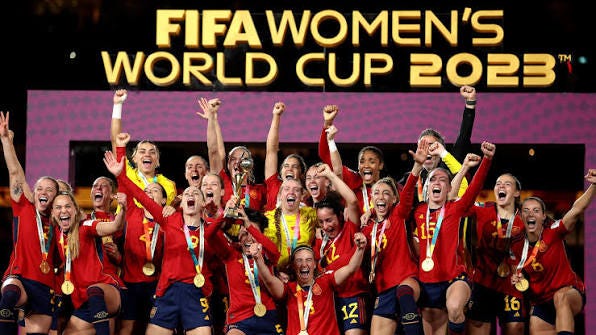
Under FIFA’s distribution model, the Spanish federation received $4.29 million for finishing as womens champions. Each of the 23 players was allocated $270,000, creating a further total player allocation of $6.21 million.
The federation payment and player allocations together were therefore approximately $10.5 million.
Compare that with 2026:
The men’s federation prize alone was $50 million, more than eleven times the $4.29 million association payment attached to the women’s title.
This is not because Spain’s women achieved something less impressive. They won the same category of competition: the senior world championship in their sport.
It reflects the commercial gap between the two tournaments.
FIFA invested $499 million in staging the 2023 Women’s World Cup and distributed $152 million to players, associations and clubs. The corresponding 2026 men’s distributions to participating associations rose to $871 million before accounting for the rest of the tournament’s operating and commercial economics.
The women’s game is growing quickly. FIFA’s total financial contribution for the Women’s World Cup rose from $50 million in 2019 to $152 million in 2023. Its club benefits programme increased from $8.48 million to $11.3 million, with money reaching more than 1,000 clubs across 48 countries.
That growth matters because it spreads the value beyond the national federation and rewards the clubs that develop international players.
But the comparison also reveals how much distance remains.
Spain can legitimately claim to be equally successful on the pitch in men’s and women’s football. Financially, the two victories still exist in different worlds.
The RFEF presents itself not simply as a national team operator but as a distributor of money through Spanish football.
In 2023, it directed €93.9 million to non-professional football and regional federations. In 2024, it reported €85 million for non-professional clubs and competitions, €36 million for regional federations and €38 million for professional clubs participating in the Copa del Rey and Supercopa.
It also directed money towards academies and the social protection of women’s and amateur players.
This helps explain why international success can become self-reinforcing.
National teams win. Winning creates prize money and commercial leverage. A proportion of federation revenue is redistributed into facilities, coaching, youth development and competitions. Those systems produce more players, who then strengthen the national teams.
There is no guarantee that the circle continues forever. Successful federations can waste money as easily as unsuccessful ones. Spain’s football institutions have hardly been free from controversy.
But the underlying sporting pipeline is difficult to ignore.
Spain does not merely produce one exceptional generation. Its men have won major titles with substantially different groups of players. Its women have done the same. Young players move through a system with a recognisable technical identity and are trusted relatively early at senior level.
The federation’s greatest asset may therefore not be the $50 million prize.
It is the infrastructure capable of producing another team that can win it.
Cycling provides a useful contrast.
The 2026 Tour de France began in Barcelona and spent its opening stages in Spain. There was a strong Spanish presence in the race, and Juan Ayuso finished fifth overall.
But the winner was Tadej Pogačar, who is Slovenian, not Spanish.
That clarification is important because Spain’s current sporting story is impressive enough without claiming everybody wearing sunglasses on a mountain as one of its own.
It also illustrates a broader point about the economics of sport.
A Tour de France winner traditionally receives a prize of around €500,000, with money commonly shared among riders and team staff. Even allowing for other classification and stage prizes, the direct purse is surprisingly modest beside the $50 million awarded to a World Cup-winning football federation.
The Tour’s real value sits elsewhere: sponsorship exposure.
Professional cycling teams are effectively moving billboards. They do not have the same dependable stadium, ticketing and domestic broadcast income available to major football clubs. Their commercial model depends heavily on sponsors believing that months of televised racing, culminating in the Tour de France, produce sufficient global attention.
The winner benefits through salary, bonuses, future contracts and personal endorsements. The team benefits because its name and jersey receive repeated international exposure. The sponsor benefits because the company’s name becomes inseparable from the yellow jersey.
For Barcelona and the other Spanish hosts, the economics are different again. Hosting the Grand Départ brings visitors, international broadcasting, hospitality activity and destination marketing. The race began in Barcelona, travelled through Tarragona and Granollers and then crossed into France.
Spain therefore gained economically from the Tour even though a Spaniard did not win it.
That is an important distinction: countries can monetise sport by producing champions, hosting events or, ideally, doing both.
Carlos Alcaraz offers another version of sporting value.
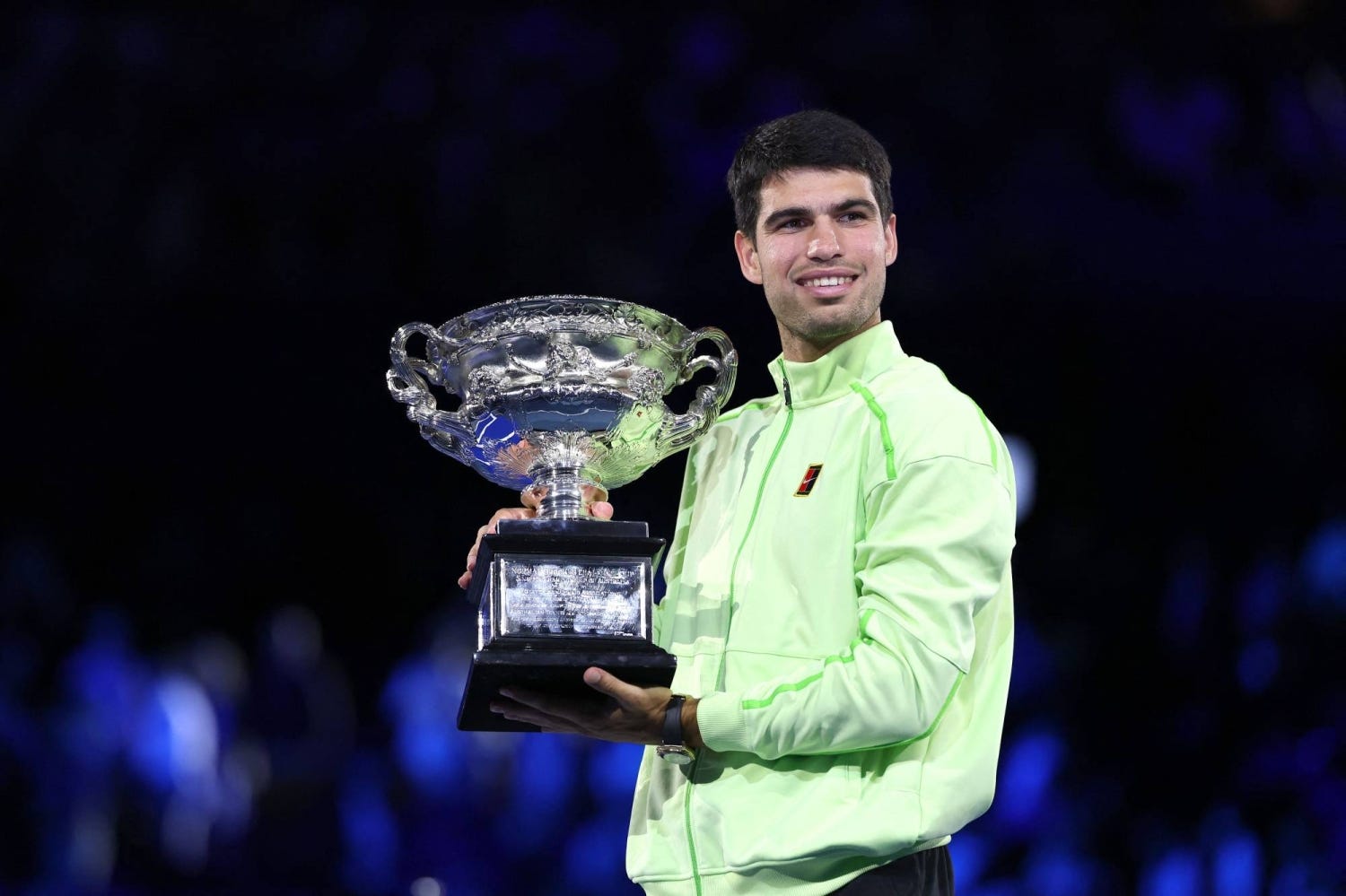
He is Spanish and finished 2025 as the ATP’s year-end world number one after winning eight titles, including Roland Garros and the US Open. He earned $21.3 million in on-court prize money during 2025, the highest figure on the ATP Tour that year. In April 2026, he was named Laureus World Sportsman of the Year.
He is not the current number one, however. Jannik Sinner returned to the top and began his 81st week there on 20 July 2026.
That does not diminish Alcaraz’s value to Spanish sport.
Individual athletes distribute their economic impact differently from national teams. Alcaraz’s prize money belongs primarily to him and his team, rather than to a Spanish federation. The country benefits indirectly.
He attracts viewers and sponsors. He gives Spanish tournaments a globally marketable home player. His success encourages participation and maintains Spain’s identity as a tennis nation following the era of Rafael Nadal. His endorsements associate Spanish sport with youth, energy and international success.
There is also an important difference between prize money and total earnings.
Prize money is visible. Sponsorship arrangements are often private. For the most marketable athletes, endorsements can rival or exceed what they earn in competition. And while an athlete’s winnings do not flow through a federation in the way FIFA’s World Cup payment does, the cultural and commercial effects can reach far beyond the athlete.
Alcaraz is therefore not a federation windfall. He is a national sporting asset in the looser, but still economically significant, sense.
The tempting conclusion is that Spain is dominating all of world sport but that goes too far.
Pogačar is Slovenian. Sinner, an Italian, currently leads the men’s tennis rankings. Other countries remain stronger across the full Olympic programme, and success in football does not automatically translate into athletics, swimming, cycling or dozens of other sports.
But Spain’s position in global football is almost impossible to dispute.
It currently holds the two biggest trophies in the world’s biggest sport. Its men have also recently won the European Championship, Nations League and Olympic gold. Its women’s success has placed stars such as Aitana Bonmatí, Alexia Putellas and Olga Carmona at the centre of the international game.
Alongside that football supremacy, Spain has produced one of the defining tennis players of his generation, remains deeply embedded in professional cycling and regularly hosts globally important sporting events.
The financial rewards arrive through different routes.
The men’s World Cup delivers a direct $50 million performance prize to the RFEF and at least $62.5 million across the broader FIFA package.
The Women’s World Cup delivered $4.29 million to the federation and $6.21 million to the players.
Tennis creates personal prize money, sponsorship and softer national benefits.
Cycling offers modest winner’s prizes compared with football but enormous sponsor visibility, plus economic value for host cities and regions.
There is no single number that captures all of this and nor should there be.
The most valuable outcome may be the creation of a national reputation for sporting excellence. That reputation makes events more attractive, athletes more marketable and governing bodies more credible. It also gives children heroes to imitate and institutions evidence that investment can produce results.
Spain’s men will receive their World Cup prize shortly. It will be celebrated as a reward for one tournament and one exceptional group of players.
But the result was not created over six weeks in North America.
It was built through years of academies, coaching, competitions, facilities, commercial agreements and thousands of people working far away from the final. The same is true of the women’s world title and of Alcaraz’s development into a global star.
The cheque rewards the outcome.
The system produced it.
Perhaps that is why I found myself thinking about Spain while beginning my own recovery.
A sudden event can transform everything in a few hours. But recovery, and sustained success, works differently. It is built gradually, often through repetitive and unglamorous work that nobody outside the room gets to see.
One movement. One exercise. One training session. One player. One generation at a time.
Spain’s World Cup victory is worth at least $50 million to its football federation.
What created it is worth considerably more.
Comments
Nothing yet. Say the first thing.
Sign in to join the conversation.