
If you take Ozempic or Wegovy, you may already know this feeling without needing it described. During the day your body is worn out - heavy limbs, no appetite, no energy for anything. But at night, when you finally lie down, your mind will not settle. You are exhausted and alert at the same time, and neither one cancels the other out.
This is one of the more commonly described sleep complaints among people taking GLP-1 drugs, with hundreds of self-reports. And it makes more sense than it first appears, because the tiredness and the alertness have two different causes.
The tiredness comes from eating much less.
The alertness comes from the drug acting on brain cells whose whole job is to keep you awake.
Once you can see both halves, you can also see how they play out across your dosing week, and that is what the rest of this article walks through.
Deep in the brain, in a region called the lateral hypothalamus, there is a small cluster of cells called orexin neurons. Their job is to connect how much energy your body has to how awake you feel. When energy runs low, orexin cells fire and keep the brain alert, so the animal goes looking for food. When energy is plentiful, orexin firing goes down and sleep comes more easily.
The evidence for this comes from mice. Orexin cells are inhibited by glucose, the sugar in your blood, and by leptin, a hormone that rises when energy stores are full. They are stirred up by ghrelin, a hunger hormone. And mice that lack orexin do not become more wakeful during fasting, which shows that orexin is needed for the alertness that normally comes with running low on fuel.
Here is where semaglutide comes in.
Semaglutide, the drug in Ozempic and Wegovy, attaches to GLP-1 receptors. A receptor is a place on a cell where a hormone or drug can bind. Orexin cells carry those same GLP-1 receptors. In experiments on rat brain, a drug acting on the GLP-1 receptor made orexin cells fire faster and made them receive more excitation from nearby cells. The response grew as the amount of drug grew, and it disappeared when the GLP-1 receptor was blocked, which shows the effect runs through that receptor. Just as telling, the sleep-promoting cells that sit in the same brain region - melanin-concentrating hormone neurons - showed no measurable response to GLP-1 at all.
So in these rodent studies, GLP-1 activates the wake-promoting cells without affecting the sleep-promoting cells next door.
That one-sidedness matters, because it means the wakefulness response is selective.
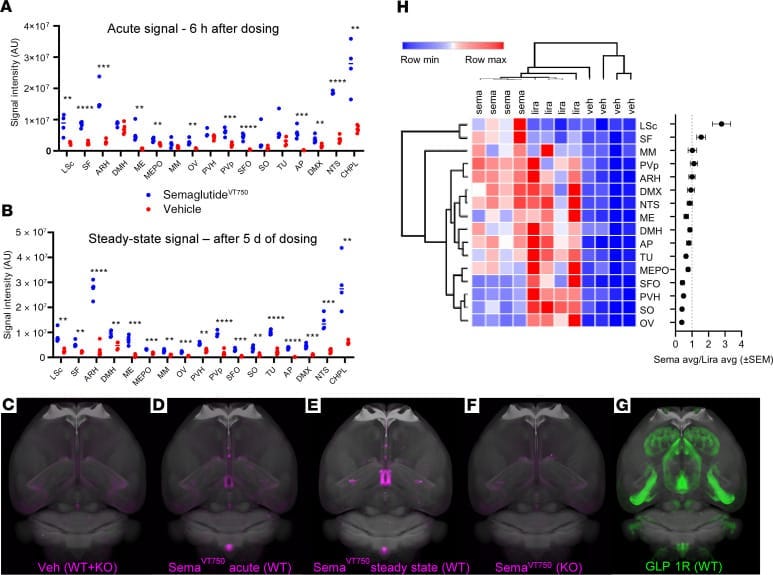
Semaglutide reaches its highest level in the blood about 1-3 days after a dose.
Because the drug enters the brain through those barrier-free regions rather than crossing in everywhere at once, the brain's peak exposure comes a little after the blood's peak. The strongest effect on orexin cells is therefore estimated to fall about 24-72 hours after a dose, which typically matches the window when users report feeling wired after their shot.
In plain terms, the wired feeling has a schedule, and the schedule can be affected by how the drug rises and falls in your blood.
The exhaustion has a different cause.
Semaglutide suppresses appetite, and users commonly report eating 500-1,000 fewer calories per day. In the STEP trials, semaglutide 2.4 mg produced about 15% body weight loss in people without diabetes, which reflects a daily energy shortfall kept up for months. Eating that much less means:
less raw material for muscle repair,
lower glycogen stores, meaning less stored fuel in your muscles and liver, and
less body heat produced by metabolism.
Together, that contributes to the same physical exhaustion seen in any long stretch of eating well below what your body uses.
Nausea makes it worse. Roughly 44% of semaglutide users in the STEP trials reported nausea, within an overall 74% reporting stomach and gut side effects. Nausea deepens the fatigue by cutting nutrient absorption further and causing dehydration.
Here is where the two halves reinforce each other. Orexin cells fire when energy is low. So the calorie shortfall can excite the same wakefulness cells the drug is already acting on. The body's fatigue and the brain's alertness are not opposites that average out. They arrive together and reinforce each other - one part coming from semaglutide itself, and a second coming from the eating deficit semaglutide created.
That is the full shape of the paradox: one drug activates wakefulness cells directly, on a 1-3 day concentration curve, while at the same time creating the energy shortfall that activates those same cells a second way.
On any given night you may be dealing with three different things that all feel similar at 11pm: drug-driven wakefulness, calorie-driven fatigue, and a restless, uneasy feeling that many people call anxiety. They follow different schedules across your dosing week, and they call for different responses.
The drug-driven part tracks your dosing day and your dose size.
The calorie part tracks how much you ate and how nauseous you were.
The third one is where the published research disagrees with itself - and the disagreement turns out to be useful.
Everything below is for paid subscribers.
What follows:
The seven-day map of a semaglutide dose - which nights the orexin effect can peak, why the wired feeling fades at a stable dose and returns with every dose increase, and the case for taking your dose in the morning.
The three-way sorting guide for tired versus wired versus restless nights, including why one European safety study and the STEP trials reached opposite conclusions about anxiety reports, and what that gap reveals.
The orexin-blocking sleep medications that act on this same set of receptors - a question to bring to your physician, framed with the evidence you would want in hand - plus a plain grading of how strong each piece of this science is.
The underlying studies are public. What you are paying for is the ordering, the sorting logic, and a plain account of where the evidence is solid and where it is inference.
Continue reading with a paid subscription
Paid subscribers can also use the member perks page for resources available with the paid articles: Member perks.
Comments
Nothing yet. Say the first thing.
Sign in to join the conversation.