
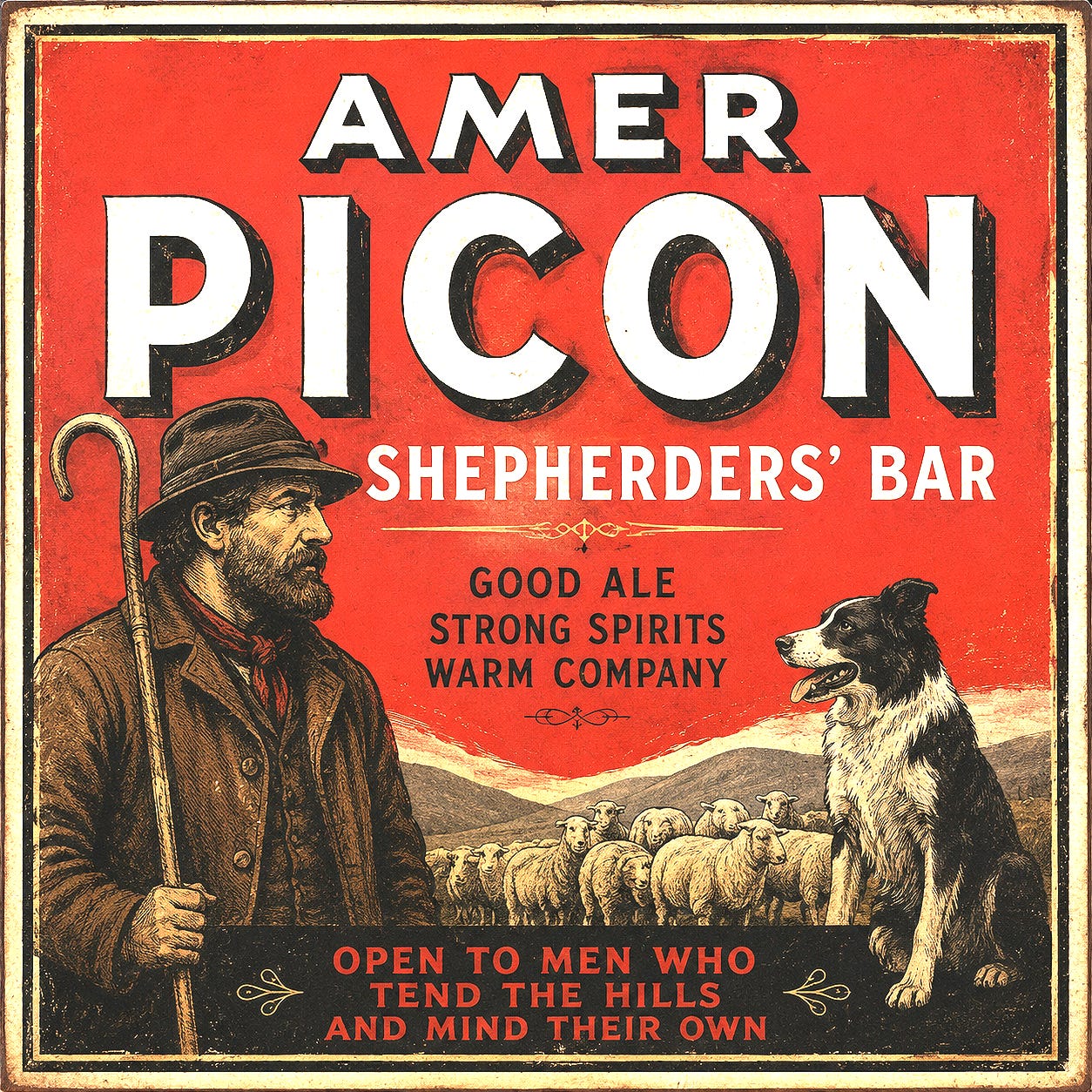
Thanks to the cocktail revival, plenty of once-lost ingredients have come back from the dead and returned to market. Sometimes these were revived by the original producer (like Laird’s Bottled in Bond Apple Brandy), sometimes by newly minted entrepreneurs (like Ted Breaux’s line of absinthes). Whatever the route, out of the crypt have come a range of once-venerable products: Batavia Arrack, Boker’s Bitters, crème de violette, orange bitters, allspice dram, falernum.
What’s missing? Amer Picon. At least the original, and at least by that name.
Amer Picon is a brand of French bitters — “amer” in French simply means “bitter,” the same as “amaro” in Italian. Picon is the family name of the Frenchman who created it.
The backstory: France invaded Algeria in 1830, ostensibly to avenge a slight — the Dey of Algiers, disputing a debt with the French consul, struck him with a fly whisk. (It was a different time.) France occupied the country for more than a century, often brutally, deploying troops to raze villages and smoke out Algerians who’d taken refuge in caves.
Gaétan Picon was one of those soldiers, and like many of his compatriots, he feared malaria. He may even have contracted it himself; the record is unclear. Quinine, derived from the bark of the cinchona tree, was administered both to relieve malaria’s symptoms and as a preventative. The problem was that quinine tasted terrible — acrid and intensely bitter. So it was mixed with sugar and various herbs and spices to make it palatable. Tonic water became the best-known way to deliver a daily dose. Angostura bitters has a similar medicinal lineage, though that one arose in the jungles of Venezuela rather than the deserts of North Africa.
Picon had some distilling experience, which gave him a leg up in concocting a potable tonic. Alongside quinine, he used gentian root — another bitter botanical believed at the time to help fever sufferers — plus sugar, and, most distinctively, orange: he macerated both fresh and dried orange peel. The deep citrus flavor, combined with a relatively high proof (reportedly around 39 percent ABV early on), made the drink popular among French soldiers stationed abroad.
The bitter tonic crossed the Mediterranean to the Continent, where it was initially sold as Amer Africain. It won a bronze medal at the 1862 London International Exhibition, and the makers renamed it Amer Picon in 1872. By 1885 it was selling 25 million bottles a year worldwide.
It made its way to San Francisco and then inland California, where it became the base of the Picon Punch — a mix of Amer Picon, grenadine, brandy, and soda water. The drink became closely associated with Basque shepherds who’d immigrated to California to tend flocks in the Sierra Nevada. (I dug into this history for The Atlantic in a 2009 article.)
Over the decades, the formula for Amer Picon has been altered more than once. At some point, calamus root entered the picture.
Calamus is a reed-like wetland perennial that’s been used for centuries as a digestive aid, stimulant, and fever reducer. It appears in Ayurvedic medicine, traditional Chinese medicine, and European herbalism alike. In 19th-century America, it wasn’t unusual to carry a stick of calamus root in your pocket to nibble on for an upset stomach. Like so many old nostrums, the practice faded. A 1942 headline in a Missouri newspaper plaintively asked, “Whence Have Gone the Legions of Our Calamus Root Nibblers?” — noting that the plant’s medicinal use “appears to have had far better justification than did the custom of hanging asafetida in a small sack about the neck to ward off diseases.”
Calamus became a regulatory problem in 1968, when the FDA banned it as a food additive after rat studies linked beta-asarone, a compound found in the plant, to tumors. Calamus advocates point out that different strains carry wildly different concentrations of the compound, and that only the high-asarone Asian variety used in those studies poses much risk — the European diploid variety contains a fraction as much. The U.S. banned the plant outright regardless of origin. The European Union took a more nuanced approach, setting permitted concentration limits rather than a blanket prohibition. In effect, Europe drew a line; America built a wall.
Exactly how this affects Amer Picon remains unclear. It’s not confirmed that the modern producer uses calamus root at all — but compounds related to it, found in the formula, have evidently been enough to raise flags with U.S. regulators. The whole situation is murky, and nobody in the regulatory chain seems eager to clarify it.
Amer Picon made what many consider a fatal misstep in the 1970s, when it cut its alcohol content roughly in half, from 39 percent ABV down to 18 percent. Diageo, which owned the brand at the time, eventually stopped importing it into the United States. By then, the American market — concentrated almost entirely among Basque-descended communities in California and Nevada — may simply have been too small and too regional for a company the size of Diageo to bother with the import paperwork.
The product remains available in France and elsewhere in Europe, at the reduced proof.
But demand persisted in the U.S., especially in the Basque bars of California, so others moved to fill the gap. Torani — the company better known for coffee-shop flavoring syrups — began producing an orange-forward, full-proof amer substitute in the 1960s, and it became the standard replacement once original Picon disappeared from American shelves. I saw it in heavy use in the Basque bars of Bakersfield when I visited in 2009.
In late 2024, Torani exited the amer business entirely, handing its recipe for the 78-proof spirit to Ferino Distillery, a small producer in Reno, Nevada, specializing in Italian-inspired spirits. Ferino has been making its own version, Ferino Amer, ever since — available online in all but about seventeen states, for around $25.
So: will the original Amer Picon ever come back to the United States? The brand was purchased by Campari Group in 2022. Campari maintains a respectable stable of historic amaro and bitter brands and appears genuinely committed to the category — but it’s also been doing a fair amount of portfolio-shuffling lately. It’s pouring marketing dollars into Aperol in the U.S. and pushing Braulio in Europe, all while streamlining elsewhere. Late last year it sold Averna, along with a lesser-known myrtle liqueur, to the makers of Disaronno.
Still, Campari looks well positioned to relaunch Amer Picon stateside if it chooses to. It’s not hard to imagine Pico Punch becoming the next Aperol Spritz with the simple application of millions in marketing dollars. And if there’s one thing Campari knows how to do, it’s turn a bitter aperitif into a cultural phenomenon.
Whether that happens may come down to a fairly unglamorous question: is anyone at Campari actually willing to walk a reformulated, calamus-free version of Picon through TTB and FDA approval, for a market this small? The EU’s strain-specific science gives them a real argument to make. The Aperol Spritz playbook gives them a real incentive to make it. What’s missing, so far, is any public sign that they’re trying — which means the most interesting chapter of the Amer Picon story isn’t in the past at all. It’s sitting, unwritten, in a regulatory filing that nobody has yet submitted.
No posts
Comments
Nothing yet. Say the first thing.
Sign in to join the conversation.