
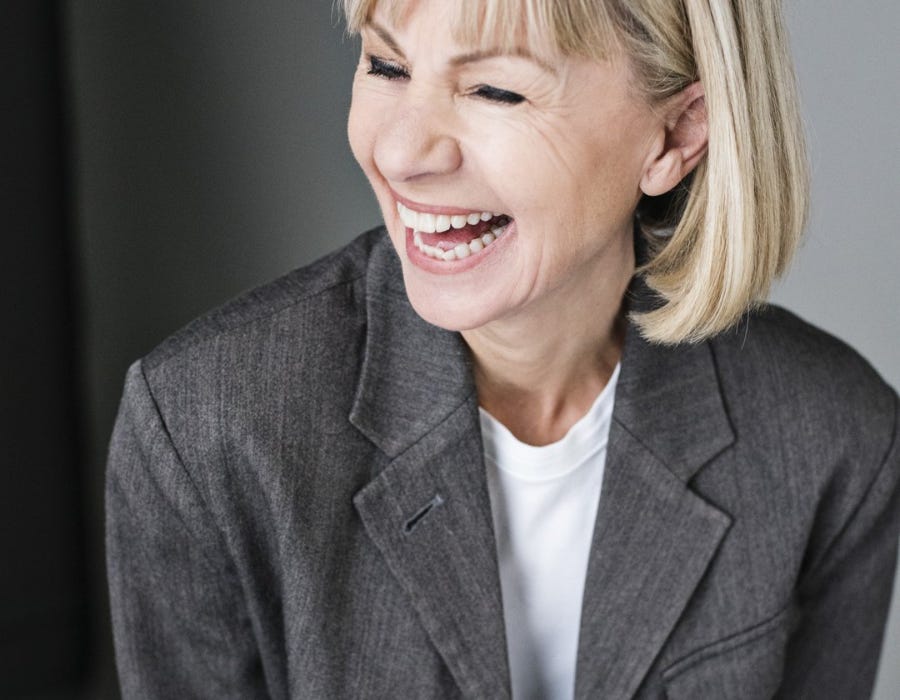
I’m cheating a little this week, because I’ve already had the lovely Kate Mosse on my Desert Island Books series. But a) she has a new book out, which is currently waiting for me at my mother’s cottage, and b) I’m at the airport about to fly back to the UK ahead of my annual reading retreat in Provence and, well, look, this week has been rather intense.
Knowing that one night in Paris and three in Provence is probably enough to undo every virtuous thing I’ve done all year, I decided to set myself the entirely sensible goal of going to hot yoga or hot Pilates every single day this week. And yes, I know: I could simply say no to a second helping of baguette in Provence. I could politely decline a seventh glass of prosecco. I could decide against smoking myself into oblivion. But what, pray tell, is the point of going to France if you’re not going to indulge just a little (a lot)? I should probably also point out that I’ve lost precisely zero weight as a result, and actually ended up so exhausted each evening that I sank two very large glasses of wine indeed—so I’m not entirely sure the week can be considered a triumph for my health.
The result is that I’ve spent most of the week dehydrated as a raisin, permanently sweaty and questioning several of my life choices—and have, consequently, fallen behind on all manner of work things.
And so I thought: what better excuse to revisit the Desert Island Books of one of my biggest literary inspirations? (I know that sounds horribly sycophantic, but she really, really is.) Kate is one of the writers who made me the reader I am today, and someone who I simply, wholeheartedly adore.
I love so much about what Kate does—not least her passion for championing women writers and bringing forgotten female voices back into the literary conversation. She’s also one of those rather rare writers whose enthusiasm for books is utterly infectious. And, having read every single one of hers, I cannot wait to get my hands on her latest, Autumn, which is sitting patiently in Berkshire awaiting my arrival.
Here’s what it says on the blurb:
‘In Autumn, Kate Mosse celebrates the season of shifting light and crisp mornings. This magical journey through the turning year captures the ever-changing colours of the autumn landscape, the crunch of leaves underfoot, the drift of migrating birds and the last warmth of the sun.
Starting in her own garden, Kate leads us out to the misty Fishbourne marshes of her childhood, with their vast skies and wading birds, and into ancient yew forests/ steeped in myth and mystery. We travel across the harvest fields, follow the river bends of the Ouse and the Lavant, and join the crowds at Lewes on Bonfire Night, where the air crackles with flame and torchlight.
Exploring nature, folklore, memory and history, Autumn is a love letter to Sussex and an atmospheric portrait of the season from one of our most celebrated writers.’
I mean, how perfect does that sound? With the seemingly endless heatwaves mercifully behind us, I can think of few things I’d rather read as we move into the new season. It’s out on September 10th and you can pre-order it here.
So, while I hurtle towards London and dream of baguettes, wine, skinny fags and absolutely no hot Pilates whatsoever, it felt like the perfect time to revisit the nine books Kate Mosse would take with her to a desert island…
Wuthering Heights by Emily Brontë
A story of obsessive love and revenge, a story of epic landscape and ghosts, a reflection on class, race and the injustice of women’s lives, of the interconnected fortunes of two families, Brontë’s masterpiece—published a year before her death in 1848—remains the biggest influence on me as both a reader and writer. One of the most ambitious novels in the English language.
Half of a Yellow Sun by Chimamanda Ngozi Adichie
From a nineteenth-century to a contemporary classic. Winner of the Women’s Prize for Fiction (then Orange Prize for Fiction) in 2007, this exquisite novel tells the story of Olanna, Ugwu and Richard before and during the Biafran/Nigerian Civil War of 1967-1970. Displacement, personal versus political lives, how communities can turn on one another, the violence of the formation of States and the loss of individual identity, it’s a ground-breaking and magnificent novel.
Sleeping Murder by Agatha Christie
When writing, I return to old favourites for my bedtime reading. Published in 1976 after Christie’s death—though written some thirty years earlier—this ‘last’ Miss Marple is a crime novel centred around recovered memory and how the sins of the past come back to haunt the present. Clever, creepy, thoughtful—a ‘gas-lighting’ story—at the heart of it is the relationship between women of different generations and trusting the evidence of one’s own eyes. Oh, and there’s a terrific twist!
Negotiating with the Dead by Margaret Atwood
Though there are many books written by writers about writing, Margaret Atwood’s 2002 non-fiction work—based on a series of lectures—remains the gold standard. Part biography, part literary history, part memoir, it’s a superb reflection on what it means to write, how authors write and why. It’s truthful, engaging, hopeful and suffused with Atwood’s trademark wryness of tone and sly wit. A must-have for those of us who labour in the ‘word mines’ as well as readers.
King Solomon’s Mines by H Rider Haggard
Speaking of which, this celebrated 1885 adventure story—while very much of its time and place in its 19th century imperialist attitudes and values—remains a wonderful, fast-paced adventure story with a great (and often less than heroic!) hero, Allan Quatermain, who swashbuckles his way across the continents and pages. My father first read it aloud to me when I was little, and the memory of that excitement, the jeopardy, the peril remains with me nearly fifty years later …
The Wise Woman by Philippa Gregory
No one does historical fiction better than Philippa Gregory, and her debut novel (1992) combines all the qualities of scholarship and storytelling that have since made her a worldwide bestseller—a genuine and authentic sense of period, a way of bringing new life to a familiar time in history, a combination of research and storytelling. Most of all, she puts women’s voices centre stage.
The Bluest Eye by Toni Morrison
Set in 1941, Morrison’s beautiful and uncompromising first novel is a heart-breaking story of powerlessness, race, poverty and what it means to be female. The narrative is centred around Pecola—a young African-American girl growing up in Ohio in the years following the Great Depression—and the hardships, abuses and misunderstandings of her life. The voices of Claudia, the daughter of Pecola’s foster parents, and a narrator, add to the sense of dislocation and tragedy. Essential reading and a novel which changes with each rereading.
Affinity by Sarah Waters
Set in London in the 1870s, this is a duet between two very different women; Margaret, unhappily married – and recovering from both the death of her father and her own failed suicide attempt—becomes a ‘Lady Visitor’ to Millbank Prison. There she becomes entranced—obsessed?—by Selina Dawes, a medium of spirits. Bristling with a sense of time and place, it’s a novel of eroticism, of longing and of what it means to be ‘other’ in a world where women’s lives are so limited by society.
Frankenstein by Mary Shelley
In January 1818, this brilliant novel—about the terrible consequences of ambition, of the battle between science and God, about love and the withholding of love, of light and dark, creation and destruction, what it means to make life and to fear death—was first published anonymously. Shelley started the novel when she was eighteen and had already suffered great tragedy in her life. This sense of grief, despair and loss infuses every beautiful page. Two hundred years after its first publication—and never out of print – it continues to speak to readers of all ages. A Gothic masterpiece.
No posts
Comments
Nothing yet. Say the first thing.
Sign in to join the conversation.