
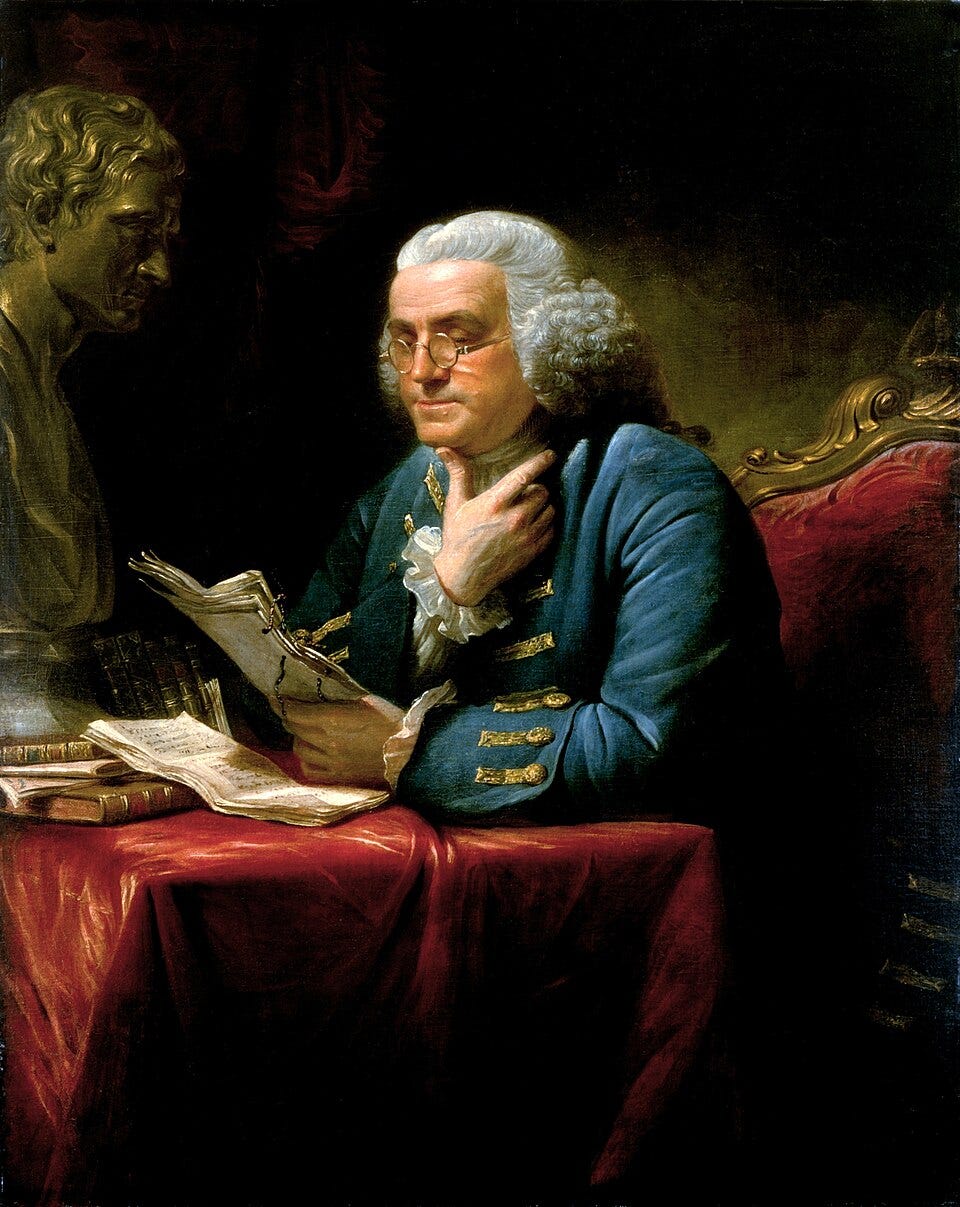
In the opening talk at the library, I mentioned several books about reading and readers, the founding of libraries, and the American spirit of the “Democracy of Knowledge.” For those who were there, I held up these books, and they were on display to look through. But I thought I’d share these with everyone.
These books capture a set of ideals. From Franklin’s dream to create a library in Philadelphia to Lincoln’s drive to read his way into a law career, these books and their protagonists demonstrate the power of ideas, the grasp of things gone before, and the value of imbibing the classical tradition.
Autobiography, Benjamin Franklin
Benjamin Franklin, Walter Isaacson
Because we’ve based our library on Franklin’s, there’s no better place to start than his autobiography. Though it ends before the major events of the American Revolution, it has all the contours of Franklin’s extraordinary American life. From a middle school dropout to a publishing tycoon to a promising career in diplomacy, Franklin shares his life with wit and wisdom.
Poor Charlie’s Almanac, Charlie Munger
One of Franklin’s modern-day disciples is Charlie Munger. Better known as a billionaire investor, Warren Buffett’s right-hand man can teach you a lot about everything. Like Franklin, Munger devoted himself to the pursuit of knowledge, mastering the basic concepts across the disciplines, and to the very rare quality of common sense. In this set of talks and essays, you’ll see Munger’s brilliance, his range, and you’ll become a bit wiser about life.
Thomas Jefferson: A Biography of Spirit and Flesh, Thomas Kidd
The great man of letters in American history must be Thomas Jefferson. Though he penned the Declaration of Independence when he was only 33, it was just one among his long string of literary accomplishments, among them being our 3rd President and founding the University of Virginia. Another great biography on Jefferson is Jon Meacham’s The Art of Power (see the American history list coming out Monday). Kidd’s is shorter and more focused on Jefferson’s faith and spiritual beliefs, including the interesting saga of the Jefferson Bible and his own claim to be a Christian.
Harry Truman, David McCullough
To take an opposite extreme, Harry Truman didn’t go to college, much less found one, but he knew the value of reading. He kept Plutarch’s Lives on his desk because he found it to be a store of wisdom for life and politics. But don’t underestimate Truman. McCullough, one of our great American historians, shows him to be an extremely consequential president, a practical man, and one who defined the presidency and set the trajectory of the country for decades to come.
Parallel Lives, Plutarch
If there is one book that has influenced almost every significant figure of history in the West, Plutarch’s Parallel Lives would be second only to the Bible. Writing in the 1st century AD, Plutarch conceived the idea of writing biographies in parallel, such as those of Alexander and Caesar, and then included an essay comparing them and drawing lessons. Of the 23 original pairs, we have 22 in the complete editions of his work. The Lives is a treasury of history and wisdom, written by the greatest biographer of the ancient world.
Churchill: Walking with Destiny, Andrew Roberts
Churchill usually needs no introduction on this reading list, but you might not know what a reader he was. Although he did not attend Oxford or Cambridge, he conducted a course of self-education while stationed in India as a young soldier. Covering Gibbon, Macaulay, and the classics of the West, he imbibed both the content and the style of these writers, and that combination would make him the man Britain needed in its darkest hour. Additionally, Churchill was a great writer of history. In his lifetime, he published more words than Shakespeare and Dickens combined. Andrew Roberts’ book is the best single-volume biography of his life and one of the great books of this century.
The Decline and Fall of the Roman Empire, Edward Gibbon
One of the books Churchill read, kicked back on his cot in Bangalore, was Edward Gibbon’s history of the Roman Empire. Gibbon was the most renowned historian of his time and a masterful writer. Passing through the temples in Rome, he was inspired to recount the history of that great empire and how it had fallen through successive centuries. Although Gibbon is unfairly critical of Christians in ancient Rome, his writing and analysis are emblematic of the best of the West.
The History of England, Thomas Macaulay
Another great British historian, and one whom Churchill modeled his life and writing, is Lord Macaulay. An essayist, member of Parliament, and historian, Macaulay had the rare gift of making anything interesting. His history of England grapples with the great themes of civilization, power, and personality. Like most Victorians, he subscribed to the “Great Man” theory of history, in which individuals play an outsized role in shaping the future. Maybe that’s another reason he was one of Churchill’s favorites.
Andrew Carnegie, Andrew Nasaw
If there is a bookend for Benjamin Franklin, it’s Andrew Carnegie. He founded 3,500 libraries out of his own pocket. He exemplifies the golden age of public benevolence and shaped the country through his love of reading and learning. This biography focuses on his early life, business success, and long quest of philanthropy in the U.S. and abroad. There are thousands today who still feel his influence as they walk into their local Carnegie Library.
Lincoln, David Reynolds
Lastly, Abraham Lincoln should be included in any list of notable readers. He is undoubtedly among our greatest presidents and one of our smartest. He got there through reading. From the Bible to law books and history, Lincoln drew upon what had come before and fashioned it into a beacon of light shining into the future. It’s difficult to imagine any other person holding the nation together as Lincoln did. When you go into the Lincoln Memorial in the capital and see his speeches on the walls, you can almost see the threads running through them from all that had come before. Reynolds’ biography is insightful, comprehensive, and an enjoyable introduction to our 16th President.
No posts
Comments
Nothing yet. Say the first thing.
Sign in to join the conversation.