
Hey!
This update is technical, getting into the weeds of the progress of building a compact, spherical ambisonic arrays (or Watermelons if you will). It’s fun, but may not be a super accessible read for general audience. Enjoy!
P.
Following my previous post, a few people have reached out to me, which I really appreciate. A couple of folks also expressed in getting access to these watermelons — that’s actually quite cool! While the progress is solid, there’s still a lot to do. So here’s an update.
Big picture:
IKO and IEM/Sonible work on the spherical ambisonic arrays is the Rolls-Royce class, hands down. But not everyone can afford it
Goal 1: come up with a practical approach to build affordable and performant SBAs (for myself, and potentially other artists), somewhere between the IKO and 393s
Goal 2: Push the category and research forward, both in terms of tech and artistry, with practicality and fun in mind
Progress
Built a 393 - not quite an achievement, but a good starter, and invaluable lessons.
Explored, simulated and designed possible scale-ups and other layouts (more below)
Thoroughly researched the market for drivers, amps, and enclosure manufacturing
Developed a pretty good understanding of the entire filter design thing, revived and incremented upon the IEM’s repository for simulating and filter design of SBAs.
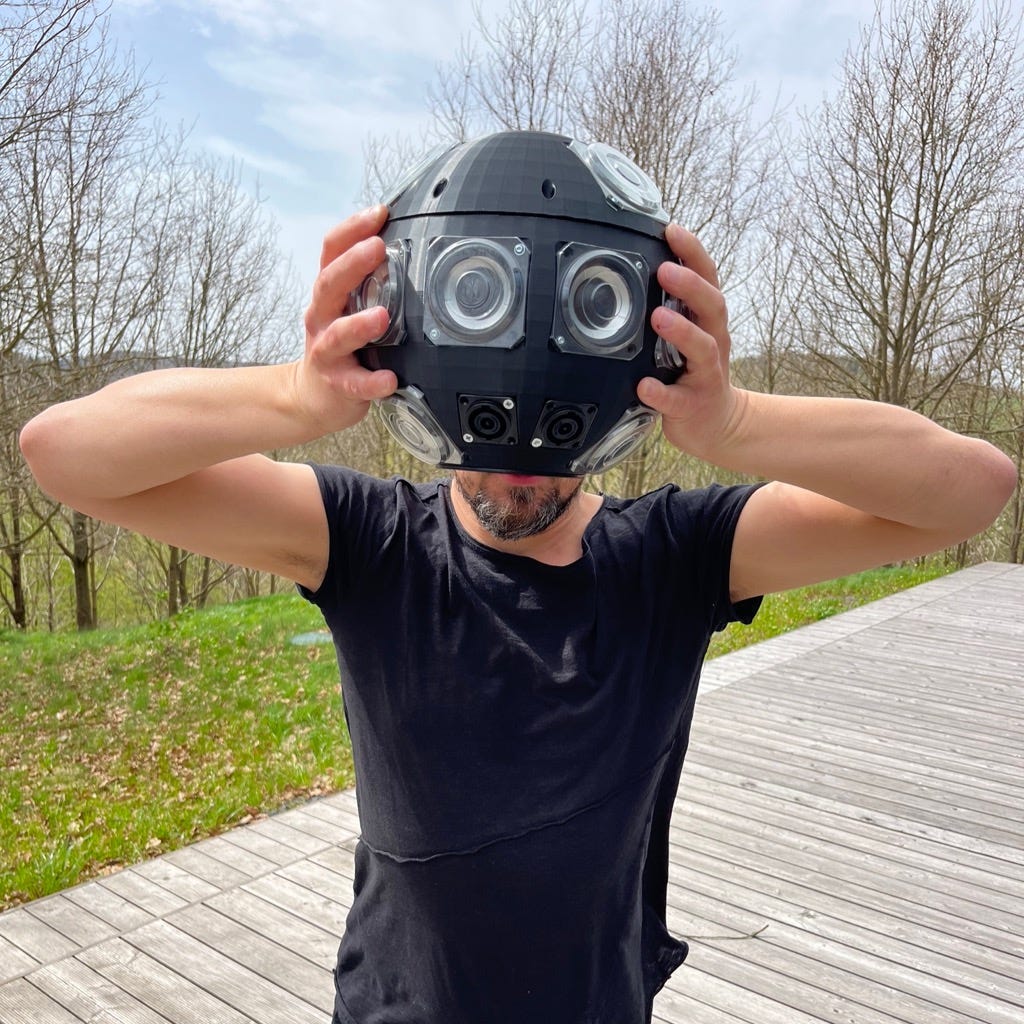
Amps
Amps are still a challenge. I’ve scavenged nearly entire market for multi-channels, and for now I do have a compact, affordable and sufficient solution for 16-24ch, likely better than what I am aware has been used so far for SBAs on the lower-end side. But I don’t consider it a full victory - there’s a room for upgrade for me, and there’s a gap on the market for sure (which I’d love filled at some point).
Drivers
393s and similar scale downs use fairly small drivers, therefore it’s easy to find a full-ranger.
The original IKO uses much larger drivers, and these are state-of-the-art, full-rangers. They are great, except for… their price.
My main challenge was to find an alternative for large and medium size drivers. With eyes bleeding from comparing countless options, I settled for a few choices, ordered, tested, measured and even accidentally made a pair of decent HI-FI speakers along the way.
So far so good, at least this chapter closed.
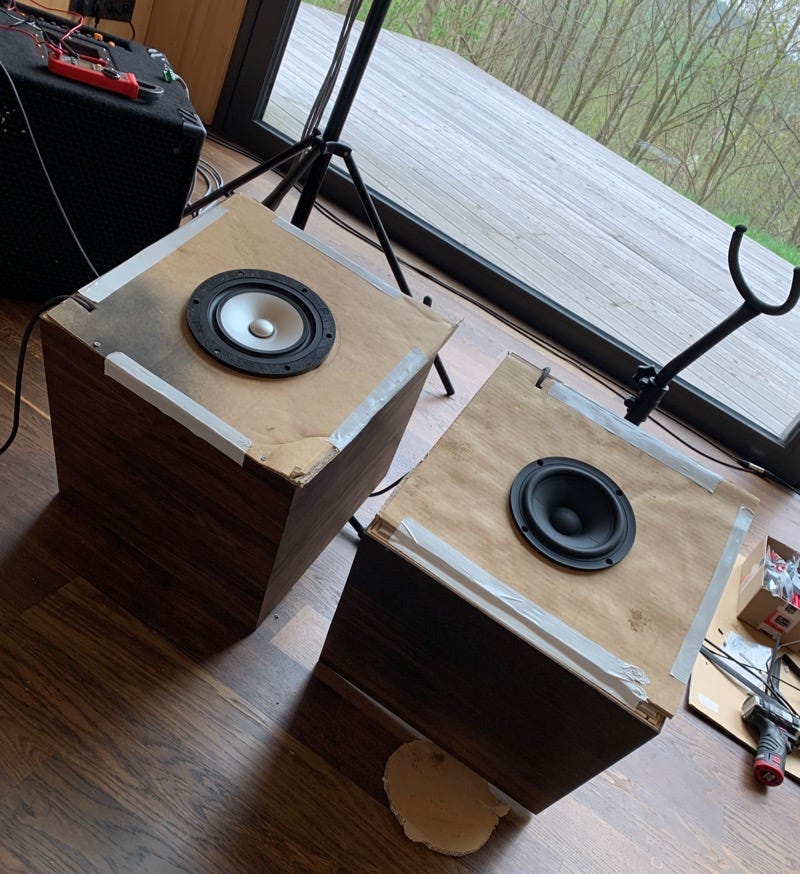
Patrick on Instagram: "It’s official. We’re opening #audiophile #hifi company."
Speaker Designs and mixed order control
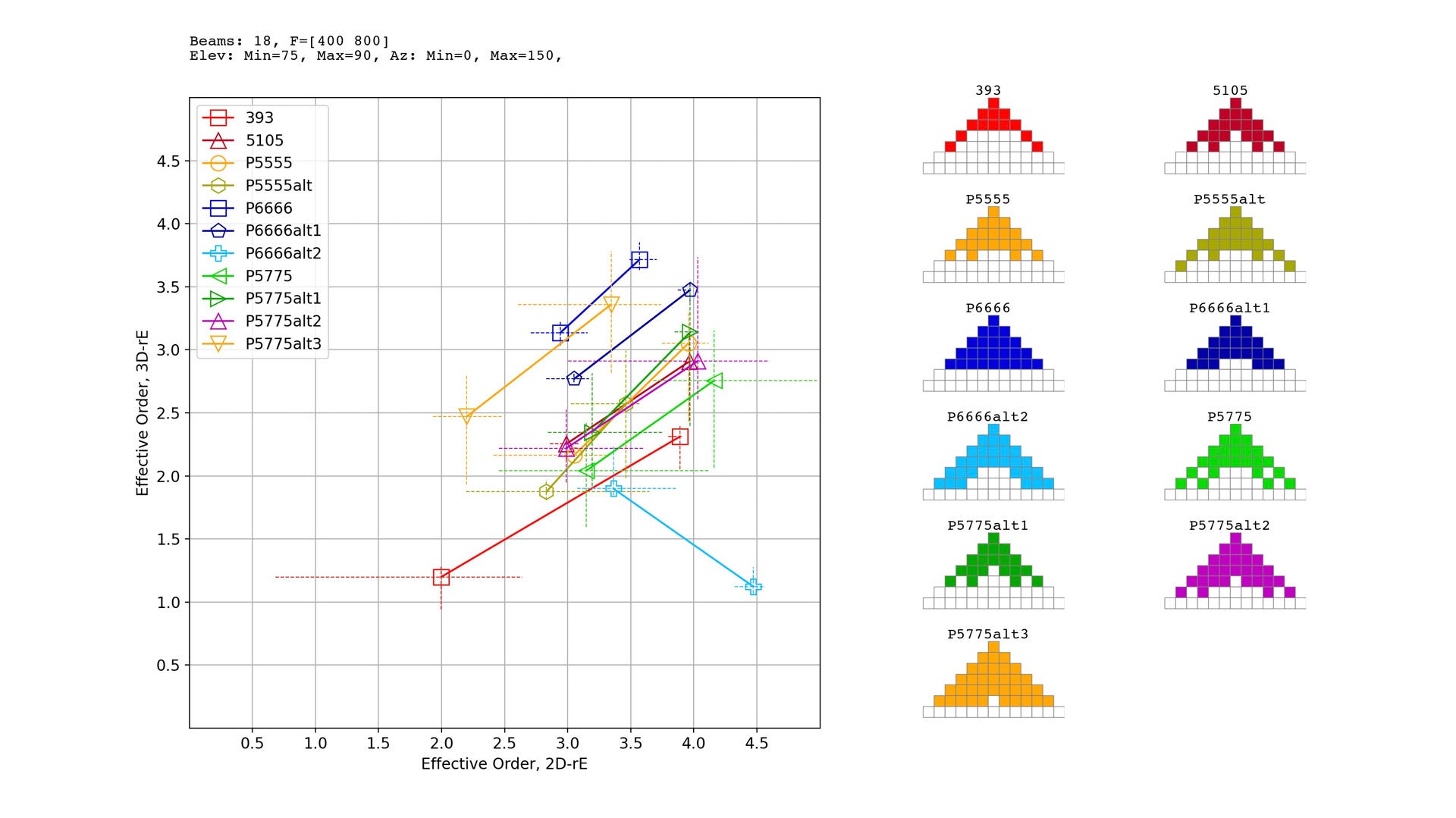
Building on 2019+ Zotter/Riedel work, I calculated and evaluated nearly all reasonable speaker layouts and mixed-order control schemes for configurations between 15 and 24 speakers.
I have to admit that the established approach is hard to beat - the layouts used for 393 (4th order) and IKO (4th order) hit a sweet spot in terms of combined 2D+3D spatial resolution.
Several options I explored seem to push horizontal resolution even further, which is actually promising!
Layouts like 6666 and 5775 (both 24 speakers) seem to beat IKO’s theoretical resolution, which is understandable, given 24 speakers instead of 20.
The increment over IEM’s repo scripts is extending the simulation across a range of beams and integrating results over them. This provides a less misleading picture of tested layouts, because the resolution plots can vary a lot beam-to-beam.
Control scheme
I’ve been exploring various control schemes, primarily combining IEM plugin suite and dedicated MIMO FIR filter sets. These subjects still raise many questions for further research, but it seems that reliance on ambisonics-only workflow for compositional work could be a bottle neck - my crude observations have been that the footprint of a single beam as soon as it’s encoded in ambisonics, is large. Therefore for my artistic practice I plan on using the ‘ambisonic bed’ and combine it with discrete channel control for high-precision spatial accents.
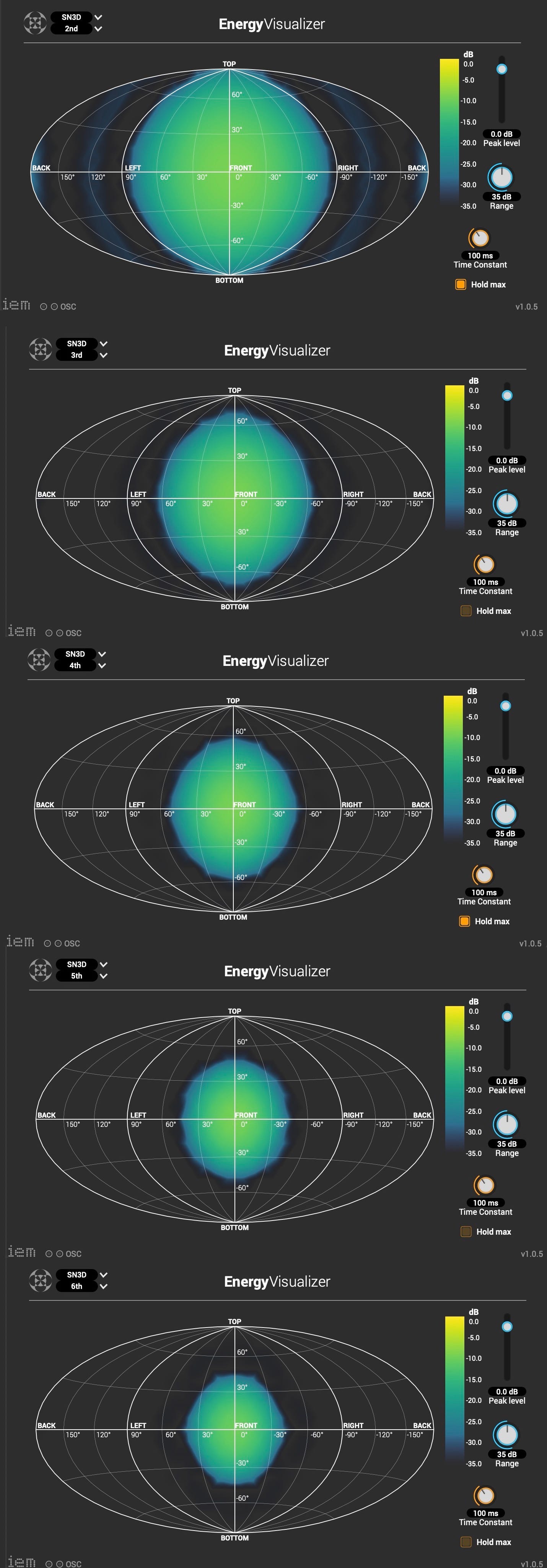
This is still pretty much an open chapter.
Enclosure manufacturing
Encouraged with the 393 ease of print, I definitely did bet on going 3D print vs plywood for the larger watermelons.
impro.dude on April 8, 2025: "Progress in progress. Two layouts: 3+9+3+1 5+7+7+5 Arranged in two wideband speaker variants. #ambisonics #spatialaudio #spatialsound #speakers #beamforming #projector".
That was a cold shower! The challenges of 3D printing enclosures grow exponentially with size and weight of the drivers, and so do costs. Anyways, It seems that I’m still on a path to 3D print those, at approx 45-52cm diameter.
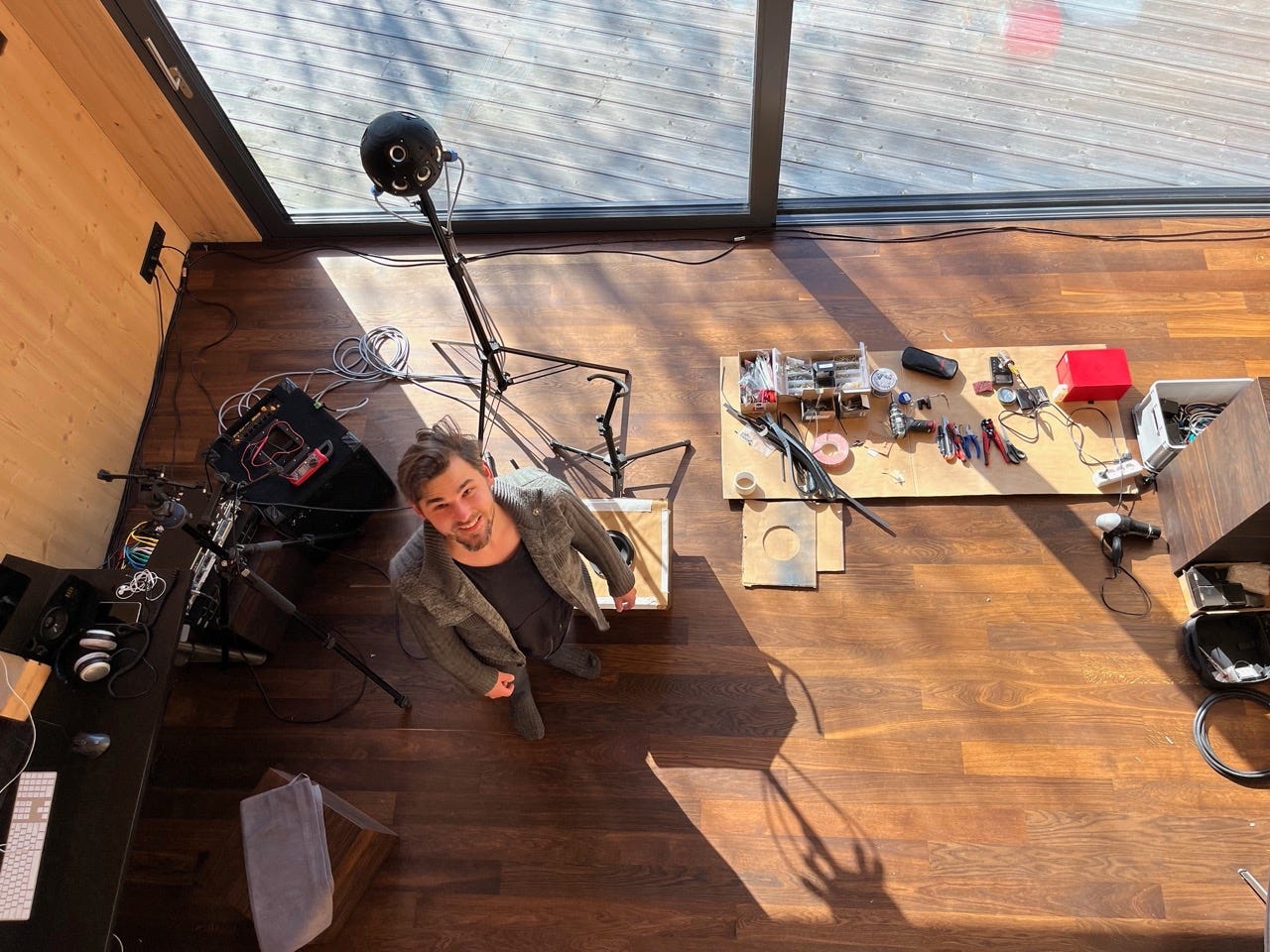
Ambisonic dome anyone?
As a side effect, it seems I’ve come across a really inexpensive way build of an ambisonic array, including high-end single-cone full-range drivers, custom 3D printed enclosures, and off-the-shelf amps to drive these. Someone mentioned to me Ottosonics, and this is could be seen as taking a similar path. Silghtly pricier, but but should be easier avoiding DIY-ing the amps and with a bit higher-end drivers.
It seems now I’ll take that route for the Echotronica festival, instead of building an ambisonic system using off-the-shelf studio monitors.
And one more thing
If you’ve read until here, you’re probably quite interested. Thanks for that. I just shared a deeper writeup on the genesis of my obsession with the watermelons, and a summary of my 3D audio trip to Berlin last month.
Labs
The futures of sound
·
April 26, 2025
This is a late, but fresh update on how I got obsessed with spherical beamforming arrays, and why you probably would, too. Grab a coffee, and enjoy this one.
Finally, a huge credit is due to the team over at IEM, particularly Franz Zotter, who’s been supporting me, and my silly questions thoroughly along the way. It would have been much much harder without it, if not impossible.
Please do get in touch - I love meeting ppl interested in everything 3D sound, making these tools sing, and the connections I made so far are totally awesome.
Best,
P
Comments
Nothing yet. Say the first thing.
Sign in to join the conversation.