
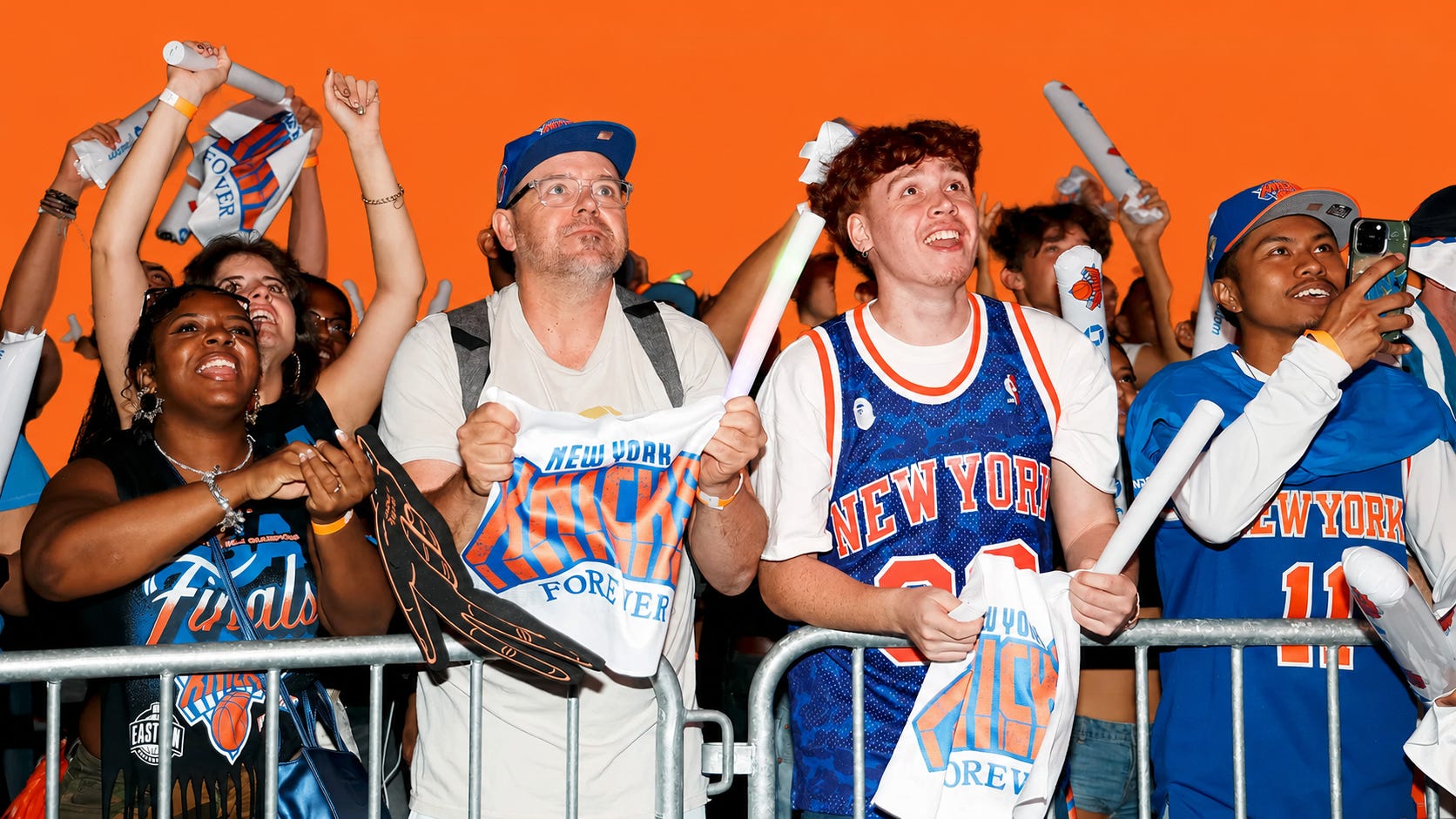
JPMorgan analyst David Karnovsky valued the New York Knicks at $11.75 billion in August 2026, using the record $12.5 billion sale of the Los Angeles Lakers to Bob Iger and Josh Kushner as a benchmark. On Aug. 14, MSG Sports filed a Form 10 registration statement with the SEC to separate the Rangers into MSG Rangers Corp. and rename the remaining company MSG Knickerbockers Corp., which plans to trade on the New York Stock Exchange under the ticker MSGK by the end of October. James Dolan will serve as executive chairman and chief executive of both companies. This essay examines how a championship, an 11-year national media deal worth roughly $76 billion, loosened private equity rules and a permanent property tax exemption for Madison Square Garden converted fan devotion into franchise value, and why fans have no leverage over any of it.
The Knicks are worth $11.75 billion.
That number is so high, so bloated with value, that I don’t have the imagination to fully grasp it. It’s beyond my wallet and comprehension.
But that’s what the New York Knicks are worth, as of this week. That’s according to a JPMorgan note. Bob Iger and Josh Kushner agreed this week to buy control of the Lakers at a $12.5 billion valuation. That’s the most anyone has ever paid for a sports team anywhere, ever. Yahoo’s read on what that did for the rest of the league is that it “validated the market for marquee NBA franchises.”
Then on Friday, MSG Sports filed with the SEC to cut the Rangers loose. If the league signs off, the Knicks will be a publicly traded company by the end of October. The name on the paperwork is MSG Knickerbockers Corp., which covers the Knicks and their G League club in Westchester. It'll trade on the New York Stock Exchange under MSGK. The Rangers get their own ticker, and shareholders get that stock free of tax. Dolan runs both.
Eight weeks ago, I screamed myself hoarse at a TV a thousand miles from the Garden. Texted shit to Knicks haters I hadn’t talked to since college. I collapsed into my father’s arms as the moment we had been waiting a lifetime for actually happened. I can’t put a price tag on that. It’s the most precious thing I’ve experienced. Is it worth $11.75 billion?
Billionaires making more billionaires doesn't change how I feel about the Knicks. Not the valuation, and not the private equity money circling the league like gulls behind a trawler. I experience the Knicks like a beggar. I’ve only ever wanted a chip. I’ve spent billions of seconds thinking about the Knicks. I’d do all of it again.
It just puts the love in context. I know what I’m paying for now, which beats lying to myself that the Knicks are sacrosanct, or anything other than an asset for billionaires.
The Dolans took control in 1997 at something like $300 million. So Karnovsky’s number works out to roughly a 39x return, most of it piled up during years when the team was, by any basketball standard, a disaster.
Forbes had the Knicks worth $7.5 billion last season and $9.75 billion after the title. CNBC crossed $10 billion in February. The league’s national media deal kicked in last season and is for 11 years, for roughly $76 billion, about 2.6 times the amount the last deal brought in annually. And it pays out the same whether you win 60 games or 20. Then, in December, the board of governors loosened the private equity rules so that one fund could hold passive stakes in eight teams instead of five, an acknowledgment of how much money was already lined up from outside sources. Two-thirds of the league started last season with private equity somewhere in their cap table. Gregg Lemkau at BDT & MSD gave the Financial Times the best explanation: the billionaires multiplied, but the number of NBA teams didn’t.
MSG Sports makes about 38% of its revenue from hosting games, according to a June breakdown by The Best One Yet. The playoffs usually push that revenue number much higher.
A regular-season home game brings in about $4 million. The first round of the playoffs brings in roughly twice that. This year, each second-round game generated about $12 million, while each conference finals game generated about $15 million. Each Finals game brought in about $20 million.
The playoff run generated about $180 million, with the company keeping roughly 55% after costs. MSG Sports had already covered its regular expenses in November. It can also sell a $40 hat for $140 after adding a Finals patch.
So when I was up at one in the morning begging for one more home game, I was begging for a $20 million line item and had no idea. How could I? Who the fuck am I? A nobody. Just a fan. There’s no way to love this team that doesn’t make somebody money. My “wanting” is the product.
For 20 years, investors valued MSG Sports at about 40% less than what the Knicks and Rangers might bring in a private sale. They called it the Dolan discount. Some of that reflected the oddity of housing a basketball team and a hockey team in the same public company. Most of it reflected how investors and the world view Jim Dolan. Who can blame them? Before he hired Leo Rose in 2020, the Knicks were the laughing stock of professional sports.
The Isiah Thomas era. The Phil Jackson era. Remember the “sell the team” chant tumbling down from MSG’s 400s section?
The Knicks' valuation was affected by losses but propped up by the fans’ unbreakable hope. Not that Dolan would ever sell, but like sharks in the waters, corporations and oligarchs salivated at the idea of buying the Knicks for 60 cents on the dollar, then watch it take off with Dolan gone.
But then the unthinkable happened. A true, honest miracle. The Knicks won. Under Dolan’s ownership.
Shares have roughly doubled over the past year. Knicks sponsorship is up 28%, to 59 partners. The company filed to split the Knicks and Rangers into separate public companies, which analysts figure will close what’s left of the discount while making it easier to sell a minority stake down the road without incurring a tax bill. Over three generations, we waited for that June chip. And eight weeks later, the Knicks are no longer fool’s gold, but the real fuckin thing.
The Garden hasn’t paid property taxes since 1982. Albany granted the exemption to keep the Knicks and Rangers from following the Nets across the river to New Jersey. The Knicks have that tax exemption in perpetuity. Meaning, For-Ev-Er. The city’s Independent Budget Office put the tab at $946.7 million between 1984 and 2023, inflation-adjusted. That’s $42 million a year. Brad Hoylman-Sigal, the state senator who’s spent years trying to kill it, Garden pays “nothing, zero, bupkis” back to New York City in taxes.
Taxpayers pay for MSG. But most of us can’t afford to get in the building.
The Knicks had the most expensive tickets in the league last season by a mile. Starting with $213.43 for nosebleeds. That’s against a league average of $52.88. The Oct. 20 opener against LeBron and the Sixers is now the priciest season opener in NBA history. It costs $1,845 to get in the door, and between $34,000 and $166,000 to sit courtside. For a regular-season game. On a Sunday.
I don’t know that any of this rises to a scandal. It’s the market doing market things inside an economy hanging by its late-stage capitalist throat. The top 10% of earners now account for something like 49% of all consumer spending in the country, per Moody’s, the highest share since anybody started counting in 1989. Some economists have taken shots at the methodology, and they should, but nobody’s out there arguing the line runs the other way. An economy running on luxury demand produces a team like this one, an asset that appreciates, with a customer base that fuels the economy like kerosene.
Owning an NBA team can be bad business. My colleague with The Knick of Time Show, Fritz Alcindor, points out that teams deep in the luxury tax often run cash flow negative, since every dollar over the line triggers penalties that eat into the gate. Boston won a title in 2024 and reportedly lost around $80 million doing so, with worse to come if they’d held the group together. That’s a lot of why the Grousbecks sold at $6.1 billion to a group backed by private equity. Some of the owners we call cheap are people who’d rather not burn nine figures a year.
The NBA Sold Out to Wall Street, and Fans Are Paying the Price
·
Jul 31
Quick answer: Private equity has become one of the most powerful forces in the NBA. In December 2025, owners voted to allow a single institutional fund to hold passive minority stakes in up to eight teams, up from five, accelerating a shift in how franchises are run. Teams that once functioned as civic trophies now behave more like appreciating financia…
The valuation is waaaaaaay downstream of us. The financial frenzy exists because the Knicks are great again.
Brunson left something like $113 million on the table extending in 2024 so the front office could keep the roster intact. The new media deal put way more games on broadcast TV than the old one. And Dolan, who ate two decades of blame for everything, stood (somewhat) redeemed in the parade.
I've weighed it all, and winning and the good vibes soften the diabolical finanaicals. But it doesn’t erase it. The truth is, the Knicks are one of the few teams that print money no matter what the tax bill says.
Back in 2007, a young democratic socialist named David Duhalde wrote that Knicks fans should just buy the team ourselves. The shares couldn’t appreciate, and there was a hard cap on how much any one person could hold, so nobody could take it over. An elected board would hire the people who run it. Democratic Left ran the piece again two days after the title, and reading it now is like reading mail from a country that no longer exists.
Green Bay is still the only community-owned team in major American sports, 538,967 shareholders collecting no dividends and unable to sell at a profit, and the NFL bolted that door shut in 1960 by writing into Article V that nonprofits can’t hold membership. The NBA never had a chance to replicate.
The Dolans run MSG Sports through dual-class Class B shares, so no boycott or shareholder uprising can force a sale. No matter how much fans wished they could for two decades. In July, he handed day-to-day control of the Rangers to his 32-year-old son Quentin, who’s been sitting on MSG boards since 2020 and ran player performance for both teams during the title run. Team president and chief operating officer, with an alternate governor thrown in.
Why the Dolan Family Are Never Selling the Knicks
·
Jul 3
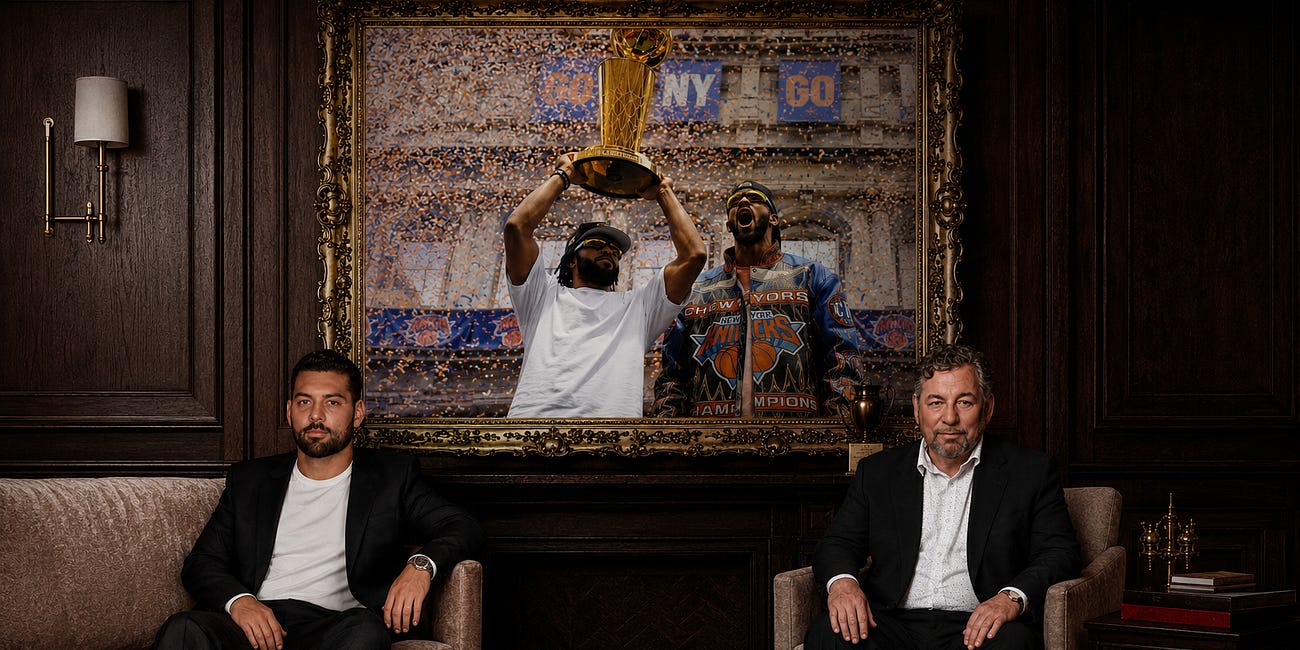
Quick answer: James Dolan handed day-to-day control of the New York Rangers to his son, Quentin Dolan, on July 3, 2026, naming him team president, chief operating officer, and alternate governor. Quentin, 32, has sat on the boards of Sphere Entertainment, Madison Square Garden Sports Corp, and MSG Entertainment since 2020, and has run player health and …
Which leaves the boycott. To do any damage, I’d have to cut down the number of home playoff games, which means wanting the Knicks to lose, which is the one thing I can’t physically do. You need to be able to want less of something to have any leverage over it. Being a fan means never wanting less of it.
So I’m an ant. Ants trot, tro, trot with crumbs on their backs, following the leader. I spent over $200 on Knicks merch and flew from Dallas to NYC for the championship parade.
I pay for a bootleg Fire TV Stick so I can watch League Pass. I buy Knicks jerseys of bums like Andrea Bargnani and Kevin Knox. I am part of the problem.
Against $11.75 billion, my contribution rounds to zero. Alcindor would tell me to loosen my grip. He says you can’t be romantic about a sports team, that what you’re actually attached to is the people you watch it with. The team was just my excuse to find my tribe.
He’s probably right. But I’m gonna ignore him. The romance is the only piece of this I actually own. The NBA is one of the better things this country has come up with. This summer made it all worth it.
None of this works without us. That $11.75 billion has less to do with a roster or a building than with how many people can’t quit the Knicks. Our inability, no, our refusal to walk away is the collateral underneath it all.
JPMorgan valued the Knicks at $11.75 billion this week, benchmarked against the record $12.5 billion sale of the Lakers to Bob Iger and Josh Kushner.
The Dolan family’s 1997 purchase valued the team at nearly $300 million, making the current figure roughly a 39x return earned largely without winning.
Game day accounts for about 38% of MSG Sports revenue, media rights 32%, and sponsorship and suites 25%. Playoff home games generate two to five times what a regular-season game does.
The Knicks charged the NBA’s highest ticket prices before the title, and their 2026-27 opener is the most expensive season opener in league history.
Madison Square Garden has paid no property taxes since 1982, costing New York City nearly $947 million in inflation-adjusted revenue.
Counterpoint: many NBA teams lose money in the luxury tax, Brunson gave back $113 million to keep the roster intact, and the new media deal put more games on free TV.
Community ownership is barred by league rules, and the Dolan family’s Class B shares make a forced sale impossible. Quentin Dolan is already running the Rangers.
How much are the New York Knicks worth in 2026? JPMorgan analyst David Karnovsky valued the franchise at $11.75 billion in August 2026. Forbes put the team at $9.75 billion after the championship, and CNBC estimated slightly above $10 billion in February.
Why did the Knicks valuation jump so much? Several forces converged. The NBA’s 11-year, roughly $76 billion national media deal reset every team’s baseline revenue. Owners loosened private equity rules in December, opening the league to more institutional money. Scarcity did the rest, with 30 franchises available to a much larger pool of buyers. The record $12.5 billion Lakers sale then gave analysts a fresh comparable for marquee teams in large media markets.
What is the Dolan discount? The roughly 40% gap between MSG Sports’ stock price and the combined private market value of the Knicks and Rangers. Investors have long applied a haircut tied to James Dolan’s control and to the awkwardness of holding two teams in one company. The planned spinoff is designed to close it.
Does Madison Square Garden pay property taxes? No. A 1982 state exemption with no expiration date relieves the arena of property taxes. The city’s Independent Budget Office estimated the forgone revenue at $946.7 million in 2023 dollars.
How expensive are Knicks tickets now? New York led the NBA last season with an average get-in price of $213.43, roughly four times the league average. The 2026-27 opener against the 76ers carries a get-in price of $1,845, with courtside seats listed between $34,000 and $166,000.
Will James Dolan ever sell the Knicks? Almost certainly not. The family controls Madison Square Garden Sports Corp through dual-class Class B shares, which insulates it from any outside pressure, and Dolan has said publicly that he expects his children to take his place. His son Quentin took over day-to-day control of the Rangers in July 2026.
Can fans buy a stake in the Knicks? Only indirectly, through MSG Sports stock, which carries no control. Direct community ownership of the Green Bay Packers variety is prohibited under major league rules.
No posts
Comments
Nothing yet. Say the first thing.
Sign in to join the conversation.