
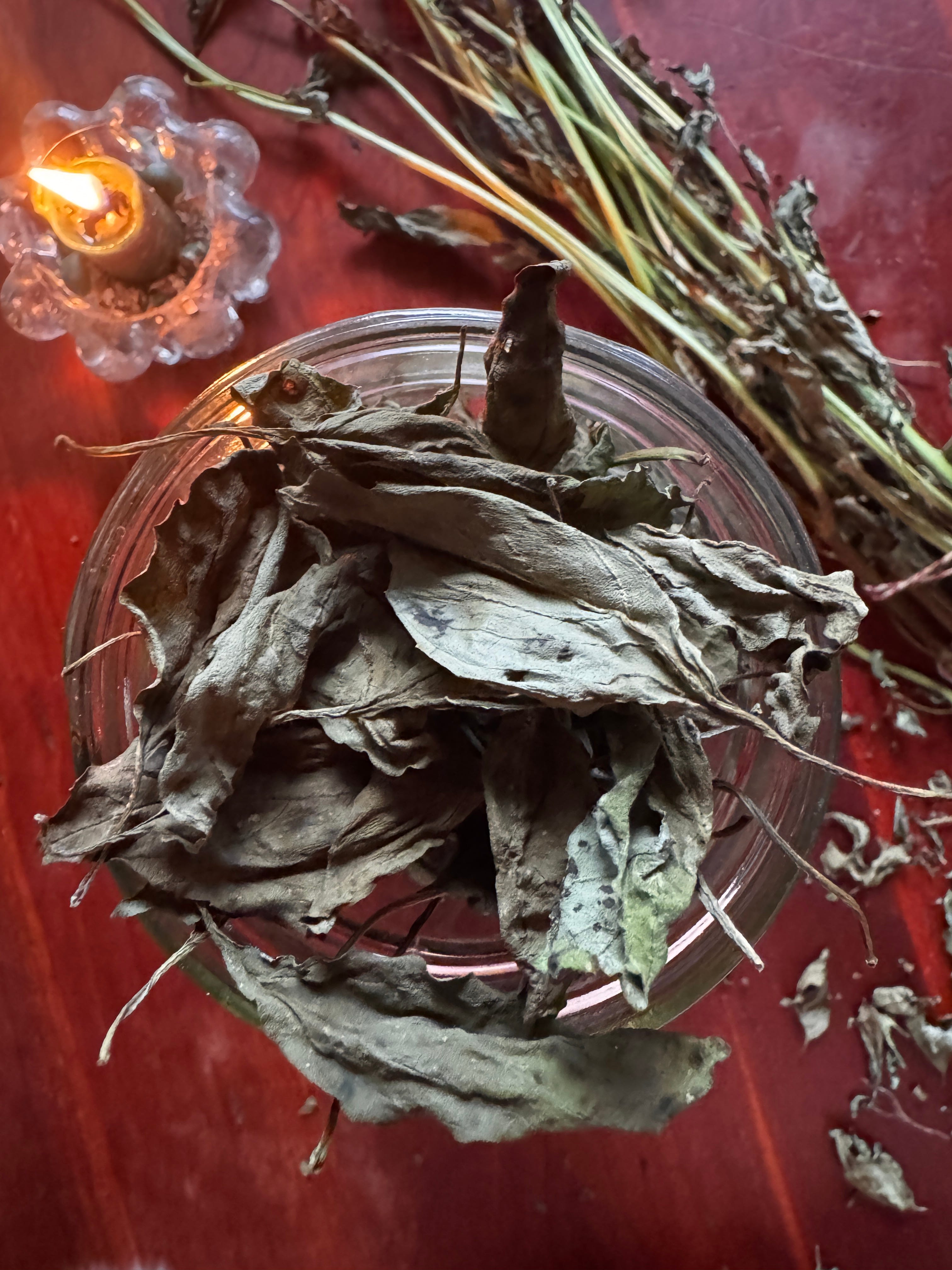
The next piece of magic I’d love to teach you is the practice of preservation: catching something at the very height of its power and holding it there, so that none of what a season gave you is lost. It’s one of the oldest workings in any kitchen, and the garden hands most of us the perfect teacher for it every August. Too much basil.
A few days ago I went out to the garden with a pair of scissors and came back inside with an armful. Not a handful, an armful. If you grow basil you know exactly the moment I’m describing. For most of the season it seems to just be coming along, growing, minding its own business, and then the peak of summer arrives and suddenly it has exploded into this mammoth of a green thing, right as the wheel of the year turns toward Lughnasadh and the season of first harvest begins. You cut it back so it doesn’t flower, and suddenly your kitchen counter is buried in green, and the whole house fills with that heady green perfume that could only ever be basil, and you’re standing there wondering what on earth you’re going to do with all of it.
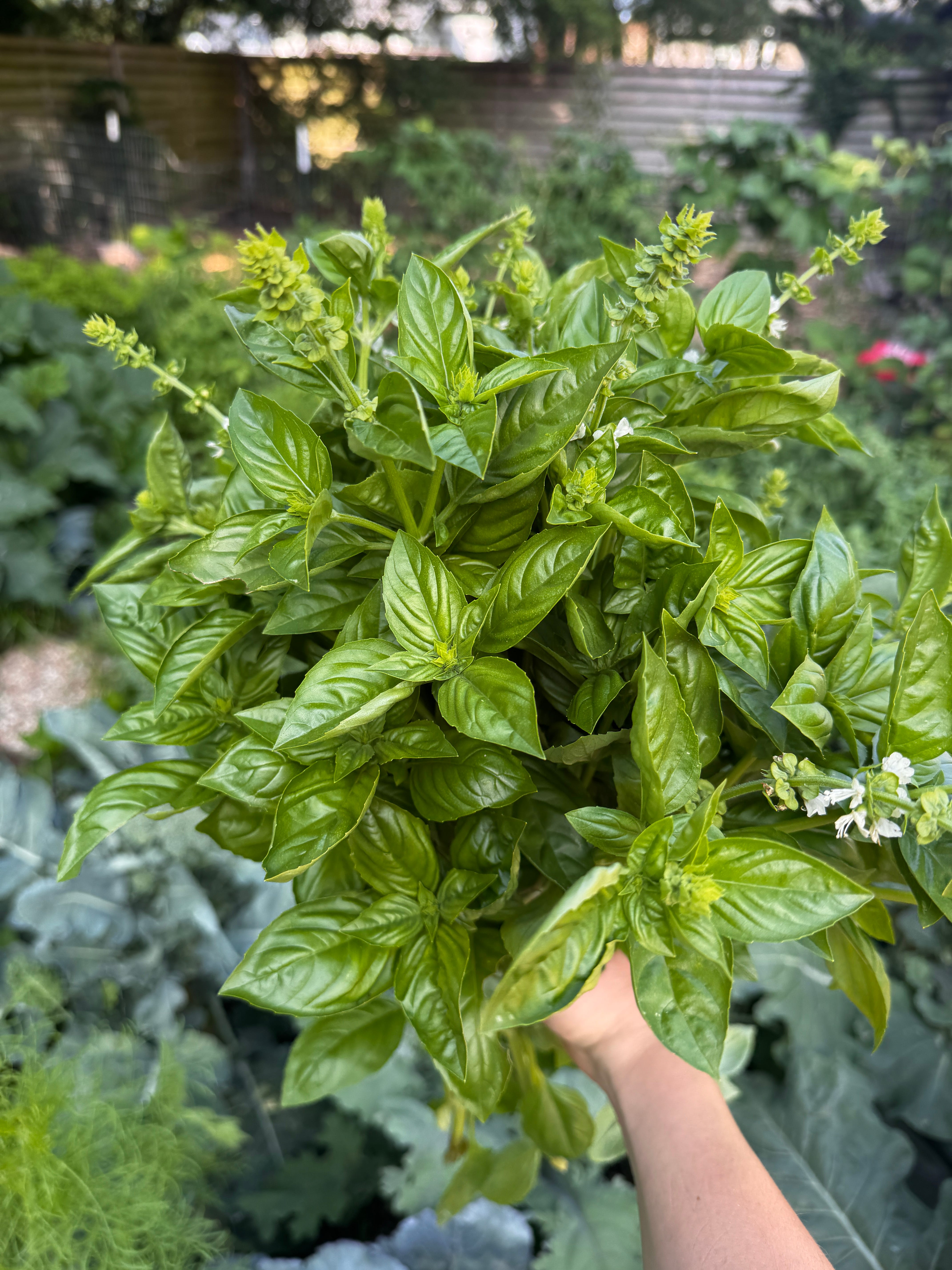
Here’s what I want you to understand before you do anything with that pile: this is not a chore. This is one of the oldest workings there is. Preservation is spellwork, full stop, and the garden just handed you enough raw material to cast with for an entire year.
Think about what you’re actually doing when you preserve a harvest.
Right now, in this exact week, your basil is at the absolute peak of its power. The volatile oils that carry its scent and flavor (linalool, eugenol, the whole aromatic choir; there’s real chemistry here, this isn’t me being poetic) are as concentrated as they will ever be. Basil holds its oils in tiny glands on the surface of its leaves, and those oils are at their fullest in the morning, just after the dew dries, right before the plant tries to flower. Once it flowers, the plant pours its energy into seed instead of leaf, and the flavor fades. Left alone, all of that gathered summer simply disperses. The leaves yellow, the oils evaporate, the frost eventually comes, and the whole season’s worth of sunlight goes back to wherever sunlight goes.
New here? Welcome. The Kitchen Witch is where cooking and magic sit at the same table. Subscribe and let’s stir up something good together.
Preservation interrupts that. When you make pesto and tuck it into the freezer, when you layer leaves into salt, you are catching something at its moment of greatest vitality and holding it there. You are telling entropy, politely but firmly, not this one. And in the middle of February, when the garden is a memory under snow, you will open a jar and August will still be alive inside it.
Our ancestors understood this without needing the vocabulary for it. Every crock of sauerkraut in the cellar, every braid of onions in the rafters, every jar on every shelf was an act of captured time. The harvest festivals (and Lughnasadh is the first of them, the festival of first fruits) were never just parties. They were the opening ceremonies of the great keeping season, the months when a household’s magic was measured in what it managed to hold onto.
Basil has been treated as sacred for about as long as people have been growing it, and I find it delightful that the plant currently overwhelming your garden bed carries this much lineage.
The name itself is a crown. Basil comes from the Greek basilikón phutón, the royal plant, from basileus, king. The French called it herbe royale. This is not an herb that history considered ordinary.
In India, holy basil (tulsi, a close cousin of the sweet basil in your garden) is one of the most venerated plants on Earth. It’s grown in courtyards and at thresholds, tended daily, honored as a goddess in her own right. A home with a thriving tulsi plant at its entrance is understood to be a protected home. I love that the protection isn’t a one-time working, either. It’s a relationship. You water the plant, and the plant guards the house.
In Greek Orthodox tradition, basil is the herb of the holy. Legend says St. Helena found the True Cross beneath a patch of it, and to this day basil is used to sprinkle holy water during blessings. In parts of Italy, a pot of basil on a windowsill or balcony was once a signal of courtship and welcome: basil as an announcement that love was invited here. In folk magic across the Americas, basil is one of the great prosperity herbs: a leaf in the wallet, a leaf in the cash register, basil water washed across the floor of a shop to draw money and good fortune through the door.
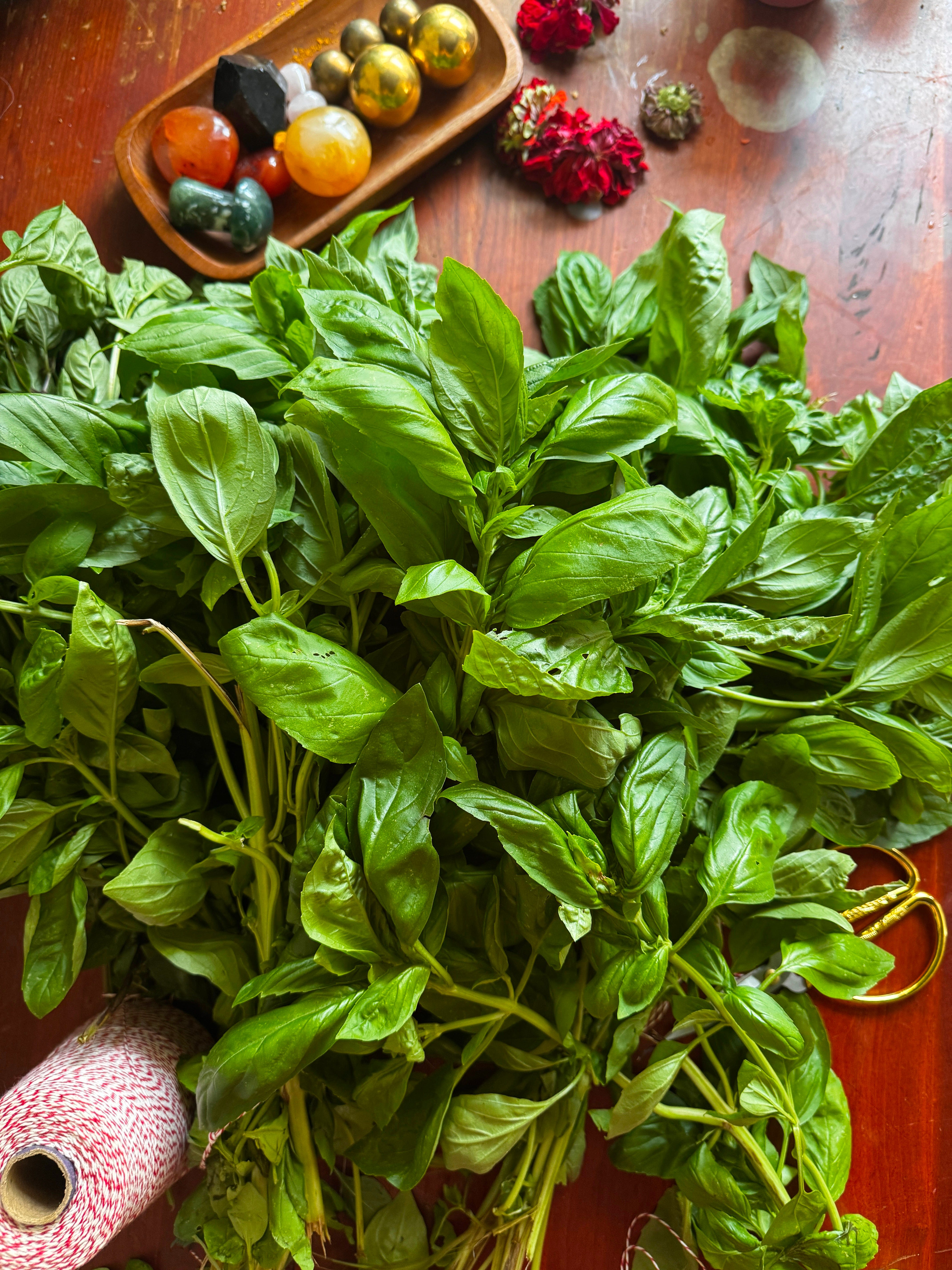
Look at the pattern underneath all of it. Love. Protection. Prosperity. Welcome. Peace in the home. Across completely unconnected cultures, basil keeps getting assigned the same job: guarding the threshold and sweetening what’s inside it.
If your counter is buried in basil too, you're in the right kitchen. Subscribe to The Kitchen Witch and we'll turn every harvest into magic together.
Basil is potent in a way that very few kitchen herbs are. I’ve written before about being able to taste and smell nearly everything, and when I cut a stem, the scent doesn’t just rise, it takes over. For a moment there is no other smell in the garden. Not the tomato leaves, not the warm soil, nothing.
And I want you to notice something about that: what basil does physically is exactly what it does energetically. A plant strong enough to crowd every other scent out of the air is a plant that overwhelms and blocks out what is unwanted, which is why so many traditions reach for it when something needs to be kept out of a home or a body or a heart.
This is also one of the ways we come to know the metaphysical properties of plants in the first place. Not from a correspondence chart, but from relationship: growing them, cutting them, cooking with them, and observing what each plant, herb, or spice is trying to say to our senses, both the ones we all name and the lesser known ones underneath.
The plant will tell you what it does. You just have to be in relationship with it long enough to listen.
Here is where the practical and the magical braid together, because every method of preserving basil is also a different kind of working. The method you choose shapes the energy of what you end up with. Pick the ones that resonate and work for your life and home. And there’s a third way, the one I’m most excited to share with you, waiting below in the practice.
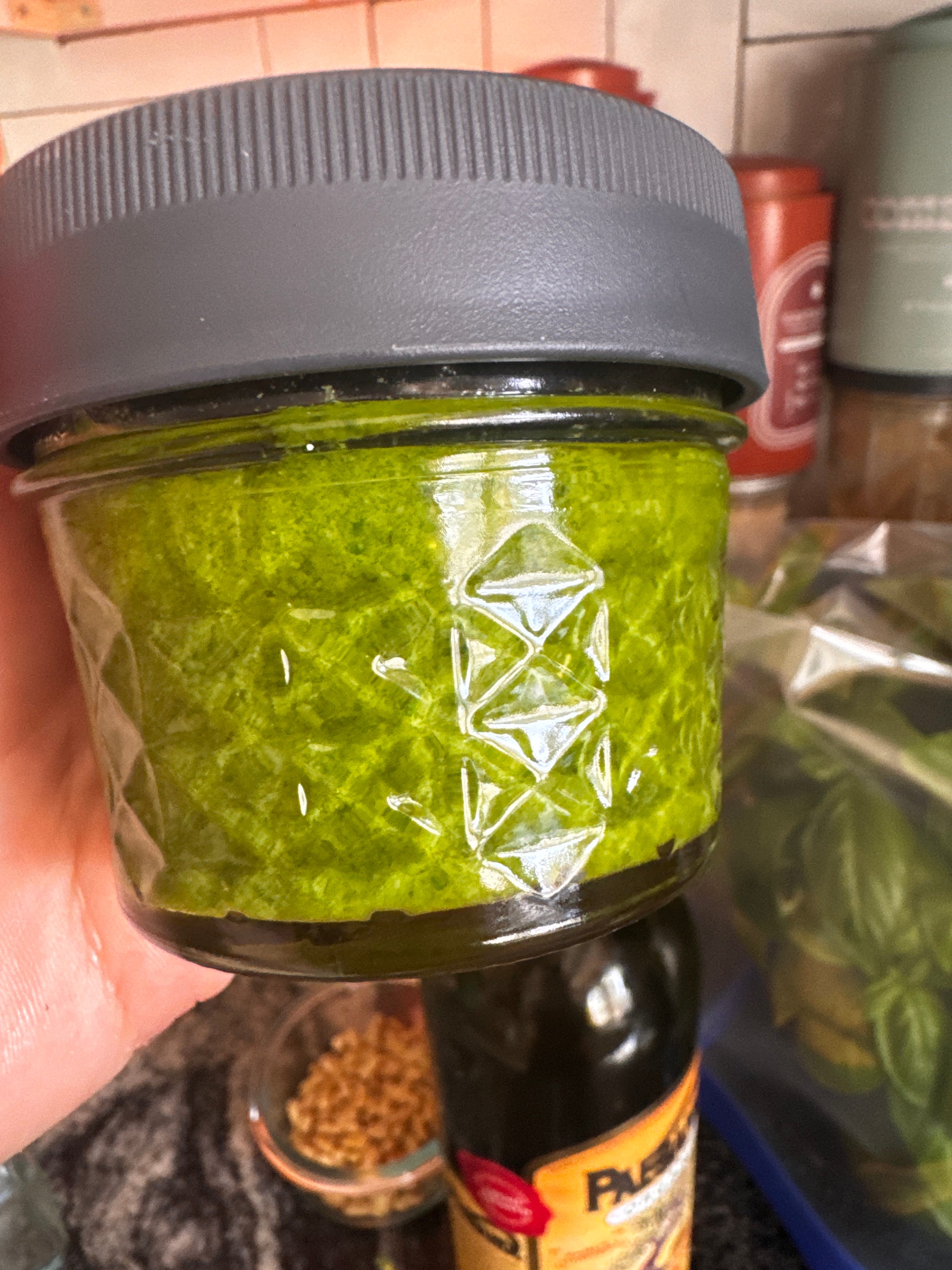
The freezer: pesto as a spell in portions. Basil hates the cold while it’s alive (never refrigerate fresh basil; below about fifty degrees the leaves blacken, which is the plant’s cells breaking and browning, the same chemistry as a bruised apple), but once it’s blended into pesto with oil, the freezer becomes its ally instead of its enemy. The oil coats and protects what the cold would otherwise destroy.
I make pesto in big batches and freeze it in an ice cube tray, and I want you to notice what that actually creates: individual portions of concentrated summer, each one the size of a single spell. One cube dropped into soup on a bleak evening is not a small thing.
Pesto itself is combining magic: basil’s protection, garlic’s fierce banishing energy, salt the amplifier, oil the preserver, and traditionally pine nuts and hard cheese, abundance and richness ground in together. You are making a compound working, and then keeping it in reserve.
The drying rack: the ancestors’ method. This is the one I experimented with this year. After my big harvest I tied the basil into bundles and hung them upside down to dry, and I’m happy to report it worked pretty well. I did learn a few things worth passing along, because basil is one of the trickier herbs to air-dry. Keep the bundles small, five or six stems each, so air can reach the center. Hang them somewhere warm and dry with good airflow, out of direct sunlight, and check on them every few days.
Those thick leaves hold a lot of moisture, and if they dry too slowly in humid summer air they can blacken or mold, so pull out any stems that look off. When the leaves crumble crisply instead of bending, they’re done. Strip them whole into an airtight jar, keep it somewhere dark, and crush them only when you use them so they hold onto their oils longer.
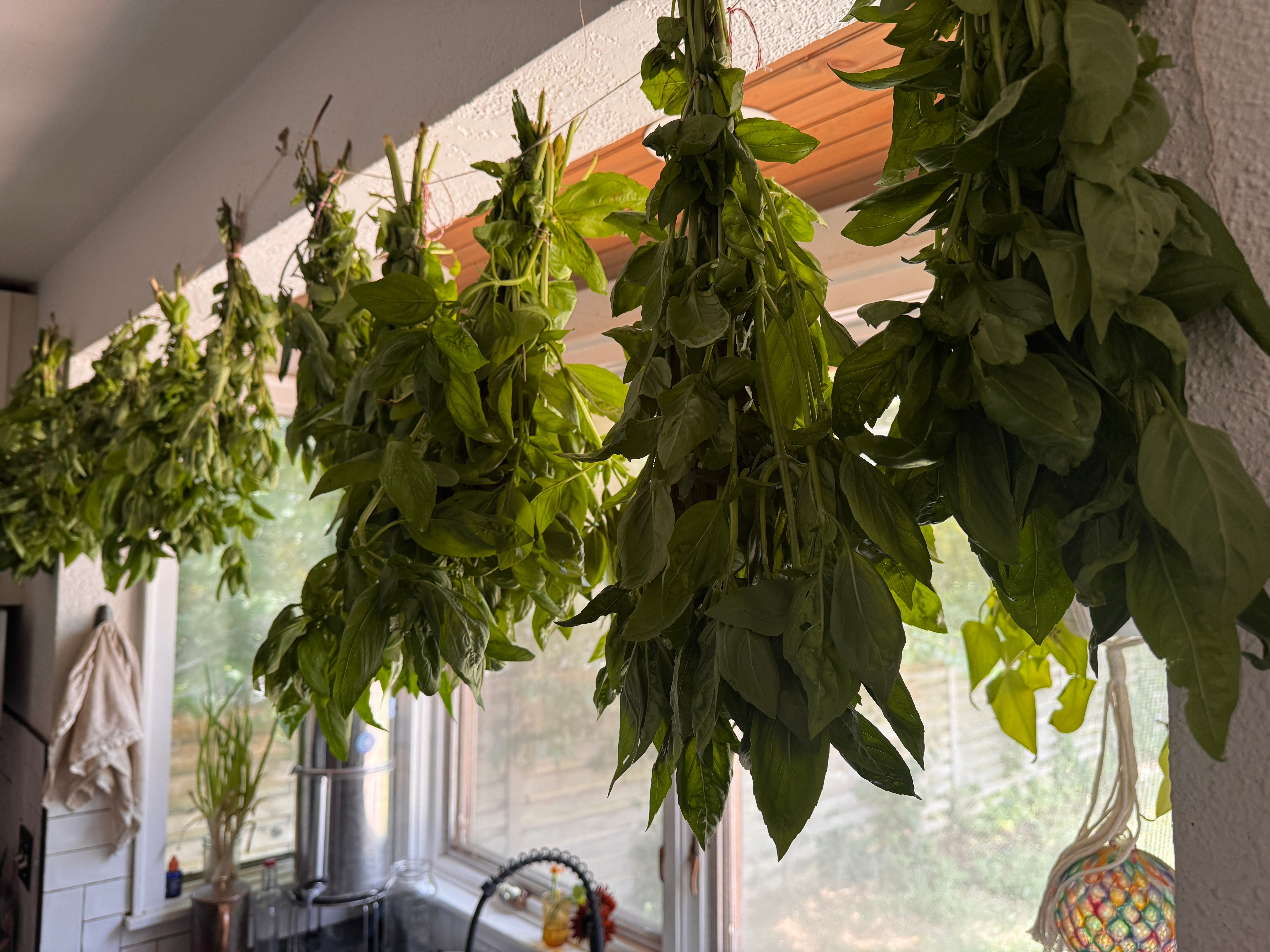
Dried basil is the weakest in flavor of all the methods, because those volatile oils largely leave with the moisture. But hanging herbs to dry is the oldest preservation magic humans have, and dried basil is fantastic for so many different forms of spellcraft: the spell jars, the sachets tucked into drawers, the pinch scattered at a threshold.
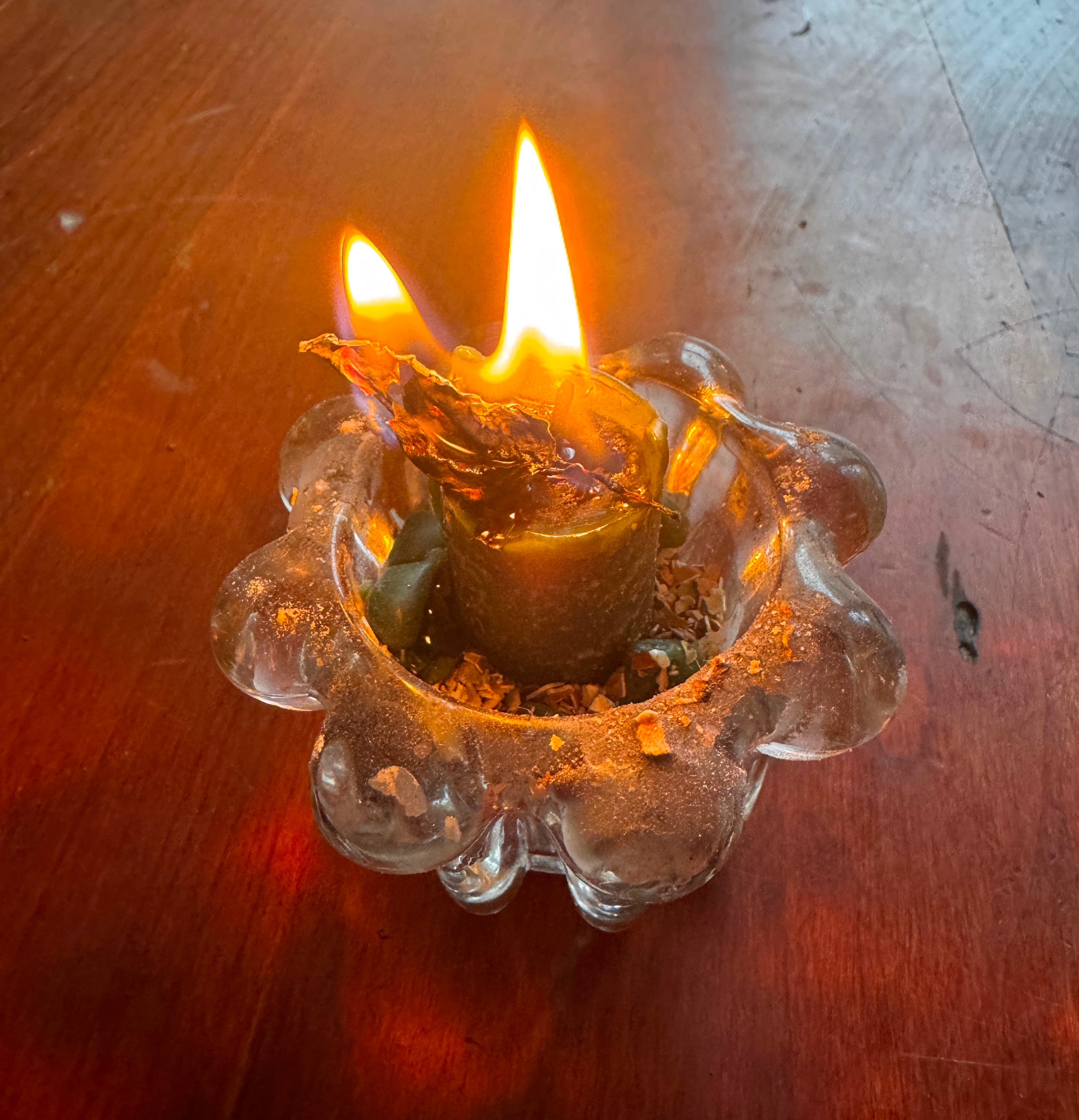
After this harvest, I offered a leaf to the candle in gratitude, asking that its blessing and protection cover my home. One leaf, one flame, one intention, and the whole working took less than a minute.
And in the meantime, the bundles themselves are doing quiet work just hanging there, the way herb bundles have hung in kitchens for thousands of years.
Lughnasadh, at the start of August, was a time to honor the first harvest and to give gratitude and offering back to the land. First fruits were offered in thanks, first loaves were baked from the new grain, and then the real work began: the salting, the drying, the fermenting, the filling of the cellar that would carry a family through the dark.
Every filled jar was insurance and offering at once. And the people doing that work (mostly women, mostly uncredited) were performing the most sustained act of practical magic in the whole turning of the year.
So when you carry your armful of basil into the kitchen, you’re joining a very long line of people who did exactly this every August.
Here is your hands-on working, and the third way to keep the summer: basil salt, the amplifier meets the amplified. If you read my last piece, you know how I feel about salt, and basil salt is where that working and this one come together to create something truly potent.
Comments
Nothing yet. Say the first thing.
Sign in to join the conversation.