
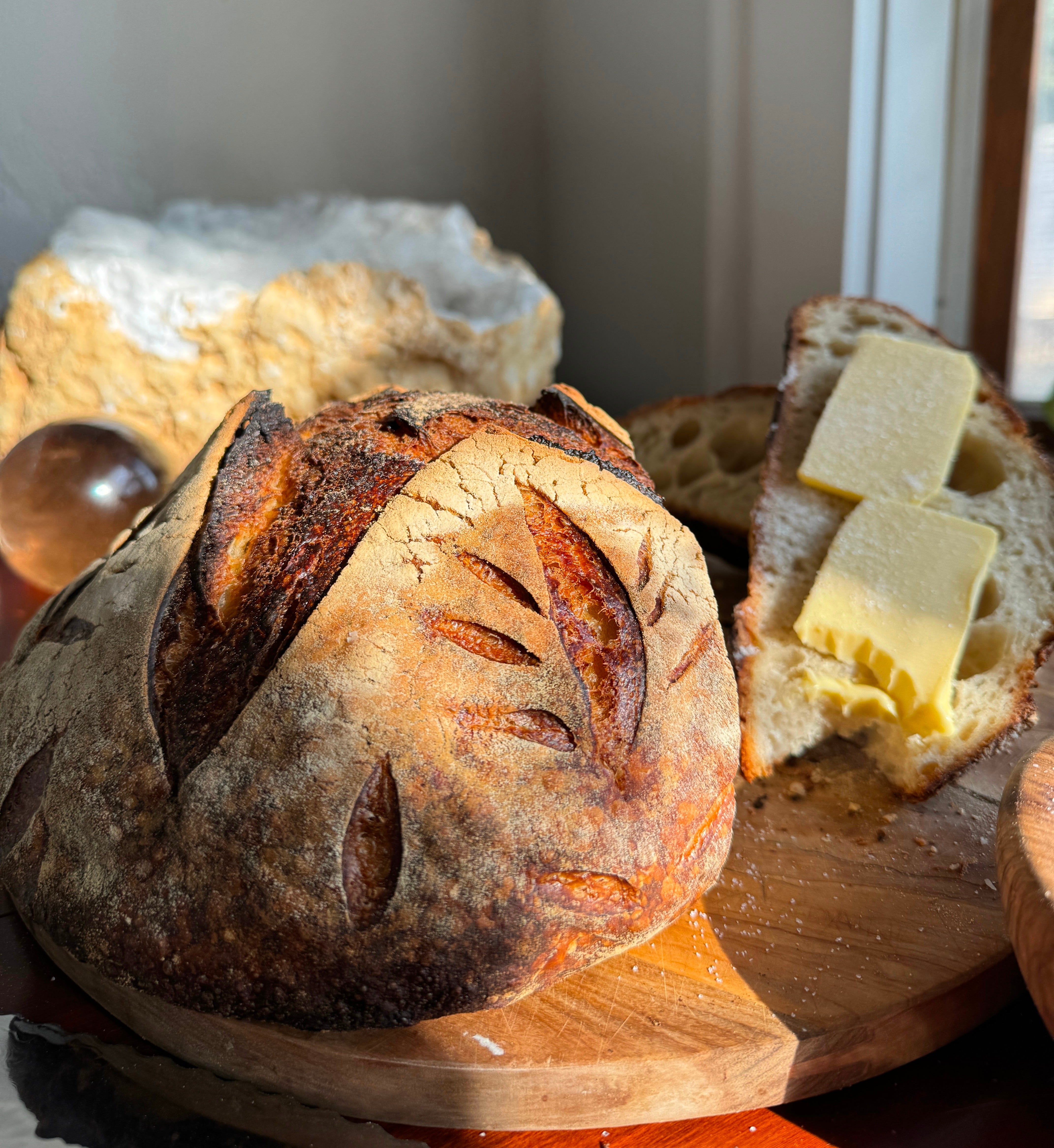
The third piece of magic I want to teach you is different from the first two, because this one is alive.
The spoon is a tool. The salt is an ingredient. But if you keep a sourdough starter, or if you’ve ever thought about keeping one, you are not dealing with a tool or an ingredient at all. You are dealing with a resident. A living culture of wild yeasts and bacteria that moved into your kitchen, took up residence in a jar, and entered into the oldest bargain there is: feed me, and I will feed you.
Many people think sourdough is a pandemic hobby or a farmers market flex, but maybe what is less well known is that for most of human history, the family leaven was treated as something much closer to a household spirit, a living inheritance that was named, fed, protected, slept beside, rescued from fires, carried across oceans and mountain ranges, and, by something very close to sacred law, never sold. Only given.
Let me tell you about the spirit in the jar. And then let me show you how to wake up yours.
New here? Welcome. The Kitchen Witch is where cooking and magic sit at the same table. Subscribe and let’s stir up something good together.
Think about what a sourdough starter actually is.
It’s flour and water, left open to the world, until the world moves in. The wild yeasts living on the grain, floating in the air of your particular kitchen, riding on the skin of your particular hands, all settle into that little pot of paste and begin to eat, and breathe, and multiply. Within a week or so it bubbles. It rises and falls like a sleeping chest. It develops preferences, moods, a smell that is entirely its own. No two starters on earth are the same, because no two homes are the same, and a starter is, in the most literal way I can put it, the invisible life of your home made visible. Your air. Your grain. Your hands. Alive in a jar, and asking to be fed.
Now hold that next to the old stories. Nearly every culture our ancestors came from believed the household had a resident spirit, and nearly every one of those spirits was kept happy the same way: you fed it. The Scots left cream and fresh bannocks out for the brownie, who did the night work of the house as long as he was fed and never insulted. Slavic families fed the domovoi, the grandfather-spirit behind the stove, with bread, salt, and porridge, and a fed domovoi kept the luck of the household, while a neglected one let things sour and break. Offerings of food, given daily or weekly, in exchange for protection and prosperity.
And then here is this jar on the counter that you feed, every day, and it nourishes your family in return. It’s another member of the family that is reactive and interactive with everyone who lives within your walls, and it is offering you constant abundance and protection.
Here is a beautiful piece of forgotten lore, and it comes from medieval England.
In Middle English, yeast, the barm skimmed off the top of fermenting ale and used to raise the household bread, had a second name. The record-keepers of the time, who filtered everything through the church, wrote it down as goddes good, and noted the remarkable rule that came with it: barm had always been given freely, or for no more than a farthing, the smallest coin there was, because it arrived as a gift no person had made.
Strip away the church’s language and look at what people were actually recognizing, because the instinct here is far older than any medieval scribe. For centuries, before anyone had a microscope, before anyone knew what yeast even was, people watched flour and water come alive, watched it breathe and rise and turn plain paste into bread and plain water into ale, and they understood that an unseen living power had entered their kitchen on its own, unbought and unbuyable. Whatever name each era pinned on that power, the custom it inspired stayed the same: you could not charge for it. The leaven moved from house to house as a gift, neighbor to neighbor, mother to child, the living heart of one kitchen carried into the next, priced by custom at almost nothing because a wild, freely arriving life belonged to no one, and so to everyone.
The leaven was given, not sold. Hold onto that rule. It comes back at the end of this story in a way I find almost unbearably lovely.
And since we're on the subject of good things traveling from kitchen to kitchen: if someone passed this letter to you, that is exactly how it should move. Subscribe and the next one will come straight to your own table.
Meanwhile, up in Norway and Sweden, farm families solved the problem of keeping their yeast alive between brews in a way that I can only describe as wandwork.
They kept the family yeast on wood. A yeast log, a piece of rough-barked birch, sometimes plain, sometimes elaborately carved, was lowered into the fermenting brew so the living yeast could settle into every crevice, then hung up to dry. Dried this way, the culture could sleep for a year or more, and when brewing day came again, the family dipped their log into warm, sweet wort and the yeast woke up and went back to work. Other households used yeast rings braided from straw or sticks. These objects were passed down as treasured family heirlooms, each one carrying that particular farm’s culture, generation after generation. There’s a woodcut of a yeast ring from 1555, and at least one surviving Norwegian yeast log carved with its date: 1621. When the beer writer Michael Jackson encountered these in Norway centuries later, he called them exactly what they are. Magic sticks.
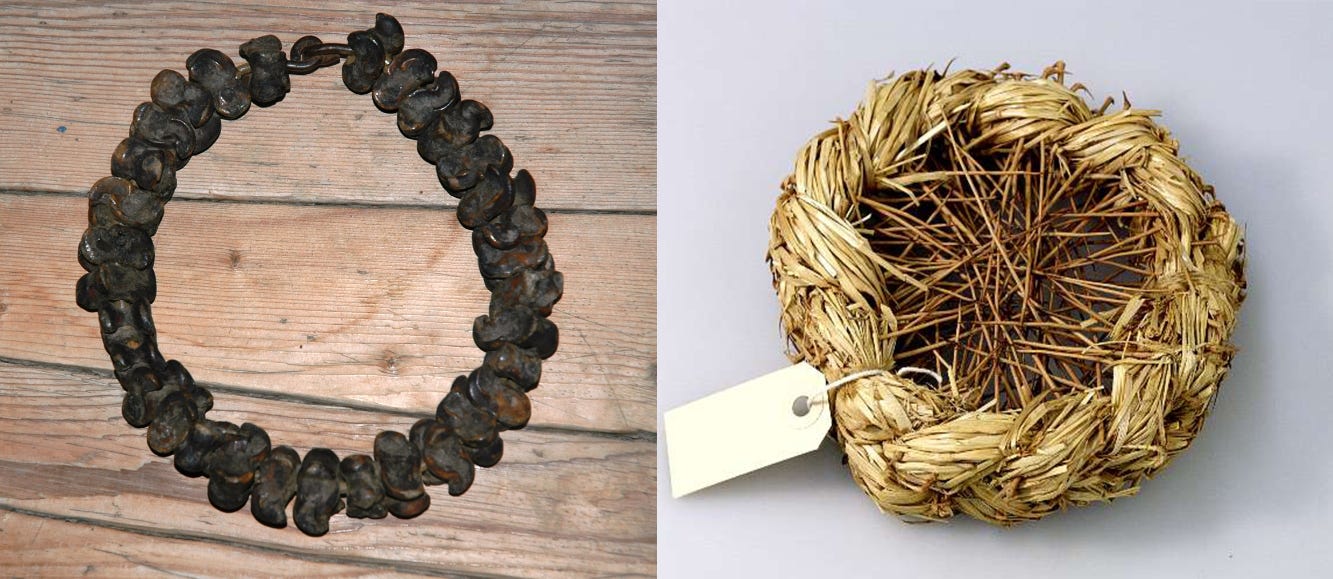
A wooden object, kept in the family, carrying a living power that sleeps until you wake it.
Now cross the ocean, because North America is where the house spirit went on the road.
The starter went west in covered wagons, buried deep in the flour sack where it stayed cool and safe. It went north to the Klondike in the 1890s gold rush, where it stopped being a possession and became an identity. The old-timers up there were called sourdoughs, that was the actual name for a seasoned prospector, because of the pot of living batter they guarded with their lives. In the subzero dark of a Yukon winter, a frozen starter was a dead starter, and a dead starter could mean no bread, so the miners kept their cultures against their own bodies, and slept with the starter inside their bedrolls. Think about that image for a second. A grown man in the coldest place on the continent, curled around a jar of living dough, keeping it warm like a heartbeat. If that is not tending a spirit, I do not know what is.
The starter survived fires, too. In San Francisco, the Boudin family had been feeding the same mother dough since 1849, raised from the wild yeast of Gold Rush San Francisco itself. When the 1906 earthquake hit and the fires came for the city, Louise Boudin fled with the mother dough in a bucket. That same culture, fed daily ever since, is in every loaf they bake to this day.
And the old farthing rule? Still holding. In 1847 a woman carried her starter west on the Oregon Trail to Oregon, where it stayed in her family for generations, eventually reaching her great-grandson Carl Griffith, who baked with it in chuck wagons and cattle camps his whole life. In the 1990s, Carl, by then in his seventies, started mailing dried flakes of it to anyone who asked, asking nothing back but postage. When he died in 2000, the people he’d shared it with couldn’t let the tradition die with him, so they organized as Carl’s Friends and kept mailing it out, free, all over the world. Tens of thousands of samples now. A nearly 180-year-old house spirit, descendant of a wagon-train kitchen, still moving from home to home the way barm moved through a medieval village: as a gift.
There was also friendship bread in the 1970s, the sweet starter that swept through American kitchens with instructions to keep some, bake some, and pass portions to friends. It was named Herman, and Herman was living in houses across neighborhoods, where he was being fed on counters and passed over fences. They were keeping and gifting house spirits in avocado-green Tupperware.
I started my sourdough over three years ago. She’s been in and out of the fridge ever since, depending on the season of our lives, out on the counter when I have time to bake, tucked away resting when I don’t, called back into service whenever our family needs more bread. And we have made so many things together. Loaves, of course, but also bagels, cinnamon rolls, muffins, brioche, hot dog and hamburger buns. Three years in, she is simply part of how this household feeds itself, the way the family leaven always was.
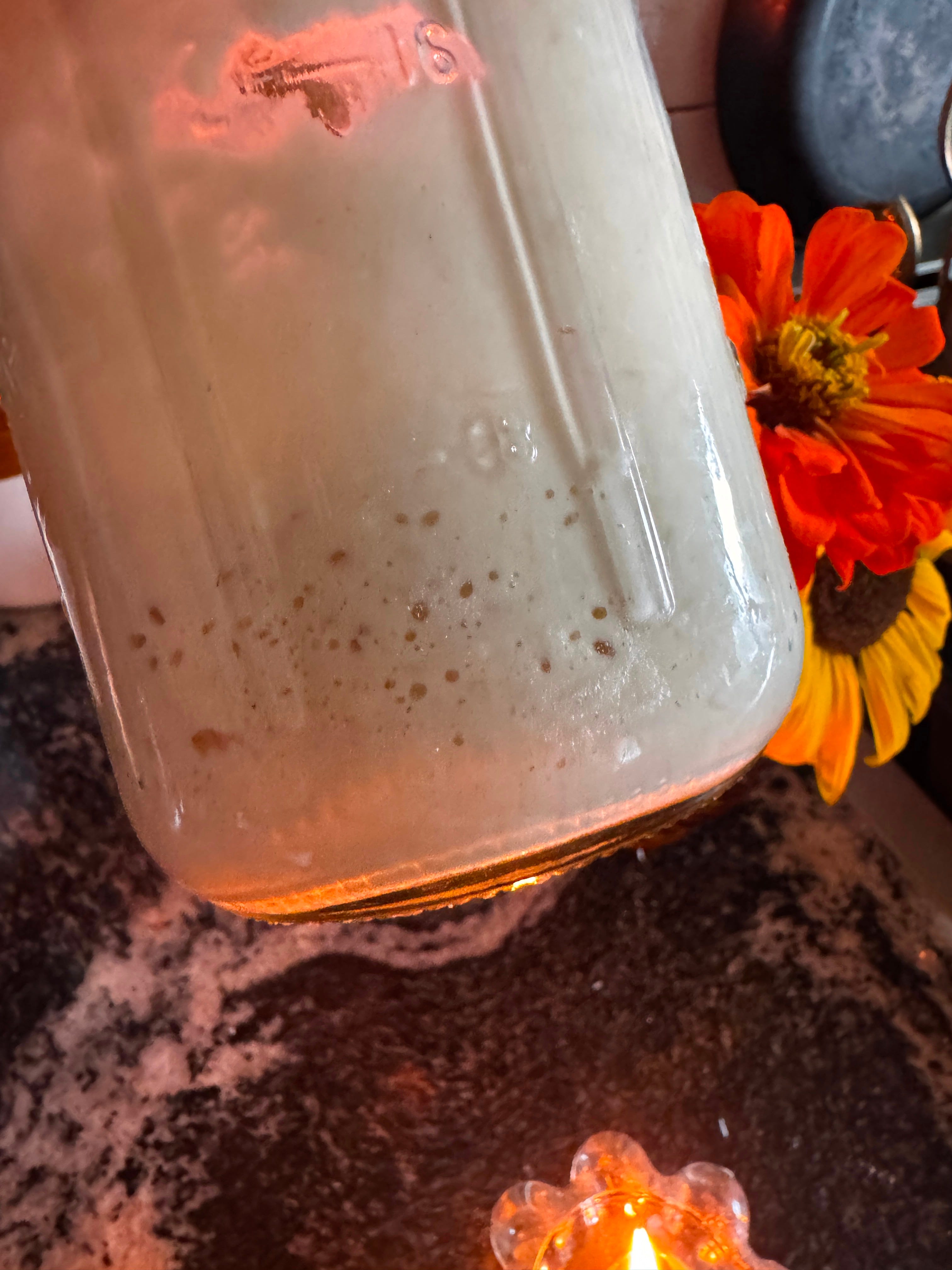
But here’s the part I most want you to hear, because I suspect some of you are where I once was. For the longest time I was completely intimidated by sourdough. Everyone made it look so difficult and so precise, all those gram scales and hydration percentages and feeding schedules timed to the hour, and I am not a huge fan of precision. I’ll measure when a bake truly demands it, but I really love going by feeling.
So that is the only way my starter has ever been maintained. I add a bit of flour and a bit of water until she’s a thick paste, I speak words of love and gratitude to her, and I tuck her back into the cabinet, or into the fridge when she needs a longer rest. And here is the thing that still makes me smile: once I stopped trying so hard, she actually flourished. The moment I let go of doing it correctly and just started tending her, the way you’d tend anything you love, her magic began to flow the way it needed to, and now we get to share in that abundance together.
My ancestors were Irish and Scottish, and their bread rose on barm from the ale, on the leaven kept back from the last baking, on cultures whose names and lineages nobody thought to write down because they were as ordinary as the fire. When I feed her, I think about the unbroken chain of hands that had to do exactly this, over and over, without fail, for the bread to keep happening at all. I promise you those women were not weighing anything to the gram. Somewhere back along my line, and along yours, there was always someone keeping the leaven alive by feel.
Now, before you panic-close this email because you’ve killed a starter before, or because you cannot handle one more daily obligation, hear me.
A starter is the most forgiving familiar you will ever work with. It does not need you daily unless you’re baking daily. It will sleep happily in the fridge on one feeding a week. Neglected for a month, it will look grim, and then come roaring back after two good meals. Even a starter dried to a crust, remember the Norwegian logs, can sleep for a year and wake right up. The pioneers kept these things alive in ox carts and snow caves. You, with your refrigerator, are going to be fine.
And you do not need the gram scale, the schedule, or the spreadsheet, no matter what the internet tells you. Mine has thrived for three years on nothing but feel, love, and a thick-paste consistency. If the precision way brings you joy, keep it. But if it’s the precision that has been keeping you from starting, please hear me when I say the precision was never the magic. The tending is.
And if keeping any living culture is truly not for your season of life right now, the teaching still stands. The magic here is the bargain itself, feed the house and the house feeds you, and you can honor that with a jar of flour and water you keep for one week just to watch it come alive, or simply by understanding, from now on, what every loaf of sourdough at the market actually is: a piece of somebody’s house spirit, sold to you by people who forgot the old rule.
Below the line is where we roll up our sleeves together. If The Kitchen Witch has been feeding you, become a paid subscriber and pull up a chair, the practices, the words to speak, and the little extras live on this side, and there is always room at this table.
For our paid circle, here is your third hands-on working: conjuring (or adopting, or reviving) a house spirit of your own, the words to speak when you feed it, and the old rule that turns it into a blessing that outlives you. Come meet the newest member of your household.
Comments
Nothing yet. Say the first thing.
Sign in to join the conversation.