
Performance-minded cyclists often spend heavily on drivetrains, wheels, and shifting systems in search of small gains. But one of the most overlooked sources of inefficiency sits at the top of the pedal stroke, where hip and knee flexion are at their greatest.
At the top of each stroke, your hip and knee hit peak flexion simultaneously. When both joints flex hard at the same time, a two-joint muscle like the rectus femoris gets pulled short at both ends at once, creating a problem called “active insufficiency,” where the muscle loses its ability to generate effective force right when it’s needed most.
Peak quadriceps torque occurs around 60 degrees of knee flexion, well short of the deeper flexion the joint reaches at top dead center.
There’s a good chance you’ve noticed this in action: you reach the top of the stroke, stall, and then produce a burst of power on the downstroke to compensate. Over time, this can lead to premature quad fatigue and, in some cases, a sharp ache under the kneecap.
There are a few signs this is happening to you:
A hitch or hesitation you can feel (or hear, if you’re on a trainer) right around the top of every pedal stroke
Quad burnout that shows up disproportionately on climbs or hard efforts rather than flat, steady-state riding
Knee pain that sits specifically under or around the kneecap rather than on the sides or back of the joint.
On their own, none of these means you have a fit issue, but if you have any of them together, there’s a good chance you’d benefit from a shorter crank.
For a long time, crank length was more or less a one-size-fits-most situation, with most cranks falling between 170 and 172.5mm, regardless of rider. This can worsen the choke point and aggravate existing joint issues, particularly for riders whose proportions fall outside that narrow range.
By shortening the crank length, you can open up the knee and hip angles, reducing strain on the knees, hips, and lower back while allowing for a more consistent pedal velocity. A Cal Poly kinesiology study shows this in action. They tested 18 elite cyclists across six crank lengths, starting at 180mm and dropping down to 150mm, measuring how far the hip and knee travelled for each revolution.
They found that as they shortened the crank length, hip range of motion fell from about 51 degrees to 45, knee range from about 75 to 67. Another study found that even adjustments as small as 5 to 10mm reduce knee flexion through the stroke.
While many believe a shorter crank will cost them power, that’s not quite the full picture. One study found no significant difference in maximum power output across a range of crank lengths during a 30-second max effort test, suggesting the power penalty riders fear isn’t showing up where they’d expect it.
When changing crank lengths, the saddle height should rise to compensate, keeping the distance from saddle to pedal the same at the bottom of the stroke.
Because the adjustment from crank length only happens at the bottom, nearly all of the resulting angle change lands at the top of the stroke instead.
That’s why crank length and saddle position have to be treated as one decision rather than two, and it’s also why a crank swap alone won’t fully close the choke point without the saddle position moving to match it.
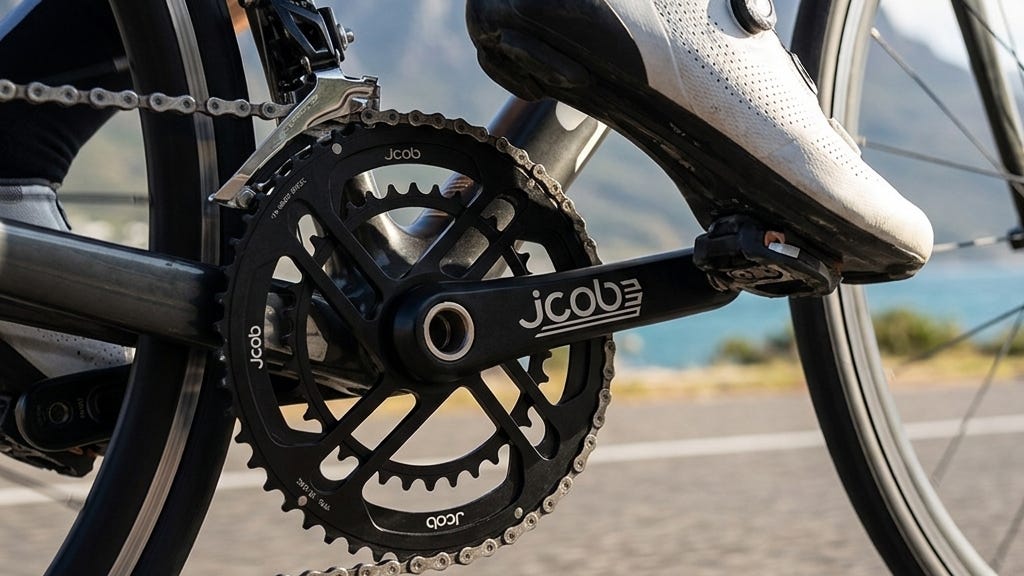
The key is to fix the geometry of your bike instead of training around it. This is the core philosophy of brands like JCOB, which size cranks and saddle position to a rider’s actual proportions.
A shorter crank cuts how far the knee travels at the top of the stroke, while a forward-riding saddle keeps the rider more upright, keeping the hips from closing too tightly. Together, they open both joints exactly where research shows riders have the least room to work with.
The result is a stroke that feels like one continuous circle, instead of a loss of power at the top of the stroke. Shorter cranks also have another benefit: they let a rider drop into a lower, more aerodynamic front end without the thigh crowding the torso on every stroke, which for some riders means easier breathing in an aggressive position.
The dead spot at the top of the stroke is rarely about how hard you’re training. It’s about a crank and saddle built for an average rider, not your rider. Before spending on a new drivetrain, ask whether your bike was built around your body, or you were bent to fit the bike.
No posts
Comments
Nothing yet. Say the first thing.
Sign in to join the conversation.