
I’ve been watching the comment sections.
Someone posts a cover or a blurb. Within minutes the usual suspects arrive: “obviously AI,” “slop,” “not real writing.” Then the nastier ones show up. Yesterday a grown adult told a single mom she should send her kids to school with her new book so they could get bullied and “learn a life lesson.” Because the cover looked AI-generated.
That is not a craft conversation. That is just mean.
I used to jump into the art-versus-slop fights. They go nowhere. People dig trenches. Nobody changes their mind. The thread just gets uglier.
Then I saw a different approach that actually shifts the temperature.
Stop arguing about whether AI is “real writing.” Start asking how the policy treats disabled writers.
A lot of people use these tools as adaptive software. Stroke recovery. Brain injury. Aphasia. Language processing disorders. Executive dysfunction. Neurodivergence that turns traditional outlining into a wall. For those writers, AI is a cognitive bridge. It helps when word retrieval fails, when structure won’t hold, when the story is fully formed in the head but the body or brain won’t cooperate with the old process.
Under the Assistive Technology Act, off-the-shelf software that increases, maintains, or improves functional capability already qualifies as assistive technology. It does not need an FDA label or a doctor’s note. It qualifies based on how it’s used.
A blanket ban on AI tools is not a neutral content standard. It is a policy that excludes writers who need that software to participate at all. That raises real questions under the principles of ADA Title III — even if social media platforms sit in a gray legal zone. Morally and ethically, the principle still applies.
When groups demand public disclosure of every tool, they force disabled creators into a choice: reveal private medical information to justify an accommodation, or stay silent and absorb the harassment. We never required authors to disclose their developmental editor, their research methods, their speech-to-text software, or whether they used a ghostwriter. Selective outrage is usually a tell.
Fiction is already understood to be invented. Readers know the story didn’t happen. Deepfakes of real people and fabricated news events are a different category. Those need disclosure. A novel does not.
So the next time a group admin posts another absolute ban, try this instead of the usual art argument:
“How do your guidelines accommodate disabled writers who use AI as adaptive software for accessibility — stroke recovery, language impairments, brain injury — under Assistive Technology standards?”
That’s it.
Suddenly the admin is no longer standing on the moral high ground against “laziness.” They’re being asked to explain why their policy functions as a barrier. Most of them have never prepared an answer. The pile-on loses steam. The comments go quiet.
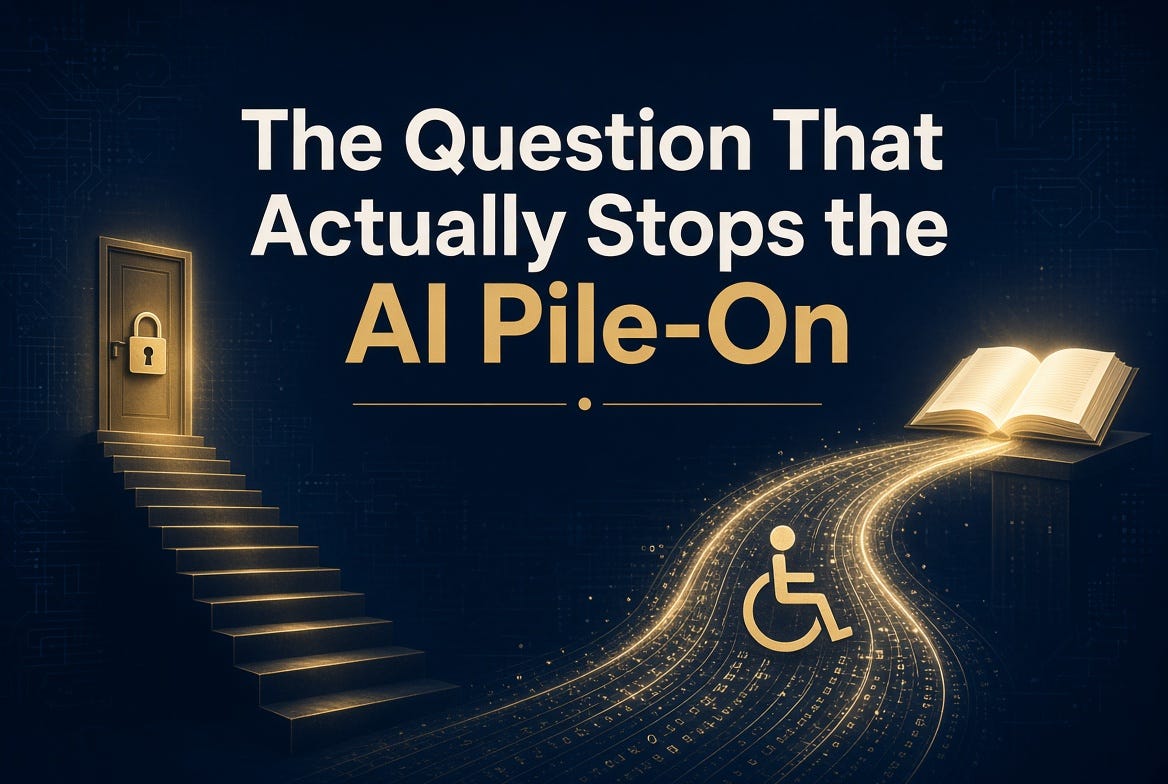
It’s the digital version of telling someone in a wheelchair they can’t come in because the only entrance is stairs.
You don’t have to be disabled for this framing to matter. When we force the conversation onto access instead of purity, blanket bans get harder to defend as moral high ground. That’s useful for every writer who uses these tools — whether for accessibility, efficiency, or both.
I’ve started using the question. It works more often than the soul-and-craft arguments ever did.
Steal it if it serves you.
If you found this helpful, don’t keep it to yourself — share it with a fellow writer who needs it.
Not subscribed yet? Join the community of writers getting weekly craft insights, storytelling strategies, and creative tools delivered straight to your inbox.
Want to go deeper? Visit www.theinvisiblepen.com — your home for writing resources, courses, coaching, and the tools you need to craft better stories.
Ready to connect with other writers? Join The Invisible Pen Skool community — where we dive even further into craft, share feedback, and grow together as storytellers.
Comments
Nothing yet. Say the first thing.
Sign in to join the conversation.