
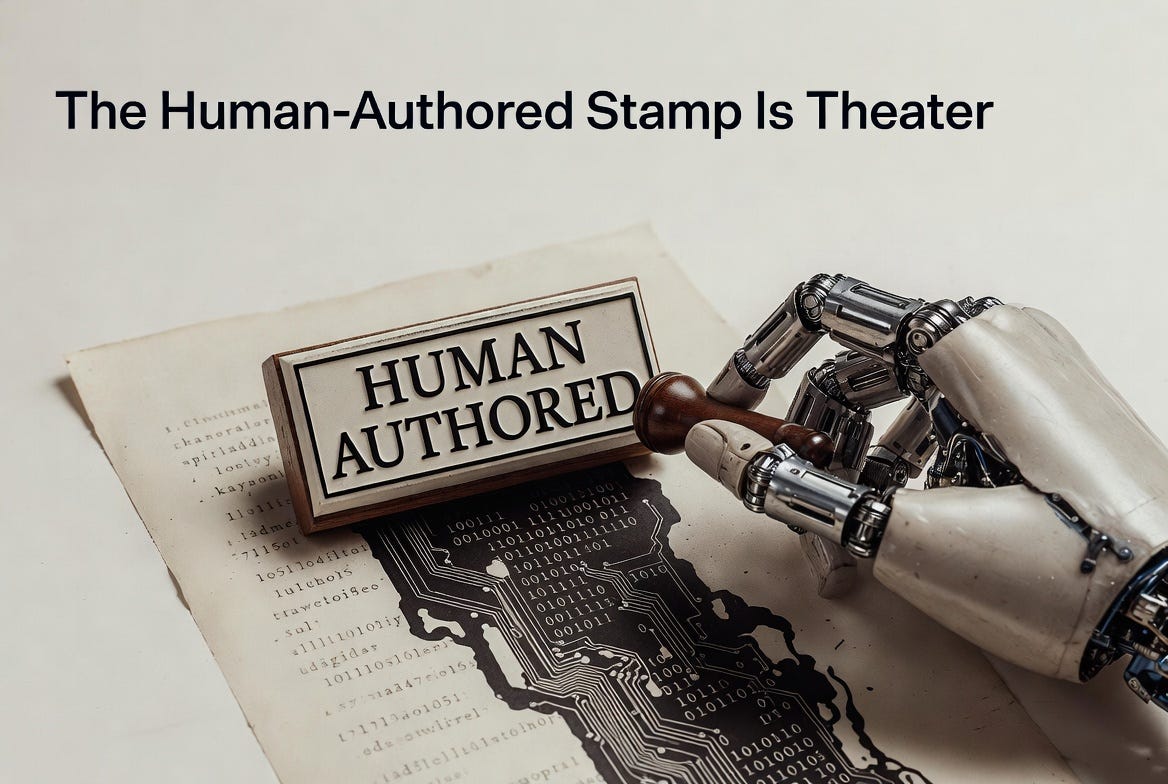
The Authors Guild has a “Human Authored” mark. Detection tools are everywhere. Agents and editors are quietly running manuscripts through scanners. Readers are demanding purity tests in reviews.
Most of it is theater.
A stamp does not tell you whether a book has emotional intelligence, lived experience, or actual craft. It tells you the author or publisher was willing to perform a certain kind of compliance. Detection software still flags human writing and misses sophisticated AI use. The same industry that spent years telling us “nobody cares how the sausage is made” is now obsessed with the exact temperature of the sausage.
I’ve used AI as a collaborator for years — research, outlining, brainstorming, continuity checks, even first-pass line suggestions that I then rewrite completely in my own voice. The final books are mine. The decisions are mine. A purity stamp would neither improve nor diminish the work.
Readers already vote. They finish books that feel alive and abandon books that feel flat, regardless of the production method. The stamp is for the people who need moral certainty more than they need good stories.
If you’re spending more energy proving you’re “clean” than making the work better, you’ve already lost the plot. And honey, the people yelling the loudest about purity are rarely the ones shipping consistently while also paying their bills.
If you found this helpful, don’t keep it to yourself — share it with a fellow writer who needs it.
Not subscribed yet? Join the community of writers getting weekly craft insights, storytelling strategies, and creative tools delivered straight to your inbox.
Want to go deeper? Visit www.theinvisiblepen.com — your home for writing resources, courses, coaching, and the tools you need to craft better stories.
Ready to connect with other writers? Join The Invisible Pen Skool community — where we dive even further into craft, share feedback, and grow together as storytellers.
Comments
Nothing yet. Say the first thing.
Sign in to join the conversation.